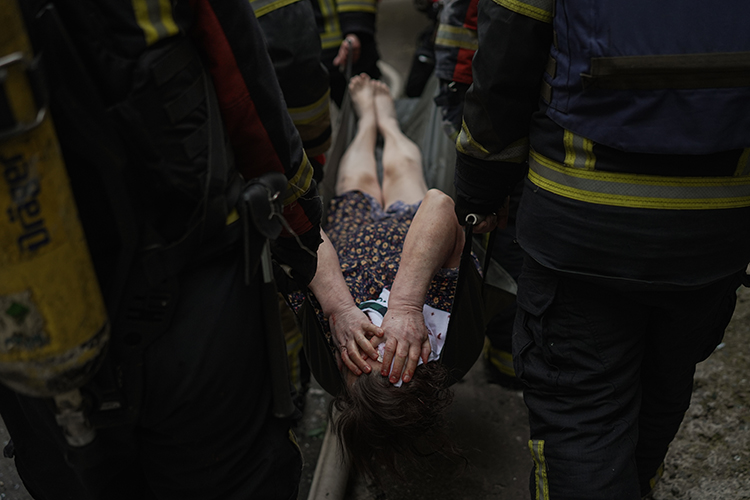
“Power-plant worker Taras was on duty in the dispatchroom when a barrage of Russian missiles hit the facility. He had stayed late tofinish critical tasks when the air-raid siren began to wail and his colleaguesran for cover. After the loud explosions, a cloud of smoke rose and darknessfell. Fires broke out, and missile fragments—after punching through the roof ofthe vast complex—brought parts of it down onto the workers below. Followingprotocol, Taras, his heart racing, shut down the coal-fired power plant,” — AssociatedPress.
Russia’swar against Ukraine is unprecedented in many ways, including the fact that thecountry’s energy system itself has become a target. The first systematicstrikes on energy infrastructure began on the eve of the heating season inOctober 2022.
“TheDarkest Winter”: 2022–2023
“Speaking at a meeting of Russia’s Security Council,Vladimir Putin said that Russian armed forces had carried out a massive,long-range strike using high-precision weapons against Ukraine’s energyfacilities, military command, and communications infrastructure,” the outlet “Argumentsand Facts” reported.
The Russianpresident described the massive strike as “a response to the actions of theKyiv regime,” also referencing “sabotage attacks on the Kursk Nuclear PowerPlant and the blowing up of the TurkStream gas pipeline.”


The United States believes that the Russian Federation plannedmass strikes on Ukraine even before the explosion on the Kerch Bridge on Oct.8, CNN reported, citing White House National Security Council spokesperson JohnKirby.
“Mostlikely, this was something they had been planning for quite some time. Thatdoesn’t mean the explosion on the Crimean Bridge couldn’t have accelerated someof their plans,” Kirby said. He noted that attacks of this scale could not havebeen planned in just a few days,” the outlet Novynarnia quoted the White House spokespersonas saying.
“In just the last three days, 128 strikes have been recorded. Asa result, more than 200 different facilities have been damaged, including 28energy-infrastructure sites,” Ukrinform reported, quoting Prime Minister Denys Shmyhal.
Ukrainianslearned to live by blackout schedules, to use camping stoves at home, and totune out the constant hum of street generators.

“It’sinspiring to see people doing what they must, despite constant outages anddisruptions after regular Russian missile strikes on the country’s power grid,” Sasha Maslov wrote in a comment onthe photo on Instagram.
During theNew Year holidays, the Russian army shelled Ukraine intensely. After anight-time New Year’s attack, residents of Zaporizhzhia and the surroundingregion welcomed 2023 without electricity. Mass strikes on criticalinfrastructure also affected nuclear power plants: after the Nov. 23, 2022bombardment, all four Ukrainian NPPs shut down simultaneously for less than aday. And the Zaporizhzhia NPP—under Russian occupation since the start of thefull-scale invasion—periodically loses external power supply and switches toemergency mode.
“According to the U.N. and the WorldBank,Ukraine lost more than half of its energy-generating capacity during the first14 months of the war, and the situation continues to worsen. A large share ofthe country’s solar generation was also lost after parts of the south—wherethere is more sunlight—fell under Russian occupation,” AP noted.

On Dec. 13,2022, Russia’s Security Council Deputy Chair Dmitry Medvedev commented on callsby Ukraine’s president to send EU missions to energy sites for internationalmonitoring.

Russia’s Security Council Deputy Chair Dmitry Medvedev advised the EuropeanUnion not to respond to Ukrainian President Volodymyr Zelenskyy’s call to sendmissions to critical infrastructure sites. Zelenskyy ‘wants Europeans to sitthere as a human shield,’ Medvedev claimed, suggesting that the deaths ofUkrainian soldiers were not enough for him and that he ‘needs fresh blood.’”

Ukraine’sauthorities faced an urgent need to rally the international community aroundrestoring and protecting the country’s energy system, as well as strengtheningair defenses.
The“Fight for Light” Continues in 2024
In spring2024, the Russian army resumed strikes on energy facilities. DniproHES HPP-2was knocked out; the Trypillia thermal power plant in Kyiv Oblast and Kharkiv’sCHP-5 were destroyed; the Kaniv and Dniester hydropower plants were attacked.Russia also repeatedly targeted the Kyiv Hydroelectric Power Plant.

The Russianarmy began using the “double-tap” tactic: after a set interval, it strikes thesame target again. This tactic targets everyone who rescues victims at impactsites and documents war crimes. New attacks on energy infrastructure—andrenewed blackout schedules—brought back memories of the previous winter.
In spring2024, at a meeting with Alexander Lukashenko, the Russian president explainedwhom he blamed for Russian troops striking energy facilities.
“Recently, we have observed a series of strikes on our energyfacilities, and we were forced to respond. I want to emphasize: even in winter,for humanitarian reasons, we did not strike. But they wanted to leave socialinstitutions, hospitals, and so on (in Russia) without energy supply. However,after a series of strikes on our energy facilities, we were forced to respond,”Putin said at the meeting with his Belarusian counterpart Alexander Lukashenko,AIF quoted him as saying. “Strikes on energy facilities are also linked to solvingone of the objectives set for the ‘special operation’—the demilitarization ofUkraine,” Putin continued.

Energy facilities are critical infrastructure that enables weapons production,and therefore are a legitimate target for Russian forces,” aif quoted LevonArzanov, a colonel and presidium member of the all-Russian public organization“Officers of Russia,” as saying. “The entire global practice of modern warfaredictates strikes on critical infrastructure, including energy, railways, androads. Because where there is no electricity, there is no control. Where thereis no control, chaos emerges. However, our strikes are precise and selective.The U.S. in Yugoslavia struck critical infrastructure first. But unlike ourWestern opponents, we do not carry out carpet bombing—we destroy targetsselectively, showing ‘humanism’ toward civilians: we destroy only those energyfacilities that supply the armed forces and the defense industry. We are notsetting the task of plunging all of Ukraine into darkness, into a Stone Age. Asthe Supreme Commander-in-Chief said, we are not fighting the population, butthe leadership of the Nazi Kyiv regime,” the colonel concluded.

“I hadthe honor of working for The New Yorker on the immense scale of Russia’sassault on Ukraine’s energy sector and civilian infrastructure,” Sasha Maslov wrote as the captionto the photo on Instagram.
Russianpropagandists have cited Ukraine’s Kursk operation as one of the reasons forrenewed strikes on Ukraine’s energy infrastructure. They urge audiences not totrust statements by Ukrainian authorities about the energy system beingdestroyed, calling such claims “a targeted disinformation campaign by the Kyivregime” aimed at misleading both Russia’s military-political leadership andWestern partners—to intimidate the Ukrainian public and confuse allies.

In spring2024, after mass strikes on Ukraine’s critical infrastructure, AssociatedPress gained accessto two DTEK power plants. Journalists were able to speak with workers and plantmanagement and assess the scale of the destruction.


‘They’re trying to drag us back into the 17th century,’ Serhii, the head of oneof the attacked power plants, said.”

AP wrotethat Russia began devising a new tactic for striking energy facilities,acknowledging that its old blackout strategy had failed. Using improvedintelligence, Russian forces would send not “three drones and two missiles” ata target, but “six missiles and up to 15 drones.” As a result of the massiveattacks on March 22 and 29, DTEK lost 80% of its generating capacity.
“If the skies were protected, I would feel calmer,” hesaid. “Energy infrastructure is what everything depends on. If there is noelectricity, nothing works: factories stop. People are left without theinternet. You won’t even know when missiles are coming for you,” power-plant worker Taras told AP.

“Thesephotos can show only a tiny part of the tragedy—and the heroism—of energyworkers who unexpectedly became targets for Russian missiles. They have to cometo work every day with the fear that this day could be their last,” Sasha Maslov wrote on Instagramunder the photo made for The New Yorker.
Ahead ofthe 2024–2025 heating season, the Russian army has been attacking Ukraine everynight with strike drones and ballistic missiles, including strikes on energyfacilities. KAB guided bombs continue to fall on Kharkiv, Sumy, Donetsk, andZaporizhzhia oblasts. Russian forces are also destroying Kherson with everytype of weapon available.
Documentinga War Crime to Hold Perpetrators Accountable
How can wedetermine whether a particular energy-infrastructure site is a lawful militarytarget? And did the destruction of that facility provide a clear militaryadvantage? Energy facilities are often used simultaneously for military andcivilian needs. When electricity is cut off, it triggers problems with watersupply and sewage, as well as household waste disposal. Hospitals, factories,and other critical infrastructure depend on these systems. Prosecuting thistype of war crime is often more difficult than others—posing a legal challengefor international courts.
Theinternational-justice information website Justice Info explains that such cases are difficult due to the lackof successful legal precedent. It can be hard to determine whether the harminflicted on civilians was clearly excessive compared to the anticipatedmilitary advantage.
LidiiaVolkova, a legal adviser at Global Rights Compliance who works with the Officeof the Prosecutor General of Ukraine, highlighted an element that—shebelieves—judges may pay particular attention to in an interview with Justice Info.It is the fact that strikes hit energy facilities far from the frontline—likely intended to “damage civilian infrastructure and energy distributionand weaken public morale.”

“The ISS judges really came to a conclusionthat “for those facilities that could qualify as military facilities at the appropriate time, the expected incidental damage and damage inflicted on the civilian population would be clearly excessive compared to the expected military advantage,” mak“ICC judges indeed concluded that ‘for those objects that couldbe qualified as military objects at the relevant time, the expected incidentalharm and damage inflicted on the civilian population would be clearly excessivein relation to the anticipated military advantage,’ making such strikes warcrimes,” the outletwrites.
For missilestrikes on Ukraine’s energy infrastructure carried out by the Russian army fromOctober 2022 to March 2023, the ICC issued arrest warrants for senior Russiancommanders Sergei Kobylash and Viktor Sokolov, Chief of the General StaffValery Gerasimov, and former Russian defense minister Sergei Shoigu.
To helphold the Russian army accountable for war crimes, the ICC opened an office in Kyiv in September.Evidence of these crimes often comes from photographs by Ukrainiandocumentarians who, despite the obvious risks to their lives, choose to keepdocumenting.
Workedon the piece:
Topic researcher, text author: Yana Yevmenova
Photo editor: Viacheslav Ratynskyi
Literary editor: Yuliia Futei