Vyacheslav Ratynskyi from the first hours photographing the course of the Russian-Ukrainian war. As a freelance photographer, collaborates with REUTERS and other media. We talked with Vyacheslav about transformations in the attitude towards war events, what can be shared with the world from the captured and reflective photo of a foreign audience.

How has your attitude to the war changed from the events of 2013-2014 to today? What is more interesting to work/document then and now?
In 2013, I filmed the events of the Revolution of Dignity, spent a lot of time there, spent a lot of time there, spent the night there. It was an incredible sight, I had never seen such a thing, so many people. such unity, so much thirst for freedom and change. Of course, a lot of pain, tears, suffering and cruelty. Many years later, these photos turned into a separate project. After the events on the Maidan, I felt a deep burnout for some time. Subsequently, I tried to participate in the filming of events in Donbas, but for some reason it did not work out for me. I went there several times, filmed something, but in fact I missed this important time. Already in 2015, attention to these events almost disappeared altogether. In short, all these years I was very sorry that I could not remove anything about the brutal war in the Donbas. But I have some good, reflective photos that relate to those times, here is one of them:

Then at least once a week the Azov movement sent buses with volunteers to the war in the Donbas. Usually it was young people, they gathered in Sofia Square, were dressed in military uniform, in balaclavas, read the prayer of the Ukrainian nationalist, and then said a long and sensitive goodbye to their loved ones, girls and women cried, embracing, these young men. In my photo, the guys in balaclavas are sitting on the stairs near the monument to Bohdan Khmelnitsky, their girlfriends stand next to them, and the wind playfully rubs their skirts.
Why I love this photo: it is not about the pain and suffering that war and Russia certainly carry, but about youth and love of life.
Or, for example, a photo with the military who had a physical education lesson in one of the gyms on the territory of the Ministry of Defense.

What was the first object he decided to look at and how did this change over the course of a full-scale invasion?
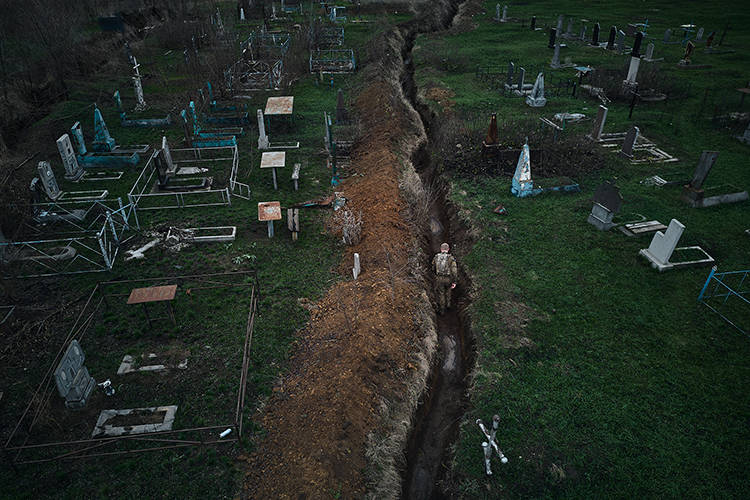
I am interested in everything, there is nothing alone, something more important. Everything about Ukraine in times of war is how we live this incredibly difficult path. Of course, the focus is on the military, on the front line, but there are a lot of things going on around, incredibly interesting stories, events of historical scale that are a consequence of the war, but not directly related to the military.
I like to reiterate that you can never know where you're going to make your best shot. I have repeatedly been convinced that he is waiting for you in the most unexpected places. That's why you have to be interesting about everything. Better to search, find, remove than not to dare and then regret it for a decade or more.
Of course, most of the photos I take now are more and more reporter work, for news, but that does not mean that at the same time I do not shoot something larger, or that certain photos will not be included in separate projects in the future. I would like to concentrate more on documentary projects, but events are still quite dynamic, there is not always enough time for reflection, documentary stories are still more reflective.
It is very difficult at this pace of work to formulate the ideas of these stories, even harder to organize yourself to shoot them.
News is always a quick result, here is a fact, here is an event, here is a photo, here is a publication. Documentary stories are long and difficult.


We know that in August in Europe, the media almost do not publish traumatic news (sensitive content), because people are on vacation. Also, if there is a photo of a dead body, then even if it falls into the ether, it will be completely bruised. How do you determine for yourself what can be shared with the world from the footage, and what is better not to show?
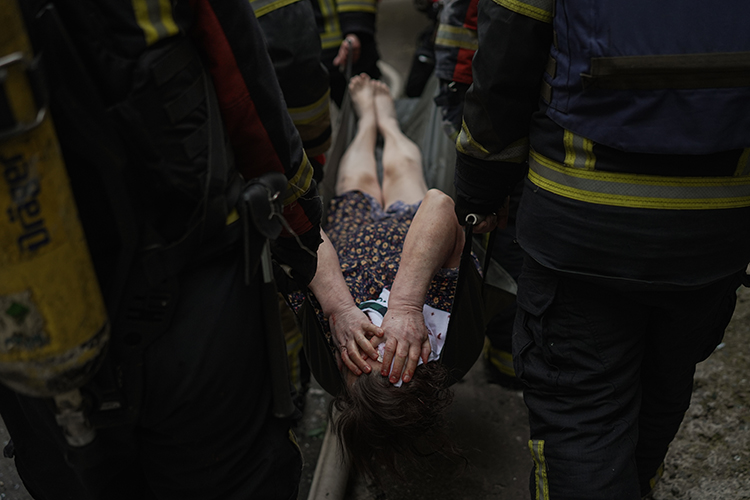
Recently filmed the aftermath of shelling in Zaporozhye. Three civilians were killed. I arrived at a place, as always, very difficult to get to the epicenter, a bunch of services that do not usually favor the work of journalists. Hardly hit the epicenter of the impact, the church burns down, a destroyed market nearby, in a high-rise building opposite the sound of glass being removed, a bunch of doctors, a bunch of police, military. There is darkness and smoke around. Saw a group of people in military uniform with flashlights standing around something, studying something by highlighting with flashlights. I start shooting, not yet knowing what is happening. In a word, I take these photos and send them quickly. These are the rules of the news agency. The first few photos should be sent immediately.

I will add that shooting the body is a disrespect for the deceased, for the audience, but there are different circumstances, sometimes it is necessary to shock the viewer in order to show the maximum horror of what is happening in the first person. But I try to avoid very violent scenes. I only take pictures in exceptional cases. I always take more accurate pictures. As a document. But I rarely publish.
So, continuing the story. I send photos in a hurry and only then notice that people in uniform study the body of the deceased. This unfortunate man lies among the debris, a body without a head. The scene is terrible. I realized this later when I selected all the photos and sent them to the editorial office. The editor calls me and says: I understand everything, but we are not pathologists for you, we will not publish such photos.
Therefore, you must always be careful. Attentive to people's feelings. It is impossible to stutter and become indifferent.
As for Western editions, it all depends on the media itself, some yellow editions are just waiting for this kind of photo, these are usually yellow editions, but from this they are not read less. But usually it is a low-test product.
But there are other publications, here, for example, I cooperate with the German Süddeutsche Zeitung Magazin. It is a magazine that is published every Friday in an annex to the largest German newspaper, the Süddeutsche Zeitung. It is read by millions of Germans. The magazine is beautifully made, although it is only a weekend supplement to the newspaper. Excellent photo editors work there, the visual part is always on top.

In the spring of 2022, this magazine introduced the category “Photographs from War” and publishes one photo from Ukraine in each issue. So in this section you will never see shocking photos or photos with a “wow effect”, there are not even explosions, very rarely there are photos directly from the front. It is usually a very reflective photograph, behind which there is a deep story.
I must admit that such photos are the most difficult and probably the most interesting.
This is the kind of journalism in photography where there has to be a long, deep story in one picture. Such photos are extremely difficult to make. But several of my photos have already been published by Süddeutsche Zeitung Magazin and next week a magazine with my next photo will be published.

The photo shows employees of one of the markets of the capital. They wait for the air alarm sitting on the lawn next to the Retroville shopping center in Kiev, Vinogradar, in August 2022. The fact is that after last year's missile strike by the Russians on the shopping center in Kremenka, the authorities obliged people to leave the shopping centers during the alarm. In addition, this is exactly the same Retroville on which the Russian Dagger flew in March 2022. Behind people's backs, we can see windows knocked out and clogged with boards.
Share your own rules and taboos of documenting war crimes and the course of hostilities
But there is no taboo, you need to document everything, and there we will figure it out. The main thing is not to harm.
You can not shoot, what is prohibited, what can harm the military or poses a threat to civilians, etc. So let's say, is it possible to shoot air defense work? Of course you can! Is it possible to publish the work of air defense? I also believe that it is possible. The only question is when it can be published. I wouldn't post it in the news. The main principle is to do no harm. Our work must be of public benefit.
Viacheslav Ratynskyi — Ukrainian reporter and documentary photographer. He was born in the city of Zhytomyr. He has been living and working in Kyiv for the last 9 years. Graduate of the Faculty of Journalism of Ivan Franko National University of Lviv. He has been published in many Ukrainian publications (Ukrainska Pravda, Hromadske, Novoe Vremya, Focus, Forbes, Ukrainian Week, Reporters and others), as well as in a number of foreign publications (Time, The Guardian, The Wall Street journal, The Washington mail, The Telegraph, Daily Mail, The New York Times, El Pais, Radio Freedom Europe, BBC, Reuters, Der Spiegel).
Photographer's social networks: Instagram, Facebook
The material was worked on:
Researcher of the topic, author of the text: Marusya Maruzhenko
Site Manager: Vladislav Kuhar
Read also: “Dronchyk” is enough one life: Elena Guseynova and photo of the week