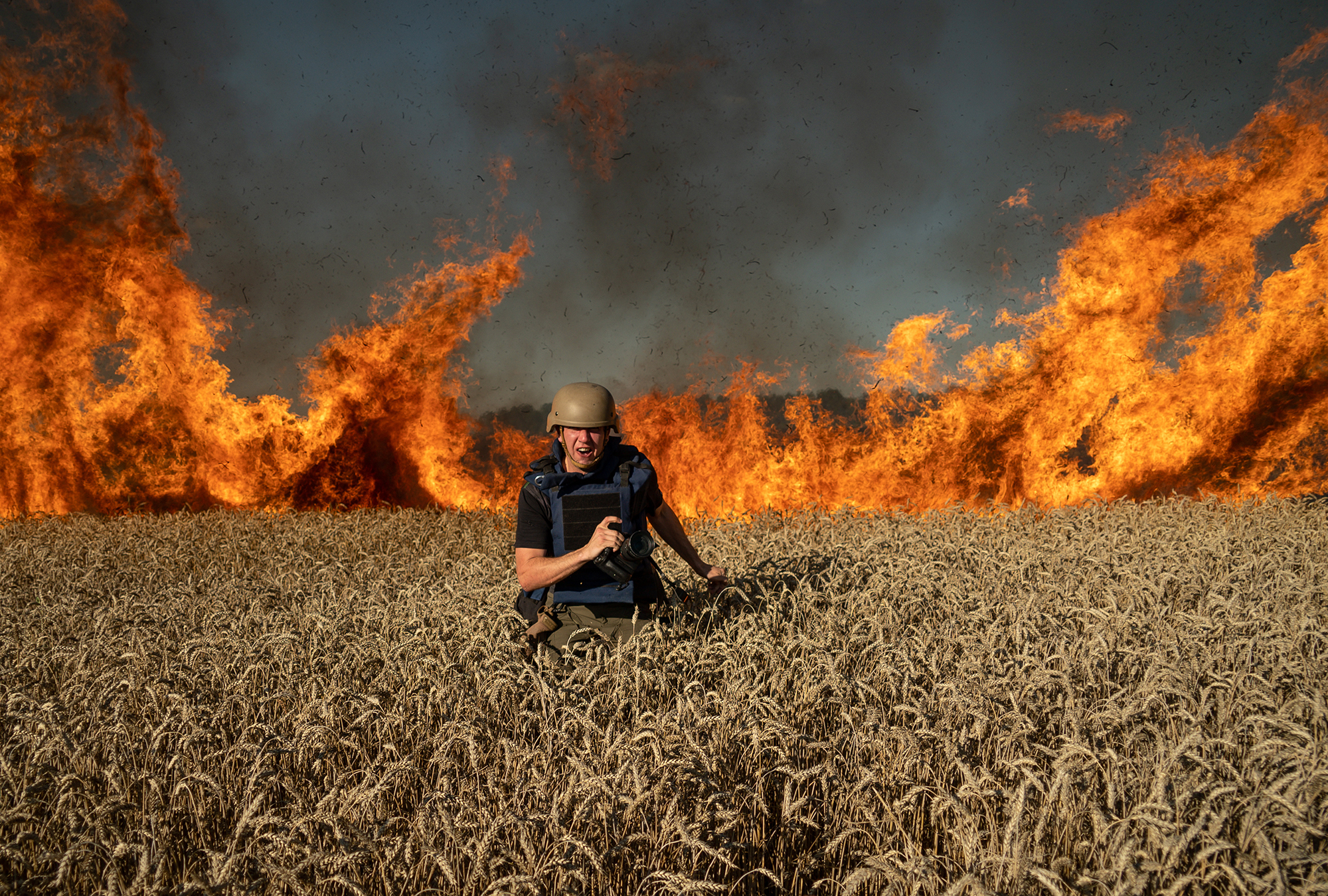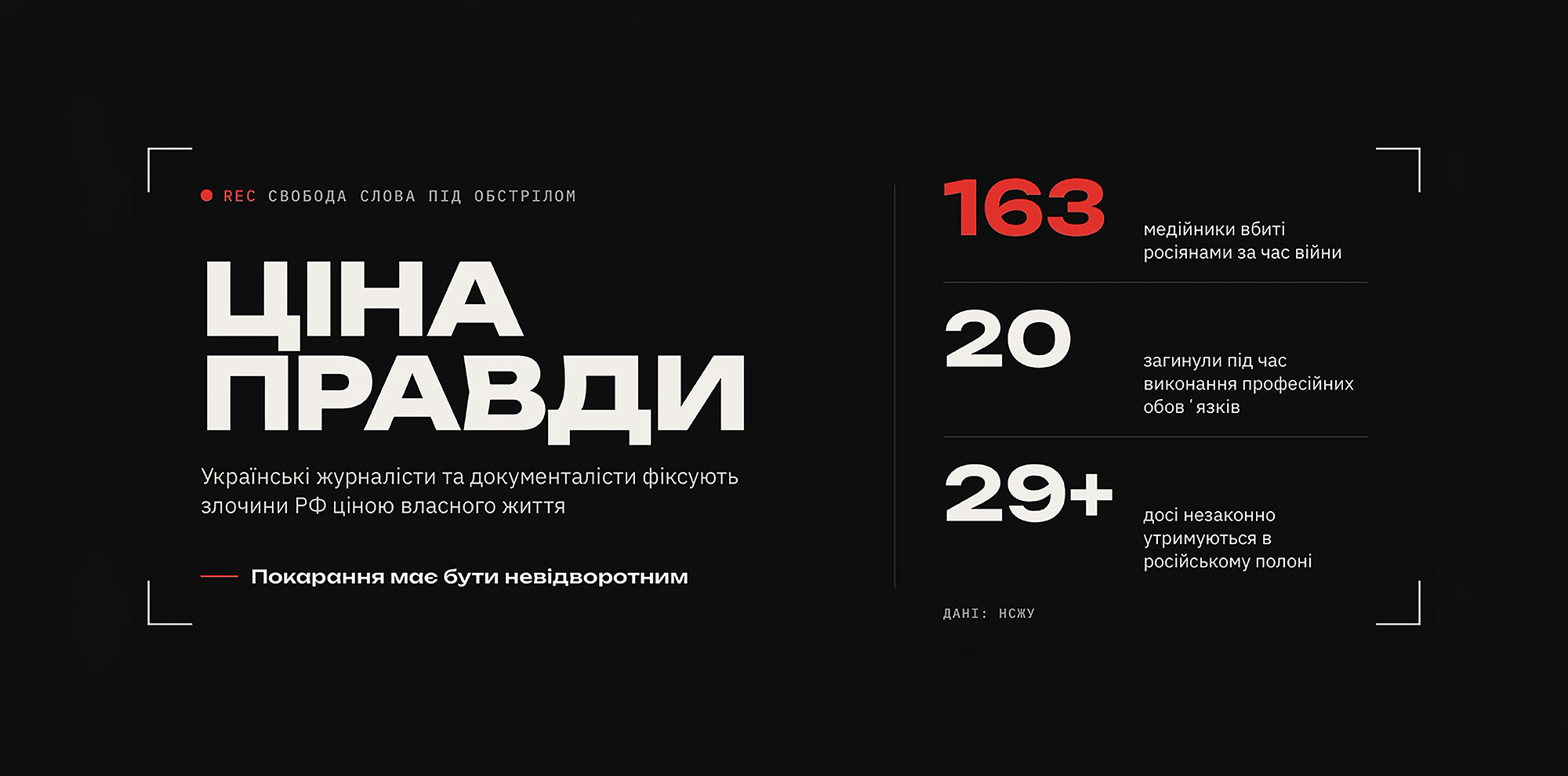
Ukrainian journalists and documentarians are documenting Russia's crimes at the risk of their own lives: according to data from the National Union of Journalists of Ukraine (NUJU), 163 media workers have been killed by Russians during the war, 20 of whom died in the line of duty; at least 29 media representatives remain unlawfully detained in Russian captivity. The enemy also intentionally targets freedom of speech through attacks on news crews, newsrooms, and TV towers, carries out cyberattacks on media websites, and jammers radio signals. Since the Russian Federation completely disregards international law, the key task is to ensure the inevitability of punishment.
On the International Day to End Impunity for Crimes against Journalists, the Ukrainian Association of Professional Photographers spoke with human rights defender, attorney, journalist, presenter, and writer Larysa Denysenko about the fight against impunity and the legal mechanisms for bringing perpetrators to justice.
First and foremost, investigating Russian war crimes against journalists is not merely a matter of judicial practice, but a battle to preserve the truth itself. Highlighting the value of journalistic work as the starting point for restoring justice, Larysa Denysenko notes: «All crimes must be investigated; accountability for perpetrators is one of the guarantees of non-recurrence. The work of journalists is vital because they weave the fabric of truth, preventing human stories of resistance, struggle, trauma, and crime from disappearing; they are essential for affirming the ethnic identity that the enemy seeks to erase; the journalistic word is a countermeasure to crime».
The Case of Viktoriia Roshchyna
In the occupied territories, pro-Kremlin authorities sentence Ukrainian media workers to lengthy prison terms under fabricated charges. A chilling testament to the inhumane treatment of captives was the death in Russian captivity of journalist Viktoriia Roshchyna, who collaborated with a number of Ukrainian and international outlets.
Ukrainian freelance journalist Viktoriia Roshchyna disappeared in the temporarily occupied territories in the summer of 2023. This was not her first detention by Russian occupiers: in March 2022, she was unlawfully detained for ten days in Berdyansk while preparing a report for the news outlet Hromadske. Official confirmation that Roshchyna was being held directly on the territory of the Russian Federation appeared only at the end of May 2024.
In Russian captivity, the journalist suffered severe abuse and torture. Toward the end of her life, as a result of constant physical violence and inhumane conditions, Roshchyna weighed approximately 30 kilograms and was no longer able to move independently.
Russia deliberately avoided returning Viktoriia to Ukraine as part of prisoner exchanges, knowing that her physical condition would immediately serve as irrefutable proof of Russian war crimes. In September 2024, the journalist was transferred to a detention center in Perm Krai, where she died on September 19. Viktoriia's body was repatriated to Ukraine only in late February 2025, after which time was needed for identification via DNA testing due to the high probability of body substitution by the Russians. The results of the international investigation by the Viktoriia Project following the repatriation of her body revealed numerous signs of severe torture, evidence of an autopsy, and missing internal organs, serving as yet another proof of systemic Russian war crimes against representatives of independent journalism.
Ukrainian law enforcement agencies issued in absentia notices of suspicion to the heads of detention centers in Taganrog and Perm Krai. Furthermore, the Council of the European Union imposed sanctions against Russian penitentiary officials involved in the torture of the Ukrainian media worker.
Suspicions against heads of Russian pre-trial detention centers and EU sanctions are important precedents. However, Larysa Denysenko explains whether there are realistic chances to hold the top military and political leadership of the Russian Federation accountable for the targeted torture and murder of Ukrainian journalists, and through which legal mechanisms this can be accomplished:
«The legal possibility of such prosecution exists, but it is a complex process. The first path is the ICC (International Criminal Court — ed. note); the difficulty lies in proving that this deliberate policy of torture and murder personally originates from someone within the military-political leadership. The second path is a Special Tribunal on the Crime of Aggression, but here it is about the possibility of convicting the military-political leadership for the act of aggression itself».
The human rights defender emphasizes that the key challenge along this path is the immunity enjoyed by senior Russian officials; therefore, the most favorable scenario would be a regime change in Russia. At the same time, she recalls precedents, notably the International Criminal Tribunal for the former Yugoslavia, and urges continuous work on building the evidentiary base, documenting, recording, and establishing clear lines from perpetrators to instigators.
As a reminder, 29 media representatives remain in Russian captivity to this day, including Melitopol journalists Anastasiia Hlukhovska and Iryna Levchenko. Iryna was sentenced to 15 years in a penal colony under a fabricated charge of "espionage."
Information Criminals and Hate Speech
Russia deliberately targets both Ukrainian and foreign journalists not only to justify the war and war crimes, but also to create an alternative information reality. To achieve this, they use propaganda as a fully realized instrument of warfare. The Kremlin's information criminals must bear equal responsibility, as modern Russian media openly call for the genocide of the Ukrainian people.
A separate ongoing threat is the aggressor's large-scale disinformation expansion abroad. Russia directs significant funds toward information operations in European Union and NATO countries, including the recruitment of foreign journalists and loyal experts who, consciously or unconsciously, spread Kremlin narratives. To effectively counter this hybrid aggression, it is necessary to systematically document such instances and convey the truth to Western partners regarding the real scope of Russian influence within their states.
Proving calls for genocide from a legal technique standpoint is extraordinarily difficult. Assessing the realistic prospects of bringing criminals to justice for genocidal rhetoric, Larysa Denysenko notes:
«Extremely important in this context is the ECtHR ruling (European Court of Human Rights — ed. note) Ukraine and the Netherlands v. Russia, where the Grand Chamber recognized systemic Russian crimes against the media and information infrastructure, including the propagation of propaganda, dissemination of hate speech, genocidal rhetoric, and the physical expulsion of journalists — persecution, unlawful detentions, and torture».
The Legal Dimension
To monitor, coordinate, and enhance the protection of media personnel during war, analyze the status of investigations into Russian crimes against journalists, and facilitate bringing perpetrators to justice at the international level, on December 4, 2025, the Verkhovna Rada established a special Temporary Inquiry Commission.
At the same time, efforts to protect media workers are only part of a broader international architecture to hold the aggressor accountable. An important step in this direction is the advancement of the Special Tribunal, mentioned by Larysa Denysenko as one of the avenues for holding senior Russian leadership accountable for crimes against journalists.
In October 2026, it was revealed that the establishment of the Special Tribunal on the Crime of Russian Aggression is moving into a practical phase: the international community has officially selected The Hague as its location, and the working group tasked with preparing the institution is headed by a representative from Estonia. Experts are currently finalizing the budget and working out legal details — from interrogation procedures to the structure of judicial bodies — which will soon allow for the launch of the decisive deployment stage of this justice system.
On July 8, the OSCE Parliamentary Assembly adopted a resolution incorporated into the Hague Declaration, officially recognizing Russian crimes against media workers as systemic. The document, developed based on data from the Institute of Mass Information (IMI) and the Ukrainian Temporary Inquiry Commission together with the French delegation, emphasizes mass killings, captivity, torture, and the deliberate destruction of over 300 Ukrainian media outlets. Beyond demanding that Russia cease repressions and release captives, the resolution calls on OSCE member states to step up support for Ukrainian media and establish a dedicated personal sanctions "Roshchyna list." All individuals involved in the persecution, unlawful detentions, and torture of media workers should be included on this list to strip them of any sense of impunity.
Larysa Denysenko views the adopted resolution as a vital legal foundation for further legal actions, while also pointing out the complexity of proving calls for genocide from a technical-legal standpoint:
«Nevertheless, Ukrainian human rights organizations have submitted several thematic filings to the ICC regarding the involvement of Russian propagandists in crimes against humanity and hate speech that incited war crimes. To my knowledge, the Centre for Strategic Communication and Information Security is compiling a database of genocidal rhetoric».
All of these mechanisms are intended to create conditions in which no one involved in repressions against media personnel feels safe. Emphasizing the role of personal pressure on perpetrators, Larysa Denysenko stresses:
«I advocate for all possible sanction options; they assist in advocating for journalists' rights, allow us to keep those suspected of committing crimes in geopolitical sight, and can serve as an instrument of psychological pressure, which might prove effective the moment a sanctioned individual crosses a border and enters the jurisdiction of judicial bodies. However, in my view, EU sanction lists are the most effective».
Contributors to this material:
Topic Researcher, Author: Yana Yevmenova
Picture Editor: Marusya Maruzhenko
Copy Editor: Yuliia Futey