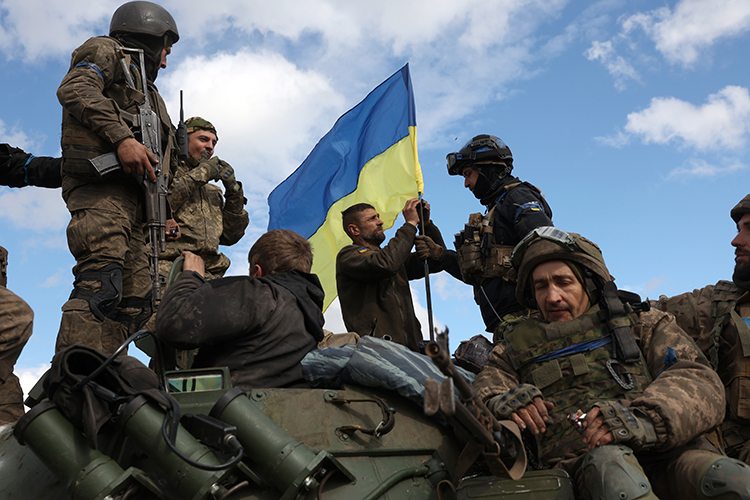
On April 30, 2018, a large-scale anti-terrorist operation on the territory of Donetsk and Luhansk regions of Ukraine was completed. ATO was reformatted into Operation Joint Forces. The commander of the operation was General Sergey Nayev.
Ukrainian photographer Danylo Pavlov spent several days with General Sergey Nayev and documented the start of Operation Joint Forces.
Without ATO
On April 30, 2018, the President of Ukraine and Supreme Commander-in-Chief Petro Poroshenko signed the decree “On approval of the decision of the National Security Council “On a large-scale anti-terrorist operation in the territory of Donetsk and Luhansk regions”. Thus, the war passed from the leadership of the Security Service of Ukraine to the Armed Forces of Ukraine.
On February 24, 2018, the law “On peculiarities of state policy on ensuring the state sovereignty of Ukraine in the temporarily occupied territories in Donetsk and Luhansk regions” came into force. In order to implement this law, the General Staff of the Armed Forces of Ukraine has developed documents on the start of the Joint Forces Operation instead of ATO.
“As of today, April 30, 2018, a large-scale anti-terrorist operation in the territory of Donetsk and Luhansk regions is completed. We are starting a military operation under the leadership of the Armed Forces of Ukraine to ensure the protection of the territorial integrity, sovereignty and independence of our state,” President Petro Poroshenko said. He added that for four years the anti-terrorist operation had fulfilled all the tasks and expressed hope that the new format would help to return the territories captured by pro-Russian militants.


“The interaction between the SBU and the units of the Armed Forces of Ukraine, the National Police and the National Guard are completely different from those provided for in the law on the reintegration of Donbas, and the leadership passes to the Armed Forces of Ukraine. The Armed Forces have additional powers to respond to aggression, and units of the National Guard and SBU, border guards, and the National Police are subordinated to them,” Petro Poroshenko explained.
“If the enemy goes into a large-scale offensive, first of all you are responsible for ensuring the repulse of the large-scale armed aggression of the Russian Federation,” Poroshenko said to the commander of the United Forces. The President stressed that this is not just a change of format, but new opportunities for the protection of Ukrainian territory and Ukrainian citizens. “We will do everything possible so that as soon as possible the land of the occupied Donbas returns to the sovereignty of Ukraine,” Poroshenko stressed. The operation of the Joint Forces lasted four years, from April 30, 2018 until the beginning of the full-scale Russian invasion.

On February 24, 2022, the military units and units participating in the PLO formed the Joint Forces grouping, which includes the operational-tactical groups “East” and “North” and parts of direct subordination. The grouping of the OS, together with other forces and means directly involved in the current hostilities, is subordinate to the commander of the Ukrainian Defense Forces.
United forces
Ukrainian documentary photographer Danylo Pavlov filmed the beginning of Operation Joint Forces. He spent several days with the Commander of the United Forces, who at that time was General Sergey Nayev. “We traveled with him to positions of the Armed Forces of Ukraine, flew by helicopter, were at zero, in Maryinka, as well as at the headquarters. Photographed the tactical exercises of the military Operation of the United Forces, — says Danylo Pavlov, — he filmed the soldiers who helped the local hospital and took care of it. They came, unloaded beds and humanitarian aid.”


Daniel Pavlov recalls the moment when General Nayev presented his watch to the soldier he met at the position in Maryinka. “Enemy trenches were very close to Ukrainian military positions near Maryinka, three hundred to four hundred meters. We looked at them in special binoculars. Nayev asked the military when the Russians most often shoot in our direction. He could not answer exactly and then the general took off his watch and gave it to the soldier,” the photographer shares his memories.

The mood of the military at that time was high. Danylo says that the Ukrainian army has changed a lot by 2018 — uniforms and equipment have improved.


“Inside the country there was such a vibe that the war was very far away and not felt at all. A ceasefire continued in the east. Of course, there were shootouts, but there were no offensives from the Russian Federation, positions were fixed, - Pavlov says. - Maryinka was peaceful. Business returned to the city, with many shops and cafes on the central street. Everything looked pretty optimistic.”

Material created with support The Free Word Foundation.
Danylo Pavlov— photojournalist since 2009, worked in the regional media of Donetsk, and later in the media holding “Segodnya” and the UNIAN agency. He also worked as a commercial photographer for several Ukrainian companies. In photojournalism, it focuses on creating social photo stories and illustrating long-read reports. In addition to working in traditional media, Danylo also contributed to the online magazine The Ukrainians, and later became responsible for the visual direction of the separate edition Reporters, which now exists both online and in print. Danylo continues to photograph and cover the events following the full-scale invasion on February 24, 2022. He reports from de-occupied territories and military positions, and is currently working on a lengthy photo project documenting the impact of war on soldiers and civilians in need of plastic surgery. He also collaborates with the State Emergency Service, for which he was awarded the State Badge of Honor last year.
Photographer's social networks:
Instagram
Facebook
Recall that the Ukrainian Association of Professional Photographers has started a series of materials dedicated tokey events of the Russian war against Ukraine, where he publishes memoirs and photographs of Ukrainian documentary photographers.
The material was worked on:
Researcher of the topic, author of the text: Katya Moskalyuk
Bildeditor: Vyacheslav Ratynskyi
Literary Editor: Julia Foutei
Site Manager: Vladislav Kuhar
.jpg)
.jpg)