.jpeg)
A new school year has begun in Ukraine under martial law. This year, only schoolswith shelters that meet the State Emergency Service of Ukraine (DSNS) safetyrequirements have welcomed students.
During anonline address at the event “Shaping the Future of Learning Now,” heldalongside the U.N. Summit of the Future, Ukraine’s First Lady Olena Zelenskanoted that “in Ukraine, children’s unquestionable right to education has to bephysically protected from Russian aggression.”
“That iswhy today we are probably the country with the most advanced online learning inthe world,” the First Lady is quoted as saying on the Office of the President of Ukraine.

The websitehttps://saveschools.in.ua, a resource of the Ministry of Education and Science, documents andprovides real-time statistics on destroyed educational institutions. Accordingto the site, 3,798 educational facilities have been damaged by bombing andshelling so far, and 365 of them have been completely destroyed.
Russiajustifies strikes on educational institutions in Ukraine by claiming thatUkrainian troops are allegedly stationed there. Propagandists actively use“mirroring” tactics to conceal their own army’s crimes. Back in 2022, theRussian outlet “Voennoye Obozreniye” (Military Review) published an article about thebehavior of the Ukrainian army—one that, in fact, mirrors Russia’s own crimesin Ukraine:
“Ukrainian troops, whose behavior in this casediffers little from that of terrorist groups, try to shield themselves withschools, kindergartens, and hospitals while conducting military activity. Atthe same time, images are sent to the West of ‘Russian troops hitting civiliansites.’ The fact that it is the forces of the Kyiv regime themselves that turnthese sites into military targets is, of course, kept quiet,” the articleclaims.
Here areseveral typical examples of how hostile propaganda works.
Lenta, in an article dated Nov. 13, 2022, about a strike on Mykolaiv:

“Accordingto him, ‘the military are whining about hits on the gymnasium building.’ Theoutlet is referring to the First Ukrainian Gymnasium named after Mykola Arkas.The ‘activist’ also claimed that in 2014, the school cafeteria sold a drinkcalled ‘Blood of Russian babies,’” the propaganda outlet wrote.
The outlet “Tsargrad”:

Gazeta,citing Russia’s Defense Ministry, wrote about Ukrainian troops allegedlyplacing weapons in schools in Sloviansk, Pokrovsk, and Dnipro.

The Russianoutlet “Politicus” reported on the use of bombs against a Ukrainian university:

Lenta onairbomb strikes on Kharkiv:

Frontlineand border regions have suffered the most destruction of educationalfacilities. In the first months of the war, Russians actively attackedUkraine’s state border from the east, from Crimea, and from the north with airsupport. Cities were bombed in broad daylight.
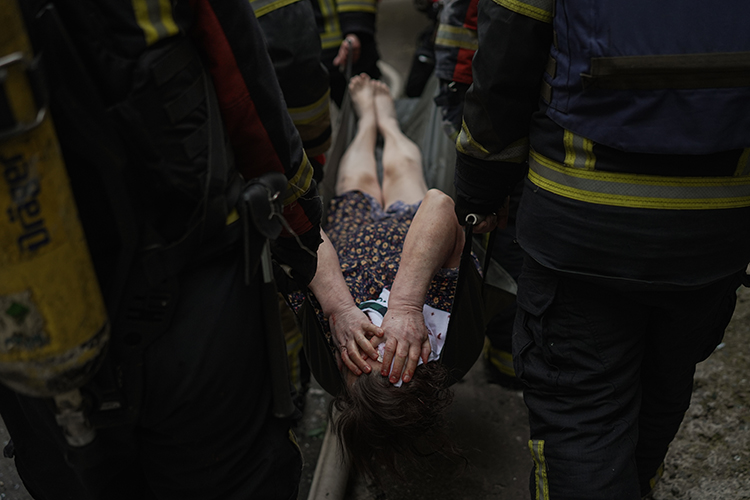
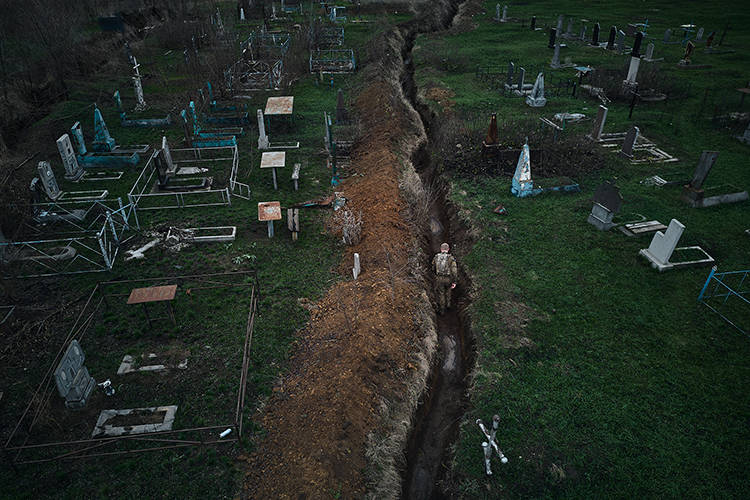
Evidence of Russian war crimes against educational institutions in Ukraine hasbeen captured in photographs by Ukrainian documentary photographers.
Fightingraged for the strategically important city of Vasylkiv in Kyiv Oblast: Russianstried to seize the airfield, blew up an oil depot, and kept the city underconstant shelling. On Feb. 27, 2022, a Russian missile destroyed the VasylkivVocational Lyceum.

The siegeof Chernihiv and the partial occupation of the oblast lasted for more than amonth. Air raids often took place, with aircraft flying low over thecity.
The Podusivka neighborhood was among the hardest hit in Chernihiv. Here, theRussian army bombed two schools at once, dropping aerial bombs. Accordingto information from TEXTY (in collaboration with the “Vist” newspaper (Chernihiv)), School No. 18 housed the city’sTerritorial Defense—local residents preparing to defend their city from theinvading army—as well as medics, teachers, and kitchen staff. The exact numberof those killed is unknown. In School No. 21, children and parents weresheltering; they miraculously survived.

Thesettlement of Makariv in Bucha Raion, Kyiv Oblast, is among the localities thatsuffered from Russian atrocities. For a short time, the occupiers managed toseize part of the settlement; they shelled residential neighborhoods andcivilian infrastructure.

On July 8,2024, a missile strike on the Okhmatdyt children’s hospital destroyed aclassroom and the library of the “School of Superheroes” educational centerlocated on the hospital grounds. Children undergoing inpatient treatmentstudied there.
In Ukraine,the war has quite literally bombed education into ruins. But there is somethingthat cannot be counted, restored, or returned: lost human potential, lostopportunities, and lost time—when children are unable to learn.
.jpeg)
The Russianarmy not only destroys Ukrainian schools—it also turns them into torture sites.Such sites were found in school buildings in de-occupiedterritories. According to the Chernihiv District State Administration, in the village of Yahidne, 15 kmfrom Chernihiv, Russian troops held nearly 370 local residents hostage in thebare concrete rooms of the school basement. Among them were 70 children. Withlittle food and water, in darkness, using shared buckets as toilets, they sleptin shifts in small, overcrowded rooms. Ten elderly people died from suffocationand from lack of medicine.

After theoblast was liberated, foreign journalists visited the village and spoke withresidents. In an April 16, 2022 article, the British newspaper The Telegraphwrote: “Kept hostage in a basement for amonth, villagers counted down the days before they ran free”. The outlet describes how nearly 400 people wereforced to live, breathe, and use the toilet in a basement for weeks.
.jpeg)
“But it is the walls of the rooms beneath Yahidne Secondary Schoolthat tell the terrifying story of the terror endured by residents of thevillage of Yahidne near Chernihiv,” The Telegraph continues. “Their ‘partinggift” (as the Russian army left the village — ed. note) was to lockvillagers in the basement by bracing a concrete slab against the door.”
Accordingto Reuters, theKremlin did not respond to a request for comment regarding the events inYahidne.
“Russiadenies allegations of extrajudicial killings, torture, and the mistreatment ofcivilians. The Kremlin said its troops do not target civilians and accusedUkrainian authorities and the West of fabricating evidence,” Reuters wrote.
At the sametime, the Russian army itself uses schools in occupied territories to stationpersonnel and store weapons. After territories were liberated, documentedtraces of the Russian presence were found in educational institutions,including inscriptions and drawings. These may also become evidence of Russia’scrimes against Ukrainian education and culture in international courts.

Beyondphysically destroying Ukrainian schools, Russia is dismantling the educationsystem in occupied territories—closing Ukrainian schools, destroying libraries,and burning Ukrainian books. The Institute of Mass Information conducted a study titled “How Russia Destroys School Educationin the Occupied Territories of Ukraine.” The study identified four schemesthrough which Russia “denazifies” education in Ukraine: recruiting teachers;“retraining” and “upskilling” collaborators; sending “humanitarian missions;”and terrorizing Ukrainian educators.
Russiaconstantly promotes a narrative that Ukrainian authorities are unable to ensurechildren’s safety. Propaganda claims that “children of Donbas” and othertemporarily occupied territories go to school feeling safe, while children ingovernment-controlled Ukraine sit in bomb shelters.

Russianpropaganda claims that it is the Russian authorities who are evacuatingUkrainian children from shelling to “save” them—while concealing who isshelling Ukrainian territory and who the aggressor is in this war. This is howthe deportation of Ukrainian children to Russia is justified.
“South News Service”:

Anotherreason Russia has fabricated to justify deporting Ukrainian children is “healthretreats” in children’s camps—after which the Russian authorities refuse toreturn children.

“Children who have been returned and reunited with their familiestestify to total russification,” Daria Herasymchuk, the President of Ukraine’s Adviser-Commissionerfor Children’s Rights and Child Rehabilitation, said in an interview with Detector Media.
Associated Press, in the article “How Moscow grabs Ukrainian kids andmakes them Russians”,writes about the kidnapping of Ukrainian children by Moscow. The piecediscusses children found in basements of war-shattered cities, children whoseparents were killed, and children from orphanages. As the outlet notes, citingthe Ukrainian government, most children from orphanages are not orphans—theirparents were living in difficult circumstances. The outlet conducted its ownlarge-scale investigation, supported by dozens of interviews with parents,children, and officials in Ukraine and Russia; emails; and media publications.The investigation traces cases to children already living in Russia. Theauthor notes that the Russian authorities did everything to simplify theadoption of Ukrainian children and encourage it.
“The APfound that officials deported Ukrainian children to Russia orRussian-controlled territories without consent; lied to them that their parentsdidn’t want them; used them for propaganda; placed them with Russian families;and granted them citizenship,” the outlet wrote.
The articleincludes a story told by Maria Lvova-Belova, Russia’s children’s ombudsperson,who said that a group of 30 children evacuated to Russia from Mariupol’sbasements initially sang Ukraine’s national anthem and chanted “Glory toUkraine!” Over time, she claimed, they came to love Russia, and she herselfadopted a Ukrainian teenager.
“Whetheror not they have parents, raising children of war in another country or culturecan be a sign of genocide—an attempt to erase the very identity of the enemynation,” the British newspaper claims.
As the Institute of Mass Informationreports, Russianshave also committed sexual violence and torture. Children are sent to camps for“political re-education,” russified and militarized, forced into labor, andused in numerous propaganda videos and staged events. According to a PACE resolution and the conclusions of an OSCE Expert Mission, the deportation of children fromUkraine has been recognized as a war crime and an element of genocide.
On March17, 2023, the International Criminal Court in The Hague issued arrest warrantsfor Russian President Vladimir Putin and Russia’s Commissioner for Children’sRights, Maria Lvova-Belova.
Workedon the piece:
Topic researcher, text author: Yana Yevmenova
Photo editor: Viacheslav Ratynskyi
Literary editor: Yuliia Futei