In memory of those killed, and to help bring justice closer, we recall how Ukrainian and foreign documentarians and human rights organizations debunked Russian disinformation about the shelling of the Kramatorsk railway station on April 8, 2022. That day, a Russian missile with cluster munitions turned the railway station—crowded with people—into a battlefield, cutting short the lives of those fleeing the war.
The Kramatorsk railway station during the Russian-Ukrainian war is not just a piece of railway infrastructure that served intercity trains. It became a true evacuation hub and a road of life for everyone forced to escape the threats of war. And it is also the site of yet another Russian war crime. On April 8, Russians launched a missile strike on the station, where thousands of people were waiting for evacuation trains. The terrorist attack on the Kramatorsk railway station, committed in the sixth week of the war, remains one of its most tragic episodes in more than 11 years of war.
War at the station
After Russia’s military defeat in northern Ukraine in early April 2022, Russians concentrated their forces on the eastern direction. For this reason, active evacuation of residents of Donetsk, Luhansk, and Kharkiv regions was underway by rail to safer regions.
The day before, the Russian army struck an overpass near the Barvinkove station in Kharkiv region from the air, temporarily halting rail traffic from Lyman, Sloviansk, and Kramatorsk. However, the occupiers failed to derail the evacuation.
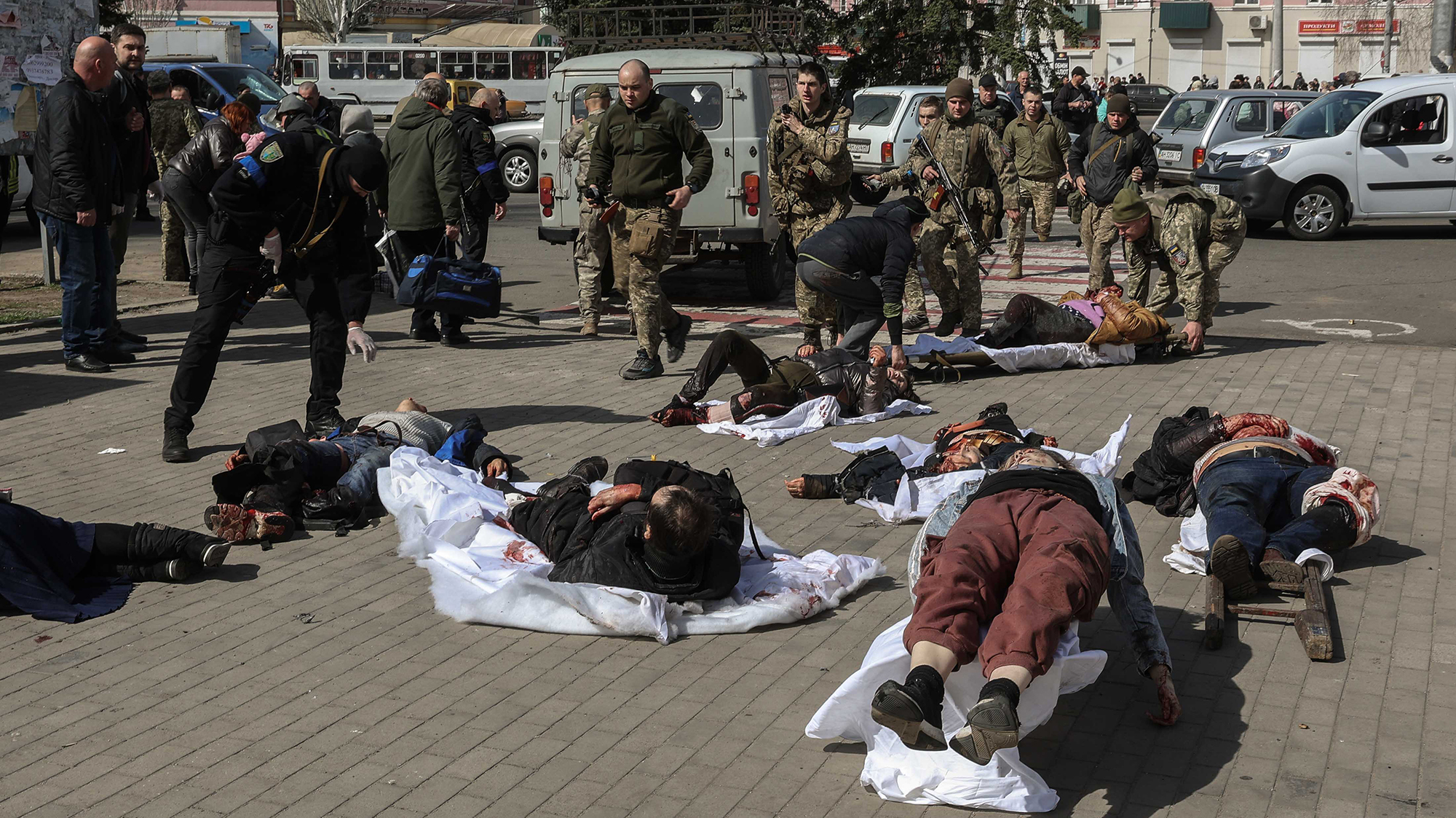
Early in the morning of April 8, 2022, a crowd had already gathered at the Kramatorsk station — about four thousand people hoping to get as far away from hostilities as possible, mostly women, children, and elderly people. At approximately 10:28 a.m., explosions rang out over the station. In an instant, the surrounding area turned into a blood-soaked battlefield strewn with human bodies and luggage.
At that time, many Ukrainian and foreign journalists were in the city; they were able to reach the station quickly to document the horrific aftermath of the crime. Ukrainian photojournalist Anatolii Stepanov was in Kramatorsk at the moment of the attack on the station.
“I was already leaving my apartment to go to Rubizhne to see the National Guard when a distant explosion sounded from the street, followed by rapid rattling. Bang, bang, bang — as if dozens of basketballs were bouncing on the floor of a gym… From the balcony on the eighth floor, I could clearly see puffs of smoke rising in the old part of the city. A thought flashed through my mind that it had hit somewhere near the station, but I didn’t want to believe it,” the photographer recalls.
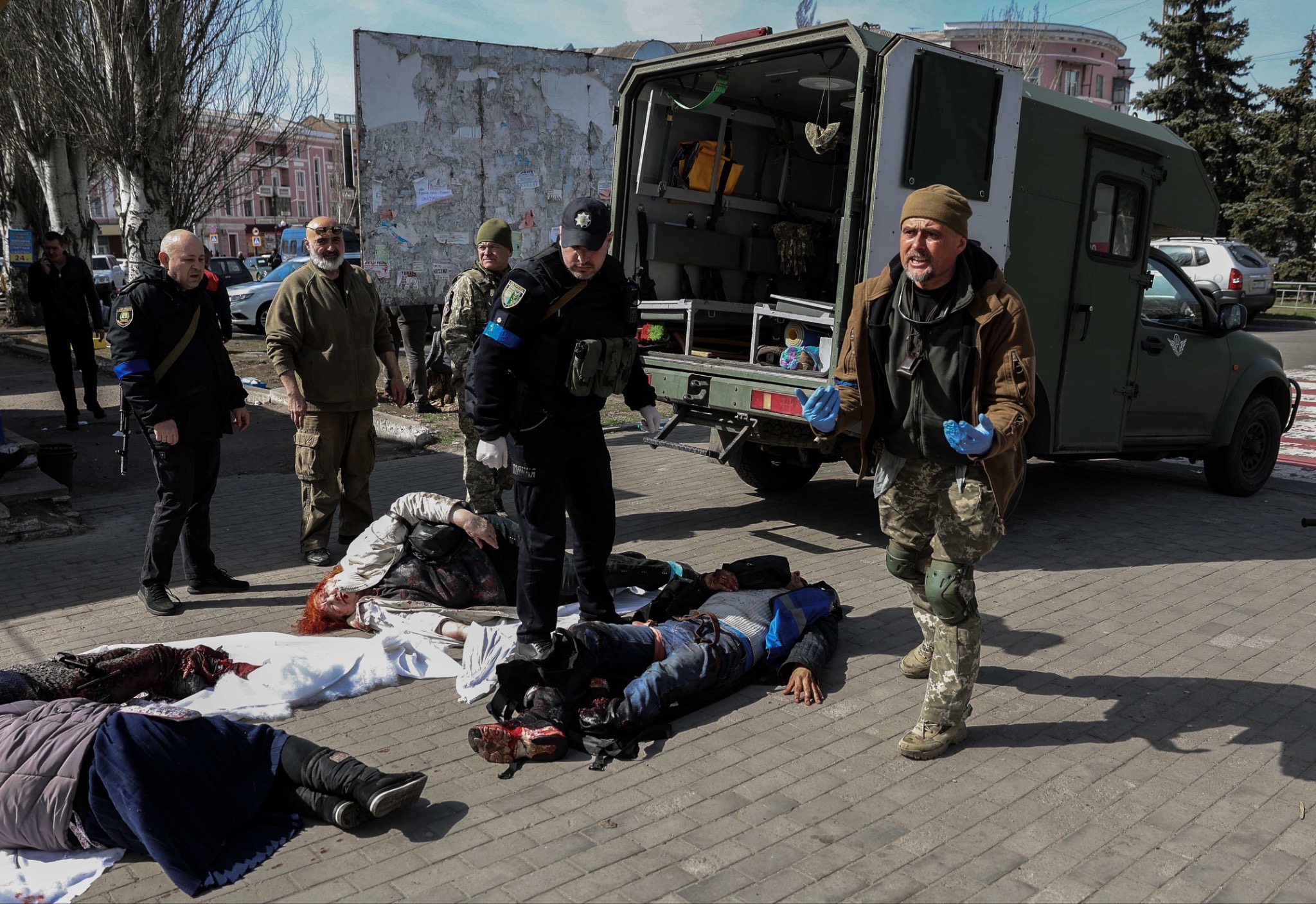
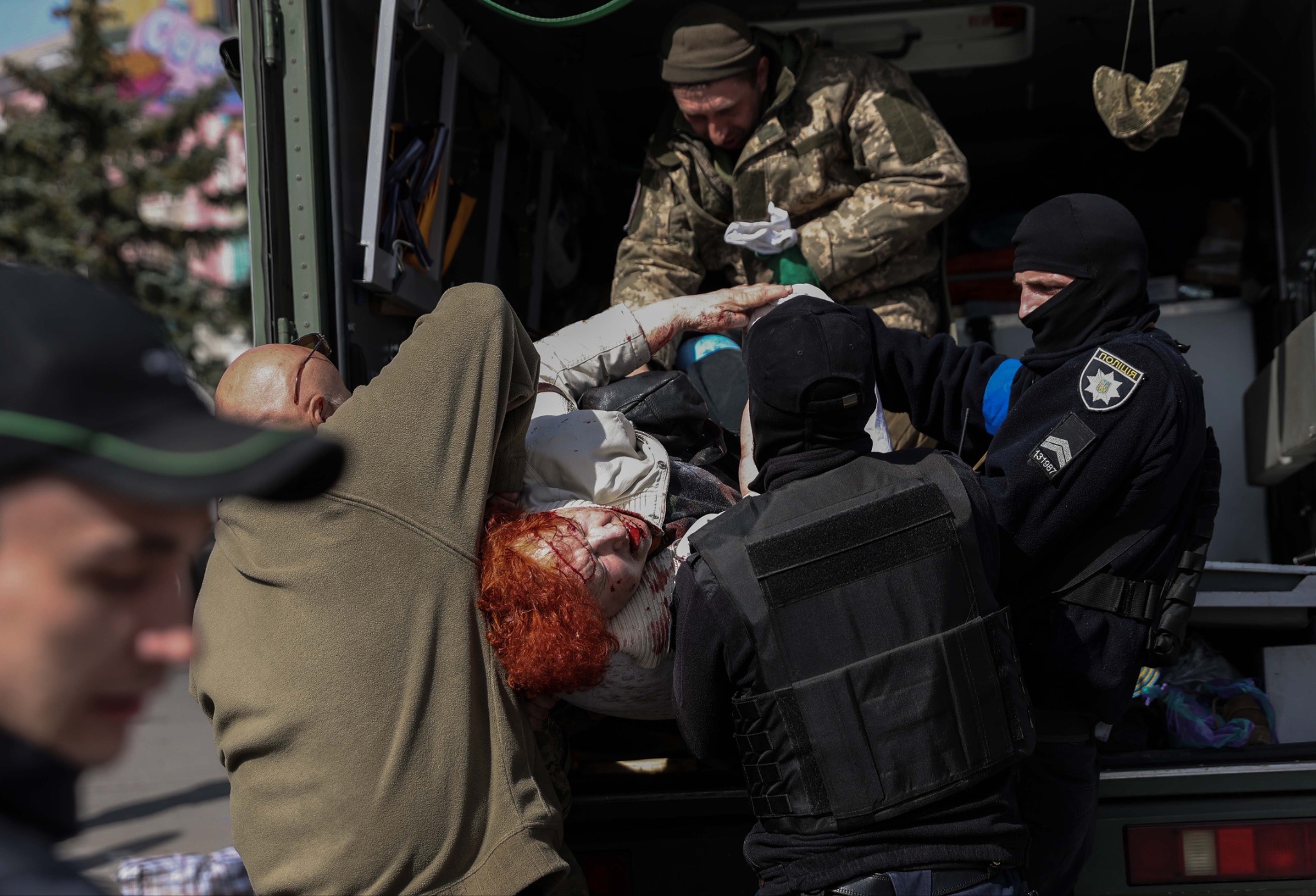
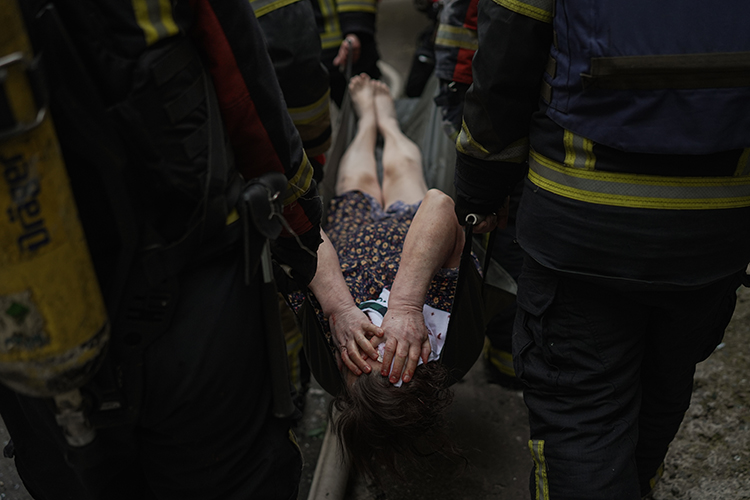
The first response services, military, volunteers, and civilians in cars quickly arrived at the station. But there were so many severely wounded people — with bleeding and torn-off limbs — that hospitals filled up to capacity within a short time.
“For several days, evacuation trains had been departing from the station and there were always many people there. The siren quickly spurred movement. On the way to the station, it became obvious that something terrible had happened. From all corners of Kramatorsk, overtaking one another, ambulances and evacuation military vans rushed toward the station.
Closer to the station, there was no doubt left. People were running toward us in whole families. On the square in front of the station, firefighters were extinguishing burning cars; near the passage to the platform, they were laying out the first wounded. It seemed like the entire city’s medical staff had gathered there. Military medics and simply soldiers were running to the station.”
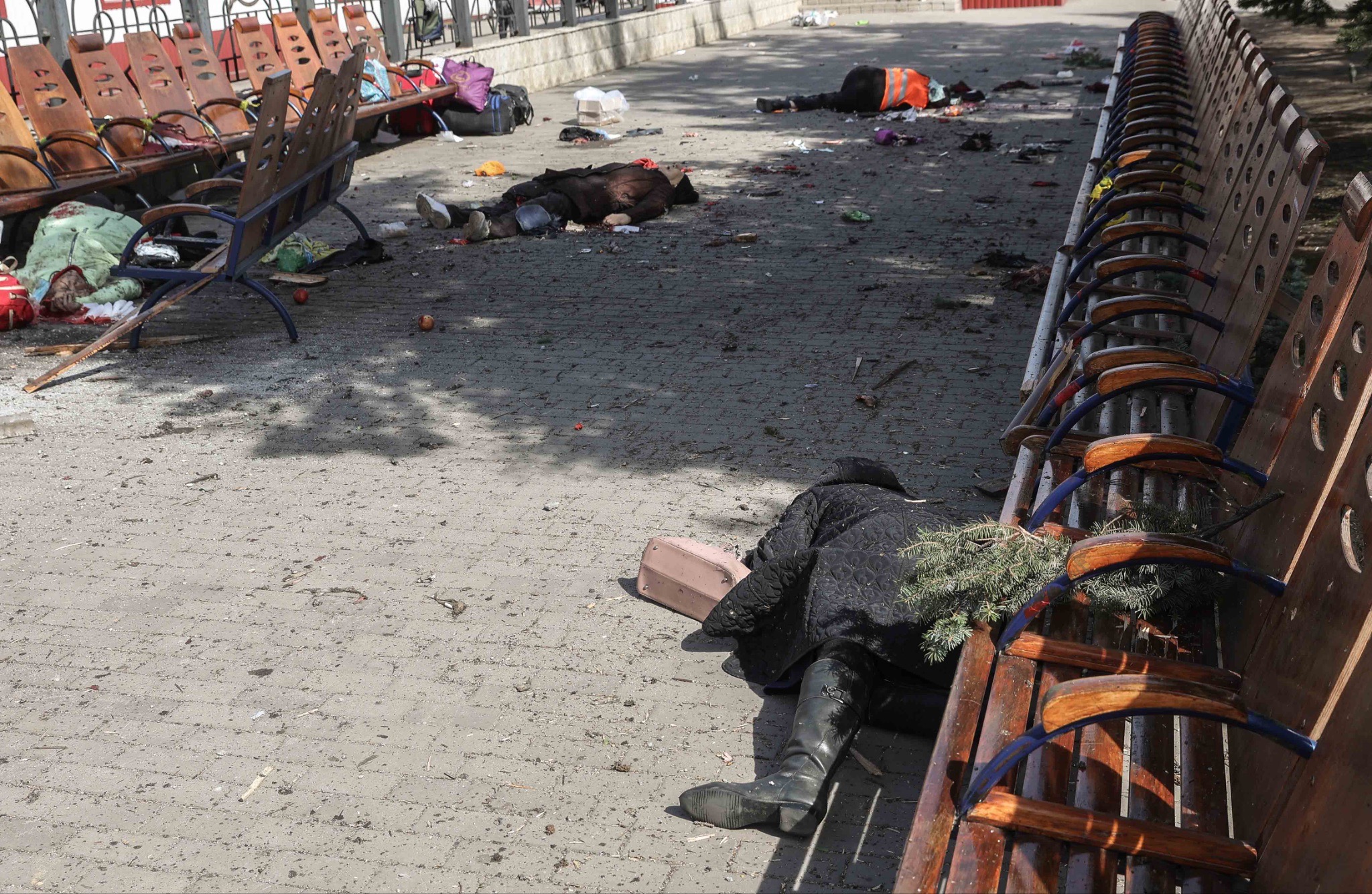
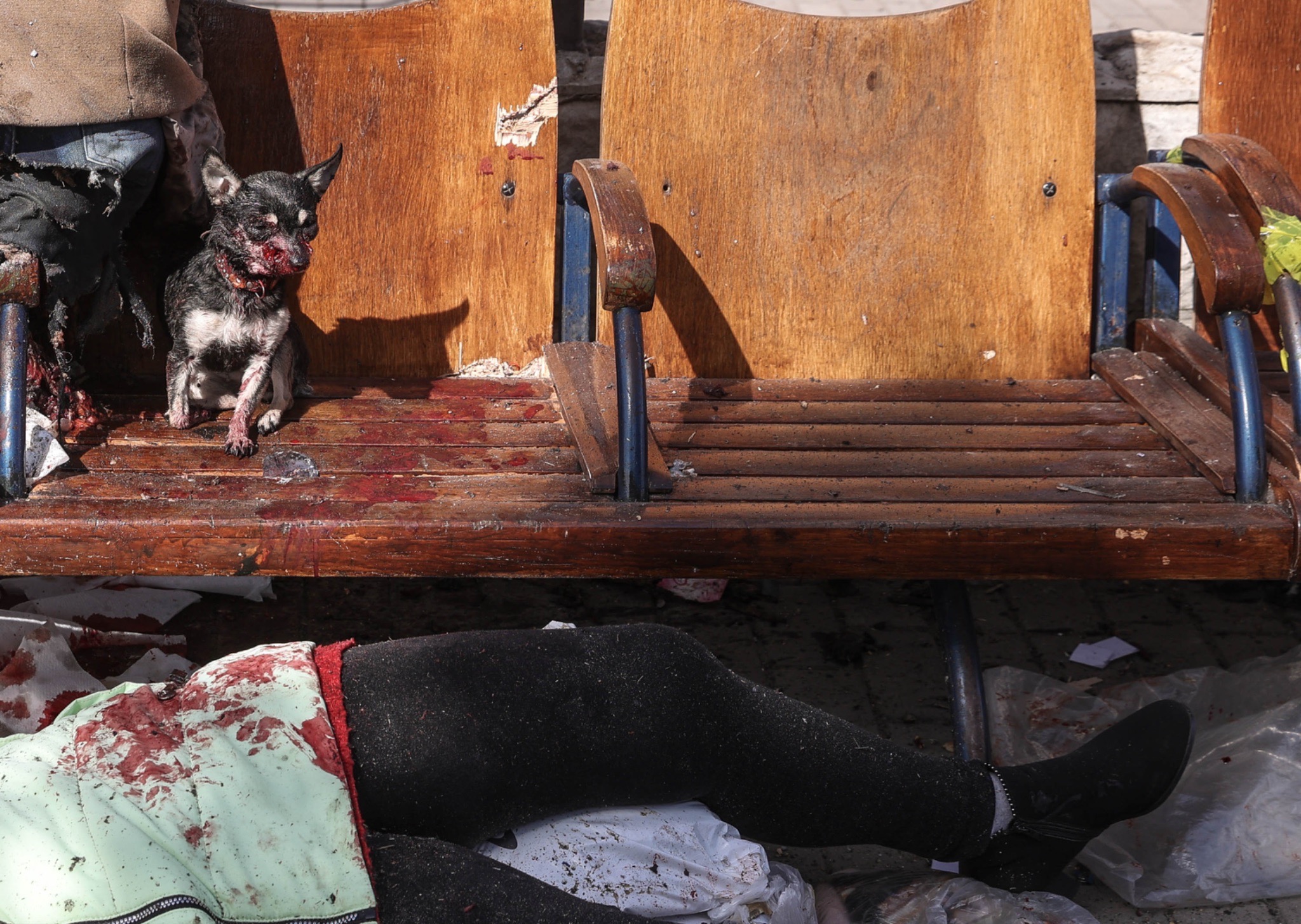
Numerous foreign media outlets published reports about the crime at the station and the victims. In particular, reporters from the American outlet The Washington Post were on site about 15 minutes after the attack and counted at least 20 killed, including children. The greatest losses were among those sitting in open waiting areas on the train platform; the wooden benches were soaked through with blood, report The Washington Post journalists.
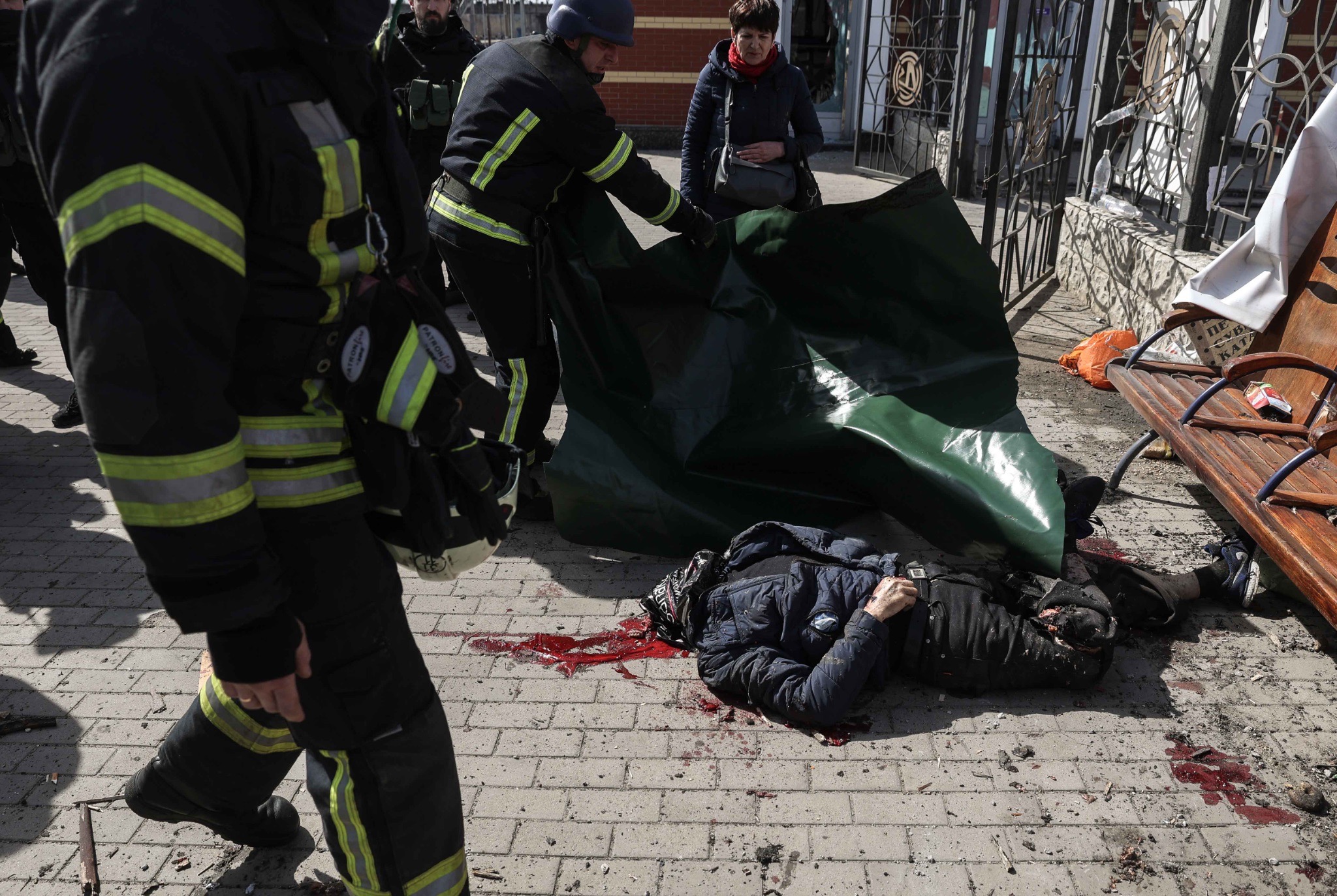
Anatolii Stepanov says that despite everything happening around him, he tried to do his work professionally:
“A small area by the gates quickly filled with the wounded. People were groaning, someone was fainting before our eyes, blood was pouring from the girl’s shattered legs and pooling on the asphalt. Nearby, they were loading an elderly woman into an ambulance, her lips covered in blood. A military medic was shouting at shocked police officers. Cries all around. I tried to film it all… I simply performed mechanical actions. As if in a fever dream, I raised the camera, pressed, lowered it, raised it again, pressed…”
As a result of the strike, more than 30 people were killed immediately and more than a hundred were wounded. Including those who later died in hospitals, the number of victims of this terrorist attack rose to 61 people, including seven children; 121 people sustained injuries of varying severity.
First evidence of Russia’s involvement
The Ukrainian side, human rights organizations, EU representatives, and the Pentagon condemned the terrorist attack on the civilian station and blamed the Kremlin. The U.S. Department of Defense spoke about Russia’s intentions to advance on Kramatorsk and involve a unit in the area of the attacked railway station, reported the Ukrainian outlet “Radio Svoboda”.
The American outlet The New York Times reported on a series of events related to the shelling. First, on the previous evening, pro-Russian Telegram channels warned Kramatorsk residents against evacuating by rail. The next day, the Russian state media resource “RIA Novosti” published a news item about the attack five minutes before it happened, while Russia’s Ministry of Defense claimed it had struck a concentration of Ukrainian troops. However, after reports of mass civilian deaths, including children, the publication was deleted. The British outlet The Telegraph wrote that on the day of the strike, April 8, pro-Russian Telegram channels posted footage of several rockets being launched allegedly from occupied Shakhtarsk in Donetsk region, suggesting it was the strike on Kramatorsk. The Ukrainian analytical project VoxCheck also cited these facts as initial evidence of Russian involvement in the shelling.
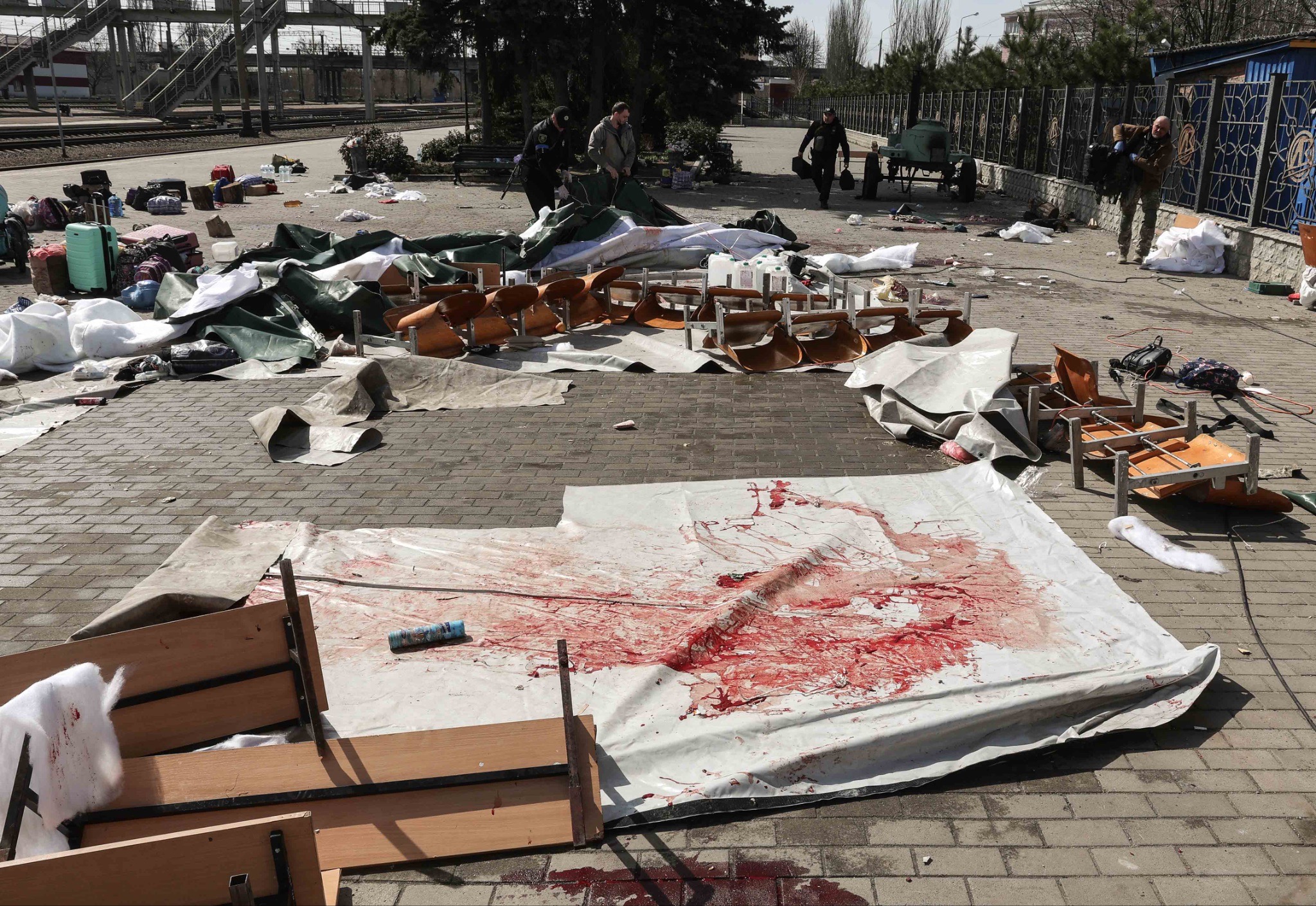
“There were no living people left on the platform. Only scattered belongings smeared with blood — suitcases, children’s toys. My eye caught a smeared bloody stain, as if someone had drawn a giant brushstroke across the asphalt. Across the tracks, rescuers were carrying bodies out on stretchers. A boy about ten on a bench… More than a year and a half has passed since that day, but I remember him all the time. His face… His chin, his lips, and then just a light rag instead of a face… He probably felt nothing — no pain, no fear. The metal instantly, mercilessly, cut short his small life,” — Anatolii Stepanov testifies to Russians’ conscious aggression against civilian life.
Investigation: “Tochka-U”
The Kremlin authorities denied their involvement in the crime, and the Russian command tried to shift responsibility onto the Armed Forces of Ukraine.
“The ‘Tochka-U’ missile that struck the Kramatorsk railway station belongs to the Armed Forces of Ukraine,” wrote the propaganda outlet ‘Arguments and Facts’.
Several international organizations conducted detailed investigations into the crime at the Kramatorsk railway station, including the international human rights organization Human Rights Watch. Together with SITU Research, they spent 10 months investigating the attack on the station, collecting evidence from the tragedy site and the likely missile launch area, analyzing more than 200 videos and photographs—including satellite imagery—conducting spatial and temporal analysis of the attack, and interviewing a large number of people connected to the tragedy.
“‘Pulse, there’s a pulse!’ — a police officer bends over an elderly woman. Her head is thrown back, her skin waxen… Two soldiers try to help him. ‘That’s it!’ — the police officer says briefly, as if exhaling. Everyone stands up and steps away from her. A minute. A minute from hope to a verdict.
Nearby, a woman stands by the dead bodies and dials her husband’s number. You can see that a munition exploded in this spot and horribly mutilated people. She wants to make sure it’s his body — maybe the phone will ring somewhere in a pocket… She stepped away for just a few minutes and then this happened… Under the fence, a small toy terrier is trembling on a bench. A fragment pierced straight through the dog’s upper jaw. Frightened little eyes, fur covered in blood. Next to it — the owner’s body, mutilated beyond recognition. Some girl takes the dog. Past the bodies they lead a young woman who is hysterical.”
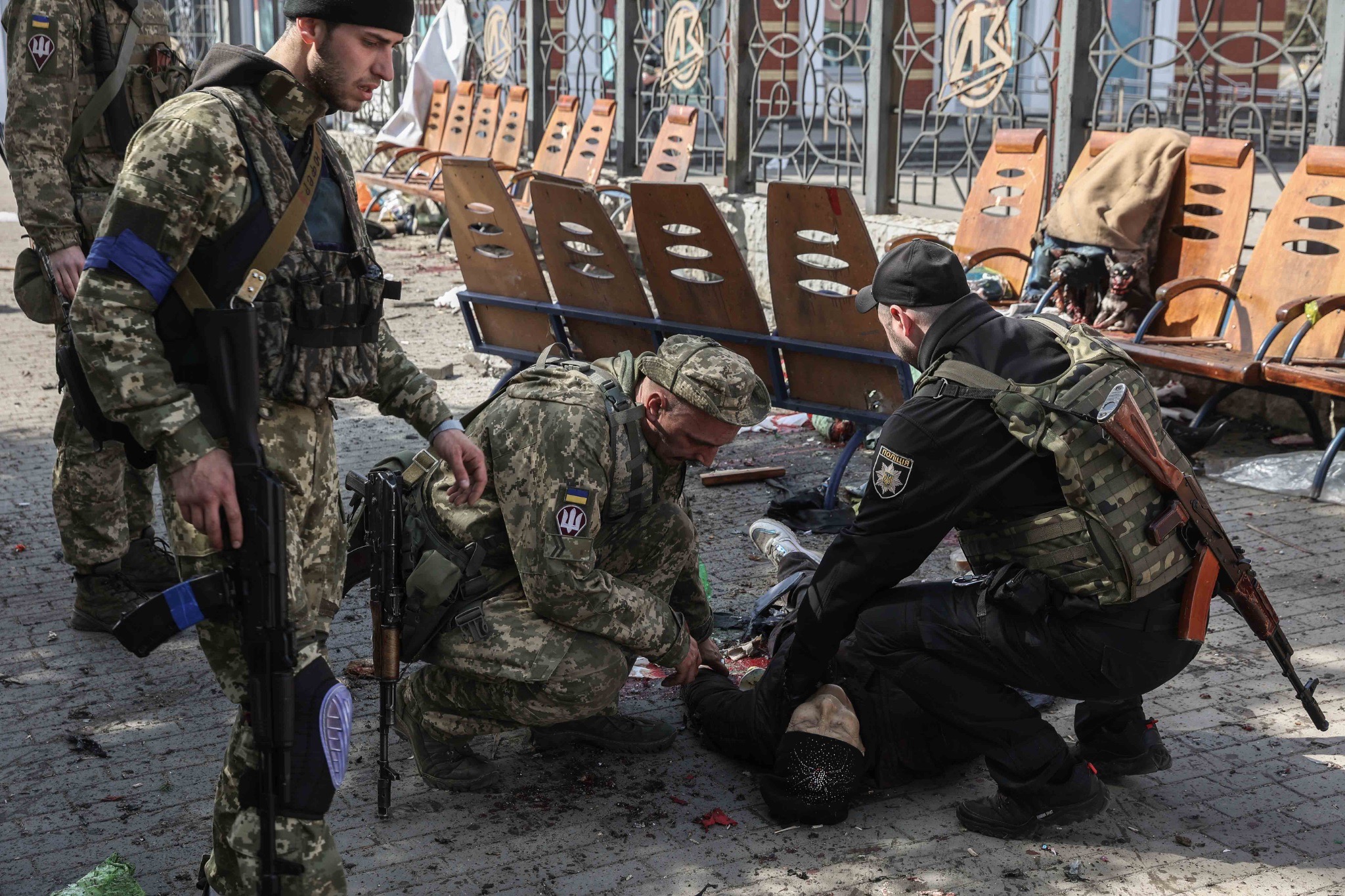
In May 2022, an SBU forensic examination established that the missile strike was carried out from temporarily occupied Donetsk region. The attack used a guided single-stage solid-fuel missile 9M79-1 with a cluster payload, known as “Tochka-U”.
“Kyiv blamed what happened on Moscow, but Russia’s Ministry of Defense emphasizes that the Russian army does not have such missiles in service,” whitewashes the Russian army the outlet ‘Ukraina.ru’.
“Journalists noticed that some photographs from Kramatorsk show the missile’s serial number: Sh91579. The TV channel claims the munitions are on the books of the Ukrainian military and were previously used in 2015 in Alchevsk and Lohvynove, and in 2022 in Berdiansk and Melitopol,” accuses the Ukrainian military ‘Arguments and Facts’.
Different researchers confirm that both Ukraine’s Armed Forces and Russia have launch platforms for this missile system. VoxCheck analysts explain that missile batches are not tied to a specific country, so the serial number does not allow one to identify the country using these missile systems. Moreover, such missiles are not produced in Ukraine; they are a legacy of the Soviet Union’s collapse. Meanwhile, there is extensive photo and video evidence on social media, as well as in news reports by Russian TV channels, proving that Russians used “Tochka-U” both before and after the full-scale invasion.
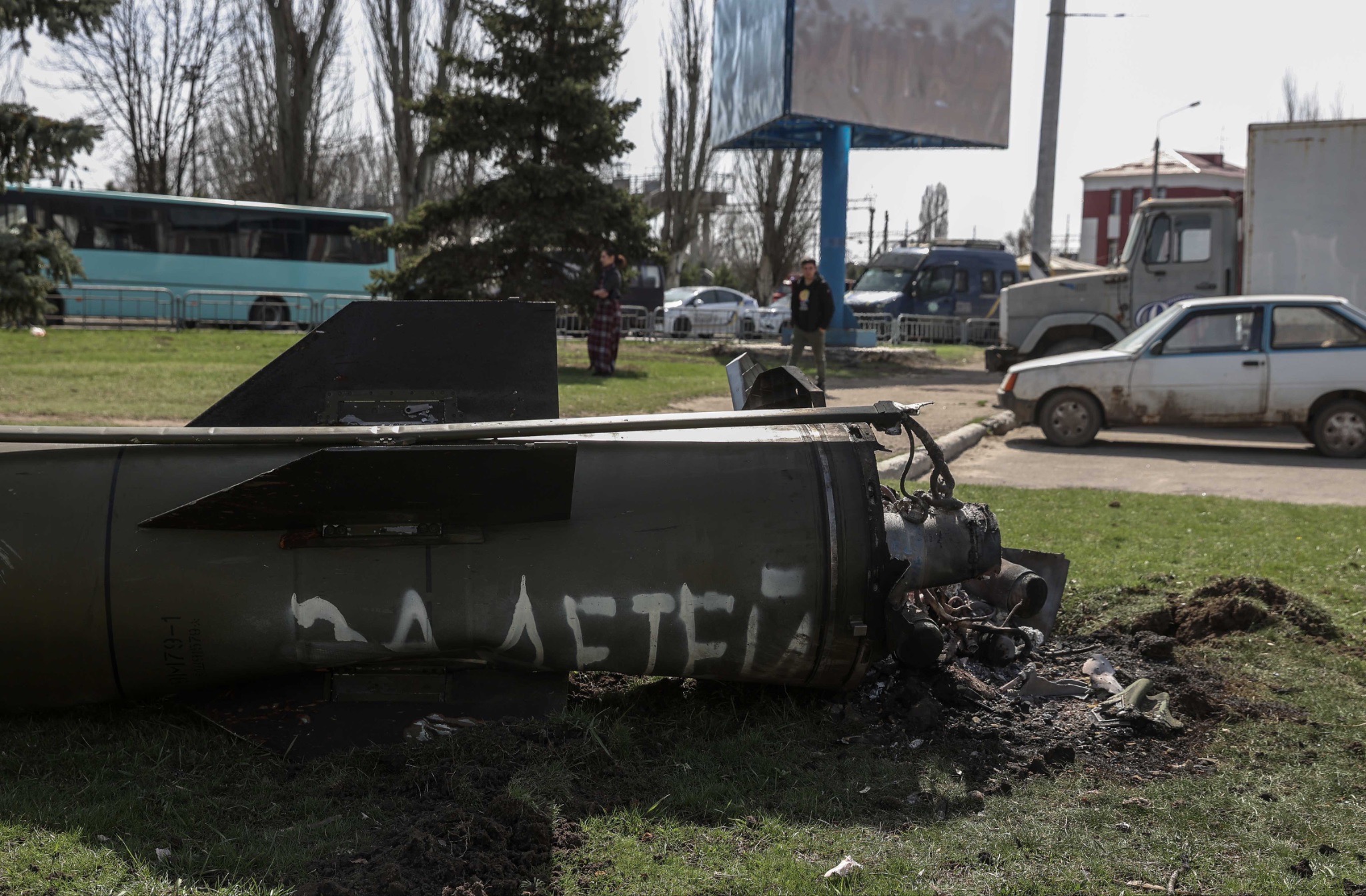
Human Rights Watch also noted the inscription “For the children” painted on the missile body found in the grass near the station. A similar slogan—“For the children of Donbas”—has been actively used by Russians in occupied territories since 2014 and after the full-scale invasion in 2022. It is a battle cry that is written on Russian weapons; it is popular in pro-Russian social media accounts and has even appeared on billboards in Moscow during an advertising campaign in support of the war in Ukraine.
Anatolii Stepanov confirms the cynicism of the shelling of the Kramatorsk railway station:
“The police have already recovered a bit from the shock and start ushering journalists off the platforms. I go out to the square in front of the station. In the flowerbed by the fir trees, the engine from a ‘Tochka-U’ missile is embedded in the ground. My eye catches the inscription in large white letters in Russian: ‘FOR THE CHILDREN’, visible on its remains.”
Investigation: launch site
One of the key goals of the investigation was to establish the likely missile launch site. It is worth noting that a “Tochka-U” can fly up to 120 kilometers to its intended target; it is known that two missiles hit the station.
“As it became known, the strike on the Kramatorsk railway station was carried out by a missile division of the Ukrainian Armed Forces from the area of the settlement of Dobropillia, 45 km southwest of the city,” publishes its version the Russian outlet ‘Ukraina.ru’.
According to Human Rights Watch analysts, Russians could have shelled from a site near the village of Kunie in Izium district, Kharkiv region — the Kramatorsk station lies within the direct strike zone of this missile system. Reviewing satellite images and visiting the village, researchers found irrefutable evidence that near Kunie at the moment of the attack on the station, Russians had a “Tochka-U” missile system in a combat position.
Other independent investigators suggest the missiles could have been launched from occupied Donetsk region. The SBU reached the same conclusion.
Indiscriminate shelling
Russia’s Ministry of Defense called the shelling of the Kramatorsk station a “provocation”:
“Obviously, the goal of this bloody action is to blame the Russian Armed Forces for what happened—at the cost of the lives of its own people—and create the necessary picture for the world community,” ‘Arguments and Facts’ quotes a publication by the ministry in a Telegram channel. “The message clarifies that the goal of the strike on the Kramatorsk station was to disrupt the mass evacuation of residents from the city. The Ukrainian side, the ministry reported, was allegedly planning to use civilians as a ‘human shield’ to defend the AFU’s positions.”
Human Rights Watch found no confirmation of any Russian claim. Russians could not have failed to know that thousands of civilians were leaving daily by rail — information from the Ukrainian authorities was available through all communication channels, and aerial observation could easily have confirmed the scale of the evacuation. This shelling provided no clear military advantage: according to the research, on the day before the strike the number of military personnel at the station was minimal, and the only “weapons” transported by trains were scrap metal.
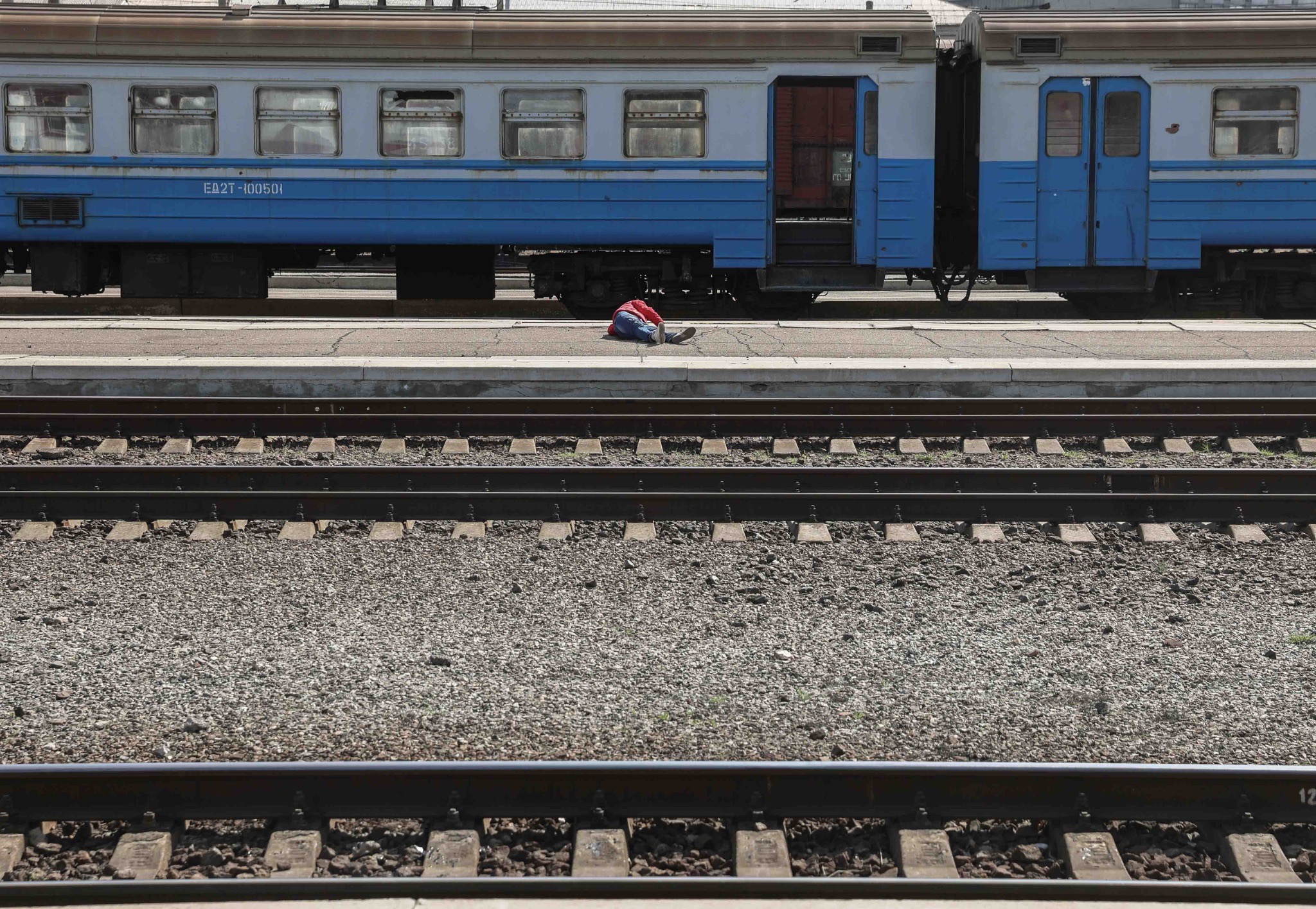
The guided single-stage solid-fuel missile 9M79-1 with a cluster payload, known as “Tochka-U”, disperses a large number of fragmentation submunitions over a wide area. Such shelling causes a large number of casualties, and unexploded submunitions remain dangerous for decades. The use of cluster munitions is illegal under international law because of the indiscriminate harm they cause. This is exactly what the shelling of the station was — Human Rights Watch examined and visualized in its report the dispersion patterns, remnants, and fragment models that matched the 9N24 combat elements. Investigators were convinced that all those killed at the station were civilians; they found 32 fragment locations across an area of 55,000 sq m.
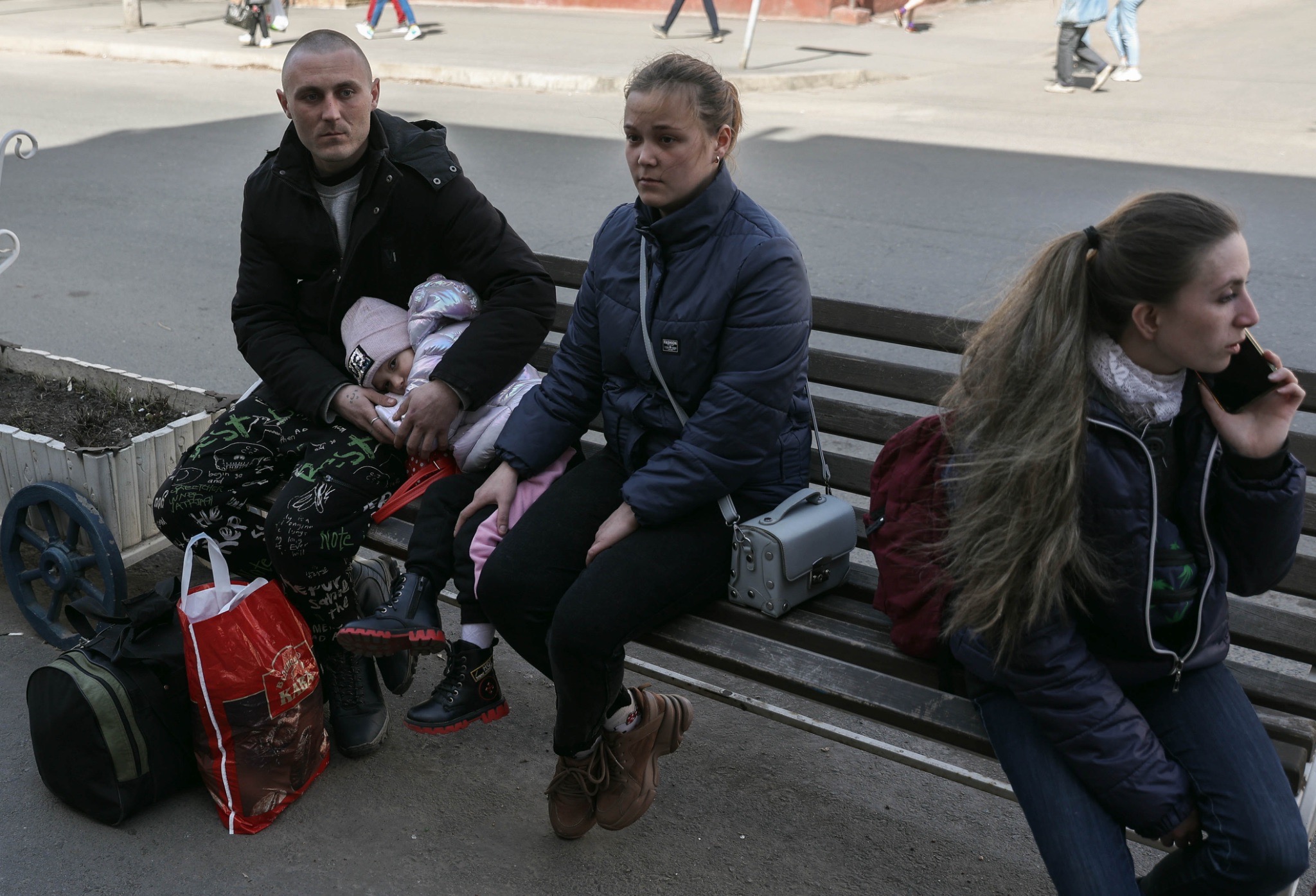
“Everyone is gradually coming to their senses. Bodies, many bodies covered with tarps, lie by the station. People who had gathered for evacuation have now scattered along nearby streets and courtyards. On the street leading to the station, I see a young couple with a child sitting on a bench. They sit hugging with empty gazes. They just stepped away to eat…” Anatolii Stepanov concludes his account of what he saw that day at the station.
After the tragedy
People who survived the attack on the station in Kramatorsk faced a long road of rehabilitation. In memory of those killed and wounded by the Russian missile strike, a memorial was installed at the station.
After a six-month halt, the station resumed operations, and the route from Kramatorsk became one of the most in-demand in the country over four years of war. Evacuation by train from northern Donetsk region continued until Russians began targeting railway infrastructure. On November 5, 2025, Ukrzaliznytsia reported the suspension of rail service to Donetsk region, including to Sloviansk and Kramatorsk.
Photographer Anatolii Stepanov admits that being at the station revived painful memories and brought fear that the enemy could repeat the tragedy:
“Only once after April 8, 2022 did I travel by train Kramatorsk — Kyiv. I always preferred traveling to Donbas by car. Every time I visited the station, I remembered: here lay the body of a woman killed, here a dead man by the entrance, and here a person’s body torn apart, and over there — on a bench — a child without a face. Hardly anything can stop the enemy from striking the station again. The question is only whether they see it as expedient. That’s why I felt relief when I heard the news that rail service to Kramatorsk had been halted. Especially since they can already reach even more distant stations. Yes, it created certain difficulties, but it did at least somewhat make passengers safer.”
Over four years of war, the list of tragedies committed by the Russian army in Ukraine continues to grow. Despite the multitude of recorded evidence, war criminals manage to evade punishment. Justice remains deferred, but the struggle for truth does not stop.
This material was created with the support of the British Council program “Creative Economy Grants.”
Worked on the material:
Topic researcher, text author: Yana Yevmenova
Photo editor: Olga Kovalova
Literary editor: Yuliia Futei