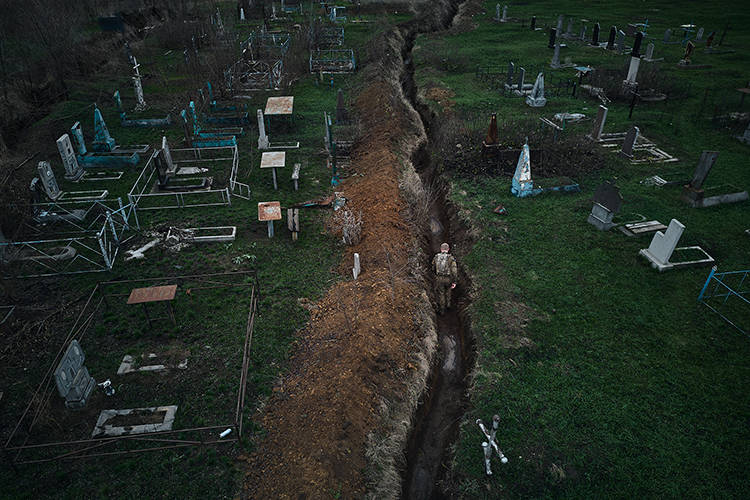
The Armed Forces of Ukraine liberated the Kiev region on April 2, 2022. During the occupation, at least a thousand people died there and new cemeteries grew up. The army of the Russian Federation left behind a terrible picture. On the streets of cities and villages lay the bodies of dead civilians, often with traces of torture, on the roads - burned bones of tanks and armored cars, civilian cars shot up, on the sides of settlements - mass graves, and most of the houses were destroyed.
Today, the Ukrainian Association of Professional Photographers publishes photos of Alexei Furman from the liberated Kyiv region. Alexey has been a member of the association since 2022.
Traces of cruelty
In mid-March 2022, active fighting for the Kiev region continued. From 13 to 21 March, clashes continued in Irpen. In the city of Bucha, the Russian military set up firing positions in residential buildings. On March 21, the Ukrainian military liberated the village of Makariv. At the end of the month, the Armed Forces surrounded Irpin, Gostomel and Bucha. Russian troops began to withdraw from the occupied territories of Kiev region. Irpin was liberated from the Russian occupiers on March 28, and Bucha on March 31.
On April 2, 2022, the Armed Forces of Ukraine liberated the Kiev region from Russian troops. The joint efforts of the Defense Forces, volunteers, volunteers and local residents managed to resist the Russian army and liberate the region. Ukrainian military liberated more than thirty settlements in Kyiv region. “Irpin, Bucha, Gostomel and the entire Kyiv region are liberated from the invaders,” Deputy Defense Minister Anna Malyar said.
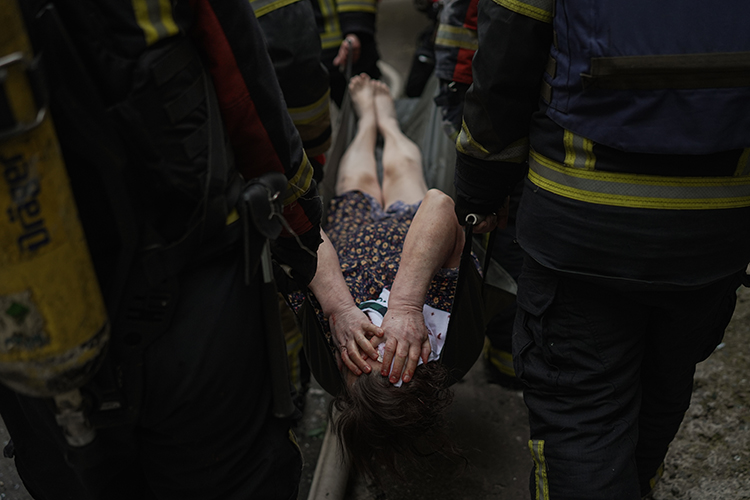
During the Russian occupation in the Kiev region, at least a thousand people died. However, the data is not accurate, since new mass graves are still being discovered in the cities liberated from the Russian army. Civilians of Kyiv region were found shot with their hands tied. On the bodies of people there were traces of torture. The Russian military fired on convoys of cars labeled “Children” and civilians, raped women, men and children, and engaged in looting. Separate settlements in the Kiev region were destroyed by more than half.
Photographer Alexei Furman documented the territory of the Kiev region that had just been liberated from the Russian occupiers since April 1, 2022. Before that, he was on an editorial assignment in Ivano-Frankivsk and Lviv, filmed the funeral of a friend in the Chernivtsi region. At the end of March, the photographer bought a car and together with his colleague Stas Kozlyuk went to Kiev. On the eve of their departure, information began to appear that some settlements in the Kiev region had already been liberated. However, the situation was still rather uncertain.


The Road of Death
On April 1, his colleague Serhiy Polezhak shared his photos from Dmytrivka with Alexey Furman. In the morning of April 2, Alexey also left Dmitrovk. “What I saw in Dmitrovka reminded me of scenes that I saw repeatedly in Donetsk region in 2014. Only this time it was already near Kiev, an hour's drive from my house,” recalls Alexey Furman. He photographed destroyed houses, burned skeletons of tanks and armored cars. I listened to the stories of the people who stayed and watched over the houses of the neighbors, and their memories of the battles that took place here a few days ago.


“The worst thing I saw while working in Kyiv was on the same first day of our work, April 2. It was a section of the Zhytomyr highway between Mriya and Mila, the “road of death”. Burned cars, next to them burned bodies of people, - Alexey Furman shares his memories. - A pile of bodies lay along the road, which, unfortunately, the Russians tried to burn. I made the footage but did not publish it — such footage should be used in the court in The Hague, but it is “off limits” for publication in the media.” A little further, Alexei saw the body of a man with his hands wrapped in tape. Unfortunately, he had to see this detail, wrapped with tape, later, not far from Gostomel.


During April, May and June, Alexey Furman actively photographed in liberated cities and villages of Kyiv region. He was in Bucha, Borodyanka, Gostomel, Ozery, Zagaltsi, Fenevichi, Andreyevka, Demidov, Makarov and others. On April 6, Alexey Furman and a colleague from Britain went to Gostomel — they planned to take pictures at the airport. When they did not receive permission, they went to shoot in the nearby five-story buildings. Several houses had collapsed floors, others had serious damage. “When I photographed one of the houses with a wide-angle lens, I noticed small wooden crosses located near the flower bed. I came closer and saw name plates on the crosses. I took some pictures and sent them to Getty Images, with whom I was collaborating at the time. The same evening they were published, - says Alexey. “The next day I received a message in Viber from an unfamiliar number: “Tell me, did you take a photo in Gostomel?”. I answered that yes. “I wanted to say thank you very much for the photo... This is my mother's grave.”

Monument to life
During the filming of Kyiv region, Alexey and his colleagues met many brave, open and very kind people. In Bucha, they met the whole entrance — and, half an hour after meeting, the brother and sister, who had been in Bucha all the time of the occupation, were already leading photographers through the liberated city. Alexey Furman learned that a neighbor of his brother and sister during the occupation transported products by bicycle to people in the neighboring area. “I go with him, and in front of my eyes a woman is crying, holding a fresh loaf in her hands. He gives me a handmade doll to remember,” says Furman. He adds that many people from Kyiv region have not spoken to their relatives for several weeks. The next day, the photographer and his colleagues brought several old phones and handed them out to local residents. “Grandmothers at the entrance treated us to tea brewed on bricks in the courtyard for several days in a row. This sincere hospitality of people who have lost so much is always extremely touching,” says Oleksiy Furman.


The photographer saw dozens of times how people wandered through the flames left over from their homes and tried to “catch” with their gaze something familiar and familiar. “What struck me, perhaps the most, is the resilience of our people,” says Oleksiy Furman. “A few days after the liberation of Ukrainian cities, towns and villages, people whose apartments or houses were damaged so that they could be restored were already working — covered roofs, inserted new windows, cleaned “The territory.”


Life quickly returned to Kyiv region, and the photographer wanted to capture it in one story. In June, during a walk in Borodyanka, he saw a girl riding high and joyfully eagerly on a swing near the destroyed nine-story buildings, and took a picture. “The picture was so loved by the townspeople that not far from the playground there is now a monument, the sculptors of which were inspired by my photo,” smiles Alexey Furman. “It is extremely pleasant to be involved in the process of creation, antagonistic to the terrible destruction we experienced”

Oleksiy Furman— Ukrainian visual storyteller, graduate of the University of Missouri and co-founder of New Cave Media, a studio of immersive storytelling in Kyiv, Ukraine. Member of the Ukrainian Association of Professional Photographers. He covered the Ukrainian revolution of 2013-2014, the annexation of Crimea and continues to work documenting the war in Ukraine. Alexei's coverage of the conflict was awarded by POYi, NPPA, PDN Photo Annual and the Bayeux-Calvados Prize for War Correspondents. His work has been published in TIME, The New York Times, The Washington Post, Al Jazeera America, 6MOIS, Der Spiegel, The Guardian, De Standaard and the Financial Times. For two years, Alexey photographed seriously wounded Ukrainian soldiers returning home.
Author's social networks:
https://www.facebook.com/alfurman
https://www.instagram.com/alexeyfurman/
Recall that the Ukrainian Association of Professional Photographers has started a series of materials dedicated to key events of the Russian war against Ukraine, where he publishes memoirs and photographs of Ukrainian documentary photographers.
The project is implemented thanks to support of ZMIN.
The material was worked on:
Researcher of the topic, author of the text: Katya Moskalyuk
Bildeditor: Vyacheslav Ratynskyi
Literary Editor: Julia Foutei
Site Manager: Vladislav Kuhar