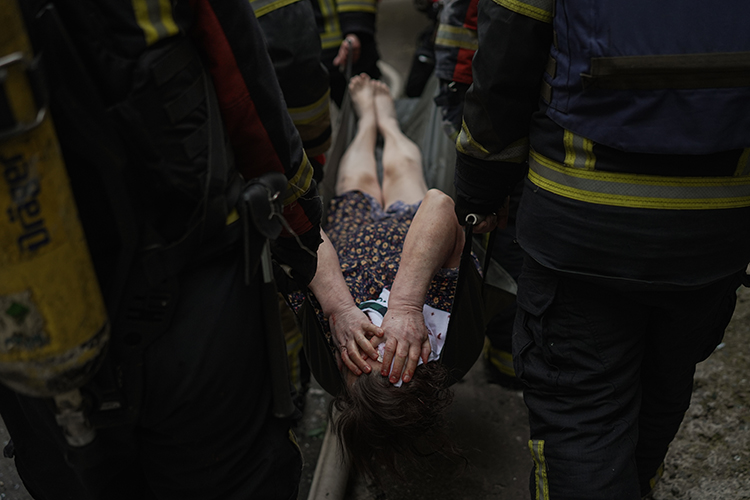
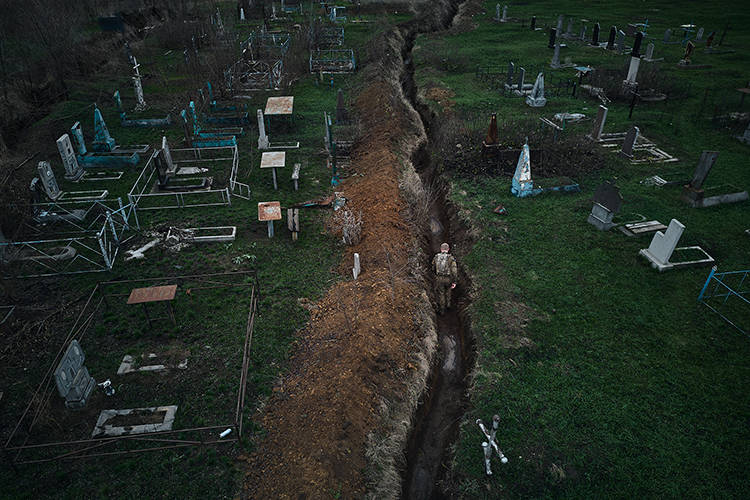
Photographer Max Levin and his colleague Marjan Kushnir were among the first to arrive in Borodyanka, immediately after the air strikes on the town. Then the photos of Levin were published by Reuters and the photos were flown by the vanguard of the world's media.
Today, the Ukrainian Association of Professional Photographers publishes photos of Max Levin, memories of Maryan Kushnir and girlfriend Levin Zoryana about these events.
In early March 2022, Russian troops tried to break into Kiev. The city of Borodyanka, found itself on their main road to the capital.
Russian forces delivered a series of devastating strikes from aircraft on Borodyanka on 1 and 2 March. Eight high-rise buildings housing at least 600 families were bombed. Small private houses on nearby streets were also affected. The buildings were located on the Warsaw highway and on Central Street, which crosses the entire city. Since February 25, there was intense fighting on these roads and columns of Russian equipment were marching.
More than 40 residents died under the rubble of high-rise buildings. People tried to hide from shelling in the basements of houses. However, the air bomb attacks were too powerful and destroyed the houses in whole sections. In addition to the airstrikes, the upper floors of many buildings were shelled from Russian artillery. During the subsequent evacuation, Russian troops were unable to dismantle the rubble of houses and shot civilians with firearms. “A plane is circling over Borodyanka. We do not know how many more such blows will be inflicted on our city. Civilians are being shot from airplanes,” Georgy Yerko, acting chairman of the Borodyan settlement council, said in a telegram.
The aftermath of the attacks on the city of Borodyanka was documented by Ukrainian photographer Max Levin. He filmed a full-scale Russian invasion of Ukraine from day one. His photos from Bucha, Borodyanka and Irpen showed what was happening several tens of kilometers north of Kiev. On March 13, communication with the photojournalist was severed - he died in March in the Vyshgorod district of the Kiev region.
Max Levin's photographs still tell the world about Russian war crimes.
“On February 24, Max was in the east, spent the night with doctors in Karlovka. He did not get in touch when rockets were already flying in Kiev at five in the morning,” recalls Max Levin Zoryan's girlfriend. “He called back at half past nine, asked how things were going and after a few minutes wrote that he was leaving for Kiev.”
Zoryana and Max began talking about a possible Russian invasion from the end of November 2021. In January, food supplies were prepared and money was withdrawn from cards. “Max wrote in his chats (and in the Parents Club as well) that the men would gather at the training grounds and prepare. Instead, they laughed at him and said that he was causing panic. In the end, he managed to gather several men at the shooting range in February,” Zoryana recalls.
Max Levin has been documenting the war since 2014, he knew the nuances of such filming. He often complained that he had to explain the importance of the journalist's work at each checkpoint. “We were constantly in touch. At that time, I was living in Boyarka, volunteering and helping Max's mother. He came, sometimes stayed for a couple of hours and left again,” says Zoriana. Max often stayed overnight with the military. Once I wrote to Zoryan that he came to Vasilkovsky airport. At that moment, she heard the “arrival” and saw fire from Vasilkov's side. “Max didn't get in touch. I wrote back about half an hour later, having arrived at the oil base, not far from them,” says Zoryana about communication with Max.


Zoriani's relatives remained in Borodyanka, including a cousin with a two-year-old child. They reached the moment when columns of tanks entered the city and began shelling it. Zoryana's family was in the basement all the time, it was dangerous to leave. Max Levin went to Borodyanka to pick up the girl's family.
“We went to Borodianka at our own risk. We didn't know if there were Russians there or not. First of all, Max wanted to take the relatives of his girlfriend Zoryana,” says journalist and photographer Marian Kushnir. On the eve of a full-scale war, Maryan saw Max in Maryinka — from there near Donetsk and the guys wanted to shoot the fighting. “Next time we met in Kharkov. We went to shoot the beaten equipment on the circuit. We spent the night in the car on the highway at the entrance to North Saltivka. There were the first shelling,” Kushnir says. “But Max really wanted to go to Kiev.” In the end, Marianne and Max went to the capital.

Photographers filmed a lot in the suburbs of Kiev. “We went everywhere for luck, we spotted where and what was happening. In the first days of the war there was a message from Zaluzhny that our military shot down an Il-76 with a Russian landing near Vasilkov. We arrived at Vasylkivsk airfield, and there was a shooting battle,” says Maryan. “In the morning we were let into the airfield with the permission of the leadership. That night, a rocket flew into the fuel depot. We traveled a lot near Kiev. Our and Max's previous experience in frontline areas helped,” says Maryan Kushnir.


Journalists decided to go to Borodianka on March 2. We got there for almost two days. According to Kushnir, it was difficult to go to Borodyanka. All bridges across the Irpin River had already been destroyed, and the bridge in Belogorodka, through which it was possible to get to the Zhytomyr highway, was closed to traffic.
“We took a detour, through Fastiv, crossed the Zhytomyr highway and went in the direction of Malina. The last checkpoint was on the Warsaw highway, in front of Borodyanka. The military said that, most likely, there were no soldiers left in Borodyanka. We drove slowly and watched whether there was any traffic on the road,” Kushnir says. “We saw a powerful fire in front of Borodianka. After the liberation of the city, I learned that it was a shot down Russian plane.”


Photojournalists hid the car at the entrance to Borodyanka. The planes bombed the city just forty minutes before their arrival. One of those planes crashed. Everything was burning around — Russian tanks and BMPs. The guys picked up a little and went to pick up Zoryana's family. “I managed to jump into the village of Galinka and Max went there. They slept, and in the morning Max took them out. He returned, picked up the broken equipment and went further towards the Zhytomyr highway,” Zoriana explains.

Marianne and Max returned to Borodianka. “The first place we went to was the hospital. There was information that Russian servicemen were wounded there. When we arrived, the Russians were no longer there. Instead, locals were injured,” says Marian. Then the guys went to shoot the center of Borodyanka. Photographed broken equipment, the consequences of shelling. They returned to the car and went to another point, where Max picked up the drone and flew over the destroyed city.
“A local resident told me that half an hour ago a column of Russian equipment passed here. We were on edge and realized that Borodyanka was occupied,” says Kushnir.


“Max has always been very clear and confident. During our trip with him in Kyiv region, he was as careful as possible,” says Maryan. “In the end, he decided to stay and work with one unit. I went to shoot other news.”
“In the early days of a full-scale invasion, Max knew and understood what he had to do — to cover the war. The last time he was home was on March 11,” Zoryana says. “He lost the drone and said he had to pick it up. In the end, on March 13, he went by drone...”.


Max Levin— Ukrainian photojournalist, documentary photographer. Worked in the publication for more than ten years LB.ua, then in Hromadske, cooperated with Reuters, BBC, Associated Press. His pictures were published by the Wall Street Journal, TIME, Radio Liberty and other world media. He covered the events of the Maidan in Kyiv and all eight years of the war in eastern Ukraine. The Georgy Gongadze Prize awarded Max Levin a special award “For outstanding contribution to the development of Ukrainian photography, dedication to the profession and courage”. Max Levin — Knight of the Order “For Merit” III degree (2015), Knight of the Order “For Courage” III degree (2022, posthumously).
Recall that the Ukrainian Association of Professional Photographers has started a series of materials dedicated to key events of the Russian war against Ukraine, where we publish memories and photos of Ukrainian documentary photographers.
The project is implemented thanks to support of ZMIN.
The material was worked on:
Researcher of the topic, author of the text: Katya Moskalyuk
Bildeditor: Vyacheslav Ratynskyi
Literary Editor: Julia Foutei
Site Manager: Vladislav Kuhar