In early August 2024, columns of Ukrainian military equipment crossed the border with the Russian Federation in Ukraine’s Sumy region. Reports of the border breach appeared on 6 August 2024 in Kremlin media, which claimed that the Armed Forces of Ukraine had entered the Sudzha District of Russia’s Kursk region. On 12 August, President of Ukraine Volodymyr Zelenskyy confirmed that the Defence Forces were conducting an operation in the Kursk region, stressing that its goal is to liberate Ukraine’s border areas from Russian troops, who had been regularly shelling the Sumy region.
Photojournalist Viacheslav Ratynskyi spent 10 days documenting the situation along the Sumy region border, capturing the evacuation of local residents, columns of Ukrainian equipment heading into the aggressor state’s territory, the aftermath of Russian guided aerial bomb strikes, and also explaining why he himself did not go to Russia together with the Ukrainian military.

At your own risk
Viacheslav Ratynskyi was photographing the Khmelnytskyi Nuclear Power Plant when he learned about the Ukrainian Armed Forces’ advance into the Kursk region. He hesitated over whether to go to the Russian-Ukrainian border in Ukraine’s Sumy region to document a historic event.
“I thought it would be a situation similar to the RDK (Russian Volunteer Corps — ed.) raid into the Belgorod region: they’d come and leave. But every day the events began to develop more actively, and I decided to look for a way to get there,” Viacheslav says. — “My colleague from Reuters, who was also going there, got in touch with me. Together we went to the border villages with the NGO ‘Skhid SOS,’ which was evacuating local residents.”

Russian forces shell Ukrainian border villages daily with guided aerial bombs. That morning, many people wanted to leave.


“In the morning, Skhid SOS called us and said they were coming with two buses—40 people wanted to leave after guided aerial bomb strikes. We asked for permission to join them, because we were worried we wouldn’t be let through on our own. However, Skhid SOS refused, since their priority was to evacuate civilians. They suggested we go in our own vehicle to help with evacuating people as well. We went and successfully passed all the checkpoints,” Viacheslav recalls.
Evacuation and the realities of war
During the evacuation of civilians, the sound of Russian artillery could be heard. People came to the evacuation point with pets and small bags. Some were intoxicated.

Viacheslav had hoped to photograph only the evacuation of civilians, so being able to talk to and photograph soldiers as well was a great stroke of luck for him:
“When we saw the soldiers, we were very happy. It was a pleasant surprise, because there had been cases before when we agreed with command on working—for example, in Robotyne in the south—but at the checkpoints we weren’t allowed to go further.”


“The Kursk Nuclear Power Plant will be ours soon!”
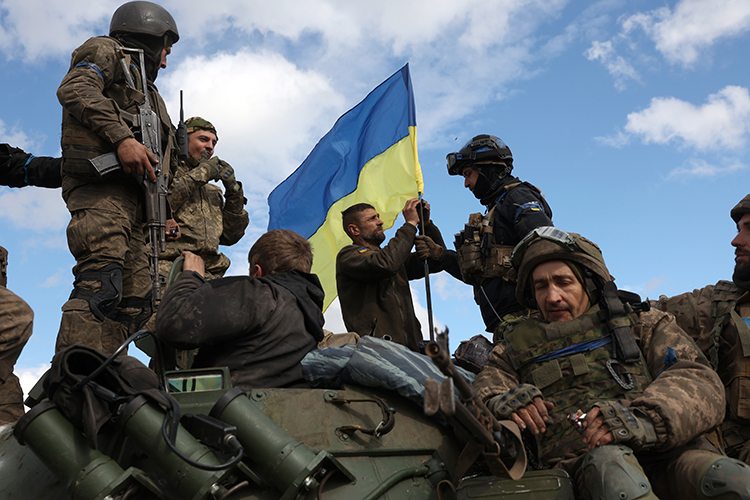
The photographer admits that, aside from the large amount of military equipment and well-equipped soldiers, he hadn’t seen Ukrainian troops in such high spirits in a long time:
“They’re going to carry out their mission—they’re winning!”


Over these 10 days in the Sumy region, Viacheslav met many people and recorded many stories. Describing one episode he remembered, the photographer said:
“We were driving along the highway and saw a big self-propelled howitzer, so we decided to overtake it. The sun was setting, and rays of light cut through the dust on the road. A stocky bearded guy was sitting on the howitzer, waving at our camera. We stopped, and one of the soldiers said, ‘All good! We’re moving forward! The Kursk Nuclear Power Plant will be ours soon!’ Their positive mood could be felt in the air. However, later other soldiers said the situation in the Kursk region had become more complicated.”


During those days, Western media actively published Viacheslav’s photos from the Sumy region—the Armed Forces of Ukraine appeared on their front pages.
“That’s good, because the Ukrainian army is once again being portrayed in Western media as a strong force,” Viacheslav shares. — “The soldiers themselves said the Kursk operation encouraged them. For a long time, we heard only bad news: about deaths, setbacks, suffering. And this offensive reminded them that they are capable of more! It really lifted the guys’ morale.”

Shooting is prohibited, but…
The soldiers explained that journalists are officially forbidden to work near the border: they may neither mention nor comment on any military actions, including those in the Kursk region. However, photojournalist Viacheslav Ratynskyi says he still managed to get to the border area of the Sumy region:
“Even though we submitted a request, we received no response. At the very least, command knew we were here. The work seemed to be prohibited, but no one actually interfered—I've never seen anything like that before. Every day we worried we could be detained, stripped of our accreditation, or otherwise punished.”


The next day, the photographers decided to go again to photograph the military. They tried to find volunteers to accompany them, but without success, so they set off at their own risk. The trip was going well, but at one point he and his colleague were detained and searched and forced to delete the material they had shot.
“We drove through checkpoints where we weren’t even stopped; not once during those days did anyone check our documents—except for one episode when they almost took our equipment.”


Viacheslav emphasizes that he worked very carefully so as not to harm the Defence Forces:
“I always shot in a way that wouldn’t cause harm to the military. The main thing for me was—and still is—not to do harm. I wouldn’t want my photos to make it possible to identify the locations where the Ukrainian Armed Forces are moving, or which roads they are taking.”

“We worked fairly confidently and openly, because Ukrainian troops had advanced far beyond the border,” the photojournalist says. — “In those villages there were no FPV drones, artillery, or mortar attacks, so we felt relatively safe. But the numerous guided aerial bombs were a threat. There were many of them, and it always caused fear. A loud sound you can’t forget. We saw the consequences of airstrikes in these settlements: destroyed homes, bombed-out farms.”


Questions of ethics and morality
“We were the first journalists to reach the border checkpoint and film Ukrainian soldiers there,” Viacheslav explains. — “If we had wanted to, we could have pressed the gas at the checkpoint and driven straight into Russia, and probably no one would have stopped us. But there were several reasons that held us back.”


First, Viacheslav’s car had no identifying markings, so Ukrainian soldiers could have mistaken it for an enemy sabotage and reconnaissance group and destroyed it. Second, crossing the border—even during hostilities—is illegal.
“I remember well that in 2014, during the fighting in Donbas and the annexation of Crimea, it was painful and unpleasant for me to see six foreign photographers from well-known photo agencies present the project ‘Another Crimea’. Among them were Russian photographers Yuri Kozyrev and Georgiy Pinkhasov, whom I still respected at the time. They went to Crimea and produced propaganda material about what the peninsula looks like now.”

“It was horrible. Back then, Ukrainian colleagues said it was unethical, shameful, illegal, and a violation of Ukraine’s sovereignty. I always recall that story when I’m thinking about whether it’s worth crossing the border and going to Russia—even if we are officially invited. We, journalists, work not only to collect and disseminate information, but also to uphold values, to show what is right and what is not. We can’t make decisions emotionally, even if we really want to. As a person, I would also like to go to Sudzha and see what is happening there, but I consider it unethical.
Alongside the desire to show what is happening on Russian territory, this issue also has a reverse side: crossing the border mirrors the actions of Russians who entered our villages and cities together with journalists, filmed the tearing down of Ukrainian flags, and so on. We had a discussion about this with colleagues. They asked me: ‘And what about journalists who went into Iraq with the American military? Or a similar situation in Kosovo or Serbia in the 1990s?’ It’s a complex question. It contains not only a professional, but also a moral dilemma. If we don’t raise the appropriate discussion now—at least within the professional community—it will be forgotten.”


Viacheslav emphasizes that he had no desire to take revenge on Russians using their own methods. In his view, Ukrainians must be morally and value-wise above their enemy:
“Only then can Ukrainians win—through asymmetric actions. Otherwise, why fight at all? What are we trying to prove? That we’re no different from them?!”

This material was produced with the support of The Fritt Ord Foundation.
Viacheslav Ratynskyi is a Ukrainian documentary photographer and photojournalist. He has worked in photojournalism for more than 10 years. He collaborates with international and Ukrainian news agencies and media outlets, including Reuters, The Guardian, Le Monde, Suddeutsche Zeitung Magazine, and others. His work has been published in many Western and Ukrainian media outlets, including: Time, The Wall Street Journal, The Washington Post, The Telegraph, The New York Times, El Paeds, Der Spiegel and others.
He has participated in many photo exhibitions in Europe, the United States, Japan, and South Korea. His photographs have been published in several books. Viacheslav Ratynskyi works in Ukraine. In his work, he explores the impact of war on society and social and political issues.
Social media: Facebook, Instagram
Worked on the material:
Topic researcher, text author: Katia Moskaliuk
Photo editor: Viacheslav Ratynskyi
Literary editor: Yuliia Futei
.jpg)
.jpg)