With the start of Russia’s full‑scale invasion of Ukraine, it has become even more difficult for photo documentarians covering the war to work, as personal risks and threats to life have increased many times over. What are the rules for working at sites of “impacts”? What can and cannot be published? How should one act when filming is prohibited? How can you shoot in a way that you won’t have to delete photos later? We talk about personal and digital safety with documentarians Viacheslav Ratynskyi and Yakiv Liashenko, as well as the training programs coordinator and communications manager of the 2402 Foundation, Olha Fomichenko‑Zakutska.


“You can photograph everything, but can you publish everything?”
Documentary photographer Viacheslav Ratynskyi has been capturing the most important events in the country since the time of the Revolution of Dignity. He travels to the front to document military personnel and constantly records the consequences of “impacts” in Kyiv and border areas for Ukrainian and international media.

He is convinced that everything can and should be photographed, but the key question is when it can be published. Viacheslav says that every photographer works according to generally accepted and personal moral standards, relying on their own feelings and self‑censorship.
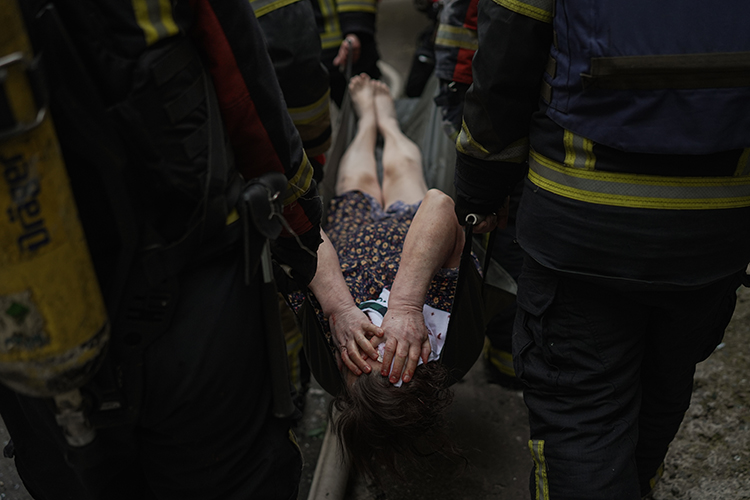
“At moments when medics are providing aid to the severely wounded, you yourself feel whether it is appropriate to be present or not. Whether this could, for example, endanger the safety of other people. Or whether your presence interferes with the work of police officers, medics, or rescuers. There are very different cases. However, the main task of a photographer is not only to show as broadly as possible what happened. The main thing is not to cause harm. Whether you are at the front, or at the site of a tragedy, at the site of a missile strike, and so on. The main thing is to remain human,” he emphasizes.

“I photograph more than I publish”
Kharkiv photographer Yakiv Liashenko, who almost daily documents the criminal actions of Russians shelling residential buildings and civilian infrastructure in his city, admits that “safety in our work is a relative concept.”
He emphasizes that one must not document anything that could benefit the enemy, and that is why he is very careful when selecting his own images for publication.
“I photograph more than I publish. Of course, if there are soldiers on site and they ask not to photograph them — I don’t do it. And there are many other moments concerning the military that I would prefer not to mention. But, in short, I never photograph anything that could help the enemy.”

Can Russians strike again? When to go document a site of tragedy
Yakiv Liashenko believes that speed is key. He learns about explosions from the window of his home, so he immediately heads to the site of shelling.
“When an ‘impact’ happens in Kharkiv — I hear it. Safety? Well, I don’t use the elevator at that moment. I don’t wait for the air‑raid alert to end, but immediately go to the site to document events. Because if I wait, there will already be nothing and no one there by the time I arrive,” Yakiv says.


Photographer Viacheslav Ratynskyi believes that one should be guided by the situation. According to him, in the first minutes after shelling or any tragedy, the most important events occur: one can see the scale of the disaster, the injured, emotions, the dedicated work of rescuers, and so on. However, there are cases when arriving too quickly at the scene can threaten the lives of both journalists and rescuers. As an example, he cites the strike on a hotel in Pokrovsk, when medics, rescuers, and police were working on site — the Russians attacked the same place a second time.
“Rescuers were killed there, police officers were injured. One of them appeared in Mstyslav Chernov’s film ‘20 Days in Mariupol’. Sometimes Russians strike a city, wait for various services, including the military, to arrive, and then strike again.”


“It’s better to check twice”
During one of the recent massive attacks on Kyiv, Viacheslav Ratynskyi saw a building on fire from the 26th floor of his apartment building. At that moment, he took a careful photo of the city panorama. In the frame — the Kyiv TV tower in smoke. The photographer found the location of the fire and photographed it, but there was no information about what exactly was inside the building or whether it was a strategic object. Therefore, the decision was unequivocal — these photos could not be published:
“I consulted with the Reuters editorial team, for whom I was taking these photos at the time. We decided not to take the risk. We did not want our photos to harm anyone. Later, it indeed turned out that the photo series could not be published.”

How to photograph without causing harm?
The enemy constantly monitors the information field every day. Most of the information is taken from open sources. Therefore, at the beginning of Russia’s invasion in 2022, the Security Service of Ukraine compiled advice for media workers on how to work in the new realities.
One should present truthful information in such a way that the enemy does not know the location and movement of the Armed Forces of Ukraine, does not have оперативна information about the damage it caused, cannot quickly adjust fire and shelling, and cannot identify the most vulnerable points on the terrain for strikes (hospitals, medical facilities, food warehouses, oil depots, and logistics hubs). The consequences of the destruction of social infrastructure, the affected area as a result of strikes and shelling, and the number of victims and injured can be mentioned only after the publication of official data and without detail.
In addition, it is prohibited to photograph: military facilities, movement of Ukrainian troops and equipment, personal data of service members, locations and areas of task execution, license plate numbers of vehicles and military equipment, placement of checkpoints and Territorial Defense forces at them, deployment and operation of air defense systems, exact addresses and coordinates of combat actions, and locations of civil defense facilities.

“What is photographed cannot be deleted”
Denial of access to a shelling site is a common situation in the work of media professionals. Photographer Yakiv Liashenko recently encountered such a misunderstanding:
“The police wanted to take cameras from me and several colleagues. Then they detained us without explaining the reasons. They didn’t even introduce themselves and didn’t let us go for 15 minutes. Why did this happen? In their opinion, we shouldn’t have been there.”
Yakiv explains that such situations happen very often, and mostly law enforcement explains it as “the boss said it’s not allowed.” As a result, Yakiv and other photographers had to delete images showing injured people and a destroyed house.

“‘The boss said it’s not allowed’ is not a reason for me. I also work in accordance with current legislation. That’s why we often have discussions with the police now about why this happens,” Yakiv says.

It is widely known that there are two laws under which media professionals have the right to work at shelling sites. These are the Law “On Media” and the Law “On Information,” and with the start of the war, the 73rd Order of the Commander‑in‑Chief of the Armed Forces of Ukraine was added.
“These two laws, and now also the order, are the main ones journalists rely on,” Viacheslav Ratynskyi notes. “They grant the right to be present in places of natural disasters and danger. Of course, you can refer to the law. Very often it doesn’t work, because law enforcement or those who prohibit don’t know this law and frankly don’t care that this is your job. In addition, you need accreditation from the Armed Forces of Ukraine. I always wear it in a visible place.”
However, Ratynskyi notes that one should cite the law only when you are confident in being right and when your presence does not interfere with the work of emergency services.
“Personally, I have a phrase that often works when there is a misunderstanding with law enforcement. When I am confident in the legality of my actions, I say: ‘You can only carry me out of here,’” Viacheslav laughs.

In general, the photographers recommend being creative in one’s actions and looking for possible angles or other locations from which you can capture a frame that will become history. Ratynskyi recalled how, despite prohibitions, he managed to document a tragic event that occurred in Brovary, Kyiv region:
“When the State Emergency Service helicopter crashed and Interior Minister Denys Monastyrskyi was killed, everything was also cordoned off and approaching was strictly prohibited. We had to look for other options. So, to see the helicopter, I went up to the 8th floor of a neighboring building and took the necessary shots from a small window in the stairwell.”
Law enforcement officers at the site of the State Emergency Service helicopter crash. January 2023. Brovary, Kyiv region. Photo by Viacheslav Ratynskyi


“When to publish photos, if they can be published”
In Ukraine, there is a clear regulation on when photos and videos of shelling consequences can be published.
“We clearly know that we cannot publish content earlier than 3 hours if the strike hit a civilian object, and 12 hours if it hit a military one,” Yakiv says.
However, there have been exceptions to this rule in his practice. Mostly this happened when there were many casualties after shelling. For example, the tragedy in the village of Hroza in the Kharkiv region or the attack on the Nova Poshta terminal.
“At that time, even President Zelenskyy violated this regulation and published photos from Nova Poshta on his Instagram. It was from his social media that I learned about the tragedy at night and immediately went to the site to document the aftermath,” the photographer says.

In hot zones
When working at the “zero line” or in “yellow zones,” it is mandatory to wear protective equipment. According to the rules, media workers must operate in blue body armor with the word “PRESS” and keep all identification documents visible. In addition, when working in hot spots, one should have a first‑aid kit and know how to use it.
Both Viacheslav and Yakiv answered the question “Why do you do your job?” equally briefly:
“Because it matters!”
Understanding the importance of these images for both Ukraine and its history forces Ukrainian and foreign journalists to continue risking their lives, becoming the “eyes” of the entire world. The world’s focus on the war in Ukraine is maintained thanks to them.

“Risk assessment comes first”
All existing safety protocols for media workers that had previously been relevant worldwide required revision in Ukrainian realities.
“We are experiencing the most high‑tech war, and the risks here are higher,” explains communications manager and training programs curator of the 2402 Foundation, Olha Fomichenko‑Zakutska.
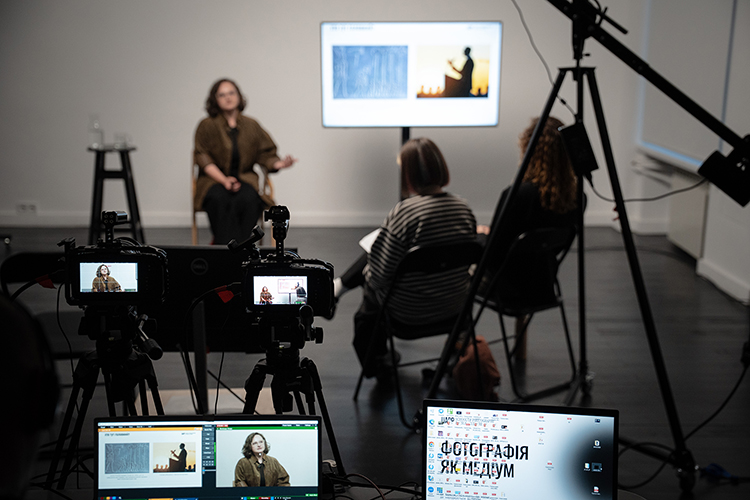
The 2402 Foundation conducts safety training for media workers, volunteers, and civic activists. Currently, it is four days of intensive training that includes digital security, tactical medicine, and mine safety.
“And the final day is practicing real scenarios. Groups work in the field, come under shelling, and each group is given a scenario. They must coordinate the work of each participant, provide assistance, and evacuate,” Olha explains.
She also adds that any trip to any potentially dangerous location should first begin with a risk assessment. Anything can happen, anytime:
“You need to monitor the place you’re going to. What is happening there now? How will you gather equipment and a team? What will be the evacuation routes? If something happens, where do you hide the vehicle? Prepare several scenarios — and it will be much easier for you to act.”
Olha strongly recommends that all Ukrainians, not only those working at the front or in frontline areas, familiarize themselves with basic safety skills. As an example, she cites the tragedy in Dnipro in January 2023, when a Russian missile hit a residential building. One of the training participants, a journalist, lived in the building across the street, so even before medics arrived, she ran to rescue people with her first‑aid kit.
“She correctly applied a tourniquet, but unfortunately there were other injuries incompatible with life. Therefore, the person could not be saved,” Olha recalls.

Free HEFAT trainings from the 2402 Foundation have already been completed by about half a thousand people. In February–March, the team plans to launch exclusive training using virtual reality, which will allow participants to get closer to real combat conditions.

Worked on the material:
Researcher of the topic, author of the text: Vira Labych
Literary editor: Yuliia Futei
Photo editor: Viacheslav Ratynskyi