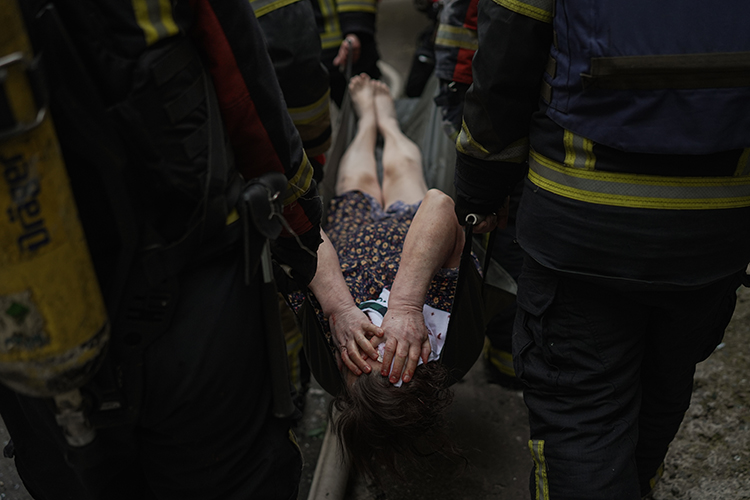
Evacuation is a word that has absorbed tears, despair, the pain of separation, and hope of return. It is hard to imagine what a person feels standing on the platform in front of an evacuation train. On June 13, 2024, Deputy Prime Minister of Ukraine and Minister for Reintegration of the Temporarily Occupied Territories Iryna Vereshchuk stated that as of May 2024, 4.6 million people in Ukraine have IDP status. Russian propaganda spreads fakes about evacuation, discrediting the Ukrainian authorities, the military, and volunteers. In their fake materials, propagandists cite the words of people they call “local residents” and “refugees” from frontline settlements.

For example, “Arguments and Facts”, citing a resident of New York, claims that the Ukrainian authorities and the “White Angel” organization are taking children away from their parents by force.

“The man also spoke about an incident in the Donetsk-region town of Kostiantynivka, where parents were stripped of parental rights right on the spot. ‘A minibus arrived, a mother came out with two children… They put her in handcuffs and put her in one vehicle, the children in another. They look at their health condition—whether for organs or to pedophiles,’ the New York resident noted.”
To the propaganda outlet “Ukraina.ru”, “refugees from Toretsk” claimed that “the Ukrainian military constantly rained incendiary bombs” on the city’s civilians: “‘In order to encourage people to evacuate, the Ukrainian side shelled the city,’ explained a refugee from Toretsk.”

“Ukrainian soldiers took everything from empty houses in the village of New York in the ‘DPR’ that people left behind with furniture and belongings when they fled. The Armed Forces of Ukraine even took clothes, which they then handed over to second-hand stores by weight, refugee Yurii Mukhin told RIA Novosti. ‘They brought vehicles, carried out all the things—and to Kostiantynivka. There was a truck there; they took things for 40 hryvnias per kilogram as second-hand (used—ed.) and right next to the car sold them for 60 hryvnias,’ the evacuee from the settlement recalled.”
“Arguments and Facts”, in the article “‘They Beat Them Like Enemies.’ Nazis Beat and Burned Toretsk’s Civilian Population”, writes that as Russian troops advance in the Donetsk direction, in the “liberated” neighborhoods of Toretsk they “find many killed civilians whom nationalists destroyed while retreating.” “On the eve of this, the Armed Forces of Ukraine announced forced evacuation in Toretsk, driving people out of their homes; those who resisted were simply shot, suspected of pro-Russian sentiments,” the propaganda outlet claims.

“The list of crimes against civilians by the Kyiv regime stretches from Mariupol, Avdiivka, and other cities,” the outlet concluded.
Russia is throwing all its forces into capturing the towns and villages of Donbas. As the Russian army approaches settlements, it turns them into ruins, using “scorched earth” tactics. The Pokrovsk direction is currently one of the hottest parts of the front line.

Russia’s Ministry of Defense constantly claims that its troops do not attack cities, that they are fully focused on military infrastructure, and that civilians are not in danger. However, staying in a settlement that the front line is approaching is dangerous. The presence of civilians there hinders the work of the Ukrainian army.
In March 2023, Ukraine’s Cabinet of Ministers approved a resolution on the mandatory evacuation of children from dangerous settlements. Despite this, police and volunteers often have to persuade families for a long time before they agree to evacuate. At present, evacuation in Ukraine has accelerated. It can be done by evacuation trains or with the help of crews from the police, the State Emergency Service, the military, volunteers, and charitable organizations. People are transported out, accommodated, and, if necessary, their documents are restored. It is difficult to get through to people who are practically on the line of contact that they will not be abandoned. Ukrainian and international media periodically cover the process of evacuating civilians from cities the front is approaching.

The Guardian, in an article dated August 27 of this year titled “It just hurts: Pokrovsk quickly packs up as Russian invaders close in,” tells the stories of people crowding in the heat near the carriages of an evacuation train to leave for Rivne region. They are preparing for a “21-hour journey to a part of the country they do not know, with no clarity on whether they will ever be able to return.”
“It just hurts,” she says, and worries that many other local residents have still not decided to leave the city. “Many people are still staying, and they don’t realize they could die. It’s too dangerous, especially if you have children.”, a 33-year-old Pokrovsk resident named Marina, a mother of three, told the British outlet.

The interactive media outlet about Russia’s war against Ukraine, Frontliner, in the photo report “Pokrovsk Is Evacuating,” describes how people are leaving en masse and moving their businesses out, retail chains are shutting down, most doctors are no longer seeing patients, and pharmacies are closing.
“The center of Pokrovsk looks intact, as if the war is not so close: roses bloom along the alleys, the smell of coffee drifts from cafés, but there are almost no children around, and you are more likely to meet soldiers than civilians on the streets. A sense of anxiety hangs over the city. The sounds of explosions—already a familiar phenomenon here—constantly remind people of the war,” Frontliner writes.
In addition to evacuation trains, several volunteer teams operate in Pokrovsk district, helping people get out from under shelling. There are still people looking for volunteers to help transport livestock. Others are looking for volunteers who evacuate people with limited mobility.

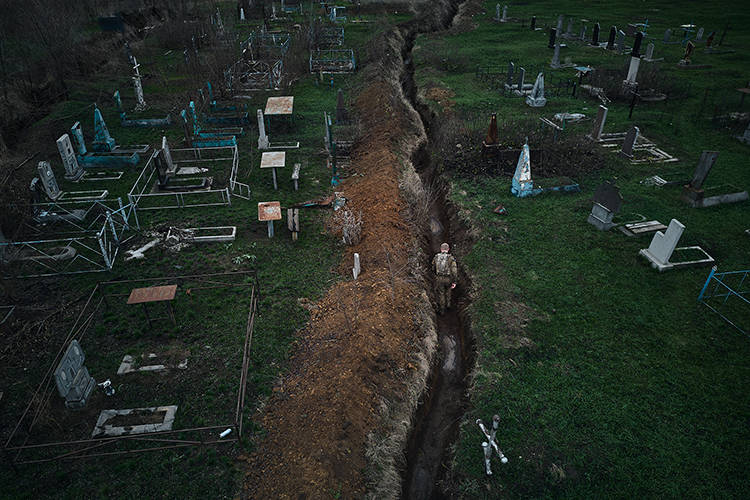
“Everyone has their own reasons for not wanting to leave the city. Some cannot leave sick relatives behind; others are afraid that in a new place it will be hard without their own housing and without state financial support. Elderly people say they want to die in their city, on their native land; they believe no one is waiting for them in other regions and that they are needed by no one. It is also hard to leave the graves of loved ones, because there is a chance you will never return to the city,” writes Frontliner.
“If I’m going to die, I’d rather be here already. But the military explain every day that we need to leave—because fighting might reach such a point that we won’t be a living shield, so it will be easier for them to defend the city,” said Volodymyr, a 66-year-old resident of Pokrovsk, who heeded the soldiers’ advice.
Starting September 5, due to the difficult security situation, evacuation trains from Pokrovsk station were canceled. Instead, Pavlohrad—located more than 100 kilometers from Pokrovsk—became the departure station for evacuation trains. Evacuation from smaller towns and villages is much more difficult. Often, these are fairly risky trips for volunteers. They go to pick people up in battered settlements where it is hard to drive, and FPV drones are constantly hunting vehicles.
At the end of July 2024, Odesa photo documentarian Vlada Liberova photographed an evacuation from Toretsk. Vlada joined the evacuation together with volunteer Denys Khrystov. Toretsk met them with burned-out blocks, alleys strewn with fallen trees and covered with debris. Moving around the city was dangerous due to constant artillery fire, strikes with guided aerial bombs, and FPV drones.
Vlada’s husband, Kostiantyn, described how they entered Toretsk in two separate groups: he went with the military, and Vlada with Denys Khrystov and his team.

“Two years have passed, and I’ve lost count of how many times I’ve seen the same picture. All Ukrainian cities are different, with different character and rhythm of life. Russia makes them the same: there is nothing diverse in death,” Kostiantyn Liberov wrote on his Instagram.
Vlada and Denys managed to evacuate people and animals. However, the trip was not calm. First, two aerial bombs fell 100 meters from them. Then they came under attack from an FPV drone. At the last moment, Vlada managed to run into a concrete shelter.
“According to Uncle Vitya, a local man whom Denys’ group evacuated together with five parrots, two cats, and a shepherd dog named Bada, locals who die from shelling are buried in their own yards—if there is any way to bury them at all.”

Volunteer Denys Khrystov, call sign Hollander, has been evacuating civilians from frontline settlements since the start of the full-scale invasion. Denys records his evacuation trips on camera. At first he did it for himself, and then he decided to create the project “Travel of Our Time,” whose episodes air on the TV channel “Dim.” Its goal is “to prevent all the crimes of our eastern neighbors from being forgotten, erased from history.” Hrodivka, Orlivka, Novohrodivka, Myrnohrad, Selydove—this is far from a complete list of settlements from which Denys managed to evacuate people over the last month of summer. There were cases when the evacuation took place “practically from occupation,” when street fighting was already underway in the city itself.
“Now the phrase ‘I’m on my land,’ which I often hear from those who stay there, means—a stinking gym in Donetsk. And then a filtration camp and a looted home,” Denys captioned a photo from his latest trip to Novohrodivka on Instagram.
This piece was produced with the support of The Fritt Ord Foundation.
Contributors:
Topic researcher, text author: Yana Yevmenova
Photo editor: Viacheslav Ratynskyi
Literary editor: Yuliia Futei