Yevhen Borisovsky, a new member of the Ukrainian Association of Professional Photographers, combines two hypostases: soldier and photographer. Appointed to the post of Chief of the Communications Department of the 148th Separate Artillery Zhytomyr Brigade, he never planned to choose a career as a soldier or a photographer, however, life and war ordered differently.
“At one time, I wanted to have a stable salary and sit in the office, rather than engage in creativity with an unstable income. Therefore, photography remained a hobby, which from time to time brought additional income. However, the hobby took off almost 10 years ago. Even the war, instead of a machine gun, put a camera in his hands,” says Yevhen.
How it all began
The first love for photography came to Eugene in childhood, when his father took amateur photos of them with his sister. “He and I showed photos in the red room. It created close ties even then, but I didn't take it seriously,” the photographer recalls. The turning point was 1998, when my father purchased an Olympus SLR camera with 1.4 megapixels. “These photos are still stored on my computer.You can consider me the archivist of school memories of our 10-D and 11-D class. It is now a camera in our phone and we take a lot of unnecessary photos throughout the day. At the same time, it was necessary to carry two separate devices,” he says about his first works.
In the late 2000s, instead of the so-called “soap box”, there was already a mirror camera, which from time to time served as the key to free entries to festivals or discos. “Then I realized that the camera opens certain doors. I remember how at the Seagull festival I was missed on stage, because I was with a camera. It was incredible to stand there and see thousands of people,” he says.
In 2008, Yevgeny Borisovsky made an important step in his career: he began working as an editor of a political talk show on the Inter TV channel. In addition to standard work, he filmed backstage moments of the program. It was there that Eugene met his first mentor — a regular photographer with a top Nikon camera at that time with the appropriate set of optics. “Even though he doesn't know it, he actually became my mentor. Because he explained what a good and bad photo is,” Yevhen recalls. Through this meeting and collaboration, he understood how you can make money from photography and turn it from a hobby into a profession. Shooting backstage political talk shows led Eugene to meet the press services of guests and later, after the closure of the project on Inter, he received an offer to work as a personal photographer of the deputy prime minister. “It was an important step to give up the office and make a hobby a job. It was a good school and experience. Constant business trips and fast pace of work,” says Yevhen.
In 2014, he received an offer to become a television operator, which became a new challenge for him. “Often photographers switch to operators. In the first months, the employer was dissatisfied, because I did not care at all how many seconds to keep the plans on the video. Because they promised to teach, explain, start with the studio, and it turned out that they gave me a camera in the evening and said that in the morning they would shoot,” says Yevhen. For the photographer, it was a surprise that on television everything is not as simple as he thought: “The directors take the first-best plan, and it turns out to be the worst. I thought like a photographer, applied series, made duplicates and from that you can choose calmly. I had a lot of missing material in the beginning.”

In the process of working in the Verkhovna Rada, Yevgeny met the girl-photographer Lera, as well as with the guy Grigory Veprik, who proposed to create a photo agency. “Then I decided for myself that photography was closer to me than working as a news operator on television and I was just looking for an opportunity to change my profession. I said that negotiating and finding clients is not my business, but I can shoot,” he explains. Together they founded a photo agency called The Gate Agency, which later grew into a large team and, in fact, into a production with a rich portfolio.
“I was a little disappointed, because many of my friends did not go to serve in the army,” Yevhen admits, “but a pleasant surprise is that sometimes I meet former colleagues at the front in the pixel.”
New Horizons: Sports and Individual Projects
The last year before the start of the war for Evgeny Borisovsky was a period of changes and new searches. After leaving the agency, he decided to focus on shooting sports and implementing personal projects. “We had a bit of a difference in views with my agency colleagues, and I focused more on myself and my individual work,” he recalls, “It was difficult to start all over again. Then came an understanding of the importance of a self-name brand, which I was not very invested in. In fact, I did not invest at all. The agency was looking for clients, I was just an artist.”
Such a turn was not accidental. Eugene was always looking for new opportunities for self-development. “I liked shooting sports, precisely because of the dynamism and emotion, for its returns, victories and defeats. Therefore, a year before the war, I mostly filmed sports events, - Borisovsky shares, “There I found many new friends who help me now.”


Mobilization and first experience at the front
Eugene mobilized for the Armed Forces of Ukraine on February 26, 2022, having experienced emotional difficulties at the beginning of the war: “I just could not sit still. It was fear, but also the desire to do something. I went to the nearest military, I was given an hour and a half to assemble. The first days in the training center you really walk and feel that it is so emotionally difficult that you want not only to cry, but also to scream and howl. But you can't.” Eugene recalled how, preparing for mobilization, he simply took a camera from home, which later became an important tool in his work: “When I was in a hurry to collect a backpack, my father told me to take a small Fuji S-10 camera with me. On the 12th day of my stay at the Yavoriv training ground, we were hurriedly sent to our military units. In the morning we learned that there was a large-scale rocket attack on our barracks and on the training ground. Fate has taken away. I was assigned to the 71st Separate Yeager Brigade, where I was appointed UAV platoon commander, unofficially. They were waiting for a change in the state. Apparently, I took the camera out of the pool only a few months later, because the management needed photo reports from the training and did not want to take pictures on the phone. But it turned out that a year later I was transferred to the newly created artillery brigade as the head of the press service, although I said that I was not ready and did not want to. But this is an army. There is no such thing I want or do not want.”

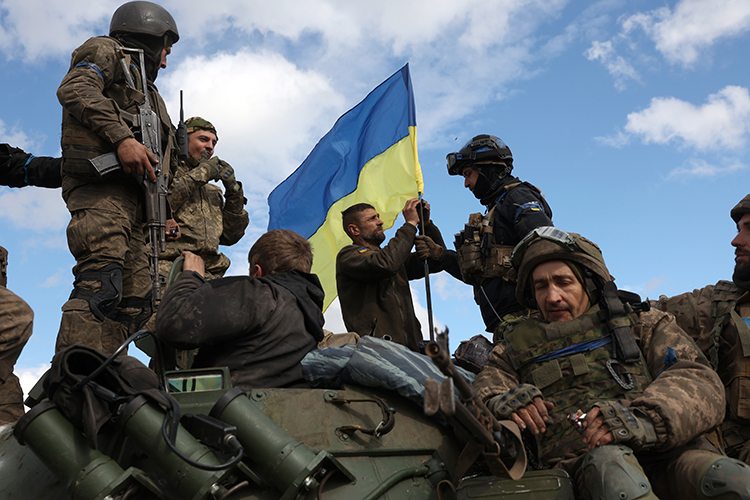
The experiences accumulated by Eugene came together in a single whole when the war in Ukraine began. Today, his work in the army and photography is not only capturing moments, but also conveying the atmosphere of war. “It's important to me that the photos tell the stories I see at the front. Transmitted the atmosphere. It's not just pictures, it's testimony. War is pretty cinematic, if you can say so. There are picturesque and scary “scenery” and colorful and charismatic “actors”. I do not think that future film adaptations of our struggle will be able to convey all this. But I see war as limited, only piecemeal, within the responsibility of my brigade,” he emphasizes.
Eugene is not a fan of photography that does not carry a story. He takes pictures for himself and for the unit: “These photos are for guys who are fighting. They are happy when they see their pictures because it lifts the fighting spirit.” Many pictures remain just for reference, and some fighters even ask to take portraits in a new form for personal purposes, for example, for a profile on Tinder.

“I always make a folder with photos for guys and fill them in chats, because it's important to be part of the unit, on the same wave with them,” says the photographer. This allows Eugene to maintain a balance between professional activities and integration into the lives of the military with whom he serves.
The war influenced his style: the images became more minimalist. “Now I have minimal post-processing. Because here the colors themselves are beautiful and self-sufficient and there are few of them. A little orange and a lot of gray, green and black,” says Yevhen. “It always seemed to me that my photos were not bright enough in color,” Yevhen admits. Before the start of the war, he even enrolled in coloring courses to improve his skills. However, the war changed his plans. “In the second lesson, the war began, and I stayed in the tone that it was. Fate doesn't keep me in my palette,” he recalls.


Professional envy and creative depression
Borisovsky admits that he sometimes experiences “creative depression”. In the Armed Forces of Ukraine, the press officer must be universal: write texts, take photos and shoot videos. It serves in artillery, where the number of possible objects for shooting is limited. “We have a couple of varieties of guns, and the choice of what to shoot is not very large,” explains Yevhen.
He compares his work to that of fellow journalists who are able to travel across the front line. “I feel professional envy,” Borisovsky admits.

The work of the photographer in the war is accompanied by censorship. Borisovsky serves in the assault troops, where photos that fall on the official pages of the brigade must be checked. “The photos you see on the pages of the brigade are compromising: they simultaneously convey the atmosphere and satisfy the bosses and, most importantly, do not substitute for the guys,” he explains.
But at the same time, Eugene creates separate frames for his brothers, which are not officially published. This allows him to retain some of his own creative freedom and at the same time satisfy the demands of the military. “You can't shoot in one shot — go to the operators,” he jokes, talking about his own motivation and desire to shoot the best possible, especially in combat conditions.
Honesty to yourself: the roles of the photographer in the war
Eugene reflects on his place during the war. “Unfortunately, I underestimate my role in this war because I feel a bit like a ticking officer,” he says. Borisovsky emphasizes that, although his profession is important, he feels split: “I am not a fighter, but I am not a fighter - I roll between positions, shoot and go back. Sometimes I don't see the point in my work, because the guys make a much more important contribution to the fight. You take an unrealistically picturesque photo that conveys the atmosphere, but then you put the camera away and go help the guys.”
.jpeg)
Despite this, Yevhen Borisovsky emphasizes: “These photos may not change the weather, they may never be published, but they are important for the people depicted in them and for history,” he says.
The most popular photo is cat and borsch
Despite the seriousness of war, sometimes it is the simple moments that find the greatest response in society. One of the most popular works of Borisovsky was a series of photos where the military fed the cat borsch. “This photo, this photoset — despite all my efforts in the war, was the most popular,” Borisovsky recalls. This highlights the importance of even small moments of humanity that help create an emotional bond between the military and the public.


Special moments: from civilian life to war
For Borisovsky, photography has always been a way to discover new worlds and explore different life situations. “Photographs allow you to get to places that are inaccessible to mere mortals,” he says, stressing the unique opportunity to be in a wide variety of locations.
The work that Eugene was doing before the war naturally flowed into what he is doing now at the front. But the war added new challenges, including the need to shoot video, which is now essential for the military leadership. “And you try to sit with one bun on two chairs,” Borisovsky jokes, talking about how difficult it is to choose between photography and video at critical moments.

Borisovsky emphasizes that although video is more attention-grabbing, photography matters more in the long run. “The photo is one, you looked at it and it can be illustrated many places,” he says, “At the same time, the video is quickly forgotten. You can invest your soul, mount a video for a few minutes, and no one watches it until the end and you don't understand why.”
The role of the pressoficer in the media space
The work of the press officer Yevgeny Borisovsky is to accompany journalists, but this is not always satisfying. As he confesses: “And you hear what questions they ask. Tactical and technical characteristics of the gun, etc. It's really frustrating sometimes. Why not talk about life, about the personal? About people? About something deeper?”

Eugene prefers to work with Western journalists who, in his opinion, focus more on human stories. “I like working with Western journalists, they talk really about life. They ask the fighters the following questions, to which I would answer myself: “How do you react to the fact that your classmates did not go to fight? About society, about the future, experiences, about home,” he says. These dialogues help not only to tell about the war, but also to highlight the personal experiences of the fighters.
Eugene describes his internal conflict when working in dangerous conditions: “To die for 150 likes. Well, who needs it? But that's part of the job.” His self-irony reflects the difficulties that pressoficers sometimes face in the performance of their duties.
Looking to the Future: New Challenges and Opportunities
Evgeny Borisovsky continues to serve in the Armed Forces of Ukraine and work in the field of visual arts, despite the challenges that the current situation brings. War and social change force everyone to rethink their priorities, but Borisovsky remains true to his calling. “In 2022, I tried to get my hands on a machine, but fate still pushes the camera to me. Can he still resist this? War, as horrible as it sounds, is both beautiful and terrible at the same time. This is something that has always caused me a certain creative excitement when you see all these scenery, devastation. You are ready to stay here. You are trying to convey this terrible war as best you can. Even in the case of demobilization, of course, I would like to return and shoot the history of our struggle, but more freely, not limited to the area of execution,” he says.

Also, Eugene dreams of filming natural disasters, such as tsunamis or tornadoes, noting that he would be interested to see it with his own eyes. “I would like to make such shots while inside the elements. But with these desires, I should probably turn to certain specialists,” Yevhen jokes.
Yevhen Borisovskyi ---- currently the head of the communications department of the 148th separate artillery brigade of the DSHV Armed Forces. On February 26, 2022, he volunteered. In April 2023, he was transferred to the artillery brigade as a pressoficer. Until 2016, he accepted photography as a hobby and additional income, until Grigory Veprik offered to create his own photo agency, The Gate Agency, which would specialize in business photography and shooting productions.
Instagram Evgeny Borisovsky.
The material was worked on:
Researcher of the topic, author of the text: Vera Labych
Bildeditor: Vyacheslav Ratynskyi
Literary Editor: Julia Foutei
Site Manager: Vladislav Kuhar
.jpg)
.jpg)