And in the end, the main question will remain this: when will the war begin?
I am still living through only one war — but that is only today. Perhaps, in a distant “tomorrow” that never comes, if we are abandoned by God, because He tossed us like a draft into His farthest drawer or the pocket of His coat and perhaps forgot that it was torn — as the poet Ihor Rymaruk wrote in the poem A LA VILLON — another one will come. A different one, or the same one.
There is more than one conflict raging in the world. There is a map on which one can track the intensity of this or that war — of course, in very different forms. Well then, all of us lie in the same pocket.
We are unlikely to ever find out when the first war took place. The only fact about the first war in the world is that it did take place.
Yaroslav Hrytsak likes to illustrate the transition from traditional society to modern society with a painting by the Polish artist Jan Matejko, which hangs in Lviv Polytechnic. The Austrian government commissioned a canvas from him that was meant to show the advantages of modernization. A railway literally stretches across the entire painting and is a symbol of movement toward that same full‑fledged modernity. Ten years later, I recall this painting and think: the train of all dizzying changes “for the common good” has been moving from the very beginning along tracks laid by catastrophes.
*
And the first photograph of war? The first war as war in photographs was the Crimean War of 1853–1858. These first photographs were supposedly taken by Roger Fenton. Of course, if people had learned to photograph earlier, we would have an even larger archive. But photography still has a blind spot — and therefore wars to which we remain blind. If photographs of the horrors of war no longer affect us as strongly (and this is true, forgive me), then how are we to empathize with wars and with people who remain in this blind spot?
Roger Fenton was born in London in a world that did not yet know photography. Just think about it: he was granted the first emergence of war from blindness — and on our present‑day lands at that, even if they are still occupied. That is striking, isn’t it?
*
When a war begins with your birth and then catches up with you again almost at the end — that is a rhyme. A heavy, shriveled rhyme. Besides the fact that it always returns, it also returns to the same people.
What am I getting at with all this, honestly. At the fact that this woman in Roman Pylypii’s photograph, in her cold home (and there is no need to explain the circumstances, right?), has seen two wars. This is why it matters so much when a photographer does not only photograph, but also asks. This is how we know that the Second World War was cold as well.
What else does this woman remember? Is it difficult, at ninety‑one, to gather anything from memory. Yet oblivion after a war makes life easier. And life does not want or strive to be simple — so the war returns to you. So can war be avoided?
War once began. And if one thinks about it — is there a generation that has not seen it? There are countless books about war. So in a certain sense, war always continues — even in peacetime.
*
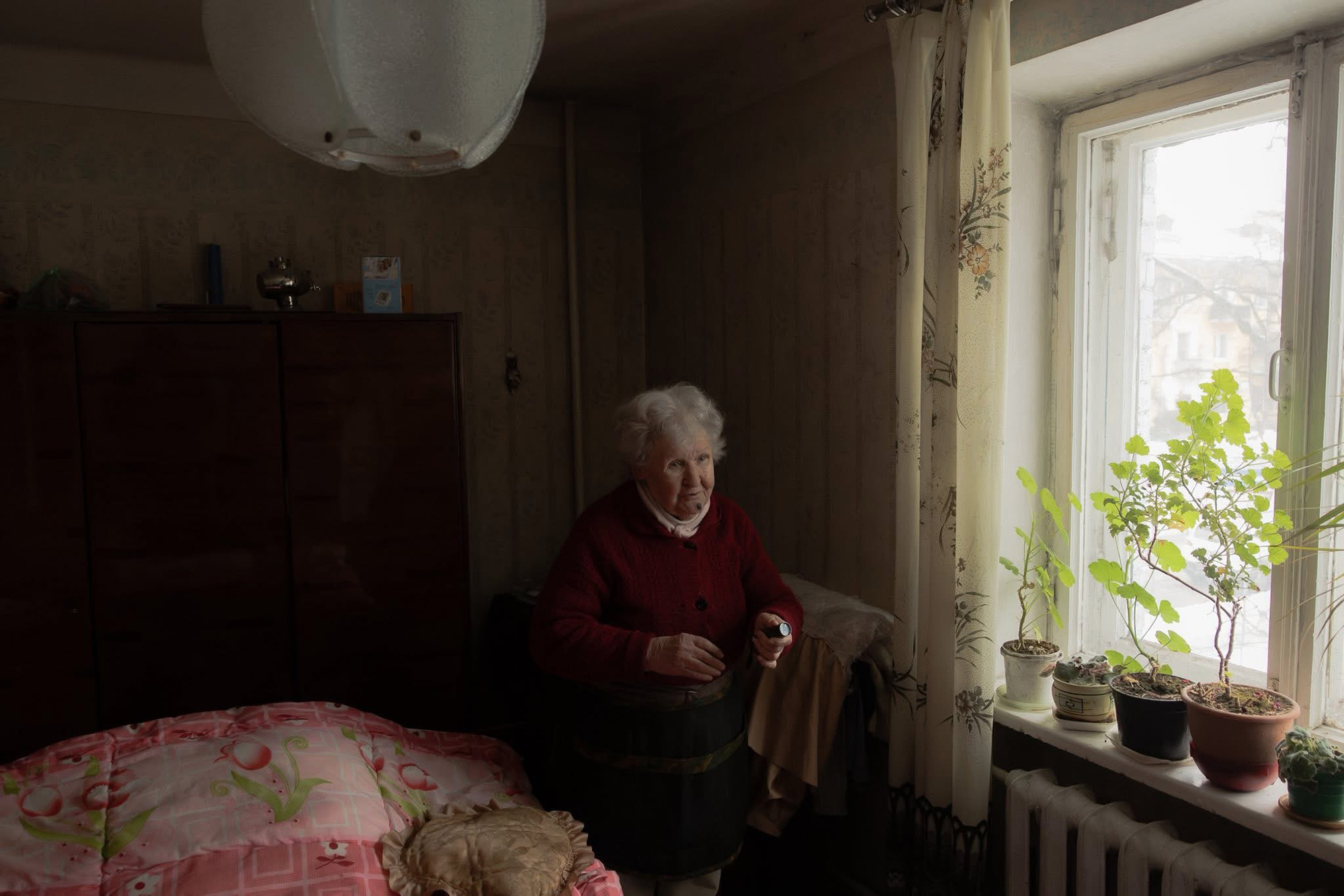
Mowgli says: we are of one blood — you and I. I am not sure. But we are certainly of one war — you and I. I would very much like this woman to survive this war and not make it to the next one. That is what I think. I think the same about my grandmother. They are already almost at the edge of finite experience.
I might never have learned that my great‑grandmother Vira was Jewish, if not for…
— Grandma, why did you never tell me?
— You didn’t ask.
That is the truth. I didn’t ask.
— Grandma, what was the war like?
— I was born after it. Mother Vira knew.
— And what did she say?
— I didn’t ask.
Such is life in the torn pocket of God’s coat. And so yes — it is good that, in addition to this photograph, the photographer clearly asked the woman about beginnings at the end.
Until the next war. Happy — and probably blessed — is the one who believes in its finality. And yet, everything in the world happens for the last time. So one may assume that…
Photo: Roman Pylypii
Text: Vira Kuryko
.png)