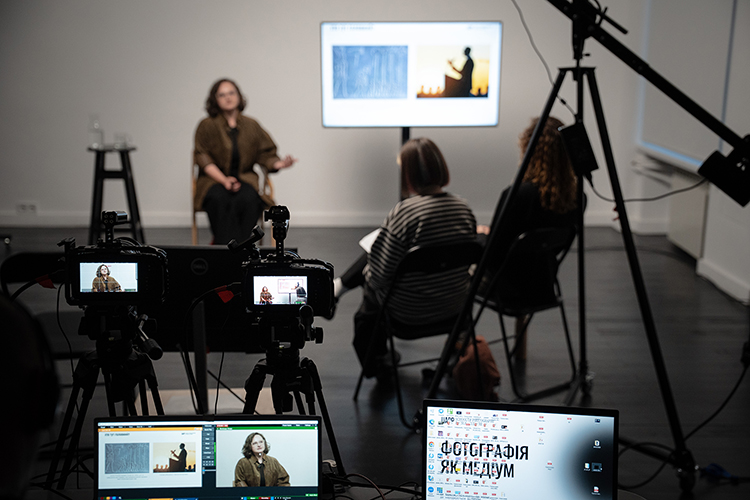
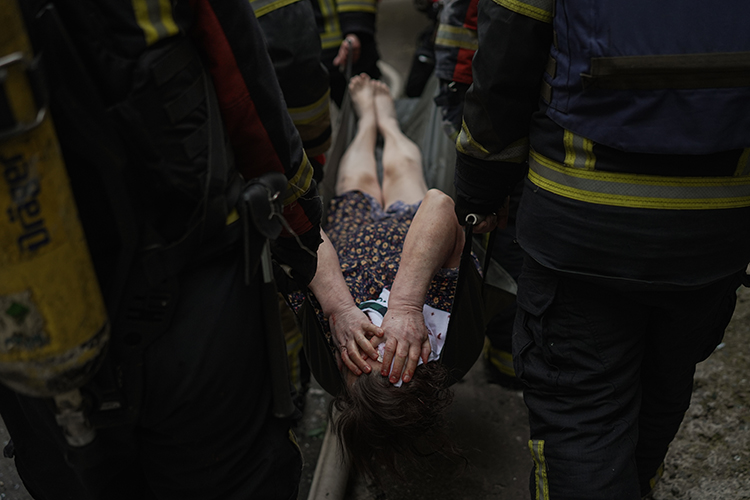
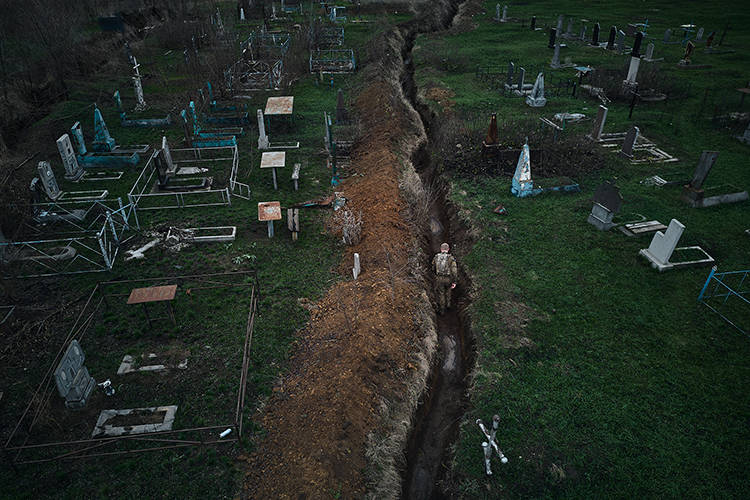
The Ukrainian Association of Professional Photographers, together with Danylo Poliluiev-Schmidt, continues to highlight events in Ukraine on the international stage. Danylo held the seminar “Armed Truth: Images of Ukrainian Media” as part of the StudiumPlus program, which also featured the exhibition “Armed Truth — 10 Years of the Revolution of Dignity and Euromaidan in Ukraine.”

The exhibition includes photographs taken by Ukrainian documentary photographers Mstyslav Chernov and Viacheslav Ratynskyi during the Revolution of Dignity and key historical events in Ukraine over the past 10 years.
“Our target audience is non-Ukrainian students who want to learn more about Ukraine,” the course lead says. “They study Ukraine’s history through the lens of media.”
Participants also gain practical experience by visiting the exhibition and related events. They engage with foundations as well as journalists from Ukraine, Poland, and Germany, learning how they report on events in the country under conditions that are often dangerous.
Improving media literacy
“Our seminar explores people’s struggle for freedom of the press and democracy over recent decades from the photographers’ point of view,” the seminar lead says.
From the 1990 Revolution on Granite, when students took to the streets demanding the country’s independence from the Soviet Union; to the Orange Revolution after the 2004 presidential election, which was rerun amid suspected fraud; to the Revolution of Dignity, which began on 21 November 2013 and lasted 93 days. And, finally, to the most recent events: the annexation of Crimea and Russia’s war in eastern Ukraine. Another goal is to improve students’ media literacy.
“One of the main topics is fake news. Students learn to recognize distorted information—including, in part, in German or British media,” Poliluiev-Schmidt says.
This is the second time the seminar has been held. In the winter semester of 2022/2023, participants developed an exhibition featuring photographs from 1990 to 2022. For this, they collaborated with the Ukrainian Association of Professional Photographers (UAPP), a nationwide association of photographers. Now, students are presenting a new exhibition with 30 images from the Revolution of Dignity. It will be shown not only at the University of Potsdam, but also at Potsdam’s Nikolaisaal and in Berlin.
Danylo Poliluiev-Schmidt brought three photographs to the interview: they show police violence by the Ukrainian special police unit “Berkut” against demonstrators on the Maidan in Kyiv. The photographs were taken by photographers Oleksii Furman and Vladyslav Musliienko, who will also take part in a panel discussion organized by the students at “Café Kyiv” in February 2024 and will explain how these photographs were made. The third photographer, Maks Levin, was killed in the war.

One of the seminar participants is Noa McKay.
“As an American, it’s important for me to learn more about Ukraine and its history,” says the student, who has close friends from the country. “In the U.S., this perspective is missing from coverage—people talk only about battles and current headlines, not the background of the war.”
In the U.S., Noa McKay studied German philology and physics at East Carolina University. In Potsdam, he is currently pursuing a master’s program in German philology. A few weeks ago, he took part in an event in Wildau about scientific links between Ukraine and Germany:
“It’s important for me to build this cooperation between Germany and Ukraine.”
With the knowledge gained in the seminar, he wants to tell other Americans about Ukraine’s history in the future.
Defending democracy
“The Revolution of Dignity took place exactly ten years ago now,” Poliluiev-Schmidt says. He has lived in Germany since 2019 and studies biochemistry and molecular biology in Potsdam. “In Germany and other countries it was ignored. And when it was reported on, at first people either called it a putsch or a far-right radicals’ revolt.”
Later, these events came to be called a revolution. Danylo Poliluiev-Schmidt is originally from Ukraine and also has Polish roots. During the Revolution of Dignity in 2013–2014, he was studying in Lviv.
“When I heard that President Viktor Yanukovych would not sign the Association Agreement with Ukraine, I had the feeling that someone had stolen my future. I was born in 1996 in independent Ukraine and grew up with the idea that we would become part of the EU and NATO, like Poland, Lithuania, Latvia, and Estonia.”
The student traveled to Kyiv and took to the streets together with thousands of people.
“When the riot police began using violence against peaceful demonstrators, we understood that this government would only oppress us. Most of the demonstrators were students. On some days there were incredibly many people on the Maidan, even at minus 20 degrees Celsius. We stood so close together that we didn’t freeze, and we sang the anthem: ‘We will lay down our body and soul for our freedom.’ Many people were wounded; during the demonstration on 20 February 2014, more than 100 people were shot dead. To this day, it is unknown who is responsible for their deaths. Back then it was about more than joining the EU—it was a fight for democracy and freedom of speech. Those events helped Ukraine continue its struggle and defend its dignity and its democracy, not only on paper,” Danylo Poliluiev-Schmidt says.


In summer 2024, he will hold the seminar again. After that, he plans to complete his studies. To keep the project alive, he already has an idea: he wants to create an association of interested seminar participants to study the country’s media culture.
Danylo Poliluiev-Schmidt is a representative of the NGO IWEK e.V., which works on cultural, political, educational and research, and social projects in Germany.
Credits:
Topic researcher, text author: Marusia Maruzhenko