Ukrainian photographer Maksym Dondyuk has been photographing the war since 2014. He has been to the hottest spots, including the Ilovaisk pocket. At the start of the full-scale invasion, he documented the fighting in Kyiv region, and his photographs have been published by leading outlets around the world. Maksym Dondyuk works on long-term author projects that are personal reflections on the war in Ukraine. Maksym spoke about creating images for the new “White Series”, about searching for his own visual language, and why each of his frames is an attempt to convey his hatred of war.
— In your author projects, including the “White Series,” you show the war through landscape. Why this genre?
— I have been photographing the war in Ukraine since 2014. After a year of shooting active combat, I decided to take a pause. In 2017, I traveled along the former line of demarcation, where I had seen war, blood, and убийства, where I had seen destroyed homes and land fought over meter by meter. I drove this line from the Sea of Azov to the Russian border several times. Sadly, this entire territory—except for a small stretch near New York—is now occupied by Russian troops.
When I arrived, it turned out that all those places were needed by no one—they were emptied out. Meanwhile, nearby there were already rebuilt houses, shops, checkpoints. It reminded me of the state I—and the people who came back from the war—were in: a feeling of inner emptiness, when you return from the front and no one understands you. You ask yourself why there is still corruption here, or why everyone is drinking wine here while people are still being killed there. Despair appears, and so does misunderstanding with relatives and friends.

In 2017, I shot the “Between Life and Death” series, where I showed the consequences of war through landscape. Before the war, I also used landscape photography—for example, in a series about Chornobyl. For me, it’s a convenient format, a possibility for a more artistic approach to photography. I was very tired of what I did at the beginning of my creative path, when I worked more with people. правда, the full-scale war pulled me back again—the first year I actively worked with the military, documented events, collaborated with magazines. When war comes to your home, there’s no time for art. Someone picks up a weapon, someone picks up a camera and does everything they can. The military fight Russian soldiers, and for me it was a war against Russian propaganda.

At some point I realized I was very tired of everything I was doing at the front. It was getting harder and harder to gain access to combat filming. I returned to landscape photography. Over the last two winters I spent time in the Donetsk, Kharkiv, and Kherson regions. After the project about the Chornobyl Exclusion Zone, I could say I had a freak-out about maps. In summer, I marked objects that interested me on the map, and in winter I would go out to photograph them.
I lived in Izium and Kramatorsk; whenever possible I went to the front line, but most of the time I was waiting for the weather I needed for the “White Series.” I needed a few centimeters of snow, rime, and no sun. All those parameters don’t совпадают that often. So I photographed some objects ten, twenty times. I would just get in the car and drive out into the fields, knowing they were all mined. I tried to walk along paths if I spotted them. When the weather wasn’t right, I looked for new locations that might be interesting to photograph. It’s a meticulous landscape approach. For me it’s also meditative: when I was alone in a field, in winter and мороз, it was a kind of conversation with myself. For me this series is very private.
The “White Series” is about what will happen to humanity if we don’t stop fighting. For me, it simply shows what our planet might look like if we kill each other over territory, resources, or religion. This is not only a problem of Ukraine and Russia; it is a global problem of humankind, because we can’t stop—we can’t not wage war. My new series is about hatred toward everything connected with war. War generates aggression; it destroys lives, nature, and machinery.
— How are your projects “Between Life and Death” and “White Series” connected? Is one a continuation of the other?
— It’s very hard to separate these two photo series. In the end, my Chornobyl project was also created using a similar approach. I used visual languages that overlap a lot—they’re like twins. But the “White Series” is different: it’s deeper, more powerful; I use medium format for the shoots. The idea was born in 2017, when I first returned to places where I had been in 2014 together with the military. I had psychological problems and I needed to go back there, see everything again, and process the events of the war.


The projects “Between Life and Death” and “White Series” are connected. But for the “White Series” I use medium format so the photographs can be printed three to four meters wide. I see this project as something for gallery exhibitions. Imagine: you enter a space and notice an interesting landscape. At first it seems like something beautiful, but in reality it’s our distorted aesthetic—because visual art is often built on suffering, wars, or religious crucifixions. As you come closer and closer to the photograph, you start to see the разрушения and scars that war leaves behind.
I’m sure that people abroad, who have completely different problems, may not understand the photographs of the “White Series.” The images will be closer to those who know what war and emptiness are. This series is probably more about me and my inner worldview—how I perceive what war leaves behind.
— Why are there no people at all in your “White Series” images?
— When I was shooting the “Between Life and Death” series, it was very important for me to convey the emptiness that I felt myself and that many of the guys returning from the front also felt. When you come home and the meaning of life runs out, there’s no understanding of what to do next. Many soldiers go back to the front because they can’t find a job; family and friends don’t understand them. If a servicemember has PTSD, it’s very, very hard inside.

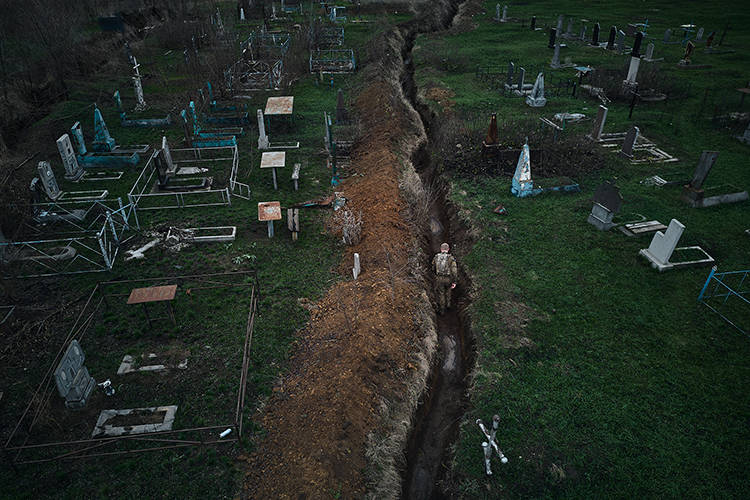
In 2017, I tried to visually depict the emptiness that was inside me. I couldn’t return to the front and start shooting again, so I went along that line of demarcation. For me it was therapy through art. Back then the war continued, but the front line didn’t move, and everything seemed frozen. Now, in the “White Series,” the idea is different, because active combat is underway. Now it’s important for me to show what will remain after humanity. If we don’t stop fighting, there will be a nuclear winter and everything will be covered with snow; everything will freeze. In places, only destroyed houses and rusted tanks will remain.
War brings nothing good. I simply don’t believe that war is ever fought with some good intention—that war is waged for religion, a nation, or any other ideals. Human life matters more than a patch of land. It’s very painful for me when I hear that we must fight, fight, and liberate everything. I would like to know how many more boys and girls must die for this. How hard and painful it will be for our country. How destructive war is for any country at all.
I have photographed war only in Ukraine. I’m not a war photographer who travels to other countries—that doesn’t interest me. I perceive war as a person, as a Ukrainian to whom this happened. I picked up a camera not because I decided to photograph war, but because this damn war came to our country. I’m an idealist humanist, and all of this is very hard for me.

With the photographs from the “White Series,” I’m trying to show what can happen to our world. We will all end up in ruins. There are many things like what I’m photographing in Ukraine now in other countries too—for example, Afghanistan and Chechnya. I can’t understand the meaning in the actions of countries that start wars—Russia, the United States, and others—when they come to чужа land and want something. I can’t find an answer. Meanwhile, I walked across mined fields for months and just photographed. Some people collect objects; others collect impressions. I collected—gathered against a white background—abandoned things that used to matter. A tank mattered; someone sat in it. This house mattered; people lived there. Now everything is destroyed and emptied out, like our entire country.
— Did the idea to create the “White Series” emerge as a result of photographing the war for a long time? How and when did you conceive its visual language?
— In this case, I decided everything before the shoot. I needed to buy special equipment for photographing panoramas and learn how to use it properly. Canadian photographer Edward Burtynsky works in this style. He helped me learn to make panoramas, and now he supports my project very much.

I decided to make all the photographs in the series fully original, without heavy post-production. It happened that I came to the monument in Izium for the twentieth time, and there still wasn’t enough fog—or the sun came out from behind a cloud. And I would just stand there, unable to make the photograph. The viewer sees one white frame. For them it looks as if someone drove by, took a photo, and drove on. But for two years before that shot I was making a map; for two winters I lived in Donetsk region; I drove many kilometers to catch a few minutes of the weather I needed. If the conditions were right, I would quickly drive to several objects at once.
— In the project “Between Life and Death,” in addition to photos, you add quotes from Laozi’s “Tao Te Ching (The Book of the Way and Virtue).” Why this book?
— After 2014, I tried to find balance within myself. At first I looked for ways in Western philosophy; for some time I lived in Europe. Then I realized that my way of thinking and perceiving the world leans toward the Eastern. Up to 2021, I traveled a lot around Asia. I’m drawn to Taoism and Buddhism; I read a lot of related literature and several times immersed myself in meditative practices in temples.
I really like Laozi, especially his “Tao Te Ching.” I simply chose the quotes that best reflect my attitude to war. Laozi writes very powerful things. For example, he talks about two countries that went to war, and one of them won. The army that killed thousands of people should not celebrate, hold parades, or drink wine. The day the war ends is a day of mourning, because no one can take pleasure in the fact that someone was killed—even if those killed were enemies. Sometimes I’m shocked when I see people in Ukrainian restaurants watching drone videos at breakfast of someone being killed and reacting with an “emoji.” It’s easiest to talk about patriotism over dinner in a safe place. I have seen war; I was wounded twice; I spent a lot of time with the military, but I still don’t understand how one can enjoy killing, even of enemies.
I can understand it when it happens among soldiers. But it’s strange to me when I see so much hatred among civilians who have no experience at the front. It’s like they came to a theater or a movie. What kind of idea is it—to watch someone being killed? I’ve seen more respect for the enemy at the front than in cities far from the line of contact. It’s just nonsense. I’m also talking about the respect that often exists at the front between soldiers on opposite sides, even considering the fact that they are fighting.
Hatred and aggression разрушает us from within; it burns us out. We will begin to уничтожать not only our enemies, but also family and friends—and, ultimately, our state. When hatred takes hold of us, we won’t be able to simply stop when the war ends. We will start looking for new enemies—only this time among our relatives and acquaintances, within our own country.
I tried to convey the message of the images by complementing them with Laozi’s expressions—because who will give meaning to my words? I added quotes from “Tao Te Ching (The Book of the Way and Virtue),” where Laozi speaks about war and about how one should fight when you have to—when an enemy has come to your country. First of all, a person must remain a humanist even during war. Preserve humanity instead of becoming a beast.
— In the foreword to your exhibition “Contemporary Ukrainian Landscape” at Lviv’s “Ya Gallery,” curator Pavlo Gudimov writes that the silence of war is scarier than active actions. How much do you agree with this statement?
— I agree one hundred percent. If you ask the guys on the front line what’s worst for them, they’ll say: silence. If you ask an assault trooper what’s scariest, he’ll say it’s the unknown on the way to combat positions. In war photos and videos, we often see action. But that’s only ten percent of war; the remaining ninety percent is silence and waiting. When you drive along a road and not a single car comes toward you, you subconsciously start worrying—you don’t understand what might have happened. For me, while shooting at the front, silence was also the worst. When you hear incoming strikes and shots, you understand where to expect danger from; you have certainty. But silence is very heavy. Even in a city, after an air-raid siren, you start living with the thought that this time it might be you who dies. Waiting and silence are the worst in war.

My “White Series” photographs are not an attempt to convey silence, but an attempt to convey my inner state. For me, art is not only a means of self-expression, but also a tool for deep analysis and reflection. I strive to create a space for contemplation, where viewers encounter difficult questions, explore their feelings, and rethink their relationship with the world and history. I hope to evoke an emotional and intellectual response, inspiring deeper understanding and awareness.
— The “White Series” images are visually attractive and beautiful. To what extent can photography about war be aesthetic?
— If you show war the way a webcam does—showing bodies and “meat”—no one will look at it. You have to work with the viewer’s mind, because everyone has a certain visual perception based on art and painting. You have to lure the viewer into this trap so that they open up, look closer, and then their consciousness feels the horror of war. In the “White Series,” I use this visual aesthetic so that people come closer and feel emotions. People often ask me why my photographs are so aesthetic and beautiful. I always ask them back: why do they perceive it as something beautiful? Why can photographs of dead bodies, destroyed homes, and mangled tanks be called attractive? Maybe it’s a problem of all humanity that, looking at images of suffering, убийства, and war, we perceive them as aesthetic. Artists understand these things and use them to communicate with their audience. Susan Sontag writes a lot about this problem in her book “Regarding the Pain of Others.”
— For you, is photographing war documentation and informing—or rather art and aesthetics?
— When the war began in 2014, and then the full-scale war in 2022, at first I did document events. But I always try in parallel to look for things I can use for exhibitions or as an idea for an author project. Because photos of current events for magazines can be printed as international propaganda. At the same time, I’m not one of those photographers who use the same photographs simultaneously for publications, exhibitions, and books. When I make stories for print in the media, I also try to create frames for myself in a different visual language. Sometimes I try to combine them, but often it’s simply impossible. To make a frame I like, sometimes I have to spend several weeks—searching for a location and waiting for the right moment.
That’s my approach to work, so I don’t consider myself a photojournalist. If there isn’t good light, a successful composition, and the right combination of colors, I won’t take the photograph. Or I will take it mechanically and then won’t use it anywhere. For me, the background of a photograph is sometimes more important than what happened in it. Photojournalists follow the subject in the frame, and their background is случайный. I choose a background and wait for something to happen in it.

While working on the “White Series,” at some point I realized that I had spent an entire week photographing the same tank. I already had two hundred photos of that tank. Sometimes you get stuck on something without even realizing it. Many young journalists shoot artillery and mortar work, catch the “tube with fire”—the moment a shell flies out. They often don’t understand that it’s already impossible to look at such compositionally identical photographs, with the same light and plot. You have to look for your own language, yourself, and your style.
Of course, it’s impossible not to repeat yourself. Now I’ve stopped photographing military things because for two years I’ve been making the same photograph—just from different angles. It happens to everyone. At such a moment, it’s important to pause, take some distance, review your entire photo archive, and, if possible, make an exhibition or a book.
— You photographed many events at the start of the full-scale invasion. Please tell us about the photograph that made the cover of TIME!
— In fact, I don’t really like this photograph. But I understand why it became the cover of the magazine. At that moment it was important for Ukraine—the cover drew attention to us.
I have collaborated with various magazines since 2014; editors knew my work. At the beginning of 2022, it was the only way for me to keep working, because photographing war is expensive. You need to find a place to live, a car, so you can travel to Kharkiv, Zaporizhzhia, Kyiv, and other cities. International magazines were my financial support. All the magazines I worked with were weeklies, so I didn’t need to send photographs every day. I had a lot of free time for my own shooting. For the first four months I worked alone, without journalists. I had freedom of movement and freedom to choose topics. I respect journalists if they respect my work. I’m ready to wait three hours while they do an interview if they’ll then wait for me when I’m working in a trench. But if a journalist expects from me only to photograph their café interviews, we definitely won’t work out.

— A lot of photographers—Ukrainian and foreign—are photographing the full-scale war in Ukraine. Over these two and a half years, many photographic clichés and templates have already formed. In your opinion, which topics and aspects of the war are still under-photographed? How difficult is it today, in photography, to create something absolutely new?
— This problem is global. In 2014 it was the same. Many contemporary photographers don’t remember it because at that time they weren’t yet in photography. There were only a few documentary photographers who had worked before the war and, when the fighting started, continued to shoot. At the same time, a large layer of young photographers appeared who began working for international news agencies or as fixers for foreign journalists and photographers. They had never heard of documentary photography or photojournalism. In 2015, ninety percent of those photographers disappeared. They went to earn money in game design or IT. Now the situation is the same.
It’s very difficult to form your own visual language when you work in a news agency and have to shoot events and news every day. Something explodes and you immediately run there. When you have only two hours—or five minutes—to take photos. I don’t really believe that under such conditions you can develop your own style. When photographers chase the subject, shoot everything in burst mode, and then choose the best from five thousand images for the agency. I’m not criticizing—it’s a job. At the same time, many photographers do things with their own money, travel a lot, look for something, and document it. They can develop their own shooting aesthetics and style.
A photo editor at Stern once told me: “Maks, the easiest thing you can photograph is war. You just need balls of steel.” But if you send a photographer to a place where nothing is happening, they won’t be able to photograph anything. They are used to photographing active war actions, where you feel like you’re in a movie. I went through that too. It’s normal. In the first year you can “grind,” and then awareness comes and you start seeing other projects.
Most photographers who are documenting the war now will also soon move into another profession that brings in more money. The profession is slowly dying out, and only news agencies still pay something for images. Magazines I worked with a lot—The New Yorker, TIME, Stern, Der Spiegel, and others—cut their budgets every year. Over a year you may get at most one or two assignments from them. Many documentary photographers change jobs.
There are photo festivals in Arles—Rencontres d’Arles—and in Perpignan—Visa pour l’Image. Both festivals are documentary, but they are like two different poles. I’ve been to both. In Perpignan, photographers talk about who spent more days in trenches or who was under shelling more times. In Arles, they talk about war from a completely different perspective—I’m talking about the art of documenting. When you work with journalism, but it still remains art. At Rencontres d’Arles they talk more about the inner world, not just stating facts. The photographs are not only about what happened; there, authors use the medium of photography to convey a visual concept or a smart concept.
You need to know these things so you don’t repeat someone else. It’s important to understand contemporary photography and read criticism. In fact, very few photographers read. I’ve spoken with many young photographers, and all of them, for inspiration, only look at colleagues’ photos. But what’s the point? To look at other photographers in order to repeat them? If you want to repeat someone, it’s better to watch films by Andrei Tarkovsky or Theodoros Angelopoulos, read criticism or philosophy of art. That approach will give far more ideas than looking through top photos in TIME compilations or Associated Press selections.
— Please tell us what inspires you. What books do you like to read, and what films do you watch?
— I’m fascinated by Eastern philosophy. I’ve probably already read everything I could on the subject. I also read Western philosophers. I read criticism and theory of photography, literature on the development of visual art. I can say I’m a bookworm. If someone offers me a party or the beach, I’d rather stay home with a book. I don’t drink alcohol, I don’t drink coffee, I don’t socialize much; I don’t have many friends in Ukraine. I feel closer to being at home with my wife, with a small circle of close friends.
The best director for me is Theodoros Angelopoulos. He tackled many difficult themes. His films are about Greeks and their culture. I especially recommend watching the historical drama “Trilogy: The Weeping Meadow.” It tells the history of Greece through one family that returns to Greece from Odesa after the civil war. The film leaves a strong impression. After watching it, my wife and I can discuss it for another week.
Everything inspires me except photography. The thing I like least is looking at photographs. Of course, I do find authors who are interesting to me. For example, I absolutely love Nadav Kander’s photographs. I like working with archival photos. I did that in the project about the Chornobyl Exclusion Zone. I still have many archives from there that, because of the war, I haven’t even begun working with yet.
— Is it possible to keep attention on the war in Ukraine through photographs going forward?
— People abroad aren’t very interested in daily news from Ukraine. Everyone actively read about Bucha, the destruction of the Kakhovka HPP dam, and so on—though we certainly don’t need such events. Attention to Ukraine can be held only through powerful, serious projects—documentary films or photography. But our authorities don’t understand: to create a large-scale, deep project—not propaganda—you need to give Ukrainian and foreign authors access and time to work. Here you’re allowed to go on a press tour for one day together with a press officer. Instead, you need to support cultural projects, multimedia projects, and work with curators.
In Europe, people constantly go to movie theaters and exhibitions. You have to talk to them through art. Our authorities must realize that money should be spent on working with museum and gallery spaces, and on sending artists to art festivals. The authorities must provide access for shooting, support documentary photographers, writers, and artists through grant programs, give freedom for creativity, and not control it. Culture matters.
Unfortunately, all my latest interviews are about censorship and restrictions on access to the front line. After the piece with Luke Mogelson about the lives of our soldiers in trenches, which came out in The New Yorker, I was summoned for interrogations by the Security Service of Ukraine. I don’t have accreditation from the Armed Forces of Ukraine, and I can’t continue photographing the front line. I don’t believe that war is not the time to criticize the authorities. If a patient has gangrene or some other болезнь, it won’t go away just because no one tells them about it. We need to talk about problems out loud.
— Please tell us about the book you are working on now.
— I came to the United States to finish, by autumn, a book about the war in Ukraine. Honorary dean of ICP (International Center of Photography) Fred Ritchin is helping me work on the book. He is writing the text for the book and interviewing me. This will be a book about the first two years of the full-scale war in Ukraine; from 2024 there will be one or two photographs. The book is not only about war, but also about my reflections on it. Of course, there will be photographs of the dead, frames of destruction, but my book is not about active combat. I think you can just attach the label “Meditation” to all my works—they are all about contemplation and awareness. When I see many photographers shooting in one direction, I обязательно turn the other way. That’s why my Maidan of Dignity is panoramas. I can’t shoot like everyone else.
I did all my long-term projects on my own. I don’t need someone walking behind me or being рядом. Often before shooting I do visual research: I just walk around, look, feel. For me, photography is about feeling—about collecting emotions. The book will include photographs I made even before the “White Series.” Based on that author project, I plan to make a separate book.
Maksym Dondiuk — a Ukrainian documentary photographer who works with photography, video, text, and archival materials. Through his projects, he explores themes of history, memory, conflicts, and their consequences. Among Maksym's projects are: his two-year work "Tuberculosis Epidemic in Ukraine" (2010-2012); "Crimea Sich" (2010-2013), a series of photographs and a documentary film about military-patriotic education of children in a secret camp in the Crimean mountains; "Between Life and Death" (2017) — a personal reflection on the consequences of wars through the ruins and devastated landscapes of eastern Ukraine; "Culture of Confrontation" (2013-2014), dedicated to the events of the Ukrainian Revolution of 2013/14, which was published as a photo book in 2019; "Untitled Project from Chornobyl" (2016 — present), where Maksym works with photographs, films, and letters found in abandoned villages of the Chornobyl exclusion zone. Maksym's works have been exhibited in international solo and group exhibitions, including at the Museum of Modern Art in Paris, Somerset House in London, MAXXI National Museum of 21st Century Arts in Rome, Robert Capa Contemporary Photography Center (House of Lucie) in Budapest, Fotográfica Bogotá in Colombia, and others. Publications — TIME, Der Spiegel, GEO, Zeit magazine, Stern, Paris Match, Rolling Stone, Bloomberg Businessweek, Liberation, Polka, 6Mois, and others.
Maksym has received numerous awards, including the Eugene Smith Grant in Humanistic Photography, a finalist for the Prix Pictet photography award, International Photographer of the Year at the Lucie Awards, winner of the Ville de Perpignan Remi Ochlik Award from Visa pour l'Image, winner of the Magnum Photos "30 Under 30" competition for young documentary photographers, and the Grand Prix "Best Global Health Story" at the "A Healthy World Hope" photo contest organized by Becton Dickinson (BD).
Contributors to the material:
Topic researcher, author of the text: Katia Moskaliuk
Picture editor: Olga Kovalova
Literary editor: Yuliya Futei