Shoot, develop, print, and scan—this is the process film photographs by Kharkiv artist, photographer, and doctor Vladyslav Krasnoshchok go through. He documents the Russian–Ukrainian war—its consequences, its tragedies, and its heroes—in black-and-white images. We talk with Vladyslav about the photographs, their meaning, and his approach to the work.
Vladyslav, who are you? How do you define yourself?
I’m a doctor, first and foremost. I previously worked as a maxillofacial surgeon at an emergency hospital, and now I work as a dentist—surgeon—implantologist at a private clinic. Photography has always been my hobby, but I position myself as an artist who also works with photography.
What projects are you working on right now?
No, I don’t really have things like “projects” in my head. Right now, I’m photographing the war.


How did your love for photography begin—especially for film?
About 15 years ago, I started photographing first with a digital camera, and then I switched to film. I chose black-and-white film for myself because I can fully control the entire process—from shooting to printing. I control all of it myself: I shoot, develop, print—and then I get the result I need.

How difficult is this process?
There’s nothing complicated about it. It just takes some time. I think working with digital also takes a lot of time: you shoot, then transfer everything to a computer, then process it somehow. In my case, I take the photos, develop the rolls, then scan the negatives to select the photographs I want to print. I print them. So I have them on paper, and then, so they can be shown digitally somewhere, I scan them.
Why black-and-white photographs rather than color?
Again, with black-and-white photography I fully control the process from shooting to printing. But if I need to shoot in color, I have to hand the color film over to a lab. And sometimes they might do something wrong there. Still, I recently started shooting on color film too. I find it interesting.


And from a visual point of view: does black-and-white photography convey something better or more precisely than color?
Black-and-white photography, in my view, is more old-school—where form does the work. Color photography, in my view, is more complex, because you have to work with color, and composition works differently.
What about quality? Why do you choose to shoot on film rather than digital?
For me, quality isn’t something you measure in pixels or anything else. For me, quality is when the image works for the viewer. From my perspective, it has to be an ideal composition. In other words, the photograph has to work formally—and if it works formally, it can give birth to some kind of image in the viewer’s mind.

You are photographing the war now. Could you tell us more about what exactly you photograph—who, where?
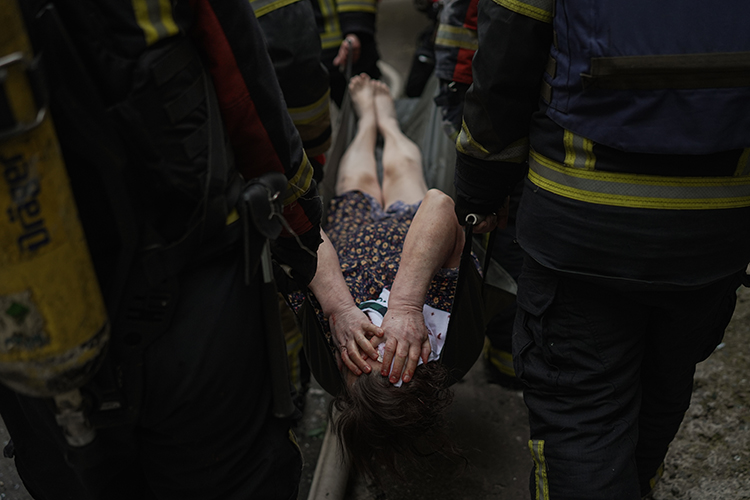
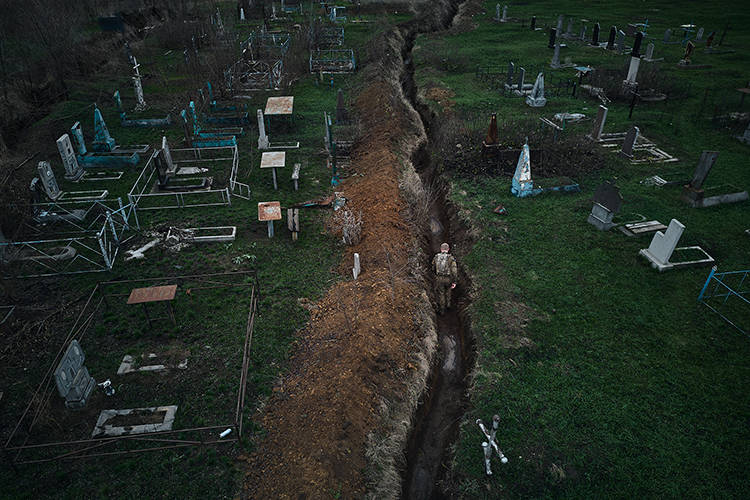
War contains many different themes, so I’ve provisionally divided it up for myself. My goal is to make a book about this war. When I’m about 70% done covering the themes I’m working on, I’ll be able to make that book. It’s not only the aftermath of strikes; it’s also destroyed buildings, blown-up bridges, the work of the State Emergency Service, the work of the military and medics, what our equipment does, prisoners, looters, and so on. And then all of that comes together separately, and from that you can create an image that could convey what was happening to us in these times.

Do frames become more valuable when shot on film because of the limit?
I’ve always said I have a sports-like approach to shooting on film: I don’t shoot everything in a row; I think about when and what I’m shooting. But I never regret frames if there’s an interesting situation. And there are shoots where you make one or two frames—and that’s already good.
And in general, how many frames are there on one roll of film, and how many rolls do you take with you to a shoot?
When I shot medium format on a Mamiya, it was 10 frames per roll. If it’s 35mm, it’s 36 frames. If it’s a panoramic camera, it’s about 20 frames. I always have enough film with me. I usually carry 10 rolls. Though it’s better to always have a spare, because you never know what you’ll see.


What did you photograph before the war? Did you take part in exhibitions?
Both before the war and during it, my photographs have been shown at exhibitions, including abroad. Before the war I photographed Kharkiv, the Maidan, as well as the hospital where I worked at the time. I also did street photography. In 2012, a photography museum in Houston bought my hand-colored prints. Then, with that money, I bought myself a Leica film camera.
Hand-colored photographs—what is that?
It’s a paper print of your photographs. It’s actually a tradition in the Kharkiv School of Photography. You take some paints—for example, we used ones you can paint on fabric with—and you color these photographs by hand.
Where do you draw inspiration from? Do you follow colleagues’ work?
There are a lot of photographers shooting very well right now, so I can’t single out someone or someone’s work. I really like how Maksym Dondiuk shoots in color. But overall, all photographers—including me—repeat things. So shooting something truly new is really hard now.

Are there photo books or anything else you draw inspiration from?
I don’t draw inspiration—I create it myself. When I get tired of something, I simply start doing something else creatively. Then I come back to photography again. Before the Russian invasion, I had a break from photography. When the full-scale war began, I realized I needed to photograph the war. Photography interested me again. So now I live for this.

Do you still manage to go to work?
Yes, of course. I’m not a news photographer, meaning I don’t have to cover every strike every day. I don’t have that routine. My goal is different: to assemble an overall picture of the war and make a book.
Is there a photograph you dream of making?
I want to make a book. That’s my goal. Maybe it will be several books. Because separately, I also work with the guys from Army Aviation. I regularly travel to them and photograph them. They deserve a separate publication.

Maybe there are some photographs that became special for you?
There are. There are photographs where the guys are still alive, and then later I’m photographing their burial. There are even photographs where I’m filming the burial of some guys, and others are carrying the coffin—and they have also already been killed. Unfortunately, situations like this are becoming more and more frequent. I believe these images are valuable from a historical perspective. It’s like you’re writing this history. Many guys die, but they remain in the photographs. These images serve their function: to preserve memory. I also want to add that film photographs are a physical object, and in case of mega-mega blackouts, when all electronic means don’t work, you will have a physical photograph. That is an advantage.

Vladyslav Krasnoshchok is a Kharkiv-based artist. From 1997 to 2002, he studied at the Faculty of Dentistry of Kharkiv State Medical University. From 2004 to 2018, he worked at the O. I. Meshchaninov Kharkiv State Clinical Emergency Hospital. He has been engaged in photography since 2008. He works in documentary photography, street art, as well as easel and printmaking graphics. The photographer’s Instagram.
Credits:
Researcher and author: Vira Labych
Photo editor: Viacheslav Ratynskyi
Literary editor: Yuliia Futei