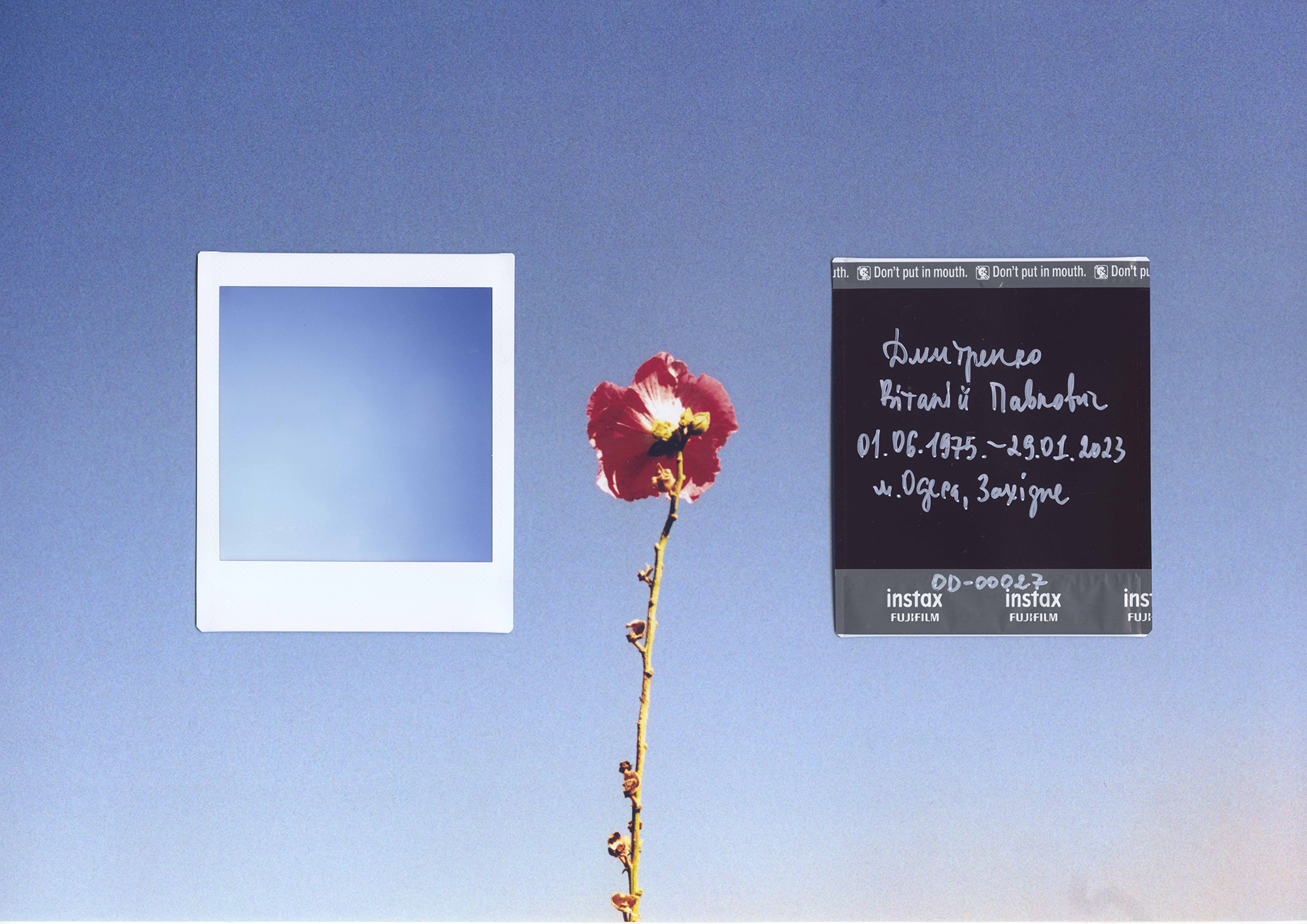
Nika Mol is a Ukrainian photographer, artist, member of the MYPH community, and co-editor of the independent print magazine 525. She currently lives and works in Kyiv. Her practice combines analog and instant photography, experimenting with physical intervention on prints to explore themes of vulnerability, inner healing, and collective memory of war.
Nika Mol shared how Polaroid experiments became her visual language for reflecting on the full-scale war, catching the attention of Polaroid itself; why we still crave physical prints and print magazines in an era of digital cameras and smartphones; and how her artistic practice evolved into the series "It Could Be Silence," dedicated to the memory of fallen soldiers.
— How did your journey in photography begin, and why did you choose this specific medium?
— Back in 2019, I held a camera for the first time—an old, very basic, vintage Polaroid 600 series. Instant cameras like Polaroid and Instax marked the beginning of my work, and they remain the foundation of my practice today. At first, I simply shot hangouts with friends and random everyday moments. Then the COVID-19 lockdowns hit.
We were all stuck at home, and I remember that feeling of productive, creative boredom—something I actually miss now, to be honest. Out of sheer restlessness, I started experimenting with prints I considered failed shots. Film packs are quite expensive, so you just can't bring yourself to throw away ruined frames—you keep them anyway. So I began cutting, gluing, and painting over my Polaroids. When I shared the results on social media, I was surprised to discover a huge international community of artists working with instant photography and Polaroids. It was a moment of incredible horizon-expanding and new connections—many of whom I still keep in touch with online today.
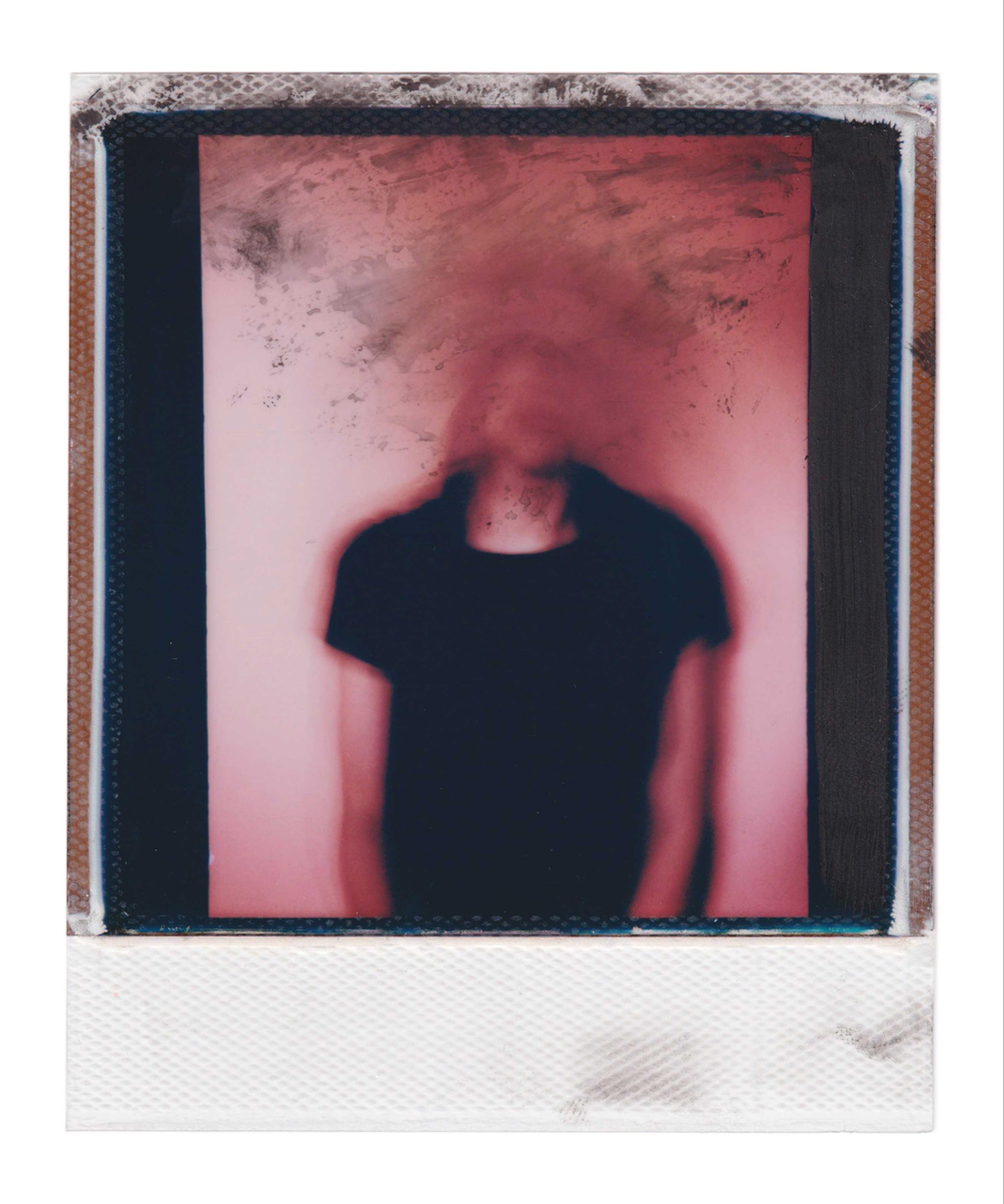
In 2021, I decided to join the MYPH School of Conceptual and Art Photography. I had been following Sergey Melnitchenko on social media for a while and was amazed by how much he was doing and how many projects he realized. The program started in late 2021 and was supposed to end in April 2022, but the full-scale invasion shifted all plans. During the first half of 2022, working with Polaroid became a form of very fast, raw reflection on the events unfolding around me and in the news. These works began to attract attention, which gradually led to exhibitions and publications. So I consider my studies at MYPH and the year 2022 as the true beginning of my professional art practice.
This year, as the winner of the MYPH Photography Prize, I received a digital camera from Fujifilm as a gift—my very first digital one. With Polaroid, everything is straightforward: one button, minimal settings. Whatever I didn't like, I fixed by hand—cutting or painting over it. Now I plan to explore this new digital shooting format. I've always leaned more toward analog techniques, but digital certainly has its perks—at the very least, you don't have to keep buying expensive film packs.
— What draws you to Polaroid specifically? On one hand, there's the thrill of waiting for the frame; on the other, the risk of ruining it completely.
— That's precisely what I love about shooting with Polaroid—that sense of magic, feeling childlike joy when you see the result. Now it feels a bit different, because the themes I address in instant photography are no longer about childhood joy. But in the early years, that's exactly how it was: you envision a frame, but something completely unexpected might emerge. The exact moment of capturing a photo and watching it develop feels like real magic outside Hogwarts.
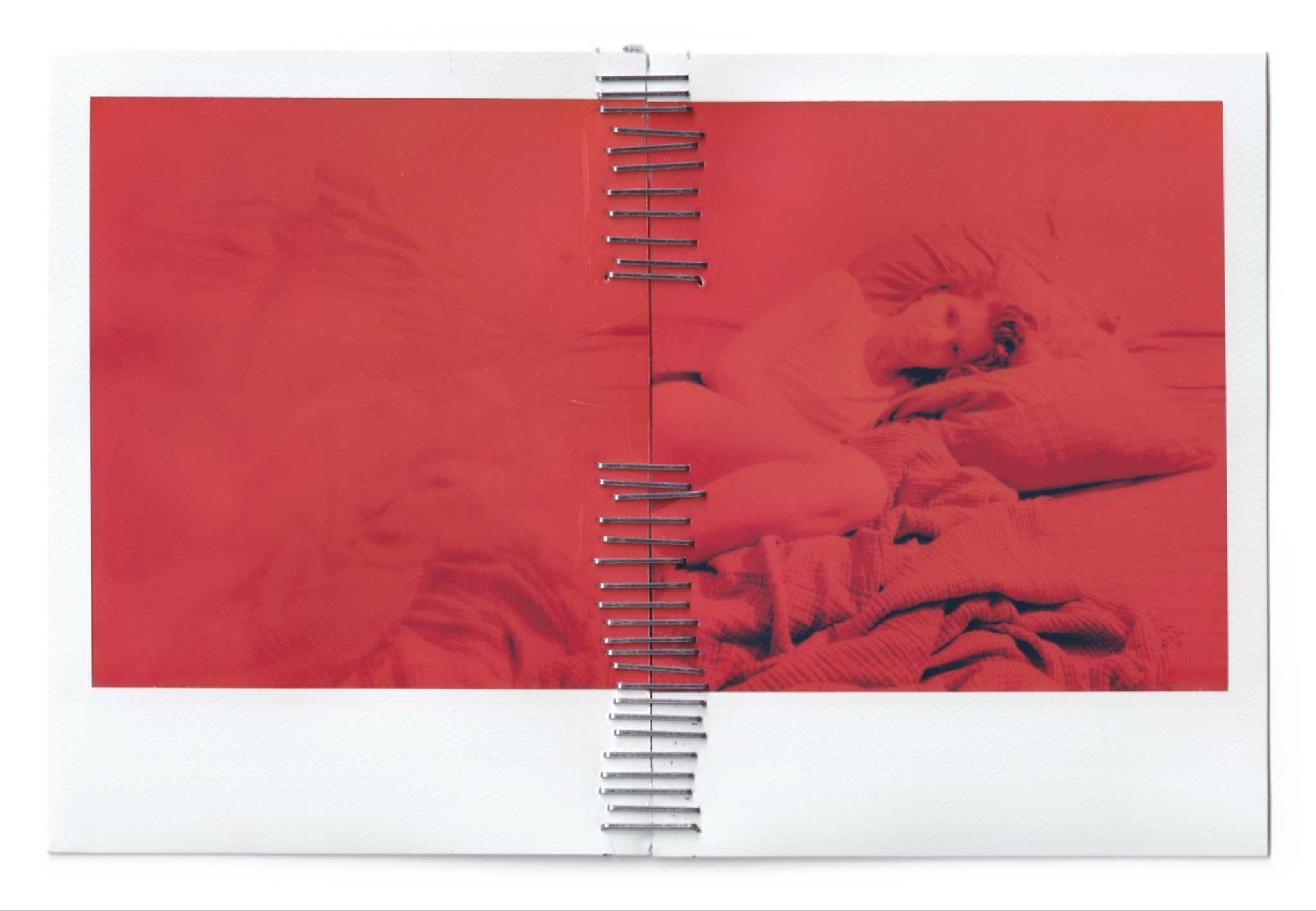
At the same time, I've always been keen to push past the limits of this small format, experimenting with what else I could squeeze out of it. Another crucial side of Polaroid is its physical materiality and uniqueness. Even if you take two shots in a row from the exact same spot, reproducing the image identically is impossible. Even if you scan the original and print it on a high-end printer, it still won't be the same.
This physical nature of Polaroids feels very resonant to me right now. It seems to be a broader trend, especially in Ukraine—this urge to capture reality physically. We all have a strong desire to see photography in person, on paper. Perhaps it's due to intense visual overload: we live with smartphones constantly bombarding us with images. Because of that, there's a need for a longer, deeper interaction with an image—through a book or a magazine. For instance, I am currently part of the editorial team at 525 magazine, where we are actively preparing our second issue.
— What does the physical process of altering a photo, of working further on it, mean to you?
— In 2022–2023, it served as a specific mode of expression for me. I don't want it to sound pretentious, but a small Polaroid essentially became my canvas. It was through this physical intervention that I managed to convey the exact emotion and feeling I wanted to embed into the piece.
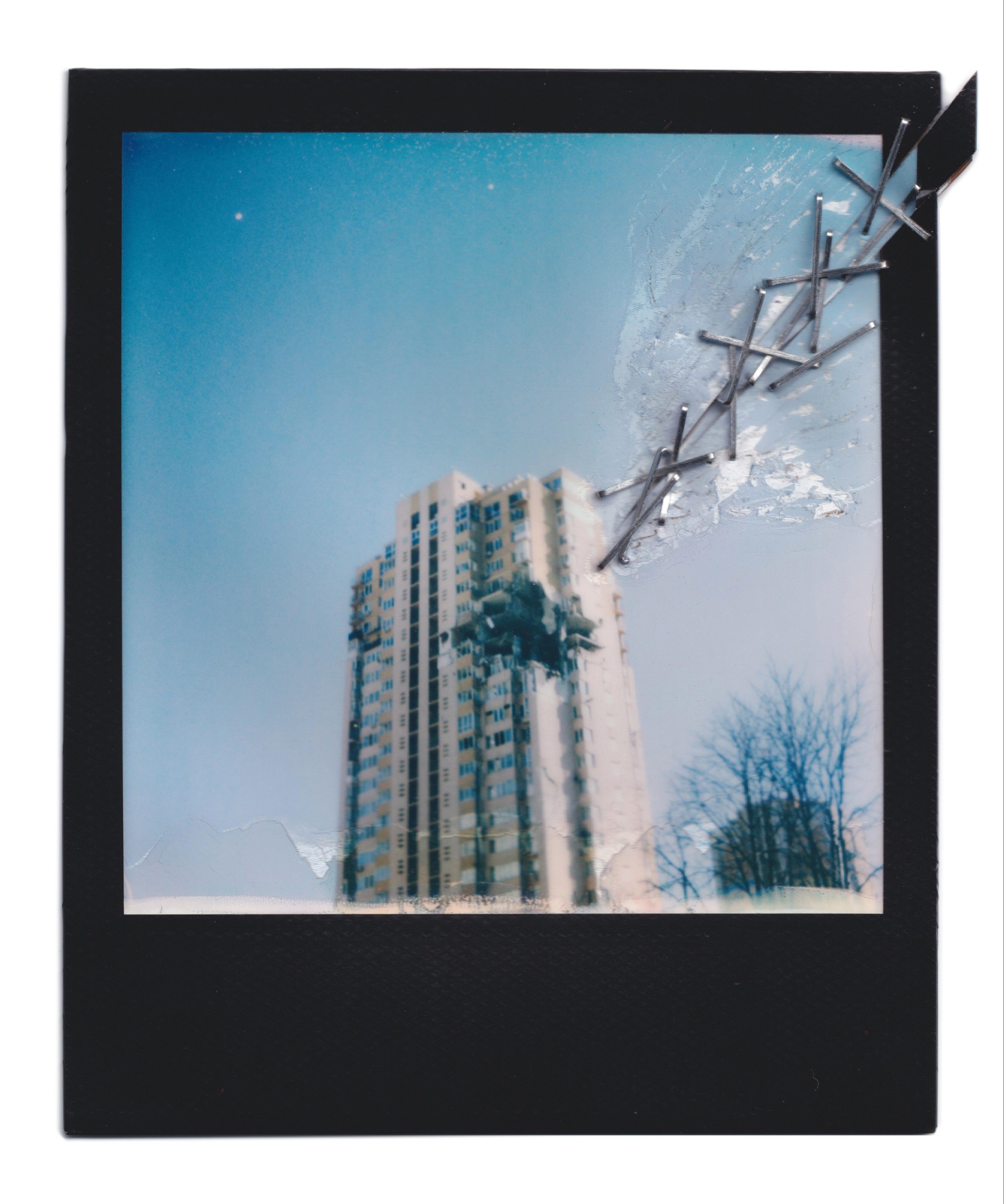
For instance, I took one of these shots in March 2022, when I returned to Kyiv and saw massive destruction firsthand for the first time. It was a residential building on Lobanovskyi Avenue—one of the first struck by a Russian missile. Fortunately, no one died then. By the end of 2022, it had already been rebuilt, but that image remains burned into my memory: a giant building with a gaping hole. Regrettably, we now adapt to such sights—destruction has become a familiar backdrop, and some people live in completely devastated neighborhoods. But seeing that ruined building for the first time left me shaken by its sheer unnaturalness. I photographed the building, but the image alone didn't capture my mental state. So I cut out a piece of the print along the missile's approximate trajectory and aggressively, crudely stapled it back together. That was how I tried to translate that feeling.
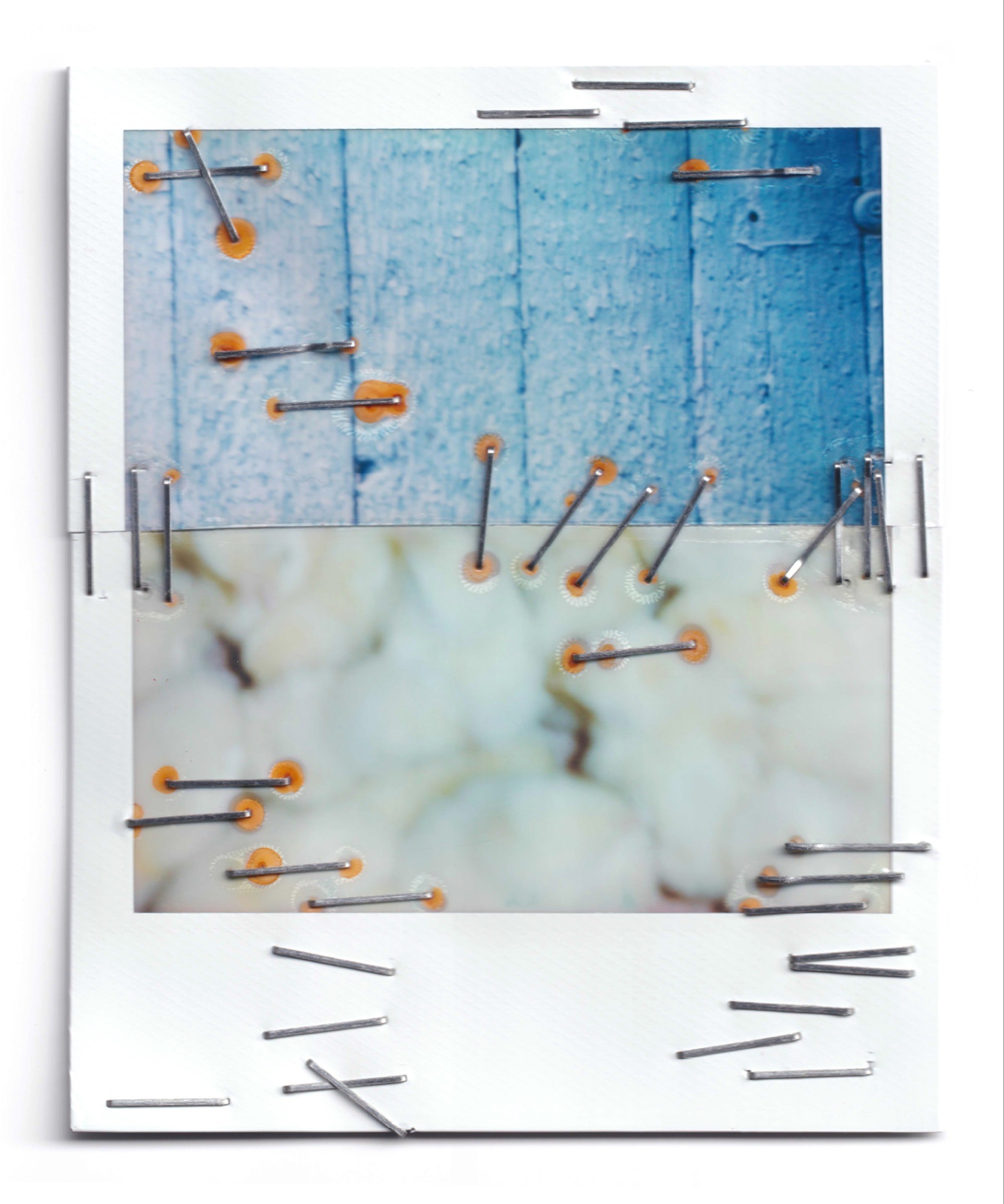
That's how it happens with many frames: whenever I want to convey anxiety, restlessness, or conversely, play around with the composition. In 2022, though, it was mostly about heavy experiences. So for me, physical intervention in a print is primarily a way to expand the image and more accurately communicate a specific emotion.
I never feel precious about photos. When I host workshops for teenagers or adults and show my work, people always ask: "Aren't you scared to cut or paint over a Polaroid? It's unique, one-of-a-kind!" Yes, it is unique, but after my intervention, it becomes completely mine. It's no longer just what the camera captured—though my perspective is there too, since I chose the moment to shoot. Here, I embed and express something far deeper.
— How is the idea to transform a print born? Does it come intuitively during the process, or do you plan how everything will look in advance?
— At first, it was very intuitive: I would just take a print, start manipulating it, and the process would lead me somewhere. Later, it reversed—an idea would come first, I would envision a rough scheme of the final piece, and then execute it. But I haven't done anything like that in a long time. I think the last time I worked with Polaroid using tactile, manual techniques was back in 2025.
Then I started shooting the project "It Could Be Silence," dedicated to the memory of fallen soldiers, where there is no physical intervention on the photographs. Recently, though, I was digging through my archives from over the years looking for specific shots and thought: "What cool, fun things I used to make back then; I should return to that." Now, when an idea comes, I can see it clearly. Still, it would be great to surrender to an intuitive process again and see where it takes me.
— Your shot of the destroyed building in Kyiv was featured in Polaroid's best-of selection. Could you tell us about your collaboration with Polaroid?
— Yes, my print was included in Polaroid's 2023 highlights. When they asked me to share a photo, I clarified if I could select that specific frame, given its political context. Even though Polaroid supports Ukraine, we all know how cautious international brands can be. But the company agreed and selected that exact shot.
Polaroid published the roundup in late December, and on the morning of January 2, my 30th birthday, Kyiv suffered another massive missile attack. Strikes landed right near my neighborhood—it was terrifyingly loud and damaged a nearby building. I remember sitting in the hallway while millions of notifications flooded my phone—media outlets had picked up the news about my photo being featured by Polaroid. Sitting in a shelter during an active shelling while this intense news stream surged around me felt surreal in the extreme.
Polaroid was incredibly supportive: in 2022, they sent me film packs and published my work. At the end of 2022, they proposed a paid collaboration to shoot a video about my creative process. That was a very meaningful gesture on their part.
Later, I conducted an instant photography workshop in the Makariv community for the children of military personnel and volunteers. I reached out to Polaroid, explained the event, and asked if they could assist with supplies. Without hesitation, they sent free film packs so every child had the chance to shoot.
— How has the MYPH school environment influenced you as an artist?
— The MYPH community has had a monumental impact on me, primarily because it is a deeply supportive, non-toxic environment. During the war, my social circle shifted, and today about 70% of my close friends are people I met through MYPH. Even though we work in the same field, there's no rivalry among us—only mutual support.
It's especially meaningful to be surrounded by mentors and friends like Sergey Melnitchenko and Artem Humilevskyi. I learn courage and speed from them: where I might need to thoroughly research and analyze everything first, only three seconds pass between an idea and the first step for Sergey. Observing that, you instinctively absorb that drive.
Moreover, the school continues to support alumni long after graduation—you just need to show initiative and apply for opportunities within the community. The scope that Sergey sets is also vital. For instance, the MYPH Photography Prize he established is currently one of the few awards in Ukraine focused specifically on young creators using photography as fine art.
Studying there expanded my worldview tremendously: before that, I didn't think in terms of cohesive projects; I just took standalone, intuitive shots. My studies were interrupted by the full-scale invasion, but as a winner of the MYPH Prize, I received a voucher and decided to retake the course, even though I now give lectures on instant photography there myself.
In art and conceptual photography, there are no rigid boundaries: you don't have to stick to one editing style or avoid mixing color and black-and-white images. Any medium can become an instrument of expression: video, performance, art books, or working with archives. Modern competitions favor these multidisciplinary projects. Through lectures by Sergey and guest speakers, I discovered many authors and started collecting photobooks. For example, to celebrate my win at the MYPH Prize, I treated myself to a gift—a book by Francesca Woodman, one of my favorite artists. Her work is emotionally intense, conveying a raw internal state, yet incredibly powerful.
Of course, in the first six months after finishing school, you experience a certain creative exhaustion from the sheer volume of visual input: it feels like everything has already been shot, or you unintentionally start copying someone. But that's a normal stage. If you keep going, ask yourself uncomfortable questions, and think honestly about what you want to say, you inevitably find your own unique voice.
— Could you tell us how you joined 525 publication and what your role in the editorial team is?
— Sergey had long wanted to launch a periodic publication focused on Ukrainian photography. Once again, his quick decision-making kicked in: he created a chat group, we got on a call, and things took off. Today, our editorial team consists of four people: Olha Lobazova, Oksana Maister, Robert Dovhanych, and myself.
We started this as an exciting side project, though in practice, producing a magazine proved to be long, expensive, and complex. It is entirely self-initiated, so we aren't bound by strict external deadlines. Delivering a high-quality product is what matters most to us. Right now, we are actively working on the second issue. Despite overall fatigue and the circumstances in the country, the issue promises to be very compelling. Its theme is "Byways," which Oksana Maister and I championed during team voting.
Pinpointing a single rigid role for myself is tough, as many decisions—such as selecting projects and images—are made collectively. While Oksana and Olha focus deeply on texts, I handle organizational tasks, communication with contributors, and print production oversight, as the magazine is printed in Kyiv, where I live.
525 is not a conventional magazine; it sits somewhere between a journal and an art book—a snapshot of our time crafted with timelessness in mind. It features in-depth dialogues between artists: for instance, the first issue featured a conversation between Serhiy Korovayny and Vladyslav Krasnoshchok, while the second will feature Yevgeniy Laptiy and Liza Bukreyeva. We also curate pieces jointly with MOKSOP—the Museum of Kharkiv School of Photography publishing house.
— How has the full-scale war reshaped your perspective on photography?
— Sadly, that sense of innocent childhood joy in working with instant photography has vanished. It was replaced by the realization that photography can serve as a ritual. As seen in my project "It Could Be Silence," photography becomes an act of commemoration, preserved in a physical frame.
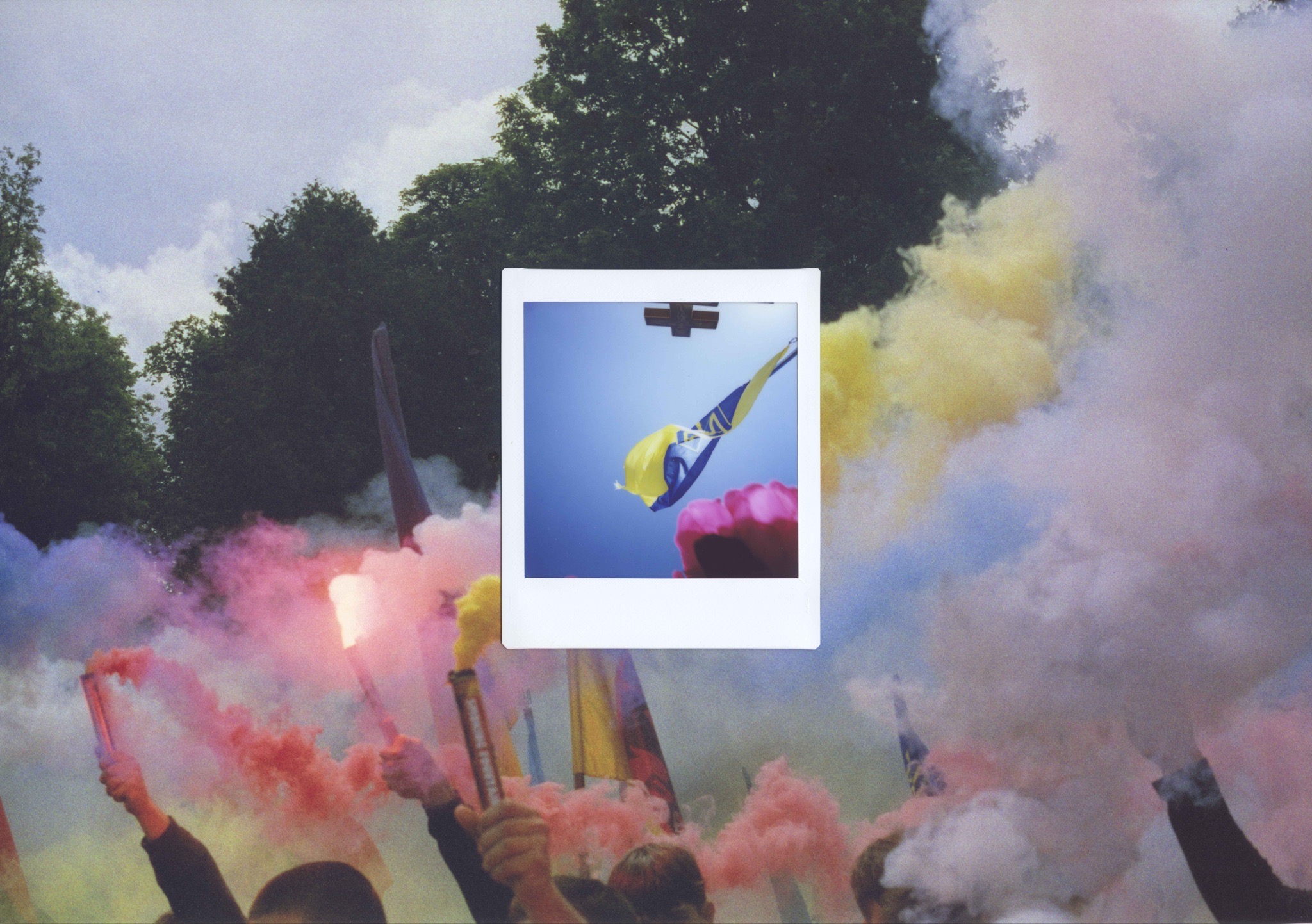
Looking at photography today broadly, it's painful to admit: the images themselves are often masterfully crafted and deeply evocative, yet the reality they portray is horrific. And despite their strength, they cannot bring immediate, sweeping change. Still, when we look back on the full-scale invasion, specific images instantly surface in everyone's memory. We might remember the photographer's name or we might not, but key events lodge in our consciousness as static pictures—not as lived personal experience, but as visual testimony we confronted.
Even if photography doesn't change the world instantly, it retains immense power. It remains a medium to maintain a dialogue with the world on multiple levels. Photography created during full-scale war serves as a vital bridge to the outside world. And to our internal world as well, given how fractured our society is right now, with everyone carrying vastly different experiences; photography helps us process and understand them. It can act as that "soft power" helping us foster meaningful dialogue across different experiences—both within Ukraine and internationally with partners and global audiences.
At the same time, accepting that war—which any rational person views as deeply unnatural—seems to be an enduring part of human history is difficult. Painful as it sounds, even a recent exhibition in Kyiv titled Image Impact offered a sobering cross-section of various armed conflicts around the globe.
Yet it is comforting to know that one's skills can support others. For soldiers, feeling remembered and supported is essential, and photojournalists carry out that mission bravely. On every level, photography functions uniquely: fine art photography speaks to one audience, documentary to another, international media coverage to yet another. Step by step, we can find the right key for each.
— Why does conceptual photography resonate with you, and why does it feel right for addressing war?
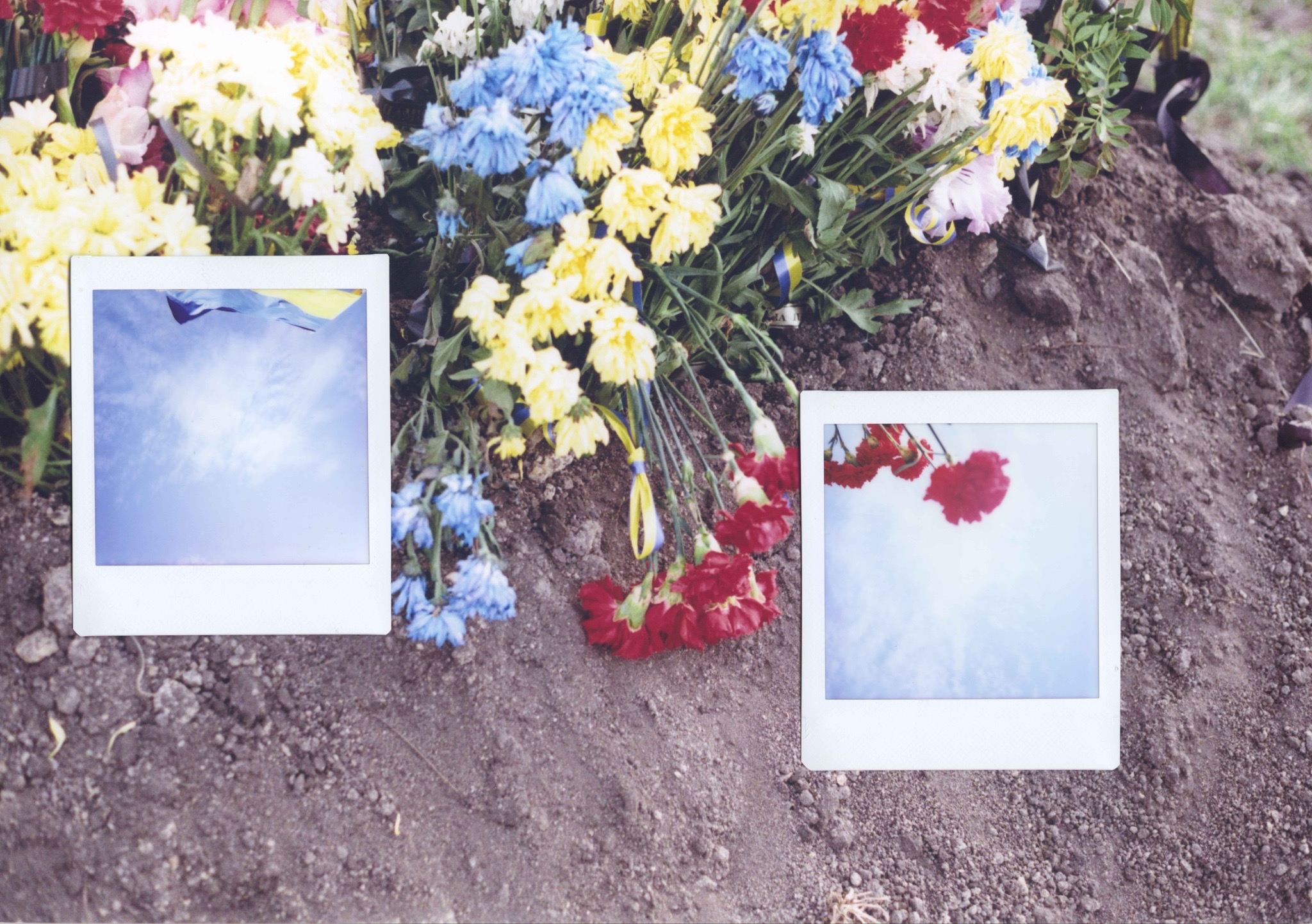
— Through art and conceptual photography, you can speak in your authentic voice—as an individual, a citizen, and an artist. Within this space, I discovered what genuinely matters to me, particularly through the project "It Could Be Silence." It reflects on the individuals who stepped up to defend all of us, including me personally, and stems from a deep desire to honor those who, tragically, returned "on their shields."
Art photography emerged as my most natural form of expression. It became my way of expressing gratitude—by coming out, capturing the image, and continuing to do so. It simply proved to be the most accessible and organic medium for me. Had circumstances been different, my path might have looked entirely different.
— Could you elaborate on your project "It Could Be Silence"? What sparked the idea and got it started?
— The initial spark came in the very first weeks of the full-scale invasion, when obituaries for fallen Ukrainian soldiers began filling social media. It hit me that so many of them were ordinary people just like me, who found the courage to defend the country and, tragically, lost their lives. While there were career military personnel among them, they were all everyday people at heart.
I spent those first weeks at my parents' home in Korsun-Shevchenkivskyi, in the Cherkasy region. It's a beautiful small town where granite formations of the Ukrainian Crystalline Shield surface—a massive tectonic plate underlying most of Ukraine that crops out as cliffs, quarries, and riverbanks. In Korsun, it forms a breathtaking landscape.
Walking among those ancient, timeless rocks, I reflected on growing up surrounded by that beauty and how it shaped me. That's when the parallel struck me: there is the Ukrainian Crystalline Shield—such a poetic, striking name—and then there is our human shield: the warriors who stood up to protect us and, tragically, returned "on their shields."
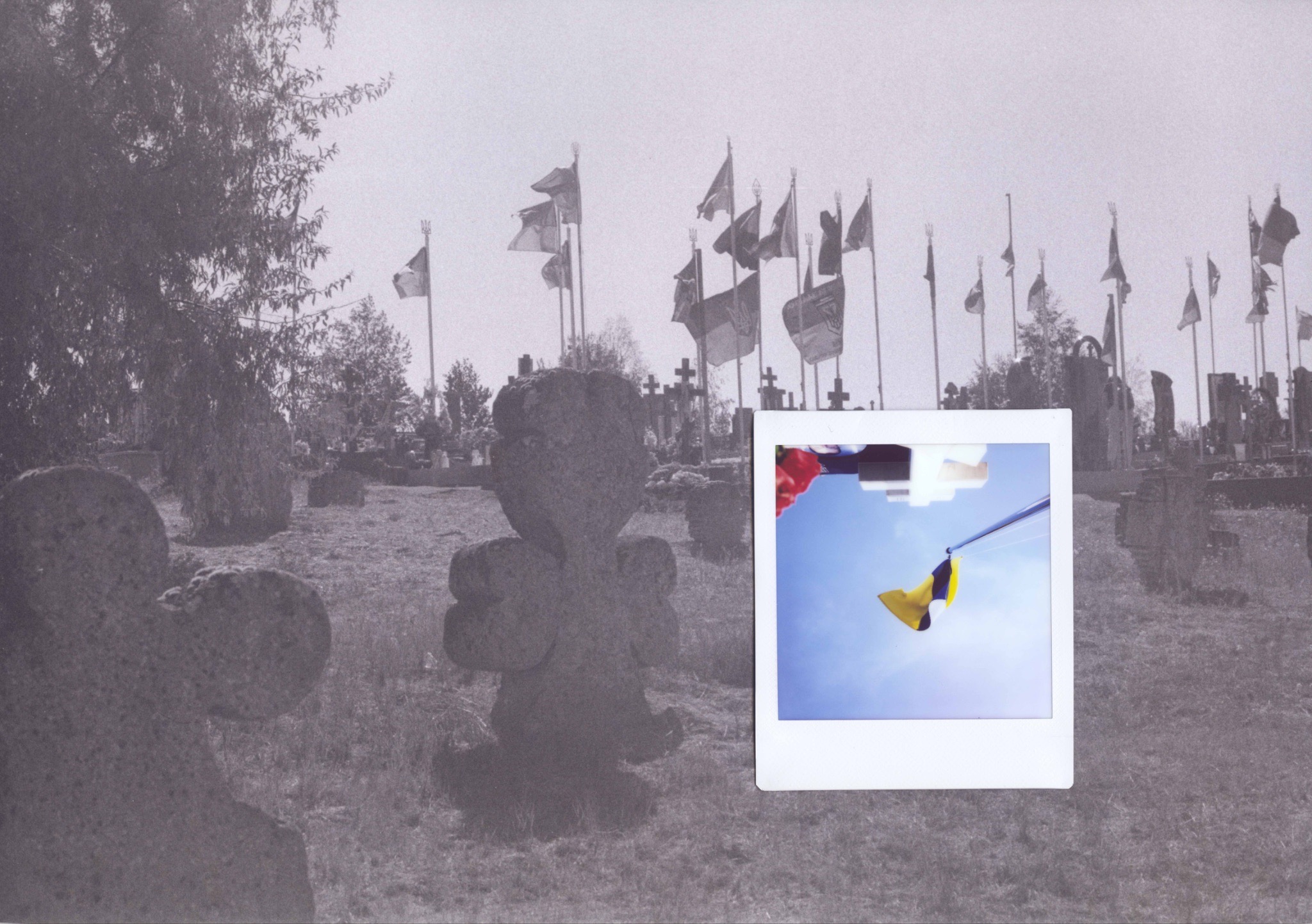
At first, I naively assumed the full-scale war wouldn't last long, that everything would be resolved quickly because war is fundamentally uncivilized. In my innocence, I thought I could honor every single fallen soldier. I even began saving every post and story about the fallen that I encountered online.
Then came the liberation of the Kyiv region, revealing the atrocities committed there, making it painfully clear: this is an existential war. It is rooted in hatred toward us as a people, toward our Ukrainian identity, and it will be a long conflict. At that point, I set the project aside and, frankly, locked it away in my mind.
Then in 2024, I participated in an extended workshop on memory, art, and history organized by the NGO "Museum of Contemporary Art." The program ran for several months: we studied how art processes historical trauma—following WWI, WWII, and the Holocaust. We had an extraordinary group of artists and inspiring curators, with everyone developing their own project at the intersection of art, memory, and commemoration.
That supportive environment brought my early concept back to life, giving me a safe space to test it out. Seeing the positive reception confirmed that the concept translated clearly, resolving many of my initial doubts about how it might be perceived. I was determined to avoid anything that looked like exploiting a painful subject. In March 2025, as the workshop concluded, one of our guest speakers, Yulia Bashlakova, offered financial backing to launch the project.
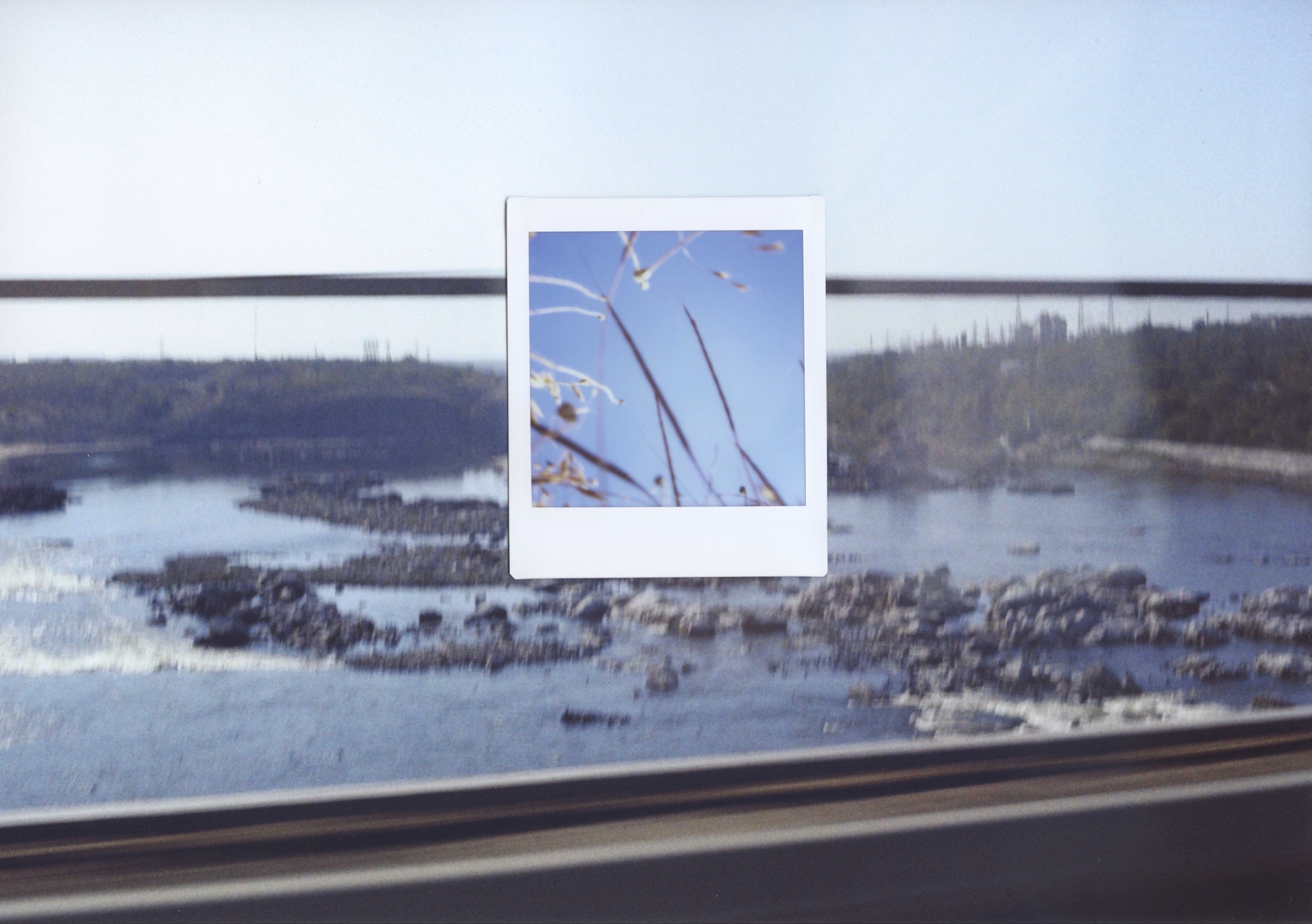
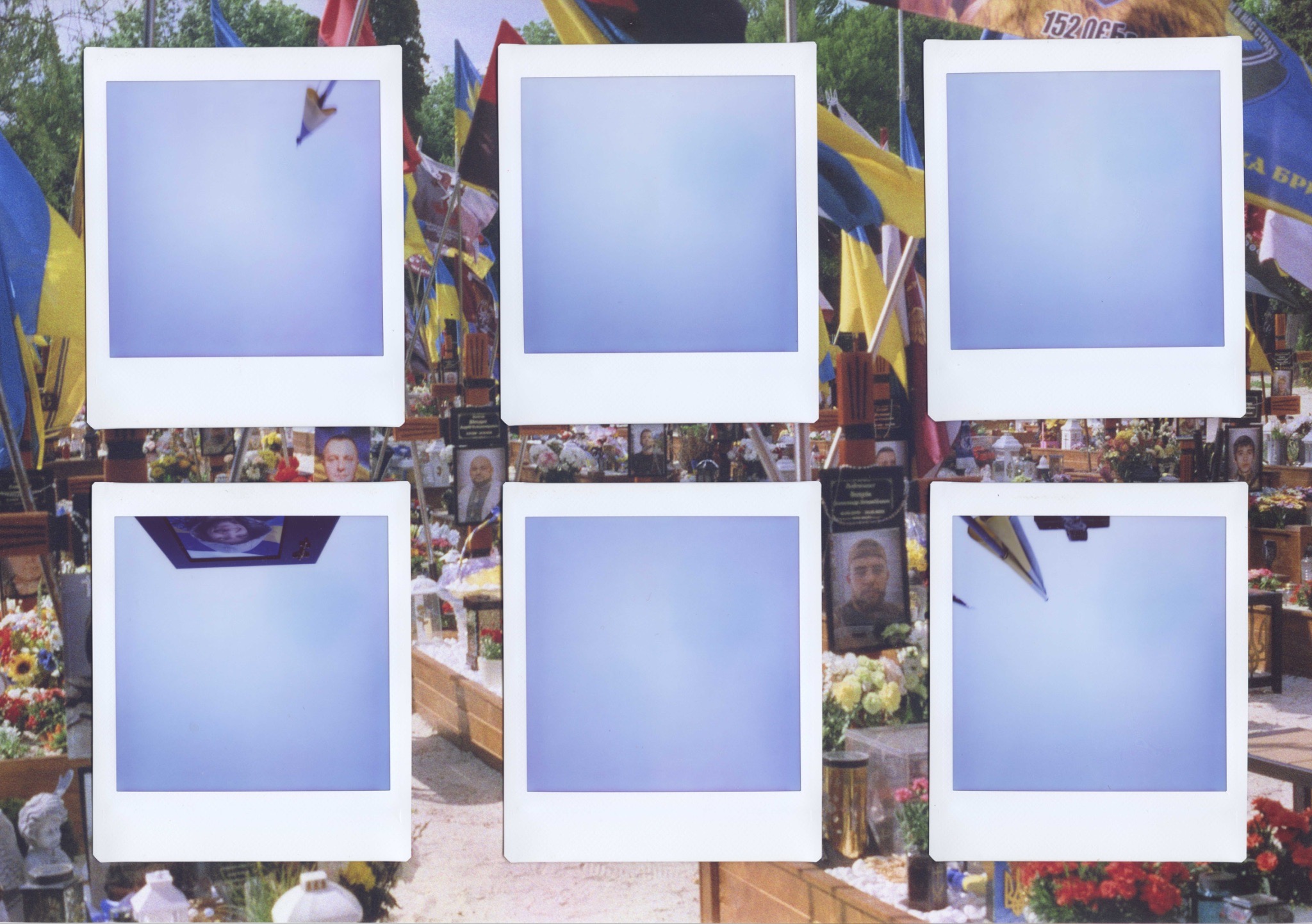
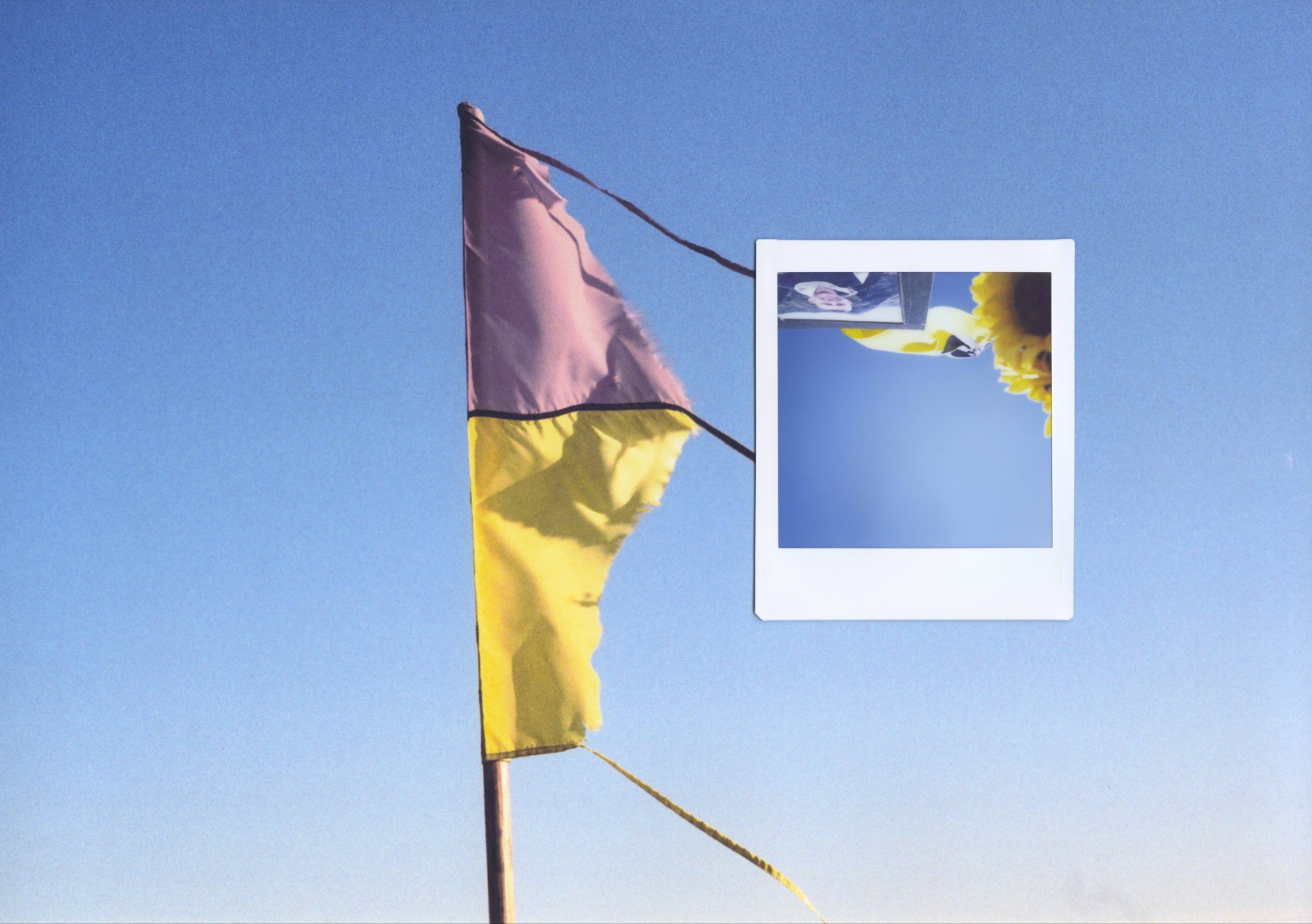
I started shooting in my hometown of Korsun. It was the easiest place to begin: I knew the cemetery layout and the military memorial section. I have continued building the project ever since: visiting Heroes' Alleys, capturing the sky above each fallen soldier's grave, and writing their name, lifespan, and resting place on the back of every print. I've traveled across numerous regions, towns, and villages—now I pack my camera for every trip I take.
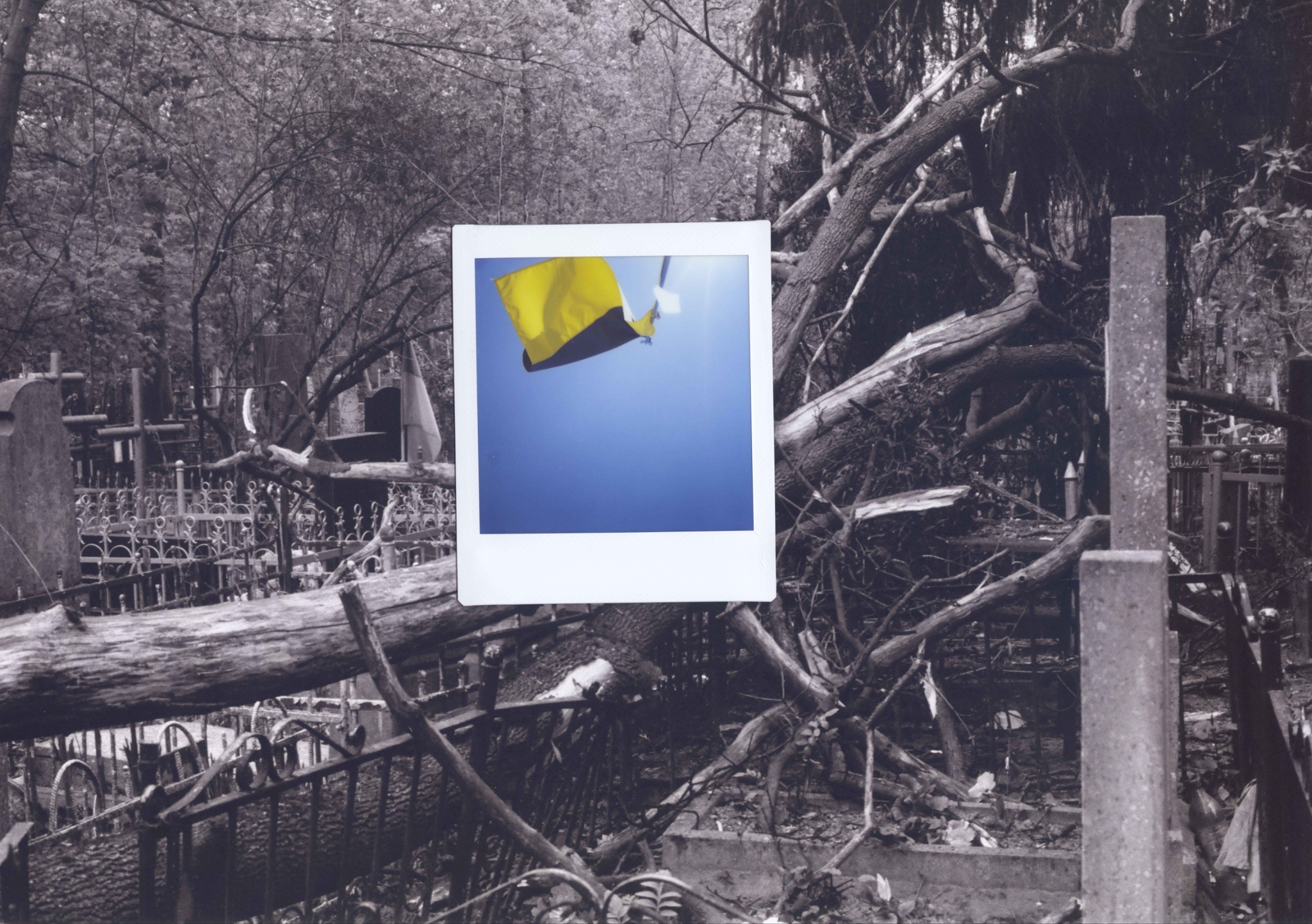
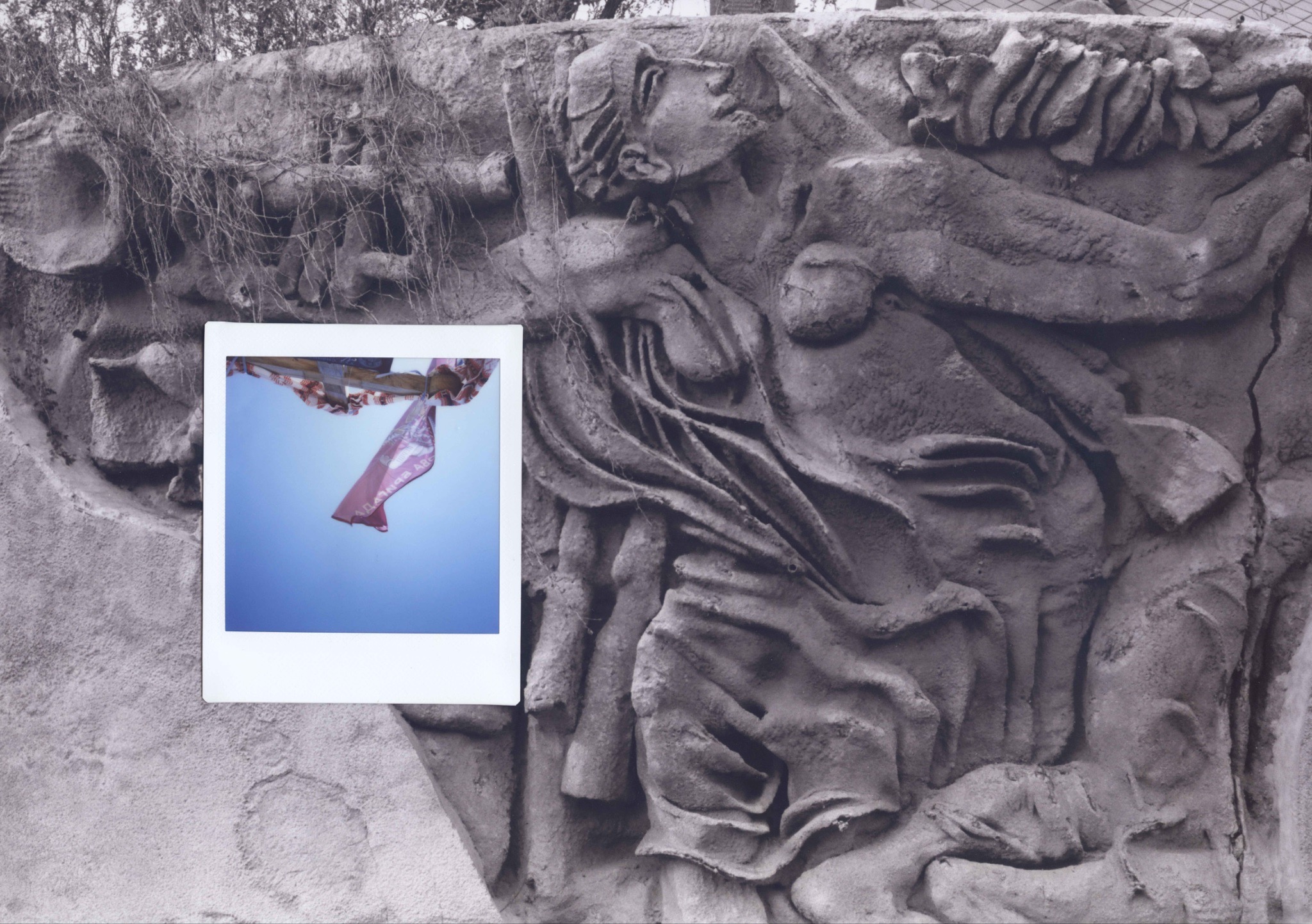
For this project, I chose Fujifilm Instax over Polaroid. Practically speaking, Instax film is more affordable, but more importantly, it delivers far more consistent and predictable image quality. Classic Polaroid film often yields unpredictable results—which is wonderful for experimental work, but when you need reliability and confidence in every frame, Instax is much better suited.
The scale of loss is overwhelming. It might sound overly idealistic, but I truly hope to visit as many gravesites as I can. Currently, I have no fixed deadlines or set vision for its ultimate form—I am doing this primarily out of an inner calling.
During my travels, I frequently meet grieving relatives at the cemeteries—mostly mothers or wives. I always introduce myself and explain my work. They consistently respond with warmth, often asking me to capture the sky above their loved ones' graves as well. While I cannot ease their grief, I hope this small gesture offers a shred of comfort, showing them that even though I didn't know their loved ones, their sacrifice matters. So many people care deeply, and preserving this memory is vital.
I typically pack a specific amount of film per trip—say, seventy frames. Arriving in a new city, I locate the start of a memorial row or section. For example, at Lviv's Field of Mars, the layout is clearly structured: I know precisely which sections I've already documented and pick up where I left off. I walk down each row, photographing every grave consecutively until my film runs out—stopping right at that frame.
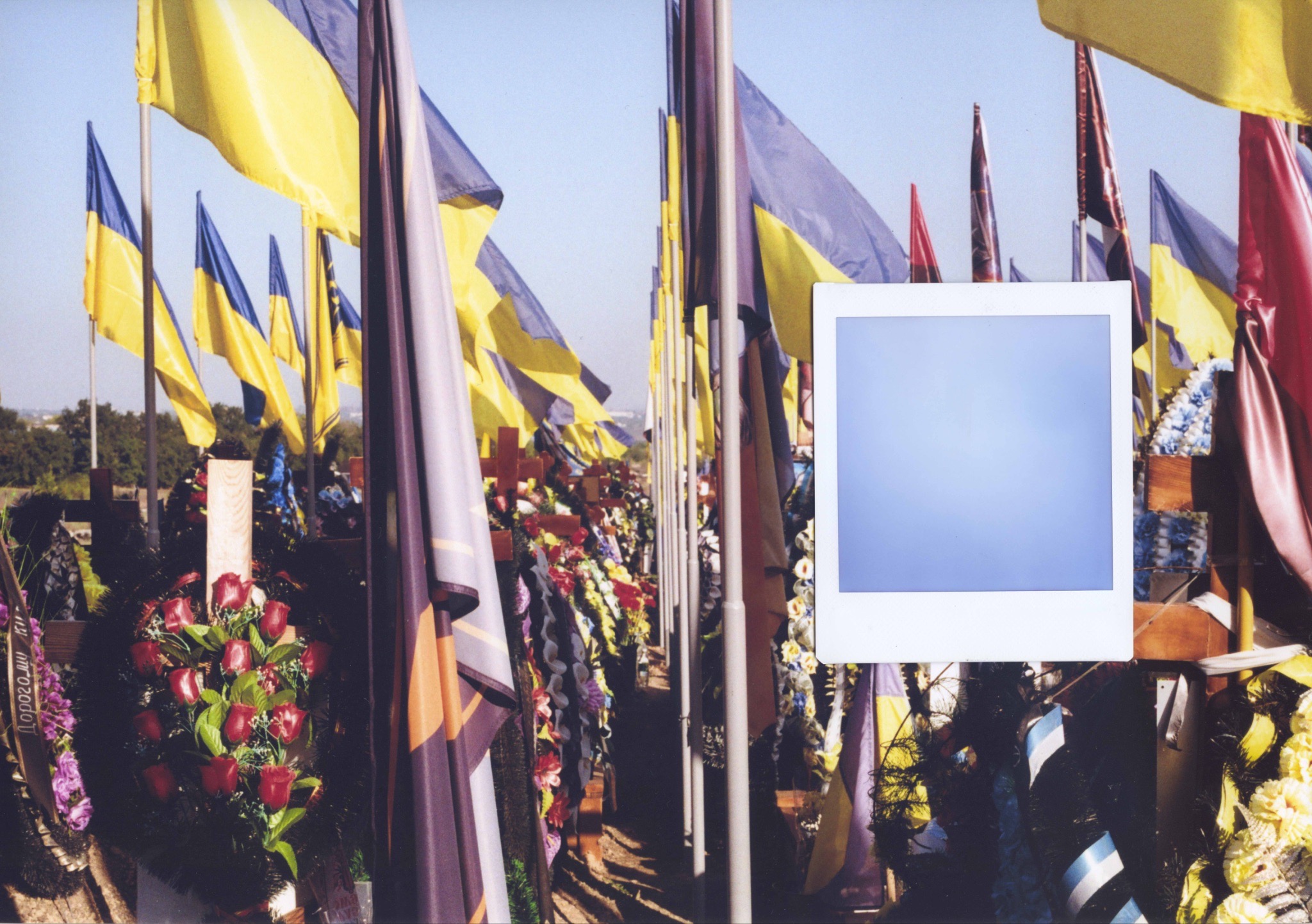
There are cities I visit frequently for exhibitions or events, and others I've visited only once so far. In larger cities like Zaporizhzhia, the burial sites are vast, making it impossible to cover everything in a single trip. In those cases, I mark my starting point, shoot sequentially for as long as film permits, and record where I stopped so I can resume on my next trip.
Alongside the physical prints, I maintain a digital index—logging all details to keep track of my progress. This database proved invaluable for an exhibition at the National Museum of the History of Ukraine in the Second World War, which opened on August 29, the Day of Remembrance of Defenders of Ukraine. Co-created with the museum and the NGO "Vshanuy" (which promotes the culture of the moment of silence), the installation featured a large display of sky prints alongside narrative walls detailing the history of the moment of silence. Our team also produced an audio track reading aloud the names and ages of the fallen. This recording incorporated every soldier I had documented up to that point, plus over four hundred names provided by the museum—both Ukrainians and foreign volunteers whose personal items are preserved in its collections.
— You mentioned meeting soldiers' families at cemeteries. Are there specific encounters that stayed with you?
— You know, every interaction with a mother or wife leaves a lasting imprint. Within the scope of the project, I can't share every individual story, but that is precisely why I photograph each grave separately—to speak about the collective loss while honoring every individual. I want people to grasp the immense scale of tragedy while recognizing that behind every single print lies a complete life, an entire universe.
When the Lviv exhibition opened, a young woman approached me and invited me back a week later—for the anniversary of the death of her loved one, serviceman Oleh "Krylov" Khrystenko. He was a vibrant person with a wide circle of friends and comrades. That day, they gathered at his grave to honor him and recite the Prayer of a Ukrainian Nationalist. A meaningful moment at the Field of Mars occurred when I photographed the sky above his grave and immediately added that print to the ongoing exhibition display.
I get to know these departed individuals through the memories and stories shared by their families and friends. It's a profound feeling—knowing so many people posthumously through the eyes of those who loved them.
Another memorable encounter happened when the project was first showcased in Kyiv. In partnership with "Vshanuy," we presented the work inside the Teatralna metro station. A young man came up to me and mentioned he was also from Korsun-Shevchenkivskyi. He said: "My uncle was killed in action; he's buried near Korsun, in the neighboring village of Harbuzyn. Could you visit his grave and photograph the sky there?" As it turned out, I had already been there—those prints just hadn't been selected for that specific display. I told him I remembered that cemetery well: four soldiers rested there, and I had already captured the sky above each of them.
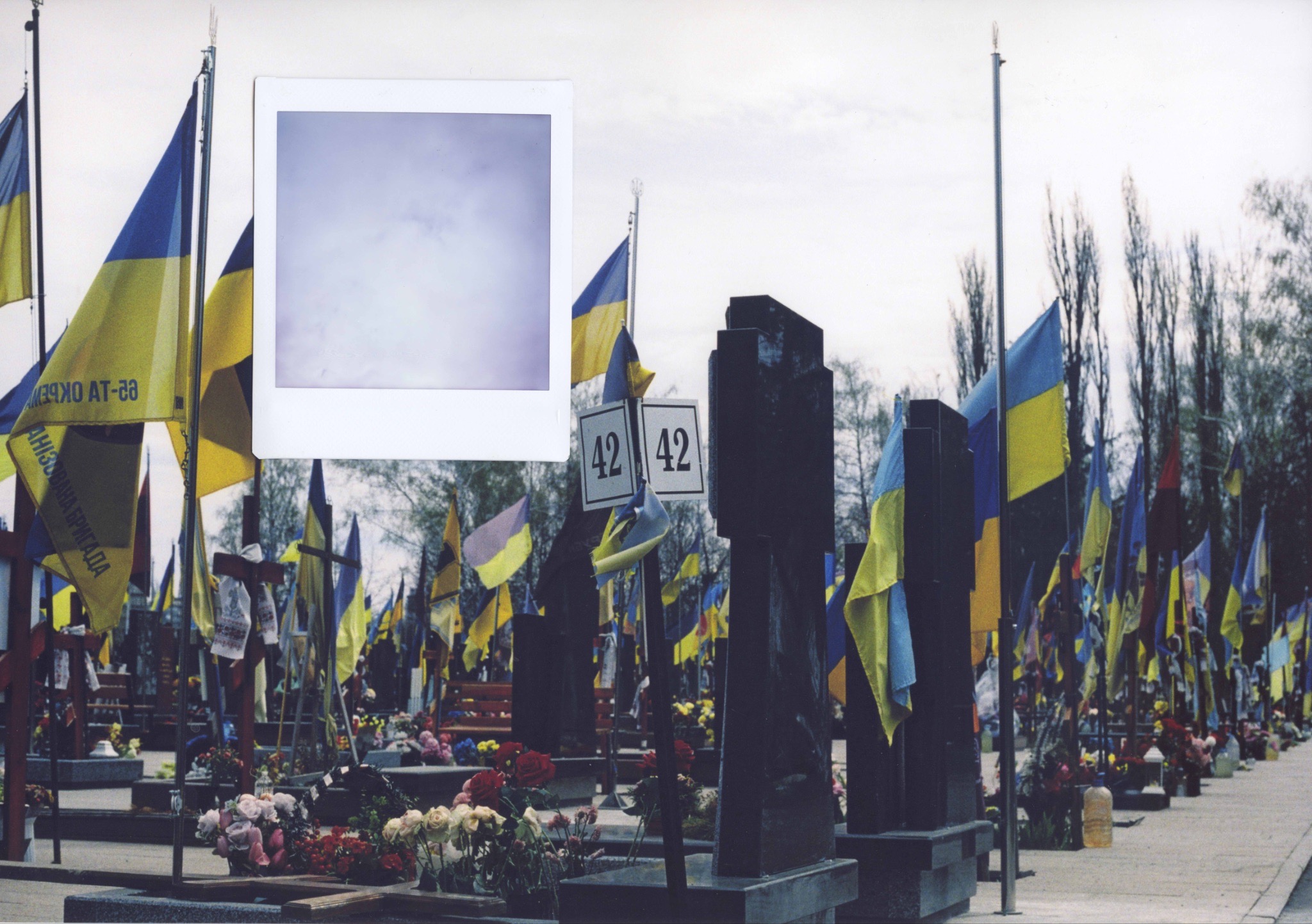
I remember a story I came across on social media during the exhibition at the WWII Museum. A young woman wrote that her friend, a soldier, had been reminiscing that morning about a fallen comrade—sharing stories of their service and what a bright person he was. That evening, she visited the exhibition and spotted that very soldier's name. She snapped a photo of the card, sent it to her friend, and he confirmed it was indeed his fallen brother-in-arms. It turned out I had already visited his grave.
Naturally, one wishes the reasons for these encounters were different, but moments like these remain etched in your mind forever. And of course, I spend a lot of time talking with mothers and wives of the fallen—it is always deeply meaningful to hear their personal memories of those they lost.
Beyond its poetic and metaphorical resonance, the imagery of the sky holds a quiet spirituality—not necessarily religious, but something everyone ponders. When we lose loved ones to war, beyond preserving their memory, we feel a deep longing for connection. A woman might speak to her fallen husband simply by looking up. It isn't about a conventional idea of heaven, but a sense of presence, enduring strength, or unseen protection.
In conversations with women at gravesites, we often return to this thought. To me, the sky as a person's hypothetical final view evokes both absence and presence, vastness, and a tether that helps people endure grief.
At the end of exhibition openings or events, I always tell attendees: if you want me to visit a specific resting place, come talk to me, we'll exchange contacts, and I will go. Once, the mother of a fallen soldier invited me to her town in the Kyiv region. She pulled out her phone, showed me a photo, and said: "On my way here, I just looked up and took a picture of the sky—the clouds were so beautiful, and one looked just like a wing." That simple act—glancing upward—helps ground you in the present moment. We usually live on autopilot, but looking at the sky forces a pause. I know many now view the sky as a threat, expecting Russian missiles or Shahed drones. But the threat is the enemy, Russia, not the sky itself. I feel comforted knowing others still look up with wonder, just like I do. When that mother shared her photo, I got goosebumps.
— Belgian photographer Anton Kusters documented the sky above Nazi concentration camps for The Blue Skies Project. Were you inspired by his conceptual work?
— When the idea for my project came to me, I hadn't heard of Kusters' work. I discovered his project later while refining my concept during my studies. Many artists and photographers turn their lenses toward the sky and clouds, so I lay no claim to singular novelty here.
Although Kusters and I use a similar visual device, we are telling fundamentally different stories. At the same time, we share a core impulse—assembling numerous fragments to reveal both the magnitude of trauma and the fine line between presence and absence.
— On one hand, without photography, you might not confront grief and war so directly. On the other hand, without documenting it, processing it might be even harder. Is photography in this context more of a trigger or a form of therapy for you?
— For me, it is definitely more therapeutic. That applies not only to my own photography, but also to how I engage with work by other artists addressing the war. Photography offers a way to remember, to prevent ourselves from forgetting, and to leave enduring evidence.
I recently watched a lecture exploring memorial practices and design approaches. Sometimes, memory is preserved precisely by honoring an absence—like the Twin Towers memorial in New York, where empty footprints mark where the skyscrapers once stood.
I've reflected on this a lot living in Kyiv's Solomianskyi district, near several residential buildings damaged by missile strikes that have already been rebuilt. For the residents, that reconstruction is wonderful because they have their homes back. The scale of this war is so vast that we cannot preserve every destroyed building in ruins as physical evidence of crimes. It is good that part of our city can be restored. There is an understandable urge to clean up quickly, rebuild, and move forward.
Yet when it comes to long-term, intergenerational memory of these crimes, we must find enduring methods. We see how past crimes committed by Russia against Ukraine were systematically erased or suppressed. Look at the Holodomor: documented, physical testimonies from survivors are scarce. Many who survived preferred not to speak of it to their children and grandchildren. We must find ways to discuss these events to hold onto memory and prevent history from repeating itself. Human memory is short, and without active commemoration, society risks acting a generation or two later as though nothing happened.
I believe art is uniquely equipped to speak to these truths on an emotional and sensory level, passing that experience forward. Of course, direct documentary photography remains essential—we have many brilliant professionals creating work so powerful that these visual records will undeniably stand the test of time.
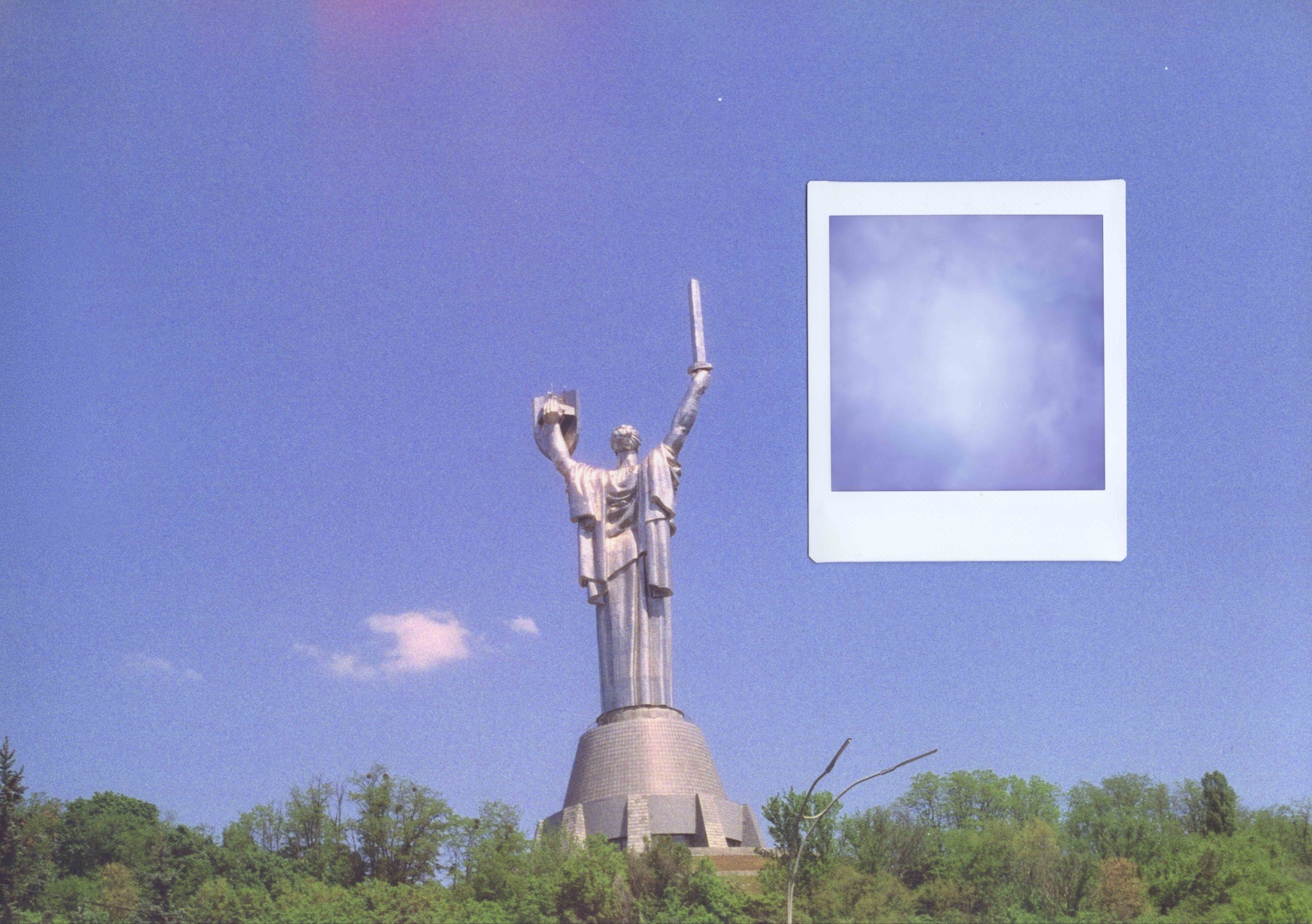
So for me, photography acts as therapy rather than a trigger. I refuse to avert my eyes. I need to witness and understand, even when facing harrowing realities. I remember reading terrifying accounts after the liberation of the Kyiv region, agonizing over the fact that these atrocities occurred a mere 15–20 minute drive from where I stayed in Kyiv. It was horrifying, yet I forced myself to read those accounts to etch them into memory—ensuring they guide my future choices, including my commitment to support our military.
If I have children one day, I will talk to them about this—not to instill hatred toward Russians, but to cultivate such a deep love for Ukraine and for the Ukrainians who made our lives possible at the cost of their own. I want that love to guide their life choices. On a monument to fallen soldiers I visited in Yuzhne, Odesa region, an inscription captured this sentiment perfectly: "A true warrior fights not because he hates what is in front of him, but because he loves what is behind him." He loves his family, his loved ones, and that is why he steps up to defend. We are not aggressors; we did not attack—we are defending what is ours.
— Tell us about your project Recovery ("Healing"), created during the early stages of the full-scale war.
— In the Recovery project, Polaroid became a medium for releasing raw, immediate, and intense reactions. Back in Korsun, working with Polaroids truly saved my mental state. I don't drive, so when the invasion started, my family planned our departure: my father drove from Korsun while we walked toward him from Kyiv toward Obukhiv. Though that route was relatively clear, a trip that normally took two hours dragged on much longer. Naturally, I couldn't pack much—just a single backpack. Alongside a folder of documents and a few changes of underwear, I packed my Polaroid camera and every pack of film I owned. I didn't even think to save my old physical photo prints. I remember looking around at my books and collections, bidding them a silent farewell since no one knew what lay ahead. But I brought the camera and film. Eventually, we returned to Kyiv and found everything intact: my apartment survived, my photobooks were safe, and my collection has only grown since.
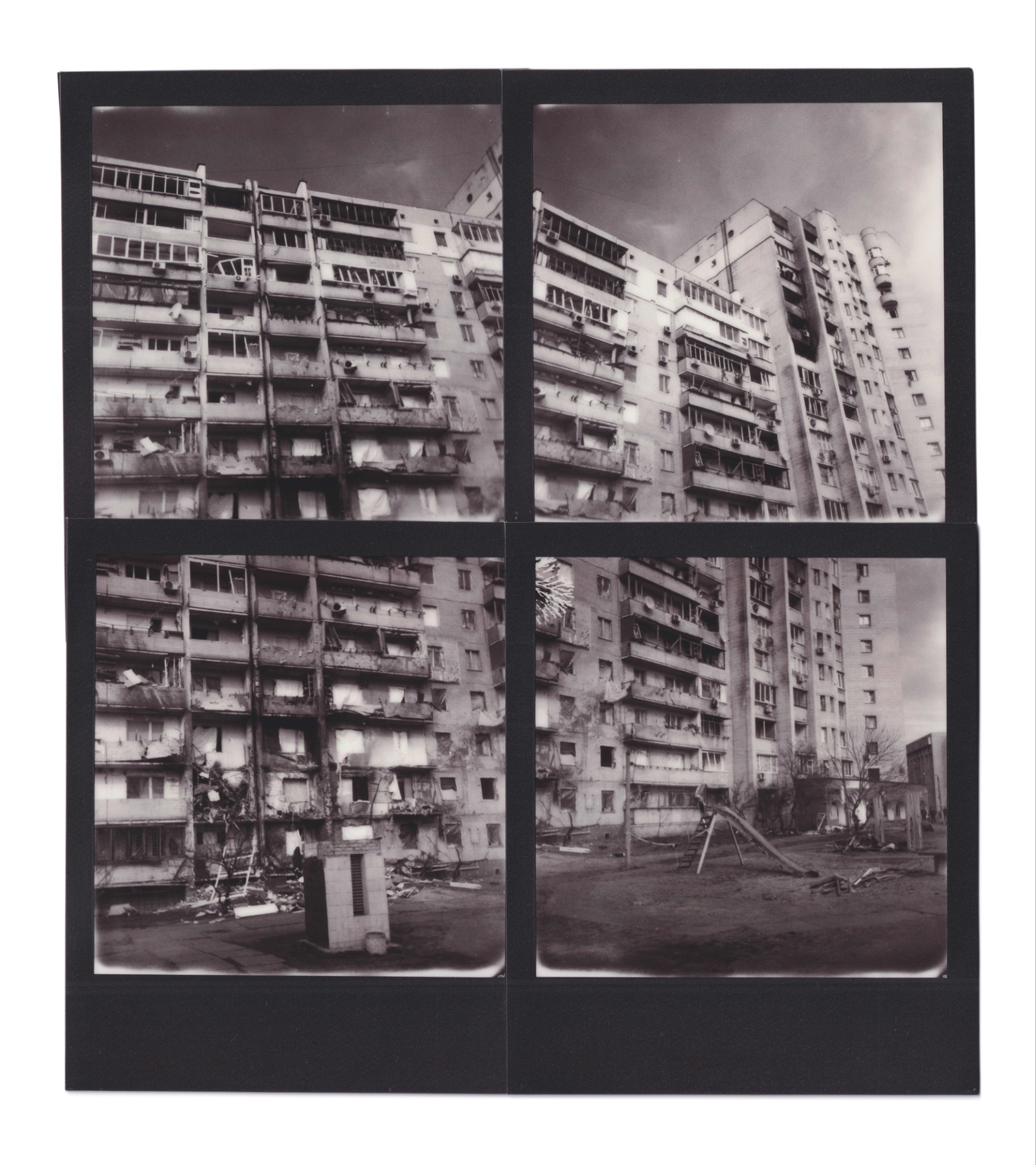
The Recovery series took shape throughout 2022–2024, during my period of active physical intervention on prints. Only a couple of shots depict damaged buildings; the rest reflect internal emotional states translated into artistic Polaroid forms. The series primarily explores personal mental states, emotions, and self-perception within a transformed reality.
— What serves as your source of inspiration today? What fuels your drive to keep photographing?
— Over the past two years, I've focused exclusively on "It Could Be Silence." Inspiration doesn't quite capture what fuels it. It's hard to phrase without sounding unusual, but visiting cemeteries and photographing graves feels like my personal sacred duty to honor those we lost. Words fail to fully articulate what I feel during the process. While it isn't easy, working on this project has made me cherish life far more deeply. You quickly realize that most everyday anxieties aren't worth obsessing over. So rather than conventional inspiration, I am driven by a profound desire to pay tribute to as many people as possible who gave everything.
In truth, the most challenging moments occur not at the gravesites, but back in my studio when I transcribe the names and dates into the archive. That is when the scale of loss truly hits me. It is especially heartbreaking when I log birth dates of people significantly younger than me. My younger brother is in the military, so seeing fallen soldiers his age hits very close to home.
So again, it's less about artistic inspiration and more about an internal need to honor memory, paired with seeing how deeply it touches others. Collaborating with the team at "Vshanuy" on joint initiatives has shown me how much this means to grieving families. That impact is the fuel that keeps me going.
Regarding purely artistic projects, to be honest, inspiration felt largely absent over the past two years. I try to manufacture it intentionally, because waiting for spontaneous inspiration is a myth—you simply have to set the conditions and push forward. Results vary: the ideas exist, but energy is often lacking. However, winter is coming. During winter, I shoot "It Could Be Silence" less frequently because Instax cameras struggle in cold weather—you have to keep them warm against your body, and spending long hours outdoors becomes difficult. I plan to use this upcoming lull to focus on developing an artistic project I've been planning.
Nika Mol is a Ukrainian artist working with conceptual and instant photography, and co-editor of the photography publication 525 by MYPH. Her practice explores memory, embodiment, loss, and transformation, blending analog photography with archival materials and manual interventions.
Her long-term project "It Could Be Silence" commemorates Ukraine's fallen defenders. Traveling across cities and villages nationwide, she captures the sky directly above soldiers' graves using instant print cameras. On the back of each print, she records the individual's name, lifespan, and burial site. Assembled into installations, these square prints form a "pixelated sky" echoing military camouflage. She simultaneously builds a digital archive of these records.
Winner of the MYPH Photography Prize 2026 and the Chromatic Awards 2023 in Conceptual Photography, she also received a Special Jury Mention at the Tbilisi Art Fair & IWPA 2024. Her work has been exhibited across Ukraine, Austria, Germany, France, Norway, and internationally.
Credits:
Interviewer and Author: Katya Moskaliuk
Photo Editor: Olga Kovalova
Copy Editor: Yulia Futey