
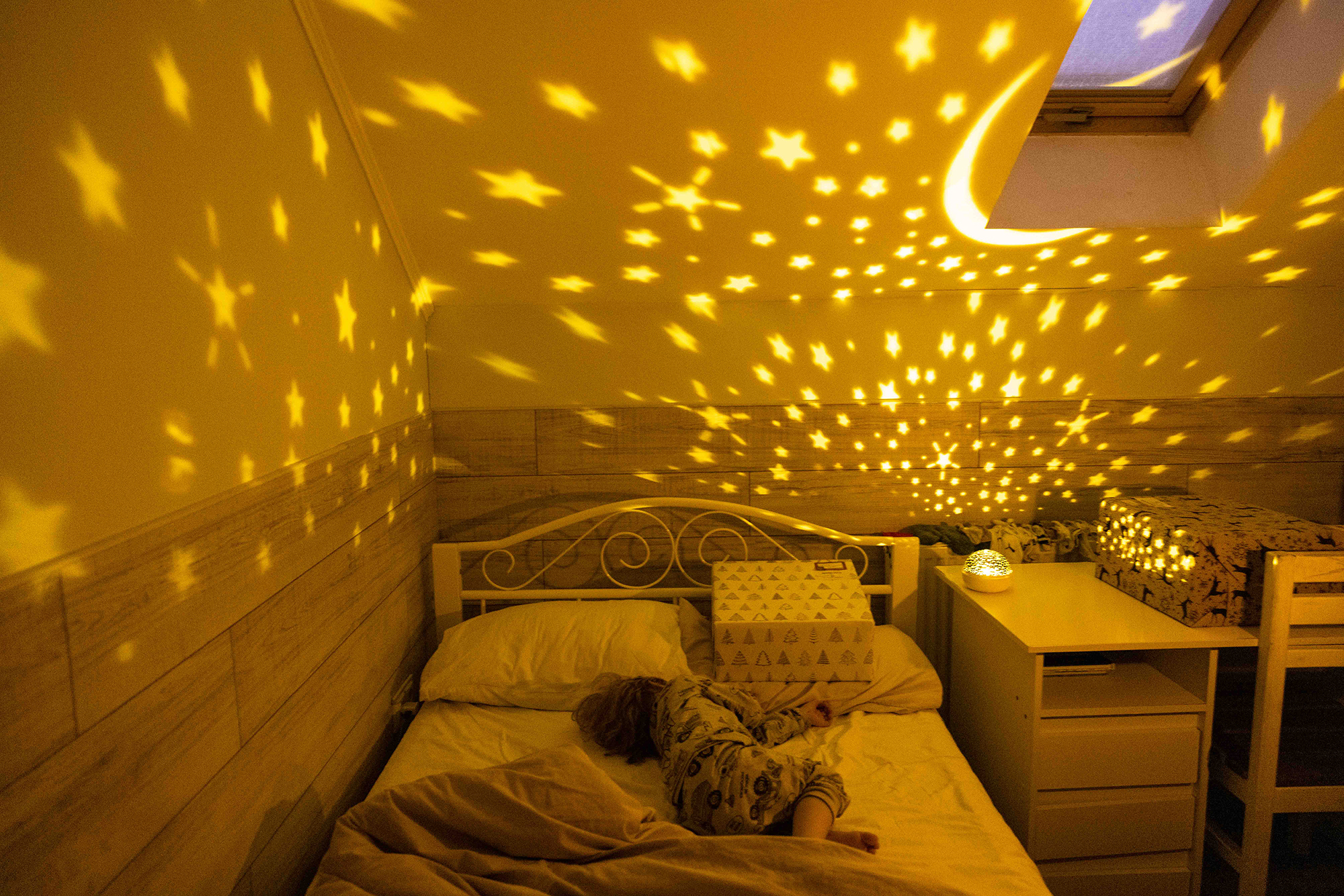
“City of Goodness” is a nationwide project launched by philanthropist Marta Levchenko in 2016. Today it is a large-scale space of comprehensive support for women and children who have found themselves in difficult life circumstances—for example, they have become victims of domestic violence, are at risk of ending up on the street, need support, socialization and reintegration, or live below the poverty line. Since the beginning of Russia’s full-scale invasion, it has also been helping children who were forced to evacuate because of the war.
“City of Goodness” has a Department for the Protection of Women’s Rights, a Medical Center with rehabilitation and palliative departments, plans for building an inclusive school, the “Khvostyky” shelter, a Center for Canine Therapy, and other areas. With the start of Russia’s full-scale invasion, it received evacuated children from orphanages. Today, in “City of Goodness”, the themes of war and vulnerable population groups are tightly intertwined.
“Miracles happen here”
“Just imagine how much work St. Nicholas has in our ‘City of Goodness’,” Yulia smiles—she has worked here almost since it was founded. I arrived here just before the holiday, and all the buildings and the grounds of “City of Goodness” are richly covered with garlands, and in the center there is a Christmas tree decorated with ornaments and lights. On the tree you can find the names of cities from all over Ukraine whose residents now live in “City of Goodness”. Among the crowd of children you can spot fairy-tale elves with huge hats and sizable ears. Adults and children hold decorative candle-lights in their hands, and artificial snow hints at winter. Everyone is waiting for a real miracle. “Miracles happen here, and wishes come true,” Yulia says, holding an unreal number of gift bags in each hand.

“City of Goodness” began with the idea of creating a safe space for women and children who have suffered from domestic violence, poverty, or homelessness. A woman with small children often becomes hostage to circumstances, and on her own she cannot manage to change her life. Everything began with helping mothers, but later the founders of “City of Goodness” realized that women needed a physical space—namely, a cozy home.
Mothers with children live in the first building. Today, there are significantly more buildings on the grounds, and the name “City of Goodness” explains its essence not only allegorically, but also literally. Nearly 300 women and children currently live in the shelter. A significant portion of them are children from three orphanages who evacuated to relatively safer regions. In “City of Goodness”, the themes of war and vulnerable groups are tightly intertwined. Here you can feel how the war affected not only frontline territories, but also families with children who were trying to pull their lives out of illness even before the full-scale invasion. The war only exacerbated all difficulties.
“A soft ball of fluffy happiness”
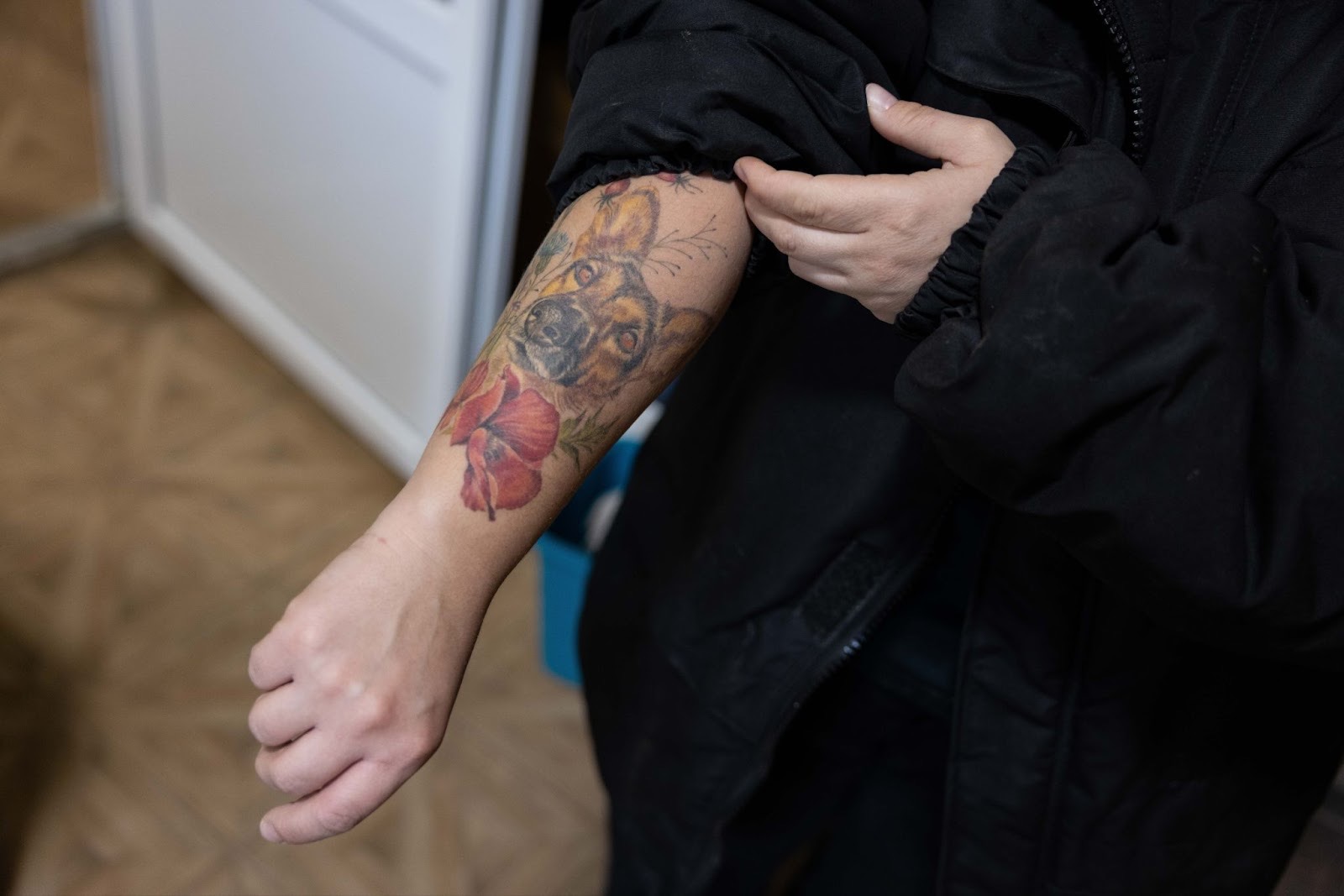
Anastasiia has a tattoo of a dog on her arm. By profession, she is a dog psychologist, but the image of a pet appeared after the start of the full-scale war. The woman ended up in Chernivtsi with her children from territory that is now occupied. She decided to go farther from the front line when the children began asking about the war and death. At first, Anastasiia lived in Zakarpattia—she began having panic attacks and disorientation. At some point, she found information about “City of Goodness” on social media, where she was provided legal, medical, and psychological assistance. Today she works at the animal shelter on the grounds of “City of Goodness” and even adopted a dog from there. It is that dog that is depicted on her arm.
In the spacious enclosures there are very different dogs, but all of them have remarkably expressive and kind eyes. The “Khvostyky” animal shelter building is designed so that the dogs can choose for themselves where they want to be—outside or indoors. When Anastasiia goes outside, all the animals move after her together.
Among the shelter’s dogs there are also therapy dogs. The Canine Therapy Center helps children overcome trauma and develop motor skills and emotional intelligence. Communication with animals is always positive emotions. Anxiety decreases, motivation to walk and talk increases, because children really want to come closer, give a command, or call the dog by name. In the process of contact with a dog, when children feed and pet it, fine motor skills and coordination develop. This is especially important for the residents of the “Butterfly House” as well.

In the learning room of the center, accompanied by a therapist, a boy is doing a puzzle. The dog Alisa helps him; the child feeds her treats from his hand. Canine therapy is a great method for developing interaction skills. Children begin to communicate better not only with the dog, but also with the therapist, relatives, and other children. “Give Alisa a treat, wait for her to take it from your hand,” canine therapist Ihor says. The boy feeds the dog and sinks his hand into her fluffy fur. “A soft ball of fluffy happiness” — that’s about Alisa.
“You have to smile”
Delicate butterfly wings made of white paper gently sway over children’s beds. Their outlines repeat the images on pillows, duvet covers, and sheets, as well as on the clothes of the staff. Butterfly images of different sizes and almost all colors are also stuck on the glass partitions between rooms. In the children’s hospice, the butterfly is a symbol of the vulnerability of children in palliative care and at the same time a sign of hope and thirst for life.
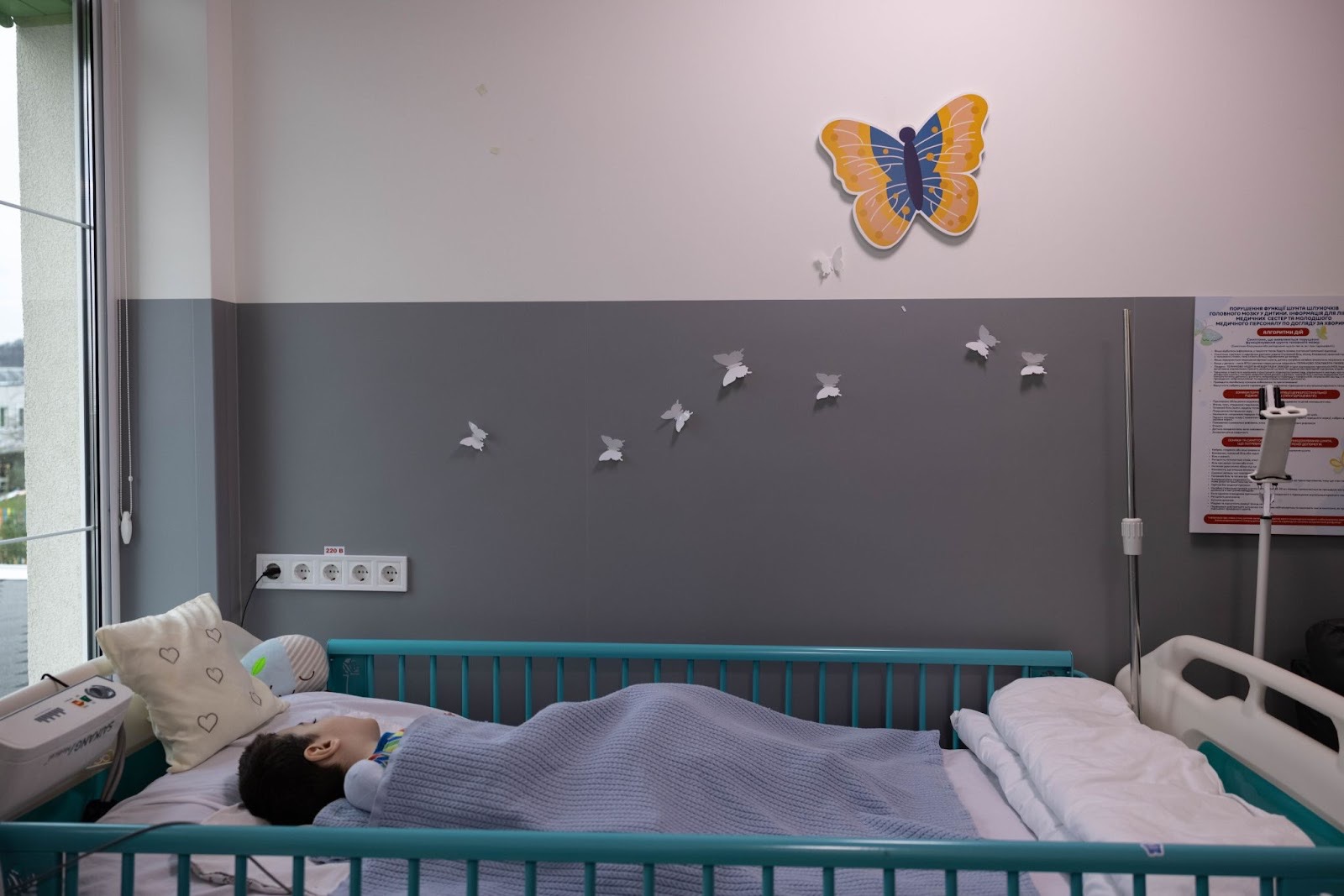
The hospice’s first child, Marichka, loved butterflies very much, and the adults promised to create a “Butterfly House” for her. People from all over the world sent the girl butterfly drawings — and in “City of Goodness” the butterfly became a symbol of support and the power of people uniting to help the weakest and create a dignified life for them. Besides butterflies, there are also unicorns, teddy bears, clouds, Spider-Men, and other characters that children love. Every detail here is a symbol of care and faith in miracles.
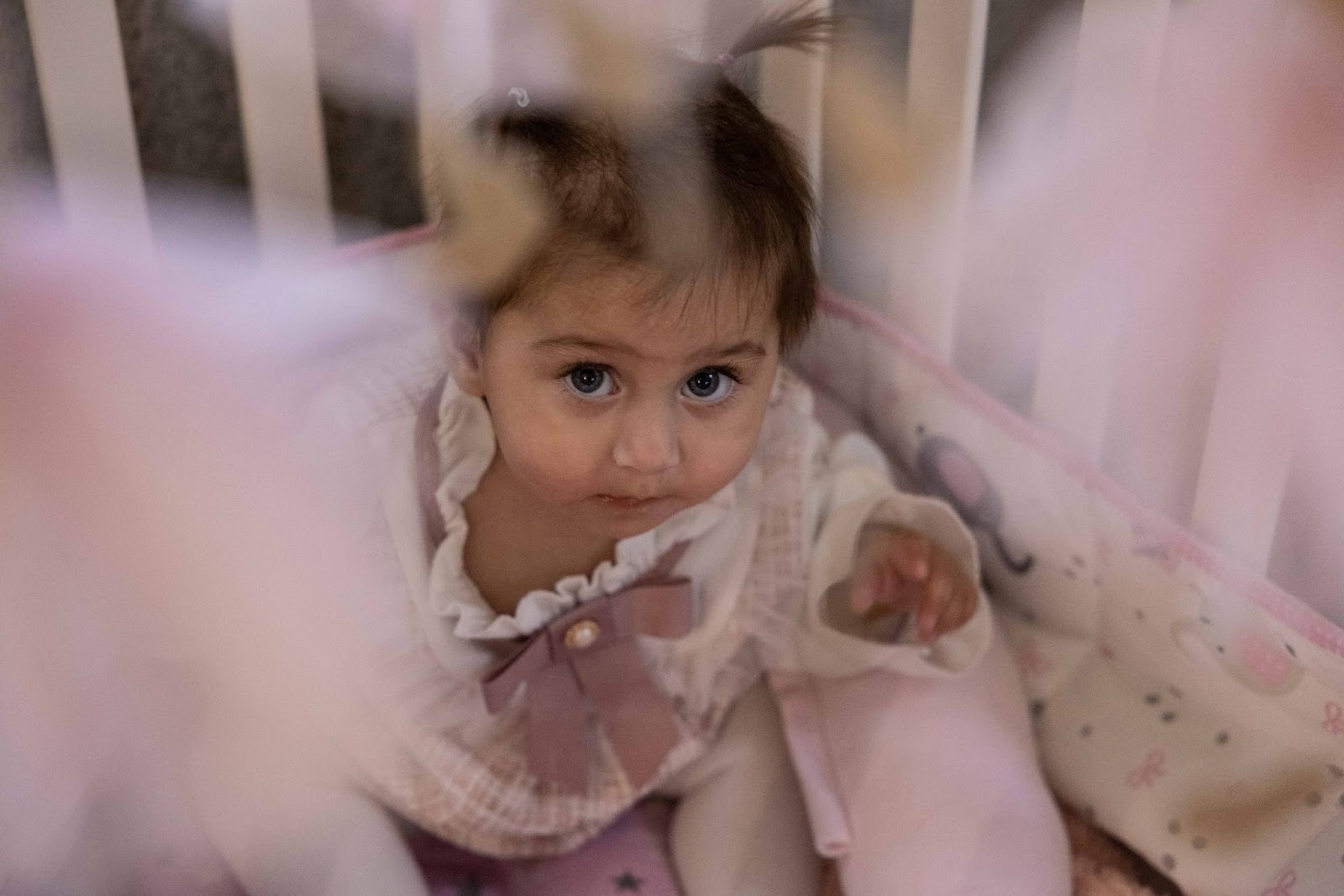
The “Butterfly House” combines a hospice and a rehabilitation center. Medics and nannies work here around the clock, helping children with disabilities and seriously ill bedbound children. There is a spacious glass terrace so children can see the sky and the garden growing around it. Calm, coziness, and flowers are probably needed by everyone, and especially by Butterflies. That is what, with a capital letter, they call the hospice’s children here. Today there are more than sixty residents in the “Butterfly House”.
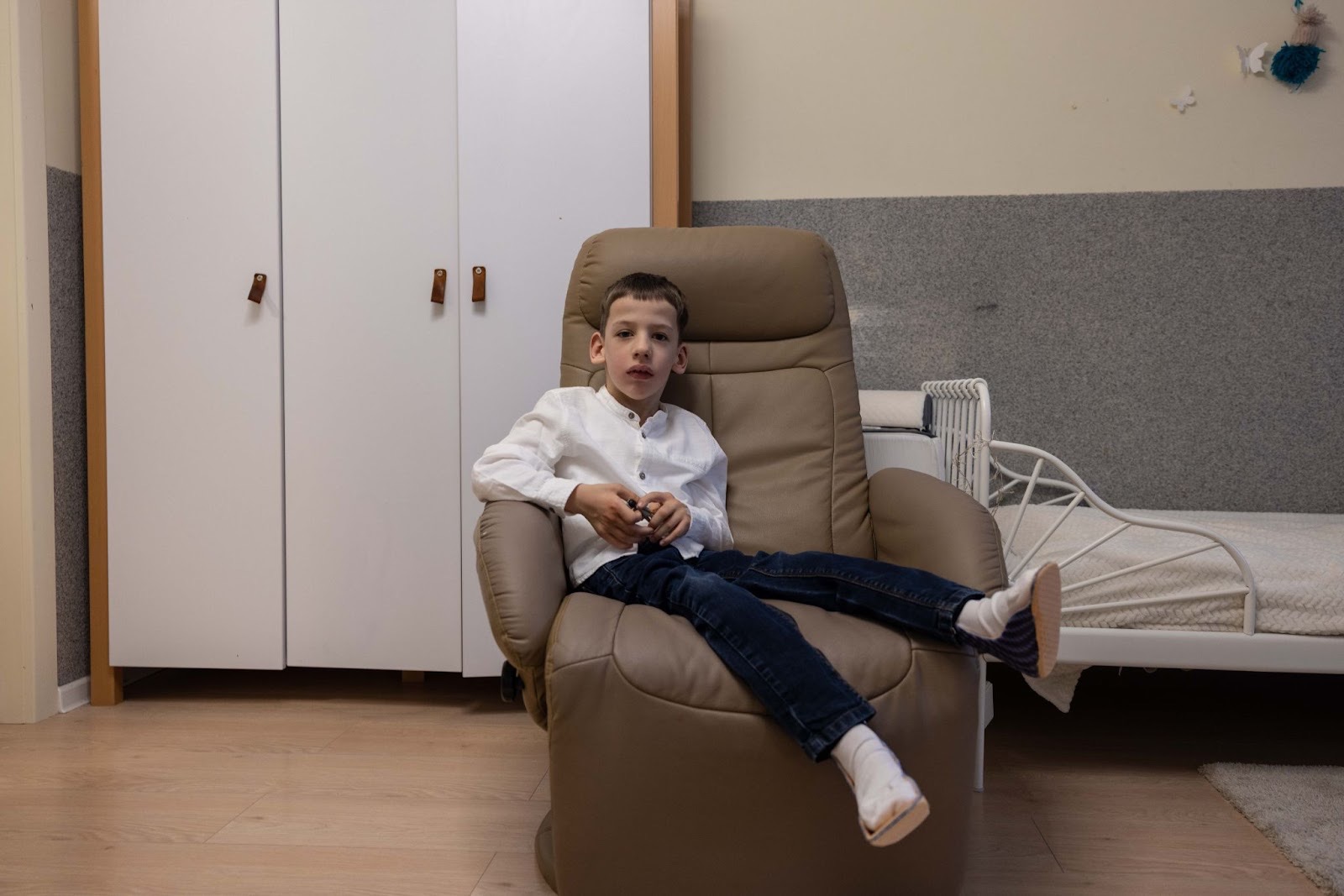
On the first floor of the “Butterfly House” there is the palliative department, and on the second there is the rehabilitation department. Children of different ages live there, who came to “City of Goodness” from all corners of Ukraine. One of the rooms brought together boys from frontline and relatively calmer territories. A boy named Ivan says he likes to take photographs. I give him my camera and he takes a few photos of the hospice staff — and also of me. “You have to smile!” Ivan says, and I smile back at him.

Kateryna Moskaliuk — a documentary photographer and journalist. She graduated from the Journalism School of the Ukrainian Catholic University. Her work has been published in Geo, Bloomberg Businessweek, Die Zeit, Bird in Flight, “Zaborona”, The Ukrainians, Forbes Ukraine, and others, and has also been presented at international exhibitions in Ukraine, the United Kingdom, the U.S., France, Germany, Armenia, Japan, and Hong Kong.
Photographer’s social media: Facebook Instagram
Worked on the material:
Topic researcher, text author: Katya Moskaliuk
Photo editor: Vladyslav Krasnoshchok
Literary editor: Yuliia Futei
.png)
.png)
%20(750%20x%20360%20%D0%BF%D1%96%D0%BA%D1%81.)%20(2000%20x%20800%20%D0%BF%D1%96%D0%BA%D1%81.)%20(750%20x%20360%20%D0%BF%D1%96%D0%BA%D1%81.)%20(1).png)


