
Survival on the border between Hodgkin and Grandt
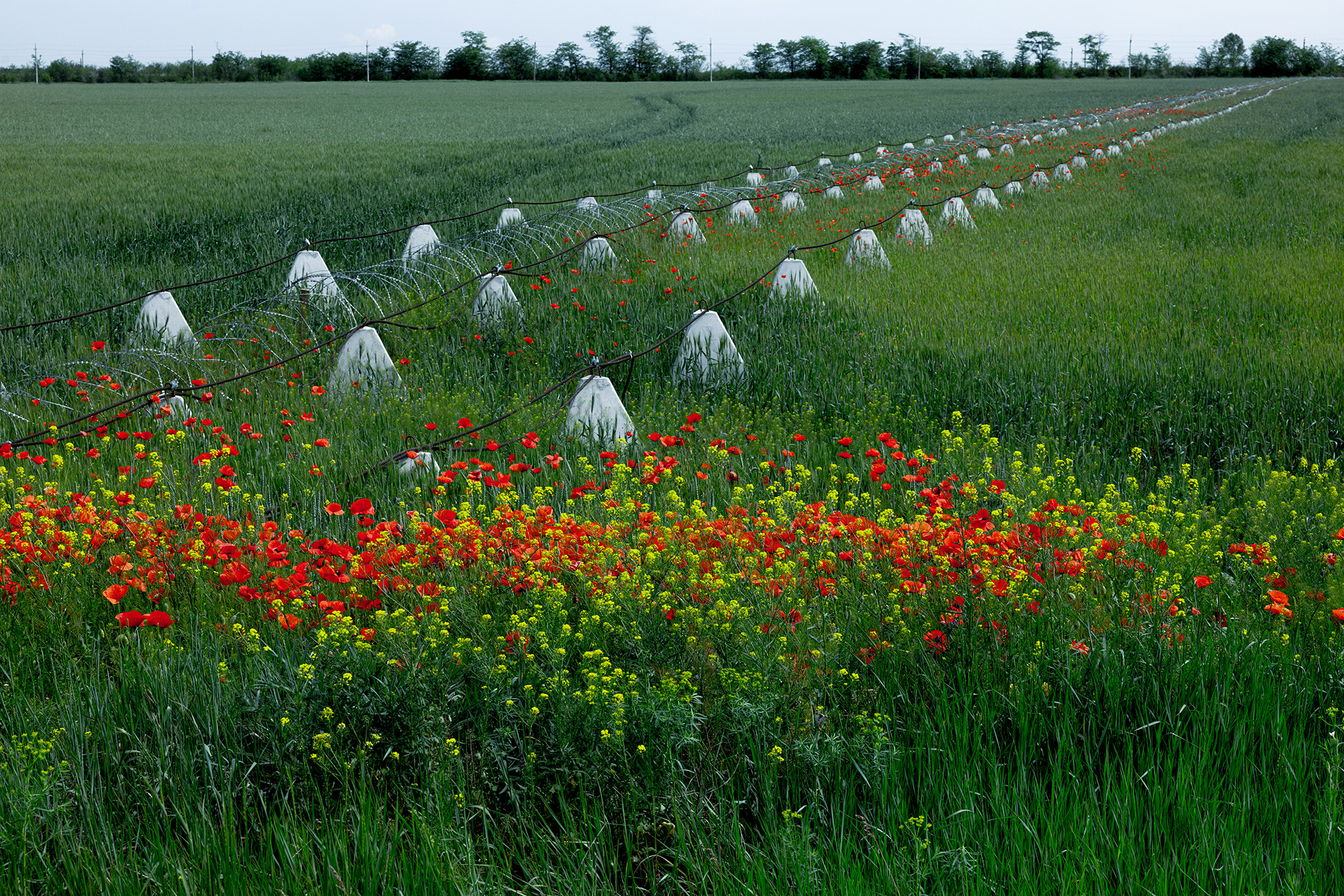
No, war is by no means picturesque or beautiful, but some of its elements are beautiful, a man told me more than three years ago, looking at a cloud of nitric acid over Rubizhne in April. When I look at this May photo by Serhiy Morgunov, I remember his words. No, it's not beautiful. Not beautiful at all. However.
A few years ago, such a landscape might still have seemed classic and contrasting — the beauty of nature and the threat of war, of course. Now, such a thought does not arise: anti-tank hedgehogs, dragon's teeth, barbed wire — a familiar part of the landscape, as man-made an element as a pond or a vine fence. Dragon's teeth really suit both meadows and fields. This does not negate the horror of war on earth, but it also does not negate the love for the land on which it takes place. This beauty does not embellish war, but instead exists in parallel with it.

Looking at this truly beautiful landscape, you understand not only how wars repeat themselves, but also that something is always lost between them. At least this photograph reminded me that there are no staff artists in this war — such as John Piper or Henry Moore in Britain during World War II. They had an official state assignment — to document the war with a brush. A series of drawings from the London Underground made Moore and his recognizable style famous. Sticking to his style, Piper asked to paint the ruins of cathedrals.
But even more interesting in this context is Eliot Hodgkin. He wanted to depict not only the ruins, but also the self-sown thistles, field mustard, and cornflowers that gradually, day after day, enveloped the ruins of London. They enveloped, stole, captured — but most likely, they reclaimed what humans had taken from them long before this war.
Documentary war photography of that time was straightforward. A destroyed cathedral — yes. People against the backdrop of ruins — yes. A woman watering a garden bed — of course. Cornflowers and peas propping up a burnt wall — hardly. However, Piper's work and Hodgkin's work are also documents. Piper arrived immediately after the bombing, while the smoke was still rising and the initial horror was still palpable. Hodgkin depicted the later, calmer ruins, searching for the best angle.
I am deliberately not describing their work here. Piper, Hodgkin, and many other war artists of the time were accused of escapism. However, escapism in this case could only be accused from a safe distance, and certainly not a few hours after the raid by 515 bombers. It is difficult to accuse a person standing in the ruins of a medieval cathedral in Coventry of escapism in order to capture a moment unspoiled by the future ant-like work on the rubble. Or to capture the moment of nature's victory before it is erased again by new construction.
There were already enough cameras during World War II, and we have more than one “iconic” photograph. Show me the recluse who has not heard of Capu. Perhaps slightly fewer people have heard of Bill Brandt, who photographed the London Blitz and the same underground tunnels that Moore painted. Of course, photographers had clear tasks in their work, although they could take a moment for their own perspective. Artists had more room for maneuver — photographers did not fully understand their presence. Now, when there are no full-time war artists, the landscape takes on even greater importance for documentary photography. In contemporary war photography, I sometimes seem to see this desire to sketch. And despite accusations of escapism, which can still be heard today, I do not see escape. I see poppies and field mustard.
The landscape may not be waiting to be painted with a brush, but it is waiting for someone who can see the opportunity in it. Painting captures not a state, but a fact. It does not testify, but remembers. And contemporary documentary art — especially photography — cannot help but be torn between Hodgkin and Brandt.
Photo: Serhiy Morgunov
Text: Vira Kuryko















.jpg)


