
.png)
Once again turning to paintings when I need to discuss photography, I want to smack my own hand—this is too obvious an approach. Perhaps my unfortunate lack of immersion in photography, which I am trying to catch up on, is to blame for everything.
From the perspective of this photo's composition—the light, colors, figures forming a closed circle characteristic of religious painting (and the hands, dear god, each in motion—a polyphony of action)—it would be better to talk about Rubens' The Descent from the Cross or Van Hemessen's The Lamentation of Christ. However, perhaps due to that same lack of immersion, I want to turn to an inversion—the opposite interpretation.
So I'll restrain myself and let's start with Rembrandt—with his The Anatomy Lesson of Dr. Nicolaes Tulp. Rembrandt painted during a time when the sinful human body—in this case, the body of a criminal, and that's why the doctor starts with the hand—became a permissible object for science.
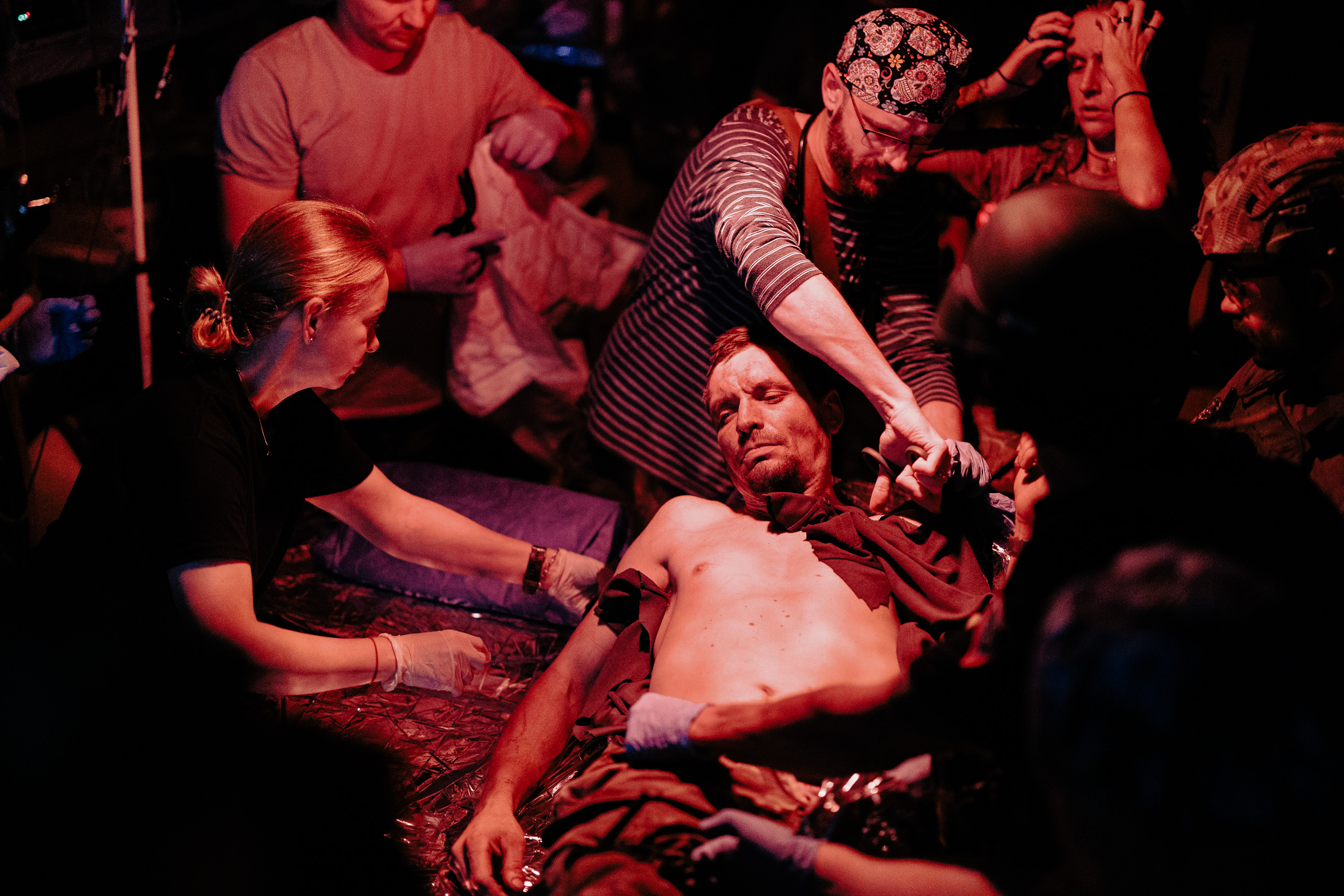
The photograph by Oleh Palchyk, now a photographer for the 3rd Separate Assault Brigade (3rd OShBr), seems to continue that rational, unsuperstitious time, but in a different reality—the time of war, in which the body once again becomes vulnerable and fragile.
In Rembrandt, death is a path to knowledge, whereas in this photograph, and generally in this war, the point is to use all that knowledge to prevent death. And now we are examining not the body, but humanity—the anatomy lesson of our time. Not unwavering science, but almost desperate empathy.
Photo: Oleh Palchyk
Text: Vira Kuryko















.jpg)


