Attention! The material contains sensitive information, and the photos are scenes of cruelty that can shock you.
Photographer Roman PylypiiOn the eve of the full-scale invasion of the Russian army in Ukraine, he filmed the Winter Olympics in Beijing. Since 2017, the photographer has lived and worked in China. The journey to Kiev took several days.
He left China for a few days.
“At that moment I was filming the Olympics, and in order to return to Beijing, I had to go through quarantine. Actually, the war started when I was still in quarantine, so I could not immediately leave for Ukraine, - recalls the photographer. - For me there was no question of going to Ukraine or not, I immediately decided that I was going. I couldn't fly directly to Ukraine because the airspace was already closed.”
Roman says that the road to Kiev was very long, I had to overcome thousands of kilometers and several countries.
“It was not easy to get to Kiev at that time: it was necessary to find a special flight, tickets. I flew to Paris, from there to Poland, and there I was lucky to find an evacuation train that was carrying people and had to return to Kiev. The train was empty, there were only a few men who also returned to Ukraine from Europe to join the army,” explains the photographer.


Many people with weapons on the streets of Kiev
“Indeed, in the early days of the war it was very difficult to work, to go outside with a camera. Both military and civilians were suspicious of people with cameras. Before shooting, it was necessary to explain the purpose and behave very carefully, because there were a lot of people with weapons on the streets of Kiev, in the first weeks everything was very chaotic,” Roman recalls the first emotions from Kiev.

He adds that it was not easy to work, there were a lot of events happening at the same time — shelling of the city and active fighting around.
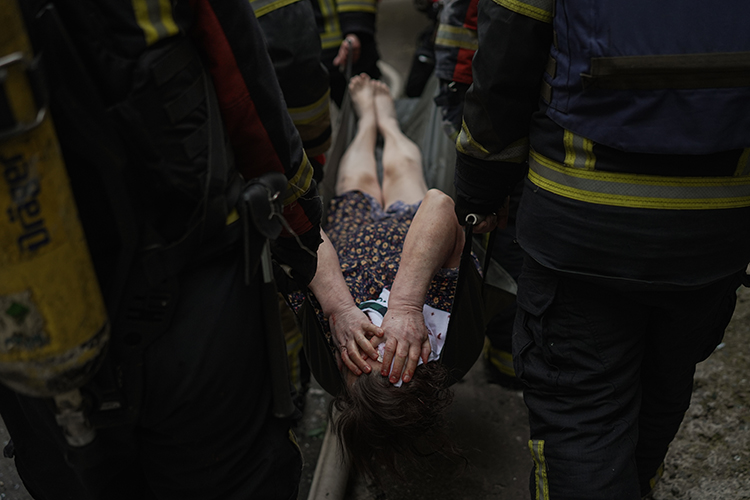
“My colleagues and I drove around Kiev and just watched what was happening in the city. They tried to make small stories, went to the Kiev region, to Irpin, filmed the evacuation. Indeed, the first month was very chaotic, there was a lot of shelling and we worked from the very morning until the curfew,” says the photographer.


Agreed to shoot directly on the block post
“There were no agreements with the presenters or requests at that time, it was necessary to negotiate personally, to have good contacts. Sometimes it was a chance meeting. So it happened to me with the guys from the terroboron, who stood near Brovary. We passed the checkpoint where the military stood, and we just asked if we could stay with them,” Roman recalls. “Then they were waiting for Russian attacks, no one knew exactly what to expect. We spent several days with them, filmed their life, work. Everything was on such simple agreements, when the military understood who you are and why you are here, why the work of a photographer is needed. The military were even happy that we show their lives and how they defend Kiev, our state.”

The photographer says that in the first month of the full-scale invasion, attention was focused on the capital under siege, after which he went to Zaporizhia and Kharkiv.
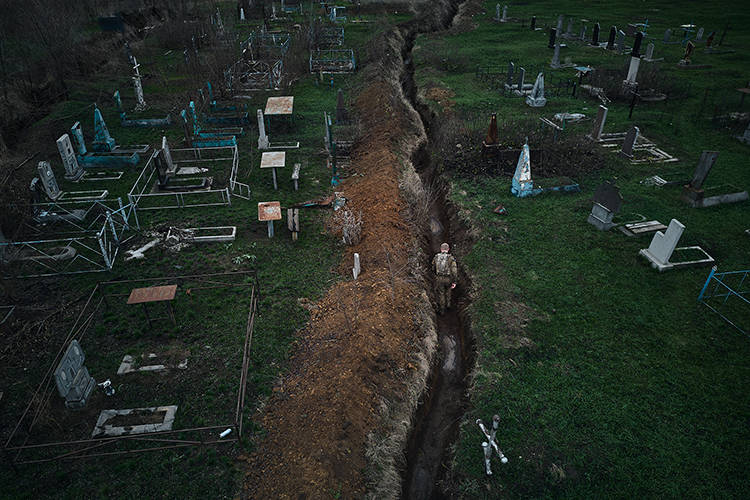
“The first month I shot mainly in Kyiv and around the city, in Irpen, I went to Brovary. At the end of March, I went to Zaporizhia to film the evacuation from the surrounded Mariupol: people broke through the Russian posts from the shattered city. There was an evacuation collection point in Zaporizhzhia. He also shot in Kharkiv and the region. When the Kiev region was liberated, he immediately returned to Kiev and filmed all the horrors that took place there,” explains the photographer.
Photo with a “happy end”
Photographer Roman Pylypiy says he has taken thousands of photos, and many of them are close to him, but there is one photo of the Bucha sisters that is especially valuable to him.
This photo was a finalist in the POY (Photographer of the year) competition, in Categories “War in Ukraine: news”.
“It's hard to single out one photo among thousands. But I really remembered the moment in the early days of Bucha's release. On one of the streets I saw two women hugging each other and crying. I took pictures of women and asked their story, - says the photographer. - It turned out that women were sisters who lived in Bucha during the occupation, but in different parts of the city and therefore could not meet. Then leaving the house was deadly dangerous. It was their first meeting since the de-occupation. The women had not been seen for 42 days. For me, this is a symbolic photograph. This story is like that with a happy ending.”


Roman Pilipey — Ukrainian freelance photographer from Kyiv, Ukraine. Member of the Ukrainian Association of Professional Photographers since 2023.
From 2017 to 2022, he lived and worked in Beijing, China.
He worked with the EPA for many years, later with Getty Images. Roman now works with AFP as a freelancer.
The photographer has several significant awards: Photographer of the Year, POY Asia 2022, NPPA Award winner, nominee for The Guardian Photographer of the Year in 2019 and 2022.
In 2023, his photo with Bucha became a finalist in the POY contest.
Photographer's social networks:
Facebook
Instagram
Recall that the Ukrainian Association of Professional Photographers has started a series of materials dedicated to key events of the Russian war against Ukraine, where he publishes memoirs and photographs of Ukrainian documentary photographers.
The project is implemented thanks to support of ZMIN.
The material was worked on:
Researcher of the topic, author of the text: Katya Moskalyuk
Bildeditor: Vyacheslav Ratynskyi
Literary Editor: Julia Foutei
Site Manager: Vladislav Kuhar