
.png)
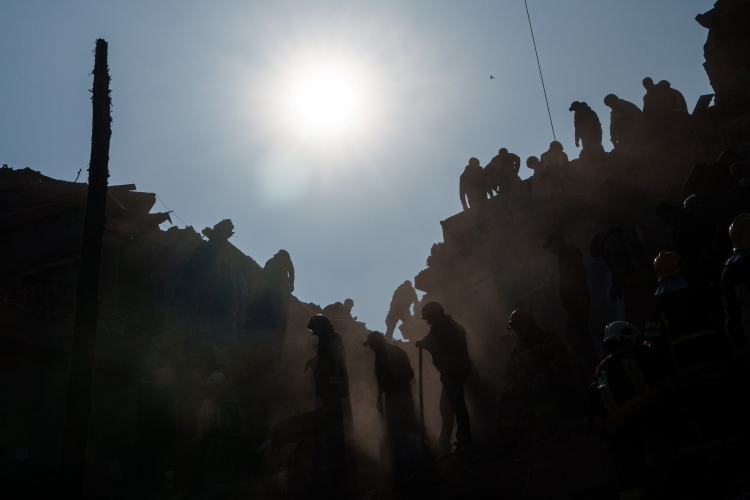
Konstantin Guzenko is a photographer, media producer, member of the Ukrainner team and candidate for admission to UAPP. Today he serves in the 35th Separate Marine Brigade named after Rear Admiral Mikhail Ostrogradsky and serves as a pressofitzer. His pictures are of war without decoration: the view from the trench, from the rear of combat vehicles and from the dungeons where those who fight live.

— Tell me, please, how did you end up in the 35th Marine Brigade? What are your responsibilities now?
— The best and most favorite part of the work now is directing journalists who come to document the work of the military to create the right content. First, it is the opportunity to talk to them in English, and secondly, the understanding that the team can give journalists for work. When I bring these two worlds together and the result is high-quality material, it brings the most pleasure.
Yesterday, for example, we arrived from the shooting at five in the morning. I do not always work in this mode, however, often shooting happens spontaneously. If a group of journalists decided to work with the team, I want to show them everything as qualitatively as possible — to organize interviews and shooting.
My supervisor is now away, and I, accordingly, coordinate the work of the communication department and solve organizational issues. I am engaged in the management of social networks, I cooperate with our and foreign journalists, I follow how the work of the team is covered. I came here to work as a photographer and continue to shoot, however, my main duty now is to organize the work of journalists.
I decided to go into the army on my own. I did not want to be in a situation where the military would determine for me what and where I would do. I knew that the 35th Separate Marine Brigade — a combat unit with a variety of means and a good history — would have something to do. The stars came together on time — they got the position of photographer and, in my opinion, this is the most saturated option of all possible.


— Unfortunately, there is not much talk about Marines in the media space. In your opinion, what exactly distinguishes the Ukrainian Morpihs from other troops?
— I cannot compare the Ukrainian Marines with other types of troops, because it was a civilian. I was actively shooting troops in 2022, but it was not an inside look. Now I see cool and honest people who have taken on serious challenges and challenges. The Marines are considered an elite kind of troops and are always faced with more difficult tasks than before the ground troops. I do not want to offend anyone, but during the whole time of the full-scale invasion, the brigade did not have a real rest.
35 separate Marine Brigade is constantly moving from one difficult direction to another, and it immediately finds itself at the forefront of all events. There is a trust in the brigade that is built on the fact that the people who serve in the Marines will be able to do everything. There is such a spirit here — if we have taken on something, we can do it. It's nice to see.


I do not have a Marine beret yet, as there is a list of mandatory tasks that need to be completed. In the early years of a full-scale war, berets were often handed out to marines who went through particularly heavy fighting. However, this was done rather in the form of an exception and now this practice has been suspended. I set myself the task of passing exams and getting a Marine beret. Last year was not decent yet, and this year — let's see. At least this is the challenge that is interesting to go through.
— Remember, how and when did the photo appear in your life?
“Photography in my life appeared in my school years. A small hobby has become the main occupation, a very important activity. The experiences and emotions during the shooting were the most vivid and important.
The first attempts to shoot were in street photography, when you are still embarrassed and do not know anything. He made his first pictures on the “figure”, but for a long time he tried to shoot on black and white film. Trying to get through the inner shame, trying to get the most out of the picture I saw, it was a great delight. Plus, shooting is each time new stories from life that develop in front of you.
Photography is a way to have your life, which is additionally saturated with the stories of others. When you study at school or university, you have a lot of your tasks that need to be done, and here there is a rich window in the history of completely different people. This moment has always fascinated me in photography, especially in documentary. I want to see cool, and sometimes dramatic situations that can develop next to you, in the same city, in the same country. Telling stories is probably the most important thing for me. Tell stories about how different and interesting life is.
Photography is a way to have your life, which is additionally saturated with the stories of others.
I really liked the shooting for the Ukraіner edition. With their expeditions, I fell in love with the regions of Ukraine because of the people who for me became the personification of this place. Thanks to the trips, my space and global perception of Ukraine has expanded. I met people who have a sense of community, love their city, decide how to live and what to do. I managed to visit Poltava region, Kharkiv region, Bukovina and Galicia. Then we filmed the de-occupation, but these are completely different stories.
%20(1).jpg)
— What topics did you focus on before the start of the full-scale Russian invasion? How did the war affect your photography?
I can't say that I worked with specific topics. I just liked to shoot a different life. Before the Great Invasion, I was most interested in the topics of communities in the city. I wanted to discuss the topic with the area of Podil in Kyiv, which has experienced a serious change in the people who live in it; I wanted to film the life that develops there, its modernist development. However, very quickly the Great War changed this process and my personal focus, set my priorities.
After the start of a full-scale invasion, he turned to photography as a tool that could help illuminate events, broadcast information to the world. I felt involved and useful. He began photographing humanitarian aid. I remember recently watching the shooting of a field hospital in Lviv region, then I still wanted to make beautiful and aesthetic shots.
Then I started shooting for the project “Deoccupation”, and this was my first shooting, closely related to the war. Not with volunteers or migrants, but closer to the fighting. For me, it was just a shock, even though I constantly looked at photos of Ukrainian and foreign colleagues. In the photos I saw what this war looks like, because it is very saturated with images. However, when we drove through Chernihiv region and saw these hewn green packages of the Russian army on the side, it was very unpleasant. There was a constant feeling that they had just been on these lands, conducting filtration, torture, and all the other horrible things that happen during active hostilities and occupation. For me, the land with green Russian packages was an even brighter trail than the destroyed central square of Akhtyrka or the remnants of self-propelled artillery installations. Garbage with symbols of the Russian army was very much ingrained in my mind.


Before my mobilization, I have long selected heroes for filming who consciously approach the process of transition from civilian to military life. At that point it was already 2023, and it was already a different choice than at the beginning of 2022. You already know much more about the war and its consequences. It seemed to me that there were fewer volunteers, and it was another moral choice to go into the army when you understand that the war will not end in two or three weeks. In no way do I want to diminish the determination of the price paid by volunteers at the start of the full-scale invasion or even before it. I was interested in the question of the internal transition from civilian to military life, how it changes a person, his environment, his life, thoughts and feelings. Obviously, he researched this question for himself as well, since he had many doubts. It seems to me that during conversations with my heroes, I was convinced that I would definitely go into the army, I did not know only where and when. I was not comfortable staying away.
Of course, not all the heroes he spoke to ended up in the army. Someone changed their mind, someone changed their focus, but these are also interesting stories. Now these conversations and filming are not collected, unfortunately, in one project. Maybe I'll come back and finish it. For example, my good friend and veteran Brittan Charbunchak has returned to art again. We recorded a great interview with him. Saw him later in the hospital with a wound and a long recovery after. It's a long road with your heroes.
The greatest value of shooting this project was for me — just gathering my thoughts, adjusting my life and figuring out why I doubted and didn't dare to make the decision to serve for so long. When a position in the Marine Brigade came up, I was written about the attitude with which I went to the military enlistment office.
Apparently, my decision to serve was influenced by working with the organization “Archive of War”. For almost a year I listened to and watched testimonies of people who had undergone occupation, torture, lost their homes and their families. It's hard not to come to the decision that you don't want to listen so much as to help stop it all, take away territories and restore justice. Of course, there is no such thing as justice, but it is nice to walk in its direction.
— In civilian life, your work was related to documentary photography and crime recording. When you chose a position in the army, did you consciously look for a job as a photographer?
“When I joined the army, I didn't really believe in the effectiveness of what journalism does here and now. Of course, public memory, a correct assessment of what this war was about and how people lived and died, not their own deaths, is important. However, at that point I lost the understanding that it was beneficial. Before the military, I had a choice between a combat position and what I already know how to do. Since I had no friends to whom I could go to a combat post, I decided to go as a photographer to the Marines.
When he came to shoot for the troops, he understood that it would be useful for recruiting and presenting the brigade. Documenting the moments now does not do much good, and thinking about it is very exhausting. Instead, a greater impact is felt in the work of the pressoficer. First, you yourself shoot and lead the social networks of the brigade, tell personal stories. Secondly, you regularly cooperate with journalists and help to cover from the necessary side this war, the efforts of our brigade and all Ukrainians.
For me, this is a constant internal dilemma. Of course, I don't have enough just to shoot for myself. I am a young man in the army, and it is not enough for me to help with media, I want to help with business. This feeling gradually appeared about half a year ago — there was no turning point or moment of decision. Gradually you become part of the team, you see many different stories, and your vision of life changes. The main thing is that I still have values. I am grateful to myself for holding on to values. It just changes the assessment of oneself in relation to them.
— How do you think you have changed during a full-scale war?
— At least, I definitely do not expect incredible help from the outside, both for myself and for all Ukrainians in general. Everything in our hands is both power and a kind of curse. Only we ourselves can solve our problems — both military and social. You don't like what's happening in the city — become an activist and make these changes.
Before the full-scale war, photography was definitely a tool of knowledge and search for me. For me, this is the greatest value — to document, to see something. It seems to me that if I thought more about self-expression, I would go into artistic photography. I don't like being categorized into genres, but I still feel the difference between fine art and art as a way to tell someone's story.
War photography has become an application tool for me that I use to benefit the brigade and the troops. Probably, first of all, this is a document for witnesses who have experienced it, and somewhere for themselves. The brigade was fighting in other directions, and I was shooting more people. For me, these photos are about what these people did and continue to do, or, in some cases, what they ended their lives with. Photographs are a reminder, a statement that this is life and all efforts were still there and that they are not in vain and must be continued.
There is still room for knowledge. I meet a lot of people, collect stories and get high from it. There was a moment recently that felt like a turning point. We worked with a Swedish group of journalists who were collecting material about the armored personnel carriers provided to us by Sweden. We had a story about an armored personnel carrier that came under fire and was stopped by an FPV drone with a cumulative charge. This charge literally from the first time broke the armor and killed the driver, who left for a shift instead of the narrator of this story. Instead, the narrator frankly and honestly told the reporters this story as an example of what problems there are with this machine. A comrade with whom he communicated closely, served together, left instead of him for a shift and did not return. I told this to journalists not from the position of provoking sentiments, but with one specific desire — to convey this piece of important information that you need to help competently. We need to fight to win. We need concrete effective help.
.jpg)
For me, this story is pretty clear. An armored personnel carrier stood in front of us and journalists, and a huge hole gaped in it, which is visible from the driver's seat. You sit in a seat and look into this hole through which someone was recently killed. Not just someone, but a person who fought side by side for our common cause. This moment was special for me, it remained in my memory. First, I brought this story to journalists, and secondly, I hope this story will force us to provide quality technology. It is also about the importance of retrieving, preserving, absorbing and etching stories.
— You mentioned that at the beginning of the full-scale invasion, I tried to aesthetize the picture and photograph beautifully. How much did this vision of photography change during the war? What is your photo like now?
— I tried to shoot not just beautifully, but in accordance with a certain aesthetic that I saw in my head. Although I am quite pragmatic on this issue. In a world full of news and documentary images, it is your job as an author to do everything possible and appropriate to make the story illustrated by your picture heard. If there are artistic means, your vision, the feeling of an attractive picture or one that attracts attention, you need to use them. Of course, with an understanding of the context and relevance of these techniques. The practical images I now make for banners, online advertising or to promote a division on social networks should be spectacular. I perform a formal task, but it is very important to leave the artistic component, so that the images are interesting and attract attention.
I still shoot with an understanding of aesthetics. It happens that I just want to beautifully remove something. When he was in the Kherson region, he periodically took a car from his colleague and rode through the steppes with a new lens — he took pictures of landscapes, birds and got a lot of pleasure from the process itself. The head was unloaded and many frames remained simply in memory. It's not about service, it's about the fact that I don't see home, I don't see family, but I'm in beautiful places that are still native places, because this is Ukraine.
— What distinguishes your photography and shapes your own style? What traits or elements are inherent in it?
— My photography was quite influenced by the fact that I shot well on film. When he began to shoot on the “figure”, he tried to process photos similar to a medium-format color film. Not sure that it is very noticeable in the pictures, but it was the starting point to fall in love with this tool again. After the wide format, I did not find it interesting to shoot on a digital camera. However, it was a good tool that did its job and something needed to be done with it.

Not sure you need to think much about the finish, your business card or the frames you have to put in front of you. Frameworks already exist, they are already in you, in your head, and manifest in how you choose objects or characters to shoot, how you build your images and put them into history. If you are a formed author or author, formed as a person, you will have at least minimal experience, then your own vision and style will certainly appear. This is followed by its cultivation and crystallization, and the editor or the curious viewer will be able to voice this style. The photographer just needs to do it.
.jpg)
Which photos would you like to highlight from all of them? What pictures are of special importance to you?
— I have a special tender feeling for the mobilization project, which I described above. A separate place for me is occupied by pictures from my military exercises. These are friendly photos taken not from a position to tell about this period or to make a photo project out of them in the future. These are just snapshots for memory, honest photos for yourself. I love and appreciate them very much. Maybe I did too little of them.
A separate important place is still occupied by pictures from the liberated Kharkiv region. I took pictures for myself on film and on a digital camera, it was just an artistic vision of these stories. He took the pictures conditionally for the future, without thinking that they should be published as news or story in the media. He took pictures that he saw immediately after the de-occupation. This trip was special, as far as it was possible in these conditions, because it is not about tourism or leisure at all. The trip was special because of the feeling of being so sad, but still a joy — because people and territories were liberated. There was this smell of war nearby.
In the liberated Kharkiv region, I shot many frames on film just for myself, as an illustration. Then he did almost nothing with these photos, periodically returned to shooting, printed several frames. These snapshots are something special absolutely, they stand out for their purpose and later reading. I hope it will be interesting to see them again in a while, maybe print them and think about what to do with them next.
— What moments of work in the team made the strongest impression on you?
— Probably the greatest impression when you first see the work of the observation point and how the operation unfolds in real time. It's pretty scary when you witness the drama with real people. You can't do anything, you're just an observer. There is a commander nearby who assists, coordinates, and transmits information. At that point, the operation ended successfully, but it's very hard — just to watch. Terrible black mirror. It was a shock to me.
There were many different dangerous moments, difficult to assess. So far I have been lucky. At the same time, my brigade was one of those that created and maintained the bridgehead of the Armed Forces of Ukraine in the village of Krynki, Kherson region, on the left bank of the Dnieper. We were the last to leave the bridge. There were no journalists on the left bank and the islands, nor did I go there. There are still some photos and videos from the direct participants in the fighting. Unfortunately, this operation is very little covered. I think this is a very vivid illustration of what the Ukrainian military is capable of. Of course, there are different examples — good and bad, but this is one of the stages in the history of the Russian-Ukrainian war that simply cannot be left aside or forgotten. It is necessary to tell about the bridgehead in Krinki correctly and leave this episode in the era of Ukraine's reflection of Russian aggression.
.jpg)
.jpg)

— In your opinion, what is the importance of documentary photography in the era of reflection of Russian aggression by Ukraine? What is the role of documentary photography during war?
“I don't want to put photography first in the aforementioned era. Photography as a document is slowly fading away. It is not a problem of photography, but our conditions and our reality in which we live together with artificial intelligence. Today it is very easy to change images or substitute facts depending on the wishes of individual political forces or figures. Still, photography remains an illustration, document, or way to better understand, feel, believe, or identify with the narrator. I would leave for photography an illustrative but very important role in ensuring that in the future this war is not taken lightly, and that our descendants see their people. Documentary photography should remain a source that the viewer accurately believes.
I, like many Ukrainians, am now very concerned that we do not slow down and devalue the efforts already spent on this war.
Most of all, I want us to survive. Survived as Ukrainians.

Contributors:
Researcher of the topic, author of the text: Katya Moskalyuk
Interviewer: Karina Pilugina
Picture editor: Olga Kovalova
Literary Editor: Julia Futei
Website Manager: Vladislav Kukhar













.jpg)


