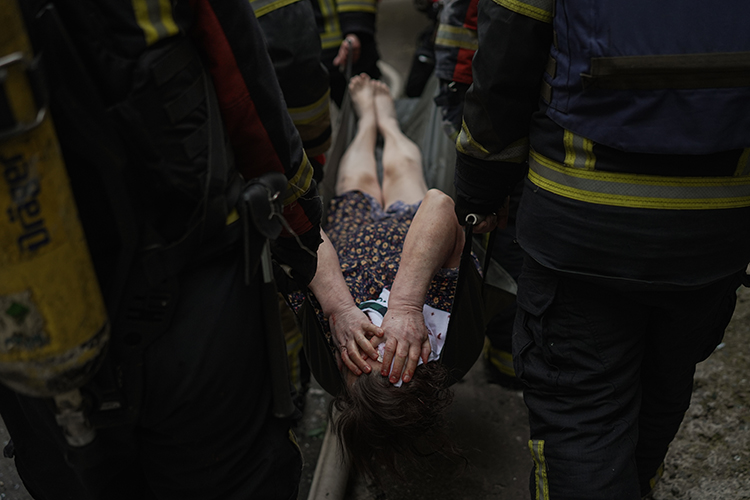
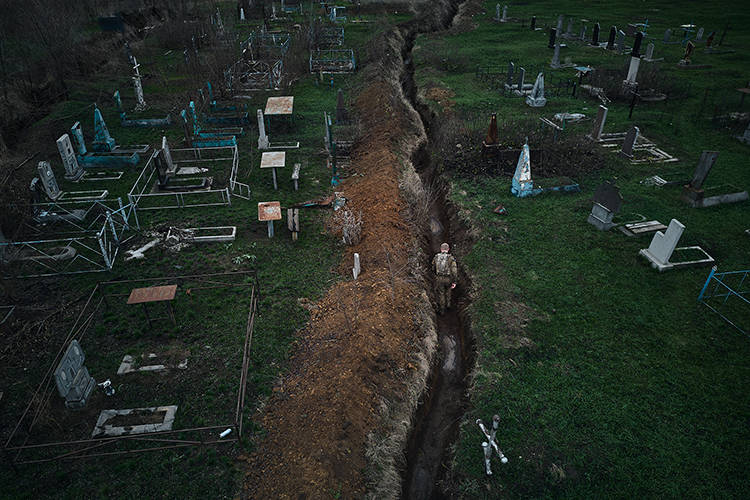
The night of November 17 became the culmination of a week of Russian terror: the Russian army launched 120 missiles and 90 strike drones at Ukraine. This attack concluded a week of massive shelling, during which the occupiers used nearly 140 missiles, 900 aerial bombs, and 600 drones, striking peaceful Ukrainian cities. Explosions were heard not only at the front but also in relatively calm rear regions. Today, the Ukrainian Association of Professional Photographers publishes images from Kharkiv and Odesa, which testify to yet another war crime committed by Russians against the civilian population.
“Molniya” strike on Kharkiv, November 12
On November 12, Russian forces for the first time used the FPV drone “Molniya” to attack Kharkiv. This drone, made of lightweight materials and equipped with an electric motor, is not detected by standard radar devices. According to Kharkiv Regional Military Administration head Oleh Syniehubov, the drone has loitering capabilities and is controlled by an operator using a remote control and camera, which ensures high strike accuracy.


“This is a rather primitive in design and quite cheap munition; it can carry from three to five kilograms of explosives. Compared to the Shahed, which contains 50 kg of explosive material, it is much less powerful, but it is many times cheaper than the Shahed and can cause damage precisely through the explosion and the scattering of fragments,” — said Kharkiv Regional Prosecutor’s Office spokesman Dmytro Chubenko.
This drone had previously been spotted in the Kharkiv region, but without a warhead. The enemy continues to use Kharkiv as a testing ground for new types of weapons, exposing the civilian population to constant danger.
Drones over Odesa, November 14
On the evening of November 14, Russian UAVs attacked Odesa and the region. As a result of the strike with combat drones, a 35-year-old woman was killed. Ten people were injured, eight of whom with varying degrees of severity were taken to the hospital. Civilian infrastructure was damaged in the attack: apartment buildings, educational institutions, a church, and more than 40 vehicles.


“Another Russian terrorist attack in Odesa. A strike on a residential building. Putin simply enjoys waging war against civilians. He respects no one, just an ordinary, mentally sick terrorist,” — wrote Andriy Yermak on Telegram.
At that time, a main district heating pipeline was also damaged, forcing one of Odesa’s boiler houses to cease operation. Additionally, the Russian army struck the city’s port infrastructure.
Massive attack on November 17: strike on Odesa
On the morning of November 17, 2024, Russian forces carried out a massive air strike on Ukrainian territory, using various types of missiles and drones. Explosions were heard in several cities and regions, including Kyiv, Odesa, Mykolaiv, Zaporizhzhia, as well as in the Dnipropetrovsk and Cherkasy regions. Emergency power outages were introduced across the country.


The Ukrainian Air Forces reported destroying 144 aerial targets during this attack. As a result of the morning Russian strike: in Mykolaiv, two people were killed, among the wounded were children. In Kyiv, explosions damaged residential buildings in three districts, and one woman was injured. In the Dnipropetrovsk region, an infrastructure facility was hit and a man was wounded. In the Lviv region, one person was killed due to falling missile debris.
In particular, Odesa was also hit, where two people — employees of an energy facility — were killed as a result of the shelling. The Russian strikes targeted the city’s energy infrastructure, leading to significant destruction and disruptions in electricity supply.
President Volodymyr Zelensky noted that the aftermath of the combined attack on our infrastructure in the Rivne, Lviv, Dnipropetrovsk, Volyn, and Odesa regions is currently being addressed.
“Russian terrorists once again want to intimidate us with cold and darkness, repeating their actions and trying to achieve a result,” — the president emphasized. Zelensky stated: “The whole world sees and knows that we are defending ourselves against absolute evil, which understands no language except force.”
This attack became one of the largest in recent months, demonstrating the continuation of Russia’s aggressive actions against Ukraine’s civilian population. The international community condemned these actions and called for an immediate end to the violence.
The Ukrainian Association of Professional Photographers closely monitors the work of community members who document the events of the Russian-Ukrainian war daily, both on the front lines and in the country’s rear cities. UAPP calls on photographers to submit images for publication — those that have already become part of history and will, over time, turn into valuable heritage and documentary evidence for future generations.
Contributors:
Researcher of the topic, author of the text: Vera Labych
Bildeditor: Vyacheslav Ratynskyi
Literary Editor: Julia Futei