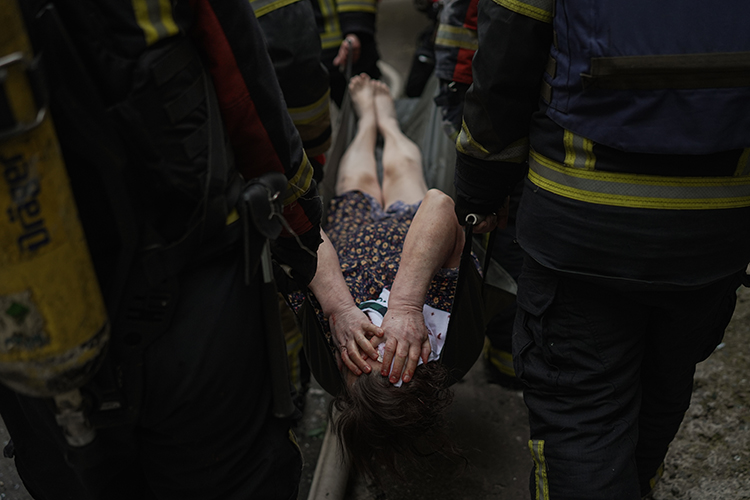
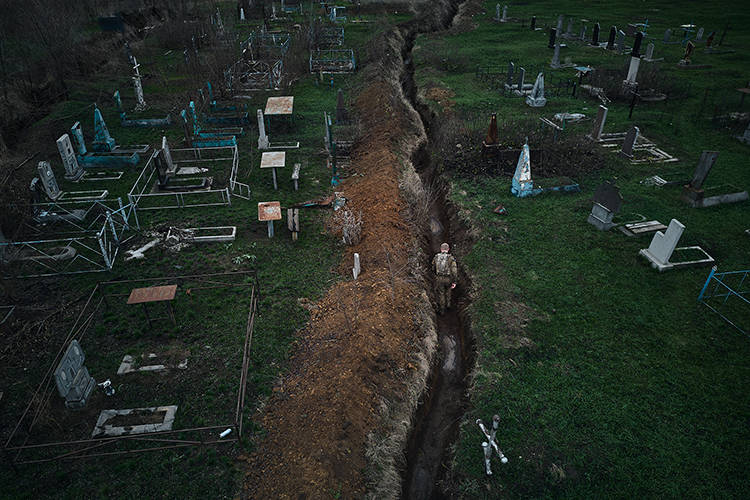
Toretsk is a city in Bakhmut District of Donetsk Oblast, located about 7 kilometers from the line of contact. Every day, the occupiers shell Toretsk, like every Ukrainian frontline settlement. In 2014, Dzerzhynsk—now decommunized as Toretsk—was a typical mining town among spoil tips. One of the mines until recently was called “St. Matrona of Moscow,” and is now shortened to “St. Matrona.”
The war came to Toretsk in 2014
Since 2014, the city has been on the demarcation line and has constantly suffered from Russian shelling. Pro-Russian militants held the so-called “referendum on the status of the ‘DPR’” on May 11, 2014. Toretsk was occupied for three months; however, on July 21, 2014, Ukrainian forces began an assault on the city. The fighting lasted eight hours. At that time there were no Ukrainian military fatalities, and four were wounded. On February 18, 2016, Dzerzhynsk was renamed Toretsk.
The war since February 24, 2022
The small mining town avoided a prolonged occupation in 2014, but life on the line of fire could not bring peace and calm. Since 2022, Toretsk has become a constant target of Russian shelling. As of March 2024, not a single building in the city has remained intact: apartment blocks, private homes, and civilian infrastructure have been partially damaged or completely destroyed. The occupiers also strike the mines that once underpinned the city’s budget. Those who do not leave their homes risk injury or death.


Today, Toretsk has no gas supply; the water mains and sewage system do not work; and instead of technical water—there is rainwater. Rescue workers are operating in the city, dealing with the aftermath of enemy attacks and, together with volunteers, delivering drinking water.

Lack of water supply
Since 2014, shells and mines have repeatedly hit the Toretsk–Horlivka water pipeline. Because of this, the city often found itself without drinking water. During the full-scale invasion, the water situation became critical: drinking water is delivered only by charitable foundations and organizations, and technical water can be obtained from tanks.


“What problems do we have here? These: this building was thriving—and look what they did. Then, on July 26, 2022, it hit—and the 4th entrance was completely smashed. On May 12 there was another hit. On June 1 it hit over there, and so on... I can keep naming dates and showing places for a long time,” a local passerby laments. “I think this war will never end. It will go on until Toretsk is wiped off the face of the earth. The next city will be Kostiantynivka, and then something else.”
The man did not have time to introduce himself or tell more about life near the line of contact—the conversation was interrupted by shelling.

Forced evacuation
Before the full-scale invasion, Toretsk was home to 70,000 people; as of April 2024, about 5 percent of them remained. Children’s laughter has long disappeared from the streets; the community is carrying out a forced evacuation of families with children. Free transport to safer regions is offered almost every week to anyone willing to leave the frontline area. However, there are families who categorically refuse to evacuate. Police officers drive around the streets, question neighbors, and persistently remind residents about the possibility of being saved.
Shelter
“There’s more shelling now, and fewer people,” says Liliia, who works as a caretaker at one of the city’s shelters. She says there are locals who leave and then still return to their shattered homes. “No one needs us anywhere,” she sighs.

Liliia and her dog Bonia keep an eye on the warmth in the wood-burning stove in the shelter, where Toretsk residents come during intense Russian attacks. The real rush here is always around 10 a.m., when locals charge their phones. Everything necessary is available here—not only to wait out shelling, but even to live temporarily.
“Right now, no one stays overnight, but everything is prepared for it. There are beds, and most importantly—there is electricity,” she explains.

Liliia shows a generator and a kettle, as well as the damage caused by a previous strike. At that time, part of what seemed to be a reliable and deep Soviet-era shelter suffered serious damage. As it turned out, even it is not designed to protect against the weapons Russia is using against Ukraine today.


The number of Russian attacks on Toretsk has increased significantly since May 2023, after the occupation forces took control of Bakhmut—a city they had destroyed to the ground. As a result, the line of contact shifted, and the war came even closer for Toretsk residents. All their problems with water, electricity, and unemployment remain unresolved due to the intensity of the fighting.
Battlefield
It is difficult for Ukrainian troops to defend settlements where civilians still remain. Nevertheless, they continue to hold the defensive line in this sector, where Russian forces are constantly trying to advance. A tangible shortage of ammunition adds to all the problems.

This problem exists along the entire 1,000-kilometer frontline. Servicemen of an artillery unit of the 80th Separate Air Assault Galician Brigade of the Armed Forces of Ukraine also speak about it. That is why the unit can fire only at precise targets, to use every round as effectively as possible. At the same time, the soldiers face a relentless stream of strikes from Russian artillery.

“The situation at the front is difficult. We don’t have enough ammunition. It would be much easier for the infantry if we had it,” says Ihor, commander of the artillery unit.
He notes that they often have to change positions due to the activity of Russian drones in the sky.


A serviceman with the call sign “Kapets” repeats that it is very hard to fight right now, but there is no way to relax, because the Russians have imperial ambitions and will go further—to Lithuania, Latvia, and other European countries.
“It’s inevitable! This red plague will keep pushing further, so it’s better to stop them in Ukraine at an early stage, rather than later—on a global scale.”

The serviceman is convinced that ending the Russian-Ukrainian war through negotiations is not the best option, so they must fight until victory.
“I believe that if we agree to negotiations with the Russians, then in 2–3 years they will come in such force that they will stop at the borders of Poland,” the serviceman is convinced.
Armory
While weapons from Western partners have not yet arrived, equipping the brigade has fallen on the shoulders of servicemen from the repair unit of the 80th Separate Air Assault Galician Brigade of the Armed Forces of Ukraine. From several destroyed pieces of equipment, they can assemble a new one piece by piece. Every part is worth its weight in gold. They dismantle damaged or captured equipment into the smallest components, patch it up, paint over Russian “Z” symbols, and sometimes clean everything not only of dirt, but of blood.


With tired eyes and blackened hands covered in grease, the servicemen continue to do meticulous work: repairing what, it would seem, can no longer be restored.


Servicemen of the 80th Separate Air Assault Galician Brigade of the Armed Forces of Ukraine repair their weapons without complaining about fatigue. What they manage to fix within the armory walls will save someone’s life on the battlefield.

“In other brigades, weapons are repaired in army workshops. These are military units where 30–50 people work. We repair everything ourselves—there are two of us. There is also a third person—a lathe operator,” explains a serviceman who asked to remain anonymous.
Within these walls, they talk not only about the lack of ammunition and equipment, but also about the shortage of human resources.

Although the servicemen hope that renewed military aid from the United States will help stabilize the situation at the front, each of them is waiting for society to mobilize so that no more Ukrainian cities have to be lost. The stakes are too high.
Olga Kovalova is a Ukrainian documentary photographer, producer, educator, coordinator, and curator of artistic projects as well as social and educational initiatives. She is also the Project Lead and Editor-in-Chief of the Ukrainian Association of Professional Photographers.
She combines editorial work with producing cultural and educational programs: coordinating teams, building partnerships, preparing and running international projects, and working with authors on the front line and in frontline regions. Her work focuses on strengthening the professional community of Ukrainian photographers, countering manipulation in the visual sphere, and creating long-term formats of memory—through exhibitions, publications, and photobooks. Her attention is centered on the human experience of war, the consequences of Russian aggression, and the recovery of Ukraine.
Olha worked as a staff photographer at the international company UAH PHOTO and taught the basics of photography within the educational programs of the School of Modern Theater and Stage Directions and the Chekachkov Photo Academy.
As the Project Lead of the UAPP, Olha coordinates the implementation of cultural, educational, social, publishing, research, and media initiatives, combining process management with curatorial and editorial work. Under her coordination, the association has implemented more than 250 projects aimed at developing the professional community and supporting Ukrainian photography in Ukraine and beyond.
Contributors:
Researcher, photographer, editor: Olha Kovalova
Text author: Vira Labych
Literary editor: Yuliia Futei