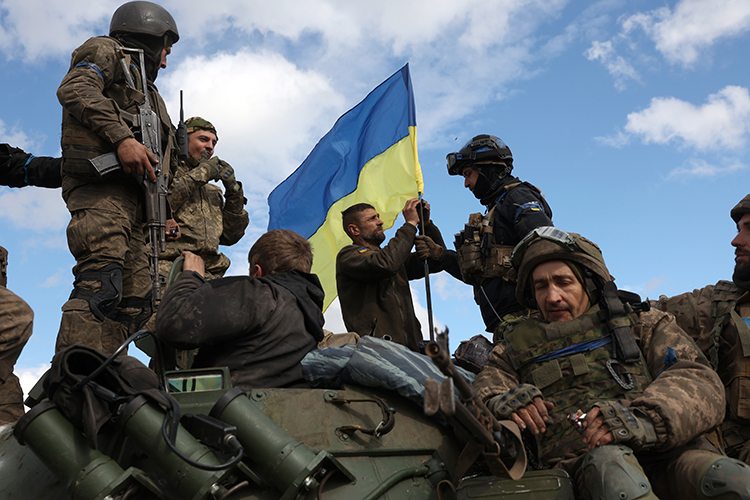
Ukrainian photographer Stanislav Ostrous told about the first days of the full-scale war in Kharkiv, the stories of the people he met in the territories liberated from the Russian troops, and about the places where the soul of the city of Kherson really was.
— Tell me, please, how do you remember the first day of the full-scale Russian invasion? Where were you at this time, what footage did you do?
— On February 23, 2022, together with photographer Anna Melnikova, we mounted her project of photo prints City No Name, which was planned to open on February 24, 2022 in the Kharkiv Municipal Gallery. The installation was difficult - Anna had a large canvas of nine works, we spent the whole evening with a hammer and pliers. It remained to literally correct the corners so that the pictures hung flat, hang signs with signatures and sweep the room. We bought wines to celebrate the successful design of the exposition and to have a good evening.
We woke up at four in the morning from the explosions in Kharkov. I immediately rushed to read the news on the Internet - all the newspapers wrote that the war had begun. For me it was a shock, a real shock. I did not think that a full-scale Russian invasion would begin. The day before, my ex-wife called me, who at that time lived with our children in Kherson, worried about whether there would be a war. I reassured her, said that everything would be fine.
On the morning of February 24, I did not even understand what to do next. I looked out into the street — a small queue of five or six people had already gathered near the ATM. I decided to get together quickly and also withdraw the cash. By the time I went outside, there were already more than twenty people at the ATM. Shops nearby were closed — everyone was afraid of looting. While standing in line at the ATM, it seemed to me that a drone flew over us. I lived in the Shevchenkivskyi district of Kharkiv, which was quite actively shelled. Russian troops came close to the city and artillery worked. I withdrew the funds and left on the same day to the suburbs of Kharkov - to the village Pokotylivka. It was relatively calm there, no hits were heard, but everywhere there were self-defense blockposts and the sounds of small arms being fired by ours.

The main problem at that time was medicines and food. We had a store next door with actually empty shelves. People began to arrive in trucks and bring meat from bombed farms. We then learned that farmers were hastily slaughtering animals so as not to leave them abandoned to the occupation. There were stories that the Russians did not allow staff to the animals and did not give them the opportunity to feed them. Russian troops approached Saltovka — Kharkiv district, and captured Feldman Ecopark. The animals there were suffering from hunger, and several ecopark workers were killed trying to bring food. These are the memories...
At the beginning of the full-scale Russian invasion, I did not have accreditation. Without the document, it was impossible to go to Kharkov and shoot. I immediately began to look for opportunities, and the Ivano-Frankivsk media “Kurs” helped me with the press card. He received his license in early March and on the first day he went to Kharkov. The city was completely empty — broken cars across the streets, anti-tank hedgehogs, every half hour a car could drive by. It was very cold. I walked through the city where the eyes look, went out to the city center and met other photographers: Pavel Dorogoy, Maxim Dondyuk, James Nachtwey. Maxim took me to his car and we went to the shooting together. I don't have a car and I walked everywhere — the transport didn't work, they asked for a taxi terrible amounts, which I don't even want to say out loud. People paid whole fortunes to leave North Saltovka to the station.

Together with my colleagues I came to Saltivka. There I shot my first shots of a full-scale war. Then he took pictures in the Kharkiv Regional Council. On the second day of filming, I was approached by a press officer who supervised all the journalists and with whom it was necessary to pre-arrange the shooting. The military was simply amazed at such insolence. However, when I saw my camera — a medium format Rolleiflex, I said that with such a camera it is possible to take pictures. I enchanted him with this camera, we talked.


The pressofizer with the call sign Karabakh was inside the regional council building on March 1 when rockets flew in. I have footage of how the employees of the State Emergency Service took the bodies of the dead. Karabakh recalls that the shock wave carried him towards the stairwell and broke the double-glazed window. When the soldier came to his senses, he saw that his sole had broken off from the impact on his shoulder blades. I photographed it on my Rolleiflex.
.jpeg)
Every day I took the train from Pokotylivka to Kharkiv, walked around the city and took pictures. I walked as long as I had enough strength. Volunteers helped to get a body armor and a first aid kit. I looked where the smoke was going and went there.
Why was it important for you to photograph the war? With whom did the media start collaborating?
It was very scary at first. Especially the first week, when I did not have accreditation and I could not take pictures, but only thought about how to get the products. I remember, the first thing we bought was three dozen eggs. We bought and immediately calmed down - at least in the next week we will not die of hunger. Then I managed to get the turkey and fill the freezer with meat. When I decided on basic needs, I was able to think about creativity as well. When I started taking pictures, I immediately calmed down, because I'm working, I'm doing business again. This was the first therapeutic moment.
Secondly, I wanted to photograph everything that was happening around. I realized that this was an extraordinary event. Then there was no fear, although the city was constantly shelled from mortars, barrel artillery, “Grad”. In Saltovka, my colleagues and I came under fire, just debris flew in front of me. I walked around Kharkov, huddled against the walls and took pictures.

My works began to be published in Ukrainian and foreign, in particular German, publications. I was actively written by foreign journalists who needed a fixer. At the beginning of 2022, I did not know Kharkiv well, since shortly before that I moved to the city from Kherson. In the center I was well oriented, but I would not be able to take someone to Saltivka or to other areas.
At first, he shot mostly reportage photography. Subsequently, the charity foundation “Global 2000 for children of Ukraine” came to me. There are more than 20 family-type houses in Kharkiv region, and I recorded the fund's assistance to children. We traveled around the area, distributed humanitarian aid. There was also a psychologist with us, as many children were brought from the occupied territories, some had PTSD.


After the liberation of part of the region from the Russian military, I went there to take pictures. He met Kharkiv volunteers who helped people from the de-occupied territories. Of course, I helped unload and distribute humanitarian aid, and simultaneously filmed. Some of the photos from these shootings were included in my photo project “Mirny”. We traveled to many parts of Kharkiv region, but the people who survived the Russian occupation had the hardest time — it seemed that something was changing inside and the camera clearly noticed it.


How beautiful can a picture taken during a war be? Is photographing now — is documentation or art for you?
— For me, photographing now is first and foremost documenting. However, this is an important question that I have pondered a lot myself. Photographers still use the means of expressiveness, in the frame there must be a composition, light, and color. Even when I take portraits of people who have experienced difficult events or tragedies, I try to take them beautifully — I bring them to the window, ask to sit down nicely. I automatically look at where the best light or which angle will be the most advantageous, think about where the color will be more accurate and where is the monochrome image.

In my opinion, what should not be in a photograph about the war is the addition of some artificial beauty there. Roughly speaking, to look for an interesting angle through a beautiful fence fence, a branch with leaves or a lace curtain on a building destroyed by the arrival, with people still under the rubble, is for me the height of cynicism. I understand that maybe someone wants to work with the first plan, but I personally do not allow such things. It is necessary to clearly show the event, to convey it correctly.
Another point that confuses me is that in the third year of a full-scale war, we began to get used to it. When I heard the sound of the arrival in Kharkov, I calmly learned more detailed information from familiar journalists, got on a bicycle and went to take pictures. At such moments, I began to realize that this shooting had become routine for me and I was making content on someone else's misfortune. Of course, all this is not the case, because I could also fly in, I am not a tourist who came to Kharkov for the weekend, I live here and I experience all this together with other people. Apart from a few residencies and exhibitions abroad, I have not left the city anywhere. I was trying to find an explanation for what I was doing. I am a photographer and the only thing I can do is convey the tragedy that is happening in my city and my country.

— Are there any shots that you didn't shoot because of ethical considerations? Had the opportunity to take a picture, but did not dare to point the camera?
Yes, I had moments like that. I witnessed the arrival and almost before my eyes a man died. I went to the supermarket in the residential complex Pavlov Pole and literally a hundred meters from me there was an explosion. I always carry a small Rollei 35 with me and, of course, I immediately ran there. Firefighters were already working on the scene, and a dead man was lying on the ground. No one interfered or hindered me — I showed my accreditation and the police were let inside. I understood that I could shoot a very expressive frame if I photographed the deceased close-up. However, a person in death is defenseless, he cannot give permission for filming. I don't know how ethical it is to shoot such footage. However, this man was in such a terrible moment - like the very face of death. I was never able to take a close-up, but instead photographed general panoramas of the deceased being wrapped in a black bag and carried. Then I wondered how professional my sense of being ethical or unethical was. I'm a documentary photographer, I have to step over myself and take pictures like that. I didn't do it that time.

There was another point when I didn't document the events. I made documentaries about Kharkov cultural figures, and Serhiy Zhadan and the employees of the Summer Museum drove together in the car. Shortly before our passage, there was shelling in one of the areas of the city, and I saw the bodies of the dead lying in the street. The girls were very scared and I did not dare to ask the driver to stop. I probably needed to go out and take pictures, but then I couldn't either.
— What are the biggest challenges you face as a photographer documenting the war?
“The hardest thing is to explain to people what I take pictures for. When shooting at the landing sites, people were annoyed at first and sincerely did not understand why to document it. Over time, of course, everyone got used to it. Sometimes I just took pictures of Kharkov, even when nothing was happening. People of the city immediately came and asked what I was shooting for. I immediately showed my accreditation, explained for whom and what I was photographing, showed my film camera, photos of which had to wait a few days. Even the police accepted this argument.

When I drove through the city and saw police or military, I immediately put my hands up and approached myself. In the early days of a full-scale war, everyone was on their nerves. I understood that if there are military in some place - accordingly, they are guarding an important object, which cannot be photographed. I showed my accreditation, the contents of my backpack and talked about my work. However, somehow my colleague and I were taken to the SBU. We photographed the building, saw us with cameras and called the appropriate services. We checked the documents and took us somewhere. I had a residence permit in the city of Kherson, which was already occupied at that time, accordingly, I caused a lot of suspicions and questions. When everything became clear, we were let go.
— How difficult is it for you not to repeat yourself, not to take pictures according to certain patterns or stamps?
I'm trying to find new forms. It has always been more interesting for me to photograph on film. Not because it is fashionable or truer, it's just that this tool suits me more. Although I normally shoot on the figure. Somehow I got my hands on a camera — an old Rolleiflex with a defect, it was impossible to track the rewinding of the film on the camera. In Austria, I bought the back of the camera and began to shoot on photo paper. I was shooting Kharkiv, iconic places in the city and a series of negatives on photo paper in one copy came out — like a polaroid, only reversed. Now I plan to make an artbook from these photos — a black series about the city. I wanted to work with the concept, but at the same time shoot a documentary.

At some point, I got emotionally tired of filming the arrivals. I photographed the aftermath of the explosions, everything I could get to or where photographers were allowed. I was so burned out from photographing the destruction and the dead that I started taking pictures of people on the beach. He rode a boat on the river, photographed the summer, the beauty of nature, people on vacation. To me, such shooting also seems important, because it all takes place during the war. War is not only misfortune, arrival, destruction, but life as such. Life in a city that is on fire. Life during war, here and now. People walk, relax, drink beer and ride catamarans. Here is such a story.

Then I cooperated with our air defense. I noticed that there are a lot of women serving there and wanted to take their portraits. However, I was not allowed to shoot combat divisions, only equipment without reference to the terrain. In the third year of a full-scale war, our air forces called and said that they needed photos of their work. He shot for them on a figure and in parallel for his project — on film. However, so far nothing can be shown from the footage, and this series of photos has not yet been published anywhere for me.
— What topics or aspects of the war do you think are not yet sufficiently covered?
To be honest, I don't even know. It seems to me that everything is probably already shot. You can look for new approaches, new forms, but most of the topics have already been revealed. Personally, I would photograph collaborators - but I do not know how to look for them, and even more so to convince myself to take pictures. When I was shooting the series “Peaceful”, I was just photographing people who came for humanitarian aid. However, people told that there were many collaborators in the villages, but they, like everyone, stood in line for bread and humanitarian aid. This topic is complex and interesting, collaborators have not shared anywhere, unfortunately, many of them are also in Kharkov.

Photographed lost abandoned animals in shelters. Dogs are a separate topic in general. All sensations are very acute in them, and from the sounds of arrivals, explosions they may have a contusion. These dogs have certain behavioral patterns that present a problem. They may howl with their tails, swaddle, and then bite unexpectedly. I photographed dog shelters with contusions. He also filmed an abandoned stable in Old Saltov. The owner left for the Russian Federation and threw more than 20 animals on the run. It was noticeable that the horses were purebred and once well-groomed, and the stable was well equipped. Two local sheriffs are now engaged in horses, they do not have any funding. The stable is privately owned, and accordingly, horses cannot be given away. In the summer, the horses are self-grazing, and in the winter volunteers prepare food for them. Of course, horses are fed, but they certainly don't get the care they need.
— Please tell us about your series of photos “Peaceful”. When and where did you shoot it?
— In the autumn of 2022, after the liberation of the Armed Forces of Kharkiv region, I started traveling in the region together with volunteers. First we went to the Chuguevsky district. They gathered at seven in the morning, loaded with various packages, medicines, necessarily bread, after which they specially went to the bakery, and carried everything to the people. I remember, the first village we came to was called Malinovka. Yes, the same Malinovka, in which the famous film “Wedding in Malinovka” was once filmed. Perhaps Malinovka village is the only place where I would like to photograph a wedding.

We drove through the village, distributed humanitarian aid. Malynivka was under occupation, and this greatly affected the people. Those who did not live in the occupied territories of the Russian Federation looked more lively, active, even more cheerful. Instead, the people who survived the occupation looked disoriented, confused. It was difficult for them, because they were in the line of fire.
I not only took pictures, but also unloaded boxes, distributed humanitarian aid, helped dig up vehicles stuck in the mud if necessary. We have been to many villages and I regret not writing down their names. I remember, we were in a village located on the very border with the Russian Federation, which was under occupation. When I look at the photographs taken on film from this village now, I have the impression that these are pictures from the Second World War. Characteristic types in vests, ragged cotton pads and earmuffs. So how to shoot them beautifully? I took pictures as they are — just said look into the camera, I need a report. People agreed because they were grateful for the help.

— What stories of people from the Kharkov region liberated from the Russian forces did you especially remember?
- We were in the village of Zalyman, which was under crossfire. It is located in a valley, and the river circles it almost around. The Ukrainian military was based on one bank, and the Russian army on the other. There were a lot of destroyed houses in the village. In this village, I met Luba, who collected all the dogs she could find in her yard. The people left, and the animals were left alone. Lyubov's husband was mobilized and he died near Bakhmut.
I also remember the Azerbaijani Ali, who wanted to show me his house. We came to the place with him, but the house is gone — everything is destroyed. Ali actually lived in a chicken coop. The village was occupied, and when the Armed Forces came, all the Russian military had not yet left. Ali said that he took advantage of the moment and overtook a gas truck of the Russian army with the Ukrainian military. I'm not sure how much truth there is in his words, but he wrote down the story.

In Donetsk region he met an elderly married couple. In early 2022, they left for the children, and in 2023 they returned to their village. It turned out that there was nowhere to go back — only the basement survived from their house. They were completely confused, there was emptiness in their eyes. They could not return to the children, so they planned to restore at least something before winter.
This year I went to Kherson for the first time. He met an amazing woman Melania. I met her in the area of the Oilfield behind the Island — it is almost the front line. She has a house on the river bank, and behind the river there is a red zone where the fighting takes place. Her house was completely covered with sand, silt, which she was excavating. When the Kakhovka Dam was blown up, in addition to sand, there was also a barge in its yard. Imagine a picture — a half-sanded house, and a barge in the yard.

Before I became interested in photography, I worked as the head of the site for the repair of industrial boilers at “Khersonteploenergo”. We had a base on the Island — a workshop with equipment. My former colleagues allowed me to enter this territory. It was first flooded, and then a rocket flew into the yard. It was very hard to see it all. In general, the visits to Kherson were the hardest and saddest for me.
— When did you first come to Kherson after the start of a full-scale war?
“For the first time since the Russian invasion, I came to Kherson in March of this year. The first day I was just walking around the city and taking pictures. He went to the library named after Oles Gonchar, which is located on the embankment of the Dnieper and which practically does not exist anymore. There were several hits and it burned out from the inside. I have very personal memories associated with this library — my friend, the famous Kherson poet Yevgeny Yanenko, worked there. Andreukhovich, Zhadan came to the library to Zhenya. Unfortunately, Yanenko died early, even before the start of a full-scale war. There was a photo club in the library, which I constantly went to when I lived in Kherson. Every Thursday we had meetings — we discussed something, discussed something. Then I went to Eugene and we talked about literature, drank tea and not only tea.

It was hard to see the library in such a state. Once a beautiful building in the style of Ukrainian modernism of the 60s. Before the full-scale war, my colleagues and I received a grant and made a project about Kherson modernism. I have preserved beautiful pictures of the library — both interiors and panoramas.
— In your social networks you are now publishing a lot of pictures from Kherson before the full-scale war. Please tell us about this series — when and where were these photos taken?
— These are photos that he took during 2017-2019. All the time I went somewhere with a camera, photographed Kherson. I had two series — shooting on a number and on film, and they were completely different narratives. If you can divide this way, then I took an objective photo on the figure, and on the film - a very subjective one. I tried to convey my feelings through the space of the city, to shoot places that have a special meaning for me. Instead, on the figure, I photographed beautiful Kherson shots. I wanted to convey to me the feeling of the city — how and how Kherson lived, what happened there.


Now I got into a creative residence and I had time to work with archives. When I began to make collections of photos, I realized that in fact nothing of what I took no longer exists. This is especially true of coastal areas, about which I once wanted to shoot a whole series. In fact, Kherson can be felt only if you take a boat and go through the tributaries of the Dnieper. It seems to me that Kherson's soul was right there. Now there are only ruins. The left bank is occupied, there is fighting, and people have been building houses there for generations. Building on the left bank was quite difficult — we had to bring all the materials. There is no road — it had to be transported by boat through smooth cement and bricks.
On Potemkin Island on the Dnieper was the cottage of the Kherson artist Vyacheslav Mashnitsky. He popularized and developed art in Kherson, created the Museum of Contemporary Art of Kherson. During the full-scale war, he remained in the city to take care of the museum's collection. He lived in his country, caught fish. Disappeared during the occupation. We are all very worried about him and hope that Slava is in captivity somewhere. This is a very big loss for Kherson. A large layer of Kherson culture was concentrated around the Museum of Modern Art, exhibitions were often held. One of the last ones I also participated in was called “Herart”.


I once told Vyacheslav Mashnitsky about my idea to capture the lives of people on the left bank of the Dnieper in Kherson, because few people know this side of the city. Slava then joked that, even if it remains so, that it is unnecessary to attract unnecessary glances. He even turned me away from filming for a while. However, my friends and I sailed on rafts, went on yachts and I always took pictures. Now, when I look at these photos, I realize that this Kherson is no longer there. Of course, we will rebuild the city, but it will be another Kherson. It is possible to restore buildings, but who will restore life on the left bank, carefree and endless hot Kherson summer, boats, fishing, swimming. It just doesn't exist physically — everything is destroyed. I am finishing work on the selection of material for the book. Some of Kherson's past life remained in my photographs and I decided that I needed to show it.
The material was worked on:
Researcher of the topic, author of the text: Katya Moskalyuk
Bildeditor: Vyacheslav Ratynskyi
Literary Editor: Julia Foutei
Site Manager: Vladislav Kuhar
.jpg)
.jpg)