Burned-out houses and cars, shattered windows, bloodstains on the asphalt, covered bodies lying on the ground—wounds on the body of the city. With every shelling, “hit,” or other consequence of Russian attacks, people suffer—and with them, the property they have built over a lifetime. Favorite places disappear, historic architecture is destroyed, high-rises turn into abandoned ghost buildings, and the city skyline loses its familiar look. For two years, the Russians have been relentlessly trying to take Kharkiv: first by assault, and after failing, they turned to missile and drone terror. Someone’s home, a first workplace, a bar for dates and meeting friends, a university—targets for the Russians. The city is being erased before our eyes; in some places, only memories and photos remain. We speak with Kharkiv residents—local documentarians who are forced to record nearly every site of pain in their native city. Pavlo Dorohoi, Yakiv Liashenko, and Oleksandr Mahula told us about Kharkiv’s wounds that hurt them too.
The “Staryi Khem” Bar
Photographer Oleksandr Mahula used to invite girls there on dates, and Yakiv Liashenko dreamed of celebrating the future victory there with friends. But on 14 March, a Russian Iskander missile hit a historic 1911 building on Svobody Street, where “Staryi Khem” was located in the basement.

The pub, named after the famous American writer Ernest Hemingway, no longer exists. A place where creative youth gathered and Serhii Zhadan held literary evenings is now ruins. Two people were killed then. For Oleksandr, this bar was one of his favorite places to relax in Kharkiv:
“When my friends and I were still students, we went there often. Just as often, we would step outside the bar for a smoke and look at the old building across the street. It’s hard to believe it’s destroyed—just like the bar itself. The Russians are erasing so many important places.”

During the full-scale invasion, the bar became an improvised bomb shelter for Kharkiv residents: they stopped pouring beer, but started offering refuge.
“I don’t have photos of this place or its ruins. Because we went there to relax—not to document,” photographer Yakiv Liashenko shares sadly.
Saltivka
At different times in their lives, Pavlo Dorohoi and Oleksandr Mahula lived in Saltivka—the largest residential district of Kharkiv. Before the full-scale war, about half a million people lived here—nearly a third of the city’s population. Today it is one of Kharkiv’s largest, most well-known, and most painful wounds—especially its northern part. From there, the occupiers tried to storm the city.

“From my building, I can see Russia,” Oleksandr Mahula begins, “and when an air-raid alert started, I would spot a small light on the horizon from my window. Missiles were launched from the Russian Federation. Forty to fifty seconds later, an explosion would be heard in Kharkiv. That meant the missiles had already arrived.”


Oleksandr Mahula compares his home to an observation deck from which he could watch not only beautiful sunsets but also what Russia would do to Kharkiv in a matter of seconds. Once, when he was at home, a strike hit nearby, on a neighboring street. He felt the windows in his apartment shake.
“I saw a huge red flame. It felt like some kind of gate to hell. It was very scary then,” Mahula recalls.

Pavlo Dorohoi’s childhood also passed in Saltivka, which is tied to his best memories.
“I love this district very much, even though many consider it depressing. I lived on the ninth floor and always loved looking to see what lay beyond those buildings. I stared at the edge of the city and the fields behind it,” Pavlo shares.
For him, Saltivka is first and foremost a green district with well-developed infrastructure and familiar streets, where his mother still lives.
“A blocky landscape of prefab panel buildings, with the ‘Rosiia’ cinema and the ‘Ukraina’ shopping center nearby—what a combination,” Pavlo notes.


Pavlo Dorohoi says it was hard for him to photograph what the Russians had turned his Saltivka into. There he saw what he began to call the “tree of war”, when someone’s belongings hang from the branches—blown out of buildings by the blast wave.
“For me, it’s also something very eerie. Of course, these are just things—but they are someone’s things. Where are their owners? What happened to these people?” Pavlo shares.

Yakiv Liashenko calls Saltivka a “panel anthill.” He never lived here and never wanted to, but he wanted even less to see all these ruins and the tragedy the residents of this district have had to face. The Russians mercilessly bombed all of Kharkiv, including Saltivka. Seventy percent of the northern part of the district was destroyed. People lived in the metro for weeks. Yakiv Liashenko still clearly remembers the first time he came to Northern Saltivka with foreign journalists during intense Russian attacks in the spring of 2022.
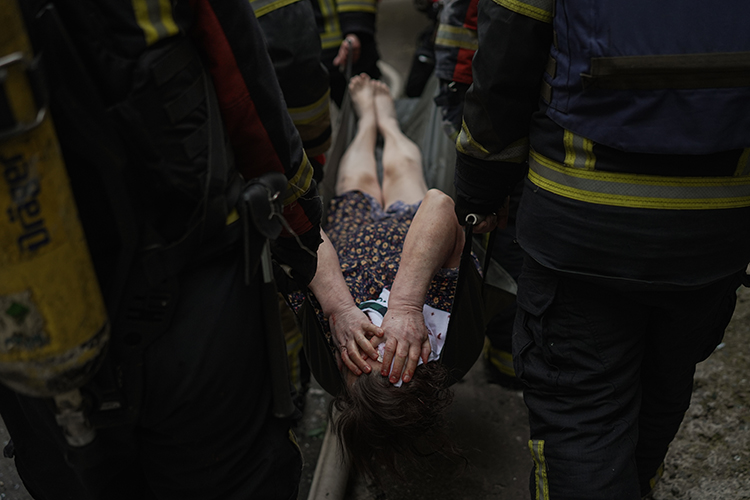
“April 1. It was very scary. Ten minutes before we arrived, a Russian Grad rocket launcher had just fired there. We saw a high-rise building burning, and next to it an elderly woman walking all alone. Russian artillery was operating, and this older woman was calmly walking around the building. The soldiers urged her to evacuate, but she refused. She stayed in danger. She chose to be at home. That scene really shook me,” Yakiv Liashenko says.

After the Ukrainian forces’ counteroffensive in September 2022, when our Defense Forces pushed the Russians back to the border, life in Saltivka became calmer. Many people whose homes survived returned.
The Heart of the City

On 1 March 2022, during the battle for Kharkiv, the Russians struck the city center with two missiles. The building of the regional military administration was damaged. As a result, 44 people were killed.
“This is the city’s central square. This is the heart of the city. Almost every Kharkiv resident passes by there nearly every day. There’s a park there, and Derzhprom is nearby—a kind of calling card of Kharkiv. Probably, this attack was the most painful for me,” Pavlo Dorohoi shares.
It was the first time the Russians struck the center of Kharkiv, and historic buildings were also damaged. Before the photographer’s eyes, bodies were carried out of the administration building—recovered from the rubble over the course of two weeks.

“It was such a powerful moral blow. Up until that moment, it felt like the war was somewhere out there around Kharkiv, but then it became unmistakably real—closer. It’s here. Since then, a lot has changed in the city—and in me,” Pavlo says.
Pavlo Dorohoi says that photography was what gave him the strength to document everything happening to his hometown.
“It’s strange: on the one hand, photography lets you be an observer—to look as if from a distance. On the other hand, it’s impossible not to let all these events pass through you,” Pavlo says.
“I’m afraid my city will turn into Gaza”
Some of Ukraine’s leading higher-education institutions are located in central Kharkiv. Education was also not spared by Russian missiles. Russian forces attacked O. M. Beketov National University of Urban Economy in Kharkiv, destroying two floors. Oleksandr Mahula documented the damaged building where he used to spend a lot of time: his friends studied there, and he went there for extra English classes.
“It was hard to see these destroyed walls when you remember them intact,” Oleksandr Mahula says.
The number of places dear to him that the Russians are destroying keeps growing.
“On top of that, my V. N. Karazin Kharkiv National University was hit too—specifically the journalism department where I studied. It feels like my city as a whole is turning into ruins. This list already includes two of my first newsrooms—‘057.ua’ and ‘Gwara Media’. I’m afraid that one day I’ll come home and my city will have turned into Gaza,” Oleksandr Mahula says.

“I understand that there are many buildings we’ve lost forever,” Pavlo Dorohoi reflects. — They won’t be restored. Because even before the war, Kharkiv had a broader problem with architectural heritage and with urban development. Now it will only get worse, I believe. Of course, it’s upsetting and even provokes anger. Sometimes it feels like we don’t even need an external enemy. We will destroy what previous generations built ourselves—even if that generation was Soviet Ukrainians.”

The documentarian notes that the war hurts not only because of the loss of architecture; the worst part is that people suffer and are left without homes. In Kharkiv, some have been hit by Russian aggression for the second time, Pavlo says:
“They came from the region, where the Russians had already destroyed their home. It’s the most painful thing—that people get hit more than once.”
“I didn’t choose to photograph the war”
A hit on a high-rise or a private home, an industrial site, an oil depot, a Nova Poshta terminal, a queue of people waiting for humanitarian aid—the list is long and keeps growing. Yakiv Liashenko is among the Kharkiv documentarians who record Russia’s criminal actions for international media almost every day. It is hard for him to say which strike hurt the most. He learns about explosions from the window of his home, so he heads to the scene immediately.
“When there’s a ‘prylit’ in Kharkiv, I hear it. I don’t wait for the all-clear—I go to the site right away to document what happened. Because if I wait, there will already be nothing and no one there by the time I arrive,” Yakiv says.

He doesn’t hide that what he sees at the scenes often affects him:
“Once, at the scene of a tragedy, there was a puddle of blood and a person’s finger. The wounded and the dead had already been taken away, but that finger was still lying on the ground. It’s impossible not to think about it.”
Yakiv Liashenko sums up:
“If I were photographing something civilian, I could choose what to shoot. But now I don’t choose anything. The war chooses me. I have to photograph what is there.”


“Kharkiv is the city that holds me and gives me strength”
Oleksandr Mahula notes that, in his observations, the portrait of the average Kharkiv resident has also changed, because the city used to be a student city.
“I noticed this change in the metro. There used to always be a lot of young people there; now I get on and realize I might be the only young man in the car,” Oleksandr shares.
With fewer people, there are fewer cars too. Yet the roads—the city’s arteries—still keep moving; sometimes there are traffic jams and parking problems.
“Of course, people live, people fight, people celebrate life, somehow keep going. That’s wonderful, but the ruins that have become scars are still there. When you see them, it’s always upsetting,” Pavlo Dorohoi adds.

Yet despite drone attacks, Kharkiv lives. Cultural events are held in the city. Kharkiv residents return home despite the shelling.
“In Kharkiv, even during the war, there are probably more events happening than in cities that don’t know what war is. Concerts are held and theaters keep working,” Yakiv Liashenko also notes that new cafés are opening in the city. — People start from scratch. They worked a lot under shelling, in extremely difficult conditions, to open their doors. Kharkiv residents did what they could so their city would continue to live. Respect to them for that.”
No one dares to predict whether Kharkiv will be the same as before the invasion—and perhaps it shouldn’t be. A new page in the history of the Hero City continues to be written every day. But sadly, it is filled mostly with dates of Russian attacks, notes on the number of casualties, and visually confirmed by documentary photographs—so that nothing and no one is forgotten.
“Once my friends in the military from ‘Kraken’ told me: for things to be okay in Kharkiv, the border with Russia needs to run at least through the center of Belgorod. Then, by pushing the front line that far back, we’ll be able to deploy air defense in Kharkiv, and it will be capable of protecting us. It’s a joke, but there’s probably a grain of truth in it,” Oleksandr Mahula hopes that in that case the Russians might stop attacking the city—at least with S-300 missiles.
Pavlo Dorohoi — a documentary photographer, documentary film director, and researcher of Soviet photography of the second half of the 20th century. The photographer’s Instagram.
Yakiv Liashenko is a Ukrainian photographer from Kharkiv. He began his professional career in 2012. After the start of the full-scale invasion, he worked as a fixer for well-known photographers while also documenting Russia’s invasion of Ukraine. He is currently a freelance photojournalist with EPA Agency.
Photographer’s social media: Instagram, Facebook.
Oleksandr Mahula is a photographer originally from Kharkiv, Ukraine. He is a journalist with Suspilne Novyny in Kyiv. He studied journalism at V. N. Karazin Kharkiv National University. Before the war, he worked in local media. He collaborated with some of the largest German-language print publications in Europe (NZZ, FAZ, TAZ, Focus, DerStandard).
Author’s social media: Instagram Facebook
Worked on the piece:
Topic researcher, text author: Vira Labych
Photo editor: Viacheslav Ratynskyi
Literary editor: Yuliia Futei