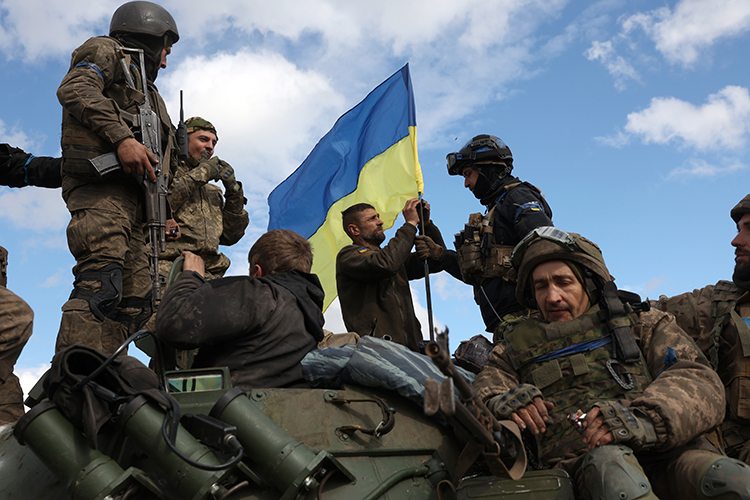
Photographers Olga Kovalyova and Vladislav Krasnoshchuk, who are actively documenting the Russian-Ukrainian war, visited the camp of Russian prisoners. They planned to prepare a photo report, but working among prisoners of war turned out to be difficult. For Vladislav and Olga, who came under enemy artillery fire in Donetsk region in the summer of 2024, shooting in the camp was not only a professional challenge, but also an emotional one. Olga was wounded at the front, so she felt an internal conflict, and Vladislav nevertheless tried to maintain detachment and distance, shooting black and white footage, which later became part of his documentary project about the war.
Emotional challenge for Olga
Photographer Olga Kovalyova admits that working in the camp was emotionally unbearable for her. According to her, the shooting was supposed to be a documentary study, but turned into an emotional challenge, so she was never able to get hold of the camera.
“We tried to look at everything in a detached way, as part of our work, but everything was too personal. I felt the wound very acutely, and it affected everything else,” she says. “It hurt me not only physically, but also morally. We have not been able to withdraw from the situation completely. I have not been able to emotionally break this boundary of stability to move on. There was a sense of a barrier.”

The camp of Russian prisoners of war, where the photographers were located, is located deep in the Ukrainian rear. This place caused them both disappointment and deep inner dissonance.
“Prisoners of war look well-groomed, not as exhausted as our soldiers returning from Russian captivity. Our people are brought back broken and crippled, both morally and physically, and these are like fattened ducklings, walking in circles, going about their business, eating together. It's a strange and painful contrast,” Olga shares.

The photographer said that the living conditions of the camp were unexpectedly good. “The medical part looked like it had just been repaired. Conditions were better than in the two Ukrainian hospitals where I was treated after my injury. Everything is sterile clean. We saw people there with lower limb injuries, some with crutches. They are provided with the necessary medical care. There is dentistry and access to many specialists.”

In addition, the Ukrainian language in the walls of the camp sounds not only from the staff, Olga recalls with surprise: “We heard how prisoners thanked for food in Ukrainian. It was so unexpected and strange to hear Ukrainian from those we call enemies. I didn't even know how to react to it.”
Black and white detachment of Vladislav
While working in the camp, photographer Vladislav Krasnoshchuk also felt split and was depressed by what he saw, but he found a way for himself to work so that the shots for which he came were successful.

“Smiles, conversations — it all looked like some kind of ironic performance. And I tried not to interfere with their space. I was just doing my job, trying to leave emotions behind the scenes.”
Vladislav tried to document the life of the prisoners in the camp and at the same time remain invisible to them: “I tried not to look them in the eyes. Just did what was necessary and that's it. I didn't take portraits.”
The photographer tells how he chose angles, looked for contrasts that would depict reality. “I always focus on composition. It helps me not to delve into the emotional aspect, otherwise I would not be able to work. I looked at this place through the lens, as if at another world. Black and white shots help emphasize this contrast,” he shares.


Camp or colony?
Camp staff assured that this place was not a colony or prison, but a POW camp, and that they felt was important. The absence of grilles on the windows, rooms with light, orderly living — all this gave the impression that the prisoners lived in quite favorable conditions. However, for photographers, this picture was another reminder of the contrast with the conditions of detention of Ukrainians who are experiencing the horrors of the Russian camps.
“It's not like captivity,” Olga reflects, “they have neither a sense of imprisonment nor a real awareness of what they have lost. Their serenity contrasts with what our military feels when they enter Russian colonies.”
Everyday life in the camp looked extremely orderly and even routine. Vladislav and Olga were amazed at how the everyday life of the prisoners was organized. “They make gazebos in the carpentry workshop, they make Christmas trees from plastic. If you see them in the bazaars in Lviv, know who made them. They weave furniture for the garden. Innocent work under the sun — but this contrast was painful and at the same time unbearable,” says Vladislav Krasnoshchuk.

At the same time, the photographer noted that the atmosphere of the camp was quite friendly — prisoners and workers communicated quite kindly. He also drew attention to the collective actions of the captives: “What struck me was that they were constantly going somewhere, doing something. This mass of people is constantly moving. This became the main theme of my photographs.”
The photographer describes the everyday scenes in detail: “When we came to the dining room, there were 30 to 50 people. All in robes and caps, hands behind their backs. They prepare their own food, take turns in the kitchen. We even tried their bread - it was quite tasty. For lunch, the first, second and compote. Standard menu”.


“When we were in the shelter during the air alert, colleagues asked if a Russian missile could hit the camp. The prisoners were sure that this would not happen. They do not believe that the Russians will shoot here, directly at them,” Olga added.
The Geneva Convention: Duty and Reality
For Vladislav Krasnoshchuk, it was important to see how Ukraine adheres to international standards for the treatment of prisoners. “They live here almost like in a sanatorium. No one tortures them, does not humiliate them. They are like cats in oil. It was important for me to see that we remain within the Geneva Convention, even when it is absurd in the context of what is happening to our captives in Russia.”
Vladislav reflects on the incommensurate conditions of detention of Ukrainian and Russian prisoners of war, the importance of compliance with the Geneva Convention and his own contradictory feelings about it.

“Our people, returning from Russian captivity, say that they begin to feed them better only a few weeks before the exchange. This is done only so that they do not look completely exhausted. All these realities are geopolitical surrealism, where only one side follows the rules, - Vladislav shares. - Russia is a signatory to the Geneva Convention, but no one can check the conditions of keeping our prisoners there. The Russians can do whatever they want with the Ukrainians, and the Geneva Convention does not work for them. We fulfill all our obligations by holding Russian prisoners at the expense of our taxes, and Russia can do anything.”
Expectations and reality of filming
“I always hope to take at least a few good pictures. When I go on a business trip, I aim to bring at least 2-3 photos that will complement the overall history of documenting the war. But, to be honest, I don't always know in advance what exactly I'm going to photograph. I try to catch the wave of what I see in front of me,” Krasnoshok explains.

With extensive experience documenting war, however, Vladislav says that expectations sometimes do not coincide with reality: “I always think I shot badly. But then, when I look at the photo, I realize that these are good pictures. From this trip, I brought two or three photos that will definitely go into my Documenting the War project. There may be more, but I will definitely use these two photos.”
The last look: without identity and meaning
“We looked at them and saw no personalities in them. These are just creatures that move by inertia, perform some tasks, but do not understand what they are fighting for. One of them told us that the real goals of the so-called “special military operation” were never explained to him,” Olga concludes.
Both photographers realized that this trip revealed to them not just the lives of prisoners of war, but something deeper — the lack of meaning, the lack of understanding of their own participation in the war of those who once took up arms.
Olga Kovalyova — chief project manager of the Ukrainian Association of Professional Photographers, photographer, coordinator and curator of art projects and social initiatives, teacher.
Vladislav Krasnoshchuk— Kharkiv artist. 1997—2002 studied at the Faculty of Dentistry of Kharkiv State Medical University. In 2004-2018 he worked in Kharkiv State Clinical Hospital of Emergency and Emergency Care named after him. O. AND. Meshchaninov. He has been engaged in photography since 2008, and in 2010 he became a member of the group “Shilo” together with Serhiy Lebedinsky, Vadim Trikoz and Vasilisa Nezabar. In addition to documentary photography, which is aesthetically transformed thanks to technical manipulations, he works with archives and hand coloring — techniques that have been formed in Kharkiv photography since the late 1970s. Also combines frames with voluminous sculptural objects. He is engaged in easel and print graphics and street art.
.jpg)
.jpg)