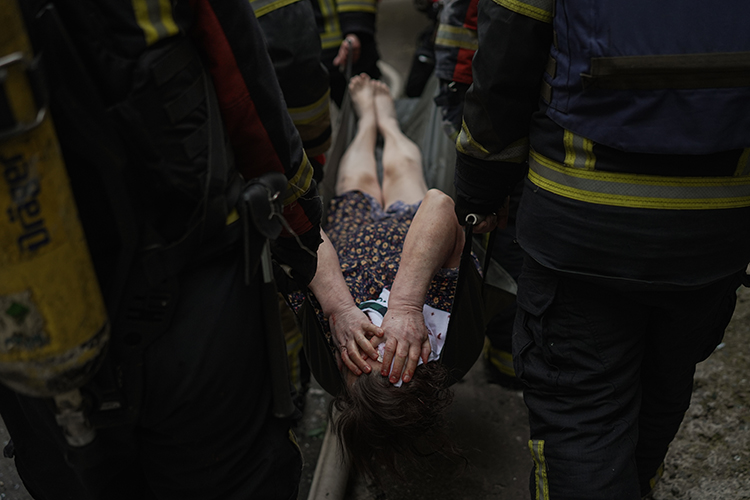
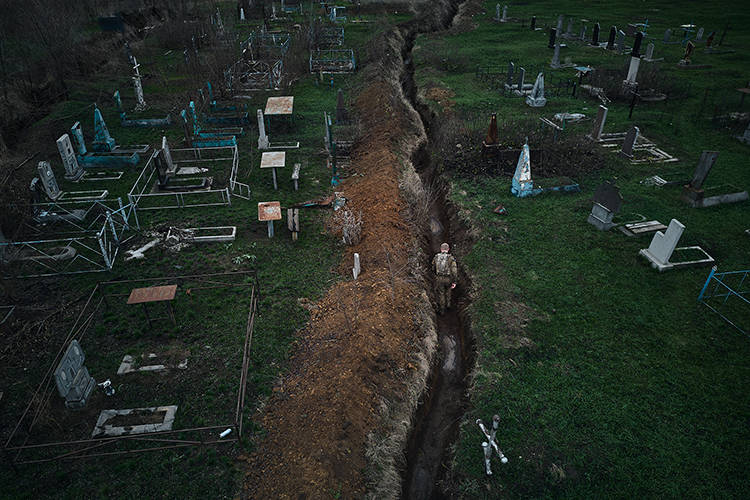
Kharkiv — a frontline city with a population of over one million in northeastern Ukraine — has been subjected daily, since the start of the full-scale invasion, to attacks with ballistic missiles, aerial bombs (KABs), strike drones, and information-psychological operations (IPSO). In their propaganda channels, Russians mention Kharkiv almost every day, justifying the shelling of the city and spreading disinformation. However, in contrast to this propaganda, Ukrainian photojournalists — both local photographers and those documenting life in the city at the very fracture line of the war — work to establish justice.
Speaking of Kharkiv, we primarily mean its residents, because the greatest value of every Ukrainian city is its people. It was thanks to the people — both civilians and the military — that Kharkiv stood firm at the beginning of the invasion, and thanks to the people it continues to stand.
Russia has been waging an information war against Ukraine for centuries. The informational pressure intensified especially after the 2014 Maidan. The foundation of the disinformation campaign against Kharkiv residents was propaganda of discord, aimed at sowing separatist sentiments in the city and preparing it for the 2022 invasion.

Photojournalist and documentarian Heorhii Ivanchenko, speaking about his first experience filming the war, said in an interview for “UAPP”:
“The desire to tell about the events brings us to Kharkiv. Obviously, this is the first major city that suffered such a massive strike, toward which Russian troops were advancing so actively. We knew about the possibility of losing Kharkiv even before the start of the full-scale invasion. What surprised us was the offensive on Kyiv; the offensive on Kharkiv was a surprise to no one.”
Propaganda of discord consisted of narratives about “territorial and mental closeness to Russia,” “Kyiv’s dislike of Kharkiv and Kharkiv’s dislike of ‘western Ukrainians,’” narratives about the “first capital” and hints at independence, as well as intimidation with “nationalist orders” and the “cult of Banderism,” allegedly being imposed in Kharkiv.

The enemy failed to capture Kharkiv, but managed to occupy part of the Kharkiv region along with major cities — Kupiansk, Balakliia, and Izium. Most of the occupied cities and settlements were liberated as a result of the Ukrainian Armed Forces’ counteroffensive in September 2022.
The Kharkiv Anti-Corruption Center (KhAC), which collects and debunks Russian fakes, reported that since the beginning of the war propagandists have tried to intimidate Kharkiv residents with a food crisis, hunger, humanitarian issues, and mobilization. However, the core of fear propaganda revolves around such themes as “nationalist battalions” and the alleged preparation of the city for surrender.
Already during the time of the full-scale war, Russians manipulated the topic of business relocation and fabricated fakes about the Ukrainian leadership allegedly transferring industrial facilities to Western Ukraine.

“In Kharkiv there is a sense of evacuation — entire factories are being taken out of the city, while the Kyiv regime urges local residents to leave in the face of the threat of a Russian ‘invasion.’ At the same time, the Armed Forces of Ukraine are preparing the defense of Kharkiv and concentrating additional efforts, equipment, and weapons here. However, according to experts, Ukraine is already ready to give up the city, but will stage a certain attempt at active resistance.” (“Arguments and Facts”)
“Even during the war, Kharkiv probably hosts more events than cities that have never known what war is. Concerts are held here and theaters are operating,” says Yakiv Liashenko, who also notes that new cafés are opening in the city. “People are starting from scratch. They worked a lot under shelling in extremely difficult conditions to open. Such Kharkiv residents did what they could to keep their city alive. Respect to them for this,” — Yakiv Liashenko told in an interview for “UAPP.”

Propagandists attempt to destabilize the situation in the temporarily occupied territories of the Kharkiv region through printed propaganda newspapers, the shutdown of Ukrainian television in the absence of internet and communication. They spread fakes about events at the front, the “capture of Kharkiv,” and the “indifference of the leadership toward its own citizens.”
In March 2024, Putin declared the alleged necessity of creating a “sanitary zone” along the border with Russia to protect border territories from shelling. This statement triggered a new wave of disinformation campaigns.

In March 2024, Putin declared the alleged necessity of creating a “sanitary zone” along the border with Russia to protect border territories from shelling. This statement triggered a new wave of disinformation campaigns.
In April 2024, hostile Telegram channels spread a disinformation video showing traffic jams at the exit from Kharkiv.
Kharkiv residents allegedly received so-called evacuation notices in personal messages, supposedly from the State Emergency Service.
The creation of the Russian Armed Forces’ “Sever” grouping on the border with the Kharkiv region, assaults in the north of Kharkiv region, and the extremely difficult situation in the energy system due to Russian shelling of energy facilities all contributed to fear propaganda.
An active campaign was conducted to discredit the local authorities. Allegedly, nationalist battalions created by the city’s leadership carried out punitive operations against Kharkiv residents loyal to Russia, used local civilians as cover, and kept the townspeople as hostages.

The Kremlin authorities continue attempts to destabilize the situation in the city and region through influencing the opinions of Kharkiv residents and by means of missile and bomb terror.

This is how enemy propaganda justifies shelling of civilian infrastructure, trying to turn the local population against the Armed Forces of Ukraine by claiming that Ukrainians are allegedly shelling themselves.
Missile strike on the “Factor-Print” printing house, May 23, 2024ц
“Ukraina.ru” admits that “the Russian army destroyed a civilian facility in Kharkiv,” but, according to their claims, they provide justification.

On May 23, Russian forces launched S-300 missile strikes on the “Factor-Print” printing house. Seven people were killed and sixteen injured. All the victims were employees of the printing house. At the time of the attack, about 50 people were working there.
“And once again, unfortunately, we have to use the DNA laboratory to identify the bodies. Seven people died at their workplace. They were printing children’s books. Five women and two men — each of them was simply doing their job. This printing house produced books for children, magazines, school diaries, newspapers, and much more. Now such an enterprise no longer exists in Kharkiv,” — wrote Serhii Bolvinov, head of the investigative department of the Main Directorate of the National Police in Kharkiv region, on his account in the social network “X.”
Photo documentarian Oleksandr Mahula quickly arrived at the site of the missile strike, as the impact occurred near his home.

“The printing house was completely destroyed, burning books,” said the photographer. “The women who died there were people who simply went to work in the morning; for them it was supposed to be an ordinary day. They were printing books. The moment when rescuers pull bodies — or rather what remains of them — from under the rubble is always very striking and probably will never cease to be. UAPP quotes Oleksandr Mahula: ‘There I met several familiar firefighters with whom I had already worked more than once at the sites of strikes. We were lucky that the enemy did not hit the same place a second time, as they have done repeatedly.’”
This was not the first shelling of printing houses in Kharkiv.
Airstrike on Aerokosmichnyi Avenue, June 22, 2024


UPD: “Most likely, from the western side. But from the west of Kharkiv, Russian troops and aviation are not operating.”
Kharkiv Anti-Corruption Center (KhACC) publishes a refutation of this fake from the military-political observer of the “Information Resistance” group, Oleksandr Kovalenko, citing TSN: “He explained that the occupiers publish a video of the destroyed building, covering the lower part with a map showing the place of impact and allegedly a point with the location of Ukrainian troops responsible for the strike.”
“But why did they do it in such a way that the lower part of the video recording is almost completely hidden? The answer is simple — because just a few meters away there is a crater from the bomb that hit. And it did not come from west to east into the wall of the building, but from east to west, onto the road,” the expert explained.

On June 22, as a result of air bomb strikes on the Osnovianskyi district of Kharkiv, two people were killed and another 52 were injured, including 3 children.
“The explosions partially destroyed a five-story building, damaged a private house, five non-residential buildings, 16 trade pavilions, 25 vehicles, one trolleybus, two pharmacies, and a car showroom,” reported “Nakypilo.”
The Ministry of Defense of Ukraine and other agencies urged Ukrainians not to film or publish footage from the sites of Russian missile The Ministry of Defense of Ukraine and other agencies urged Ukrainians not to film or publish footage from the sites of Russian missile strikes, so as not to help the enemy adjust its attacks. However, in the third year of the war, Russian propaganda continues to use photos and videos from the sites of shelling in its campaigns against Ukraine. That is why every frame captured by Ukrainian photo documentarians is significant.
Georgy Ivanchenko, who documented the crime of the Russian army at the site of the strike, commented on his photograph:
“Russian guided strike on the residential center of the city. People who were standing at the traffic light and at the public transport stop were injured.”
Airstrike on a residential building in Saltivka, September 24, 2024
Northern Saltivka is a residential district of Kharkiv located on the side facing the Russian border. It was from there that the assault on the city began in 2022. This is the most devastated area, where—despite propagandist claims—there is not a single military unit.


This is how Russia attempts to falsify the results of its own shelling. However, at the sites of strikes there are usually many photographers, journalists, and documentarians who record the impact from different angles.

“The Russian army carried out strikes on Kharkiv. Once again, from the territory of Belgorod region, aircraft launched eight KABs, six of which hit residential neighborhoods of Kharkiv. One struck a residential building that had already been repaired after the shelling in 2022. The Russian army continues to bomb Kharkiv and its suburbs daily,” — wrote Ivan Samoilov on his Instagram, documenting the site of the strike.

“The consequences of several FAB-250 attacks in Kharkiv yesterday. As a result of one strike, several floors of a multi-story building collapsed. Three people were killed and more than 30 were injured in the attack,” — commented Yevhen Hertner on his own photograph.
The Russian army constantly uses Kharkiv to test its old modernized munitions. These include cruise bombs that glide during flight.
“Kharkiv residents have about 4–6 minutes—depending on where the launch was carried out and where the bomb is intended to strike,” quoted Nakypilo, citing Dmytro Chubenko, spokesperson for the Kharkiv Regional Prosecutor’s Office, speaking to the “FREEДОМ” TV channel. A ballistic missile launched from Belgorod reaches even faster. Timely provision by partners of the necessary air defense systems, F-16 aircraft, and electronic warfare could help resolve the issue of protecting Kharkiv, which, despite constant terror, continues to live.

“The full moon illuminates buildings in which it is hard to notice even a couple of lit windows. In the morning, people will once again appear on these streets to live and create in Kharkiv under the Ukrainian flag,” — wrote Ukrainian photo documentarian Ivan Samoilov.
Earlier, the Ukrainian Association of Professional Photographers had already written about how Russian propagandists tried to justify the strike on Kharkiv’s “Epicenter” by spreading fakes on TikTok.
Contributors to the material:
Researcher of the topic, author of the text: Yana Yevmenova
Photo editor: Olga Kovalova
Literary editor: Yuliia Futei