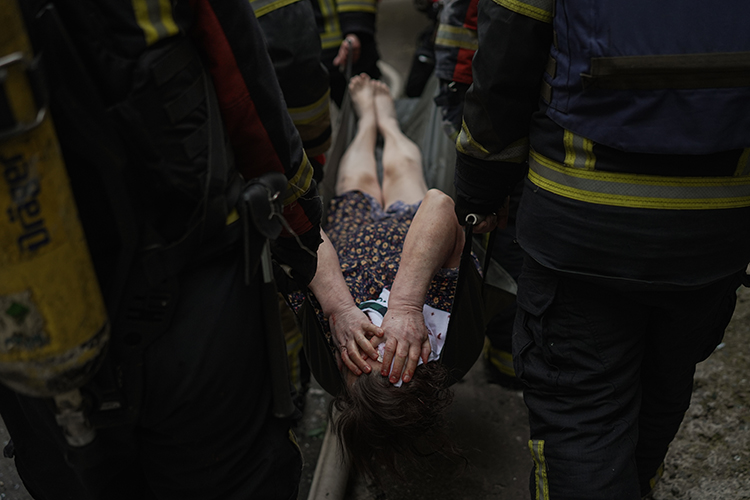
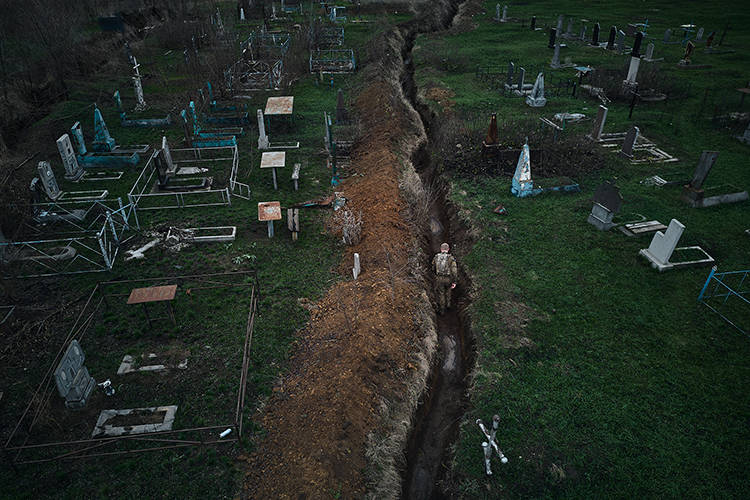
Russia occupied Ukrainian territories back in 2014. By the third year of the full-scale war, a significant part of Ukrainian lands still remains in Russian hands. Five regions of Ukraine and the Crimean Peninsula are partially occupied, including large port cities and critical infrastructure.

During the full-scale invasion, after the territories were liberated from the occupying army, the word "occupation" is no longer just a word from Wikipedia for Ukrainians.

2024 marked significant advances and captures of settlements by the Russian army in Donetsk region. Amid increasing talks about possible negotiations, peace plans, and scenarios for ending the war, Russian advances have become a topic for hostile propaganda manipulation. They use this to fuel conflicts within Ukraine.
"The enemy is implementing a comprehensive strategy to exhaust Ukraine — a combination of military (frontline actions and strikes in the rear) and non-military tools (information campaigns) to undermine the will to continue resistance," — quotes analyst Mykola Beleskov from "Detector Media".
In Donetsk, the occupiers are trying to capture as much territory as possible, make a breakthrough in the south, and reach the border with Dnipropetrovsk region. Scaring Ukrainians with an offensive and intensifying shelling is the Russian tactic aimed at forcing capitulation.
On November 21, 2024, the Russian army used a new type of weapon in Ukraine. Russia, through its president, called this strike a "test in combat conditions." As reported by the Strategic Communications Center of the Armed Forces of Ukraine, Ukraine became the first country in the world against which an intercontinental ballistic missile was used. The Ukrainian Air Force reported that the "Oreshnik" missile flew to Dnipro along with other missiles.

The British agency Reuters, quoting Putin, wrote that this strike was a "warning to the West against supporting Ukraine's military efforts."


According to BBC News, the missile was equipped with six warheads, each containing six submunitions. It caused explosions that lasted for three hours. This was confirmed by a video recording of the strike. The publication notes that the missile's impact zone covers almost all of Europe, and it is capable of overcoming any existing modern air defense systems. The Russian authorities stated that missile tests will continue, "including in combat conditions."

"Of course, the Russian aggressor has not become less dangerous, but he lost another battle on the information field. The Russians did not take into account the resistance of Ukrainians, supported by a sense of humor and tempered, in particular, by their own missiles and the brandishing of a nuclear stick, to which Moscow returns again and again with manic persistence," wrote the Institute of Mass Information.
We must remember that the Russian army daily bombards the territory of Ukraine with missiles capable of carrying nuclear warheads. If we look back almost two years ago, 46 people were killed and 79 injured in the same Dnipro on January 14 as a result of a Russian missile strike with X-22 missiles on a high-rise building.

“A Russian missile launched at an energy infrastructure facility was hit by Ukrainian air defense forces. Since the installation of air defense violated the norms of international law, which you all care so much about, placed in a residential neighborhood, the rocket hit a residential building,” he said during the meeting (UN — ed.) Nebenzia”.

“This was the case in Kremenchug and Dnipro, Ukrainian missiles, which did not reach the target, flew into Poland and Moldova,” Nebenzia stressed.

"As reported by the project 'NotaEnota', citing the spokesperson of the Ukrainian Air Forces Yuriy Ignat, the missile launch over Dnipro was carried out from a Tu-22M3 long-range bomber from the Kursk region and the Azov Sea. In total, there were five launches of such missiles. The Kh-22 is called the 'aircraft carrier killer.' The missile's warhead weighs 950 kilograms and can be equipped with a nuclear warhead. It is designed to destroy aircraft carrier groups at sea. Such missiles are not used in cities, but Russia launched it over Dnipro," reports "Detector Media." "The situation was again addressed by the Ukrainian Air Forces command, which reported that radar systems detected the approximate launch location, altitude, and flight speed. 'There is no doubt that it was indeed a Kh-22 missile. The Armed Forces of Ukraine do not have weapons capable of shooting down this type of missile,' the agency stated."
Russia is a dictatorial state that cannot exist without war and the seizure of foreign territories. For the third year, the occupiers have held Europe's largest nuclear power plant, Zaporizhzhia NPP, and the city of Enerhodar hostage..

In November alone, due to shelling by the Russian army, the Zaporizhzhia Nuclear Power Plant lost power three times. The Russian army has turned the station into a military base and a tool of nuclear blackmail. Meanwhile, the Russian authorities and Kremlin mouthpieces appointed to manage the plant under occupation accuse the Ukrainian government and Armed Forces of Ukraine of nuclear terrorism.

Propagandists call the IAEA inspectors present at the Zaporizhzhia Nuclear Power Plant probable spies, while the Russian military on the station's territory are referred to as "personnel of the Russian National Guard ensuring security at the station." Across the river from the captured Enerhodar, under constant Russian shelling, lies the city of Nikopol and its district.

"Today, Russian troops are using the Zaporizhzhia Nuclear Power Plant as a shield and a tool for provocations: the enemy terrorizes the city of Nikopol daily from the territory of the NPP, taking advantage of the fact that the Armed Forces of Ukraine cannot respond, as a corresponding strike could lead to a second Chernobyl," — wrote the Liberovs on their Instagram.
Russian propagandists, speaking about "nuclear terrorism by the Ukrainian authorities," mention another facility in the Zaporizhzhia region, namely the Dnipro Hydroelectric Power Plant, which they shelled during a massive missile attack on Ukraine on March 22, 2024. Propagandists spread messages that allegedly the Armed Forces of Ukraine, under the leadership of the Ukrainian authorities, have long mined the hydroelectric power plant. They plan to blow it up when the Russians enter the city. These fake statements take us back to the tragic events of June 2023, when the occupiers blew up the dam of the Kakhovka Hydroelectric Power Plant, causing a man-made disaster.


The OSINT agency team "Molfar", after conducting an investigation, found that the Russian army was involved in the blowing up of the Kakhovka dam, most likely the first motorized rifle battalion of the 205th Separate Motorized Rifle Brigade of the 49th Combined Arms Army of the Southern Military District of the Stavropol Territory. They also refuted the propaganda version that the dam was destroyed by the Armed Forces of Ukraine, hitting it with the "Vilha" MLRS, since the destroyed part of the dam is 200 meters long, which theoretically cannot be done by a 250 kg warhead.
"The flooding of the Kakhovka HPP occurred because the Russians from the first days of the full-scale invasion occupied it and had uninterrupted access to it. Then they mined it, after which they deliberately increased the water pressure, which led to the destruction of the dam and its supports. As a result, the dam of the HPP was destroyed. The Russian leadership knew about the planning of the terrorist act and the approaching catastrophe and prepared a legislative basis for themselves. Why the Russians benefit from blowing up the dam — slowing down the advance of the Armed Forces of Ukraine — was said by the occupation military correspondents themselves. The Main Intelligence Directorate in October indicated that the mining was carried out back in April 2022, and in October they also mined the sluices and supports of the HPP, and trucks with explosives were located on the dam itself," concludes "Molfar". Moreover, the Russian army opened fire on evacuation sites.
"Honestly, we did not expect this." "I was struck by the maximum inhumanity of our enemy. Not only did the Russians flood the city and commit one of the largest ecocides in recent decades, but they also continue to shell the civilian population. Then it hit a residential area. People were screaming. Fortunately, no one was hurt, but the situation was very tense," — said UAPP Konstantin Liberov, who also documented the consequences of the explosion in Kherson.*

"When everyone had already left, the water receded" — and people were left alone with this misfortune. We saw the real scale of the catastrophe. Thousands of families were left homeless. People told us: "The Russians didn’t finish us off, they flooded us." But at such a crucial moment, they often told me: "We will still cope with this, if only they don’t come back here. Because it was worse during the occupation." People wanted to live in Ukraine, to manage their own land. The value of freedom for these people, for all of us, is vital," — quotes Ivan Antypenko UAPP.
While facilities such as the Kakhovka Hydroelectric Power Plant and the Zaporizhzhia Nuclear Power Plant remain under the occupation of a country that daily violates international law, the real threat looms not only over Ukraine but over all of Europe.

To justify the so-called "special operation" and the desire to seize the eastern and southern regions, propaganda actively promotes the theme of "Novorossiya," declaring: Ukraine is an artificial country.

In April 2014, during a "Direct Line" event, Volodymyr Putin spoke for the first time about Novorossiya, specifically about its historical roots. Putin's speech was built on two theses: first, Novorossiya is the historical name of Eastern and Southern Ukraine, with a predominant ethnic Russian population; second, these territories, as Putin claims, were illegally transferred by the Bolsheviks to the Ukrainian SSR in the 1920s, writes "Hromadske Radio." Oksana Populyak says that no matter how much Putin wanted, the concept of "Novorossiya" has no national meaning. It is merely a fanciful name for a territory that characterizes Russian expansionist policy. Russian propaganda actively uses the term "Novorossiya" to legitimize the dim modern occupation of southern Ukraine. It began to be actively used since 2014.
Russian propagandists are urging residents of Zaporizhzhia and the region to evacuate because the Russian army is preparing to capture the entire Donetsk and Zaporizhzhia regions. To increase psychological pressure on Zaporizhzhia, modernized KABs were launched.


"The city of Mykolaiv became a turning point for the Russian southern offensive. If the city had fallen in the first weeks of the full-scale invasion, the road to central Ukraine, as well as the much-desired route to Odesa, would have been open for Russia's brutal invasion. For Ukraine, the city and its residents are a symbol of unwavering resistance and self-sacrifice," — wrote Sasha Maslov on his Instagram.


Odessa is a Russian city in general, we know about it, but we invented historical nonsense, and after the collapse of the USSR we put up with it,” he said during the annual press conference.

After the Russian withdrawal from the grain deal, Russian forces increased the number of attacks on southern Ukraine: they tried to destroy port infrastructure by shelling it from occupied Crimea, which over the years of annexation turned into a base for strikes on southern Ukraine.
Russia justifies the attacks on Odessa and Nikolaev by claiming that ships with NATO weapons arrive at the ports. Russia also spreads fakes about “illegal mass transportation of NATO weapons in civilian ships, which are hidden in fuel and grain.”

Considering Odessa a Russian city, the Russians do not forget to regularly shell the city. On the night of July 23, Russian forces launched a massive attack on the territory of Odessa and the region, firing 19 missiles. The historic center of Odessa, protected by UNESCO, was damaged. The Russian army damaged 25 architectural monuments at once, including the Transfiguration Cathedral, showing the world that their ostentatious Orthodoxy is actually not about religion.


"The Spaso-Preobrazhensky Church, which apparently baptized the Moscow Patriarch Kirill in 2010, was severely damaged. The same one who now blesses the aggressive war of conquest. However, the Russians once again proved that they have nothing sacred," wrote the Liberovs from Odesa on their Instagram.
As the Russian army advances in Donbas, it leaves behind devastated cities. Ukraine has already lost many fortresses in Donetsk and Luhansk, turning them into ghost towns.
"We see from the example of Crimea and Donetsk, that people who consumed Russian news had a distorted perception of what Russia brings and what it actually is," — quotes Ruslan Deinichenko, co-founder of StopFake, "Ukraïner".».

Enemy propaganda traditionally reflects its own crimes, accusing Ukraine of all sins. Allegedly, "Since 2014, Kyiv has been deliberately destroying the industry of Donbas." ("Arguments and Facts").
Propaganda claims "that near Pokrovsk, by Zelensky's order, the last reserves of coking coal will be destroyed, just so they do not reach the real owners — the residents of Donbas." ("Arguments and Facts").

“Kurakhove without exaggeration — the new Bakhmut”. [...] Burned cars with bodies of locals who tried to escape the city lie on both sides of the road,” — says Anton Shtuka in an interview with UAPP, describing the difficult situation in the city.

"Once a dense majestic forest — now an accumulation of dead, completely shattered trunks, which will soon disappear as well. A forest where it is never quiet, and every sound heard can be the last," — captioned the photograph Konstantin Liberov.
Russia has never acknowledged any crime committed against the civilian population. In Mariupol, occupied by Russians since the beginning of the large-scale war, people died from shelling and inhumane conditions created by the city's blockade. One of the bloody terrorist acts of the Russian army was the bombing of the maternity hospital in Mariupol. To whitewash this, the Russian authorities cite the testimony of Marianna Vishemirskaya from Mariupol. The girl survived the bombing of the maternity hospital and later moved to Russia, where she spreads hostile propaganda.


"If Associated Press journalists had not stayed in besieged Mariupol in March 2022, risking their lives alongside medics, military, police, and others, the world would not have received reliable facts about the atrocities of the Russian army in this city. Or these facts would have been much fewer and would not have resonated so loudly," — said Ivan Antypenko in an interview with UAPP.
Mstyslav Chernov, together with colleagues from Associated Press, were the only ones in March 2022 who documented the crimes of the Russian army in besieged Mariupol for 20 days. The footage formed the basis of the documentary "20 Days in Mariupol." This film won an Oscar for Best Feature Documentary. All these crimes are the face of the Russian invasion of Ukrainian land. We do not know the future, but we definitely know there is no future where the "russkiy mir" comes. And we also know that Ukrainians heroically create the future, make history, and document it.
Previously, the Ukrainian Association of Professional Photographers had already written about how Russia is trying to devastate Kharkiv through shelling and propaganda.
The material was worked on by:
Researcher of the topic, text author: Yana Yevmenova
Image editor: Olga Kovalova
Literary editor: Yulia Futey