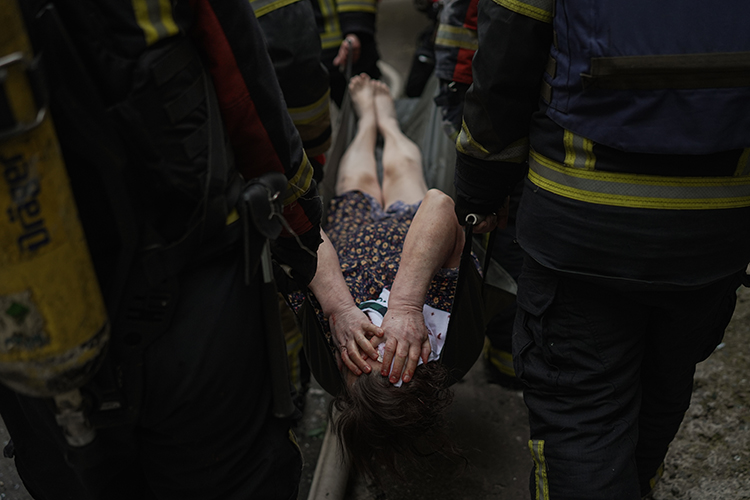
Mutilatedtowns and villages across Kyiv, Chernihiv, Sumy, and Kharkiv oblasts share acommon tragedy—one endured under occupation. After part of Kharkiv Oblast wasliberated from the invading forces, mass burial sites and torture chambers werediscovered across the territory from Vovchansk to Izium. A bombed-out city,mass graves, and places of torture where locals were abused—this is what theRussian army left behind in Izium. Kremlin propaganda rejected all accusationsand responded quickly to footage from liberated Izium, manipulating painfultopics.
"Lenta":

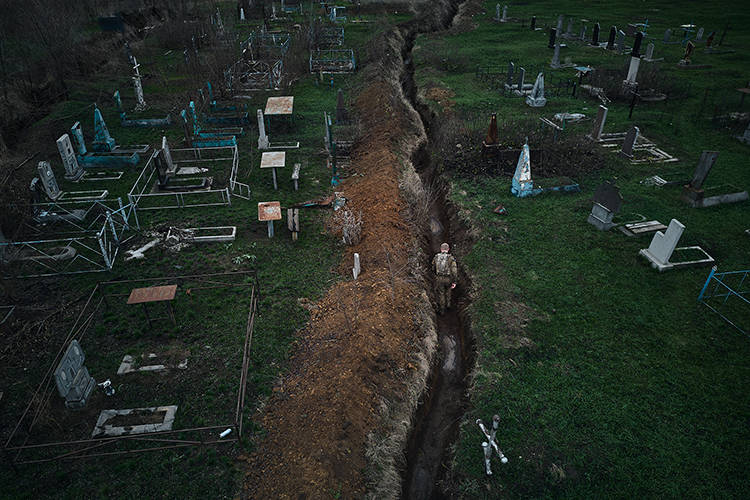
Accordingto him, the Ukrainian authorities did not show mass graves, but rather acemetery with ordinary graves.
“Eachgrave had an Orthodox cross, meaning the people were buried, and Ukrainiansbegan digging them up,” he said.
Propagandaalso spread disinformation using a photograph of the grave of a family killedin their home on March 9 by a Russian aerial bomb.
Reporter: “It’s worth noting that the dates on thegraves are March 9, 2022. The ‘spiciness’ of the situation is that Russiantroops took Izium on April 1. Thus, all the burials in this area before thatwere done by the Ukrainian authorities, and now they are digging up the graveson camera of those they themselves buried. So who abused people and tied theirhands behind their backs before killing them?”
DariaHerasymchuk, adviser to the President’s Office on children’s rights and childrehabilitation, reported that on March 9 the Russian army killed sixmembers of one family by dropping an aerial bomb on their home in Izium. Thehouse was then deliberately finished off with tank fire. At least 44people died under the rubble.

“In thetown where 447 bodies of Ukrainians were found, three mass burial sites werediscovered. Some of these people were brutally murdered; many were torturedbefore death,”Danylo Pavlov captioned the photo on his Instagram.
The mostcynical statements about the tragedy in Izium came from propagandistsoriginally from Ukraine.
Podolyaka-video:


It may seem like a minor detail. But it is very telling.”
Podolyaka-videois the website of Yurii Podolyaka—an “analyst and military expert,” as he callshimself, but in reality a blogger and propagandist originally from Ukraine.After the Revolution of Dignity, Podolyaka moved to Russia. He has beensentenced in absentia to 12 years in prison for justifying Russian aggressionand for collaborationist activities.

According to French journalist Adrien Bocquet, many corpses were brought toIzium for a bloody photo shoot.”
Thepropagandist cites statements by Adrien Bocquet, a former serviceman fromFrance. Bocquet has repeatedly been exposed for lying and for spreading Kremlinpropaganda internationally. He lied even about his military career. StopFakereported this, citing an investigation by Libération. StopFake also found that his ex-wife has Russian roots, and thattheir daughter is named Lena.

“A fewdays ago, on the outskirts of the newly liberated city of Izium, a mass burialsite was found. More than 400 graves. Most are unnamed. It’s impossible to lookat this, but everyone must see it!”, Kostiantyn Liberov captioned the Izium photoon Instagram.
Anothertopic for manipulation was the tragedy of a serviceman’s family: his body wasfound in a mass grave. His wife recognized him by his tattoo and ablue-and-yellow bracelet on his wrist.
Х-true:

The hand with the bracelet, the photo of which became a symbol of accusationsagainst Russia of ‘genocide,’ belongs to a Ukrainian serviceman from Nikopol,Serhii Sova. He served in the 93rd Brigade ‘Kholodnyi Yar’.”
Propagandistscalled the hand with the bracelet a “symbol of Kyiv’s propaganda.” Footage ofthe bracelet on the wrist of a Ukrainian soldier killed by Russians in Iziumshocked the public. Contrary to propaganda messaging, it became a symbol of theinvaders’ atrocities.
X-trueclaims Russians had to bury Ukrainian soldiers because, allegedly, the ArmedForces of Ukraine leadership refused to collect them from the Izium morgue.
“Russian forces did not leave Ukrainian soldiers to rot anddecompose in the open for the delight of stray dogs and wolves that live in theIzium forests—they buried them,” the hostile outlet wrote.

Detector Media debunked this fake:
“If theArmed Forces of Ukraine leadership did delay an operation to transfer thebodies of fallen soldiers from occupied Izium, there could have been only onereason: constant Russian shelling of the city. One of the crosses in the forestreads: ‘AFU, 17 persons, Izium, from the morgue.’ At the same time, some graveshave no crosses. In addition, a burial site of about 20 Ukrainian servicemenwith their hands bound was found nearby. This may indicate they were prisoners,Ombudsperson Dmytro Lubinets said on his Telegram,”
In the massburial site near Izium, body No. 319 was identified as children’s authorVolodymyr Vakulenko, whom Russians shot in the spring of 2022. DNA testsconfirmed it.
“Seventy-four bodies remain unidentified. Most of them areburials in Izium: 56 bodies. We cannot identify them due to the absence ofrelatives we could use for DNA comparison,” explained Kharkiv Oblast policechief Volodymyr Tymoshko to Gwara Media, as of March 2024.
Mass burialsites and torture chambers were also found in the de-occupied towns of Lymanand Sviatohirsk in Donetsk Oblast. In Lyman in particular, two mass burialsites were discovered—one with civilians, the other with military personnel—aswell as more than 130 individual graves. People were buried in trenches, andsome graves had numbers instead of names.

“Amongthe exhumed civilians in northern Donetsk Oblast, 85 were men, 66 were women,five were children, and the sex of another 10 people has not been established,”police said. They clarified that people died from mine-blast and shrapnelwounds from Russian shelling, as well as from natural causes; some bodies boresigns of violent death,” Radio Svoboda reports.
Associated Press published exclusive photos and video footage of mass burial sites in Izium, atown recaptured by Ukrainian forces. The first to reach the site and interviewofficials were AP video journalist Vasylysa Stepanenko and photographer YevhenMaloletka. As AP writes, local residents of Izium showed them the way. The military hadonly begun demining the area and preparing for the exhumation planned for thefollowing day. AP reported that “Ukrainian authorities invited international media to theburial site for the start of the exhumation.”

Associated Press released exclusive footage in the evening,immediately after the Ukrainian president’s video address. Over the first 12hours, images from Izium were amplified by major global broadcasters. YevhenMaloletka’s photographs were published by nearly all major outlets, includingThe Washington Post and The New York Times. British media reported that “AP’scoverage as evidence of a mass burial site was confirmed by leading media andofficials.”
As theoutlet reports, AP journalists arriving at the burial sitesaw graves marked with simple wooden crosses. Some had names written on them,and flowers hanging from them. Citing Ukrainian officials, the same mediaoutlet describes a mass grave containing more than440 bodies. Some of those buried in the pit were shot; others were killed byshelling. Many bodies had not yet been identified at the time. Numerous“torture chambers” were also found, where both Ukrainian citizens and foreignerswere held “in absolutely inhuman conditions.”
Journalistsfrom Reuters also visited the mass burial site in the Iziumforest. There they met local resident Volodymyr Kolesnyk, who was searching forthe graves of his relatives.
“Clutching a neatly written list of names and numbers, citizenVolodymyr Kolesnyk stepped between graves, searching for relatives who, hesaid, died in an airstrike on an apartment building shortly before the cityfell in April, when invaders swept through Kharkiv’s northeastern region,” the British media outlet reports.
On Sept.19, 2022, Reuters reported the first results of the exhumation. CitingKharkiv Oblast Governor Oleh Syniehubov, Ukrainian forensic experts exhumed 146bodies, mostly civilians. Some showed signs of violent death; among the exhumedwere two children.
On Oct. 2,2022, Associated Press published an investigation into the torture chambers Russiansset up in Izium. The investigation is based on what journalists saw in theforest and on interviews with survivors of those events, as well as withpolice.
Journalists heard from officials that the mass burial site was heavily mined,and they saw bodies with hands tied.

Theymanaged to speak with 15 people who survived torture; some had been taken totorture sites more than once. They also spoke with families whose relativeswent missing. AP cites testimony from a local doctor who treated people with injuriesconsistent with torture, such as “gunshot wounds to hands and feet, brokenbones, severe bruises, and burns.”
“Associated Press’s investigation found that Russian torture in Iziumwas arbitrary, widespread, and entirely routine—for both civilians and soldiersacross the city,” the outlet wrote.
APjournalists identified 10 sites where torture was carried out in Izium, andgained access to five of them. Torture sites were found in a police station, akindergarten, and a residential complex. The investigation also mentionstorture sites in a local school and in a medical clinic’s garage. The latterheld both men and women; the women’s room was closest to the room where Russiansoldiers stayed. Victims were thrown into pits with water, beaten withsticks, hung upside down by their legs, and tortured using gas masks andelectrodes—this is only what survivors dared to describe. AP journalists found gas masks in two Iziumschools.
“Torture in any form during an armed conflict is a warcrime under the Geneva Conventions, regardless of whether it is used againstprisoners of war or civilians,” the outlet concluded.
Workedon the piece:
Topic researcher, text author: Yana Yevmenova
Photo editor: Viacheslav Ratynskyi
Literary editor: Yuliia Futei