
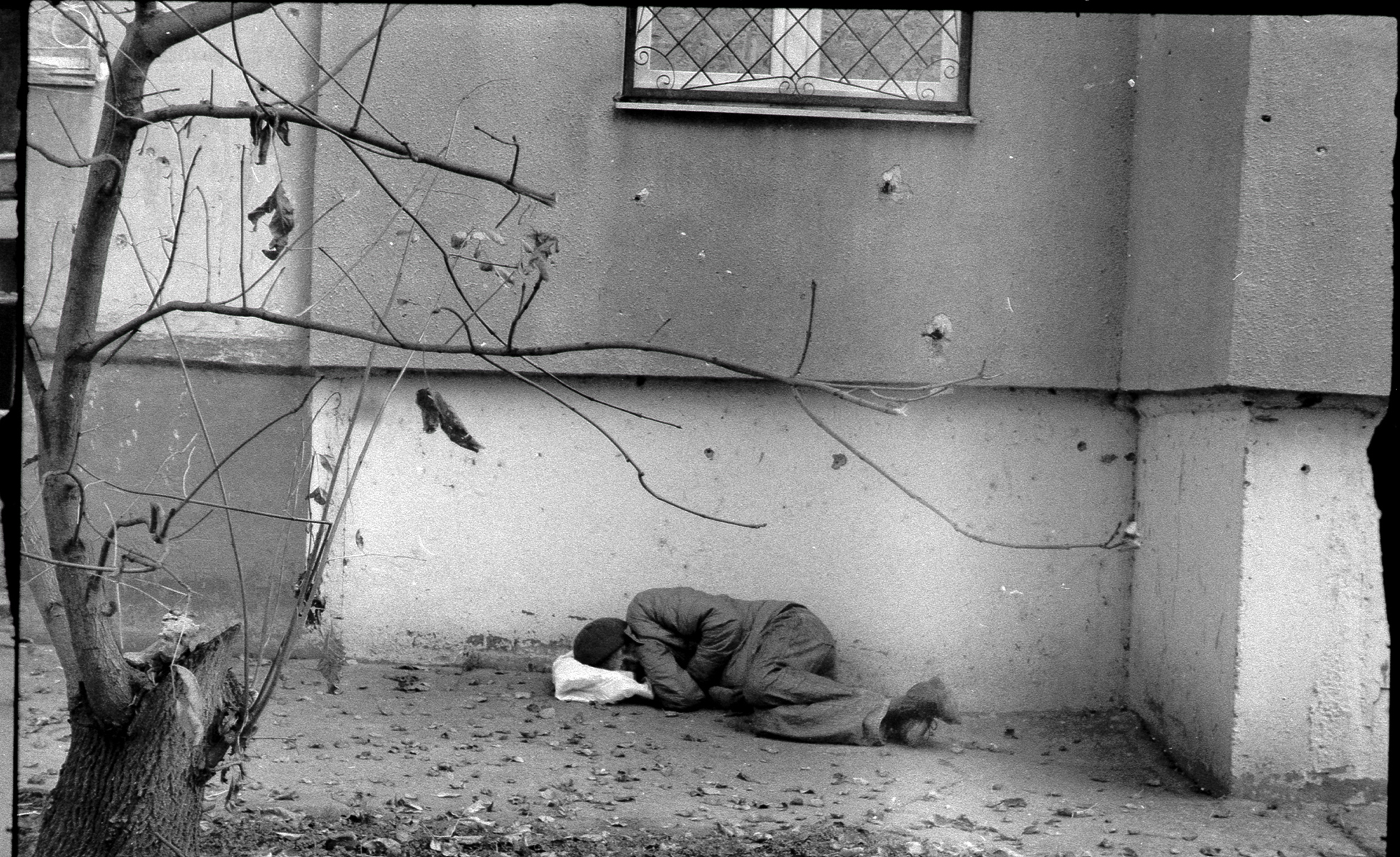
On the anti-drone-net-wrapped streets of Kherson, people celebrate birthdays, hold weddings, and go to the theater. Amid the surreal scenery of war, life in the city goes on. However, central Kherson is emptying out, and people are moving to relatively safer areas — farther from the Dnipro River and closer to the residential neighborhoods. Photographer Stanislav Ostrous once again visited his native city of Kherson to capture different aspects of its existence.
A game of survival
From Mykolaiv to Kherson, the train slowly pulls two cars. Passengers, without introducing themselves, speak openly — awareness of nearby danger brings people together. Everyone is equally afraid. Police and officers of the Security Service of Ukraine walk through the car — they question everyone and check documents. A night on the side berth brings no rest, and in the morning you unbearably want coffee. Outside the window, the steppe drifts by covered in fog. The land has been plowed for winter crops, and the pheasants that used to run along the road are gone.
Three years have passed since Kherson was liberated from Russian occupation. The city is bombed daily with KABs, “Grads”, and drones. Russians practice dropping munitions on “moving targets” — military or civilian; women, pensioners, or children. They don’t care whom they stage their “safari” on. City life huddles closer to the residential neighborhoods, being pushed farther and farther away from the Dnipro. Until recently, the relatively safe Shumenskyi neighborhood in the western part of the city has now come under active shelling. At the end of October, a local volunteer, Rostyslav, filmed a massive “Grad” barrage from his balcony — explosions sounded one after another, and thick black smoke rose above the struck high-rise buildings.

The city center has long looked like a desert, through which desperate marshrutkas fly at speed. There are almost no pedestrians. Here, you can occasionally meet mostly marginalized people who have nothing left to lose. The streets Perekopska, Himnasychna, Soborna, and Bohorodytska have fallen into the kill zone. Near the “Fregat” hotel in the city center is the front line.
Kherson is turning into a ghost town: ruined, charred buildings look at the few passersby with the black voids of their windows. Streets wrapped in anti-drone nets resemble the labyrinths of a giant prison. Surreal scenery of a game of survival. A quest with no right to make a mistake. Residents equip themselves with anti-drone detectors, but this often does not help. In November, the trees are already without leaves — there is nowhere to hide.
Sorrow and despair
For photographer Stanislav Ostrous, Kherson is his native city, and he uses every opportunity to get there. Together with volunteers from the organization “Sylnі bo vilni” (“Strong because we are free”), he went to help people at strike sites. “I’ve already seen so many ruins all across Ukraine, but every time I feel real pain, sorrow, and despair when I look at the remnants of what used to be ordinary human life,” Ostrous says. Disoriented homeowners try to help the volunteers. Charred remains of an apartment are shoveled out onto the street. A column of dust rises from the ground — the dust that people’s hopes have turned into. A whole life can now be packed into a couple of suitcases.


The volunteers work quickly. First, everything has to be finished by three in the afternoon, because afterward it becomes difficult to get home, and second, enemy drones are somewhere nearby. The detectors keep beeping, and their screens show the direction the drones are moving.
After the work, Stanislav Ostrous returned with the volunteers to their base. The basement rooms are set up as classrooms, playrooms, and sports halls. Rostyslav Kulyk, one of the founders of the “Sylnі bo vilni” team, can’t resist and hits a punching bag with trained blows. His birthday is coming up soon, which coincides with the day Kherson was liberated from Russian occupation. The guys on the team are preparing congratulations for his 45th birthday — printing certificates with jokes, as a counterbalance to official thanks.

Rostyslav Kulyk hid from Russian troops at the Kherson Cotton Mill. “Our guys came to pick me up and started honking under the windows. A burst of automatic fire rang out and I saw the guys. Tears, joy,” Kulyk recalls. “One of my brothers has already been demobilized, the other is still serving — if not in the Pokrovsk direction, then in the Kurakhove direction. It’s hard everywhere. There is no place where it’s easy.”
“Sylnі bo vilni”
Rostyslav Kulyk and his friends created the organization “Sylnі bo vilni” on February 26, 2022. The volunteers organized seven points where people could eat. “We tried to minimize the criminogenic situation so that people wouldn’t loot from hunger — wouldn’t break into shops, wouldn’t steal,” Rostyslav recalls. “We even resolved everyday conflicts that often arose due to нервова tension.” During the occupation, it was scary — Russian troops took people to “the pit,” took them away. One acquaintance of Rostyslav Kulyk spent more than half a year in a special facility near Simferopol. He was a civil servant and they pressured him to cooperate. Now he has left Kherson.
Today the hardest thing for Rostyslav and his team is evacuating people from the coastal areas on the opposite side of the Dnipro — Antonivka, Sadove, Stanislav, Shyroka Balka, and Kizomys. “People held out until the last, and now they put themselves and us in danger,” the volunteer says. “Sometimes they call and say they’re wounded, bleeding out. The military and police no longer go there so as not to expose themselves. I won’t even mention an ambulance. We have to ‘fly’ there ourselves.” People in Kherson’s coastal areas live without electricity, water, and gas. That is, they survive, not live. One grandmother in Antonivka told Rostyslav that icons protect her. “I tell her, take the icons and let’s go. She promised to think it over. She’s still thinking,” Rostyslav Kulyk says.
Kherson’s volunteer organizations cooperate and help one another. “Sylnі bo vilni” also signed a memorandum of cooperation with the local authorities, and now it is easier for them to resolve various administrative issues. “Long-term projects are closing down, and we constantly feel a lack of funding. After evacuation trips, our cars need repairs. Sometimes we hit petal mines — wheels get torn off, engines break, and so on,” Rostyslav Kulyk shares. “There are still many people left in the city, especially elderly people. They need help. We’re not going to run. We will live!”
“Eternity and a Day”
The next day, Stanislav Ostrous went to the theater, which continues to operate despite its immediate proximity to the front line — a few hundred meters away is already the red zone. Unexpectedly, the photographer ended up at a rehearsal for a holiday concert held in the basement, in a small hall. Not many people come, but all 10–15 seats set aside for viewers are always occupied. “There I met Ernest — a well-known Kherson biker and, at the same time, a saxophonist. I used to photograph their biker hangouts,” Stanislav Ostrous smiles.


In the theater’s inner courtyard, protected from drones by a net, Stanislav Ostrous met the director — Oleksandr Andriiovych Knyha. He is a Ukrainian theater figure, director, actor, People’s Artist of Ukraine, the long-time director of the Mykola Kulish Kherson Regional Academic Music and Drama Theater, and the founder and president of the international theater festival “Melpomene of Tavria”. “Oleksandr invited me to go with the theater troupe to Lilac Park — to plant trees in honor of Kherson’s fallen defenders. Imagine planting trees in a city scorched by war,” the photographer says. Oleksandr Knyha leads the tree-planting process in the park and recalls that once he also planted hundreds of trees near his own home. Now his home is in occupied territory.


Oleksandr Knyha recalls that before the start of the full-scale war, the theater had planned the premiere of the play “Eternity and a Day”. The title, as it turned out, is quite symbolic. From the moment of the full-scale invasion and the occupation of Kherson region, Oleksandr Knyha lived in his house in Oleshky. He went home and immediately found himself under occupation. The theater director was held captive by the Russians; he was accused of organizing rallies. However, Oleksandr Knyha was released because the incident received wide coverage in the media. The occupation forces pressured Oleksandr to collaborate, and he had to leave for territory controlled by Ukraine. But after Kherson was liberated, he immediately returned to the Kulish Theater. “We are free people. We felt our strength and Russia’s weakness. They are trying to destroy us and force us to leave, but we want to live — and to live here,” Oleksandr Knyha says.
An orphaned city
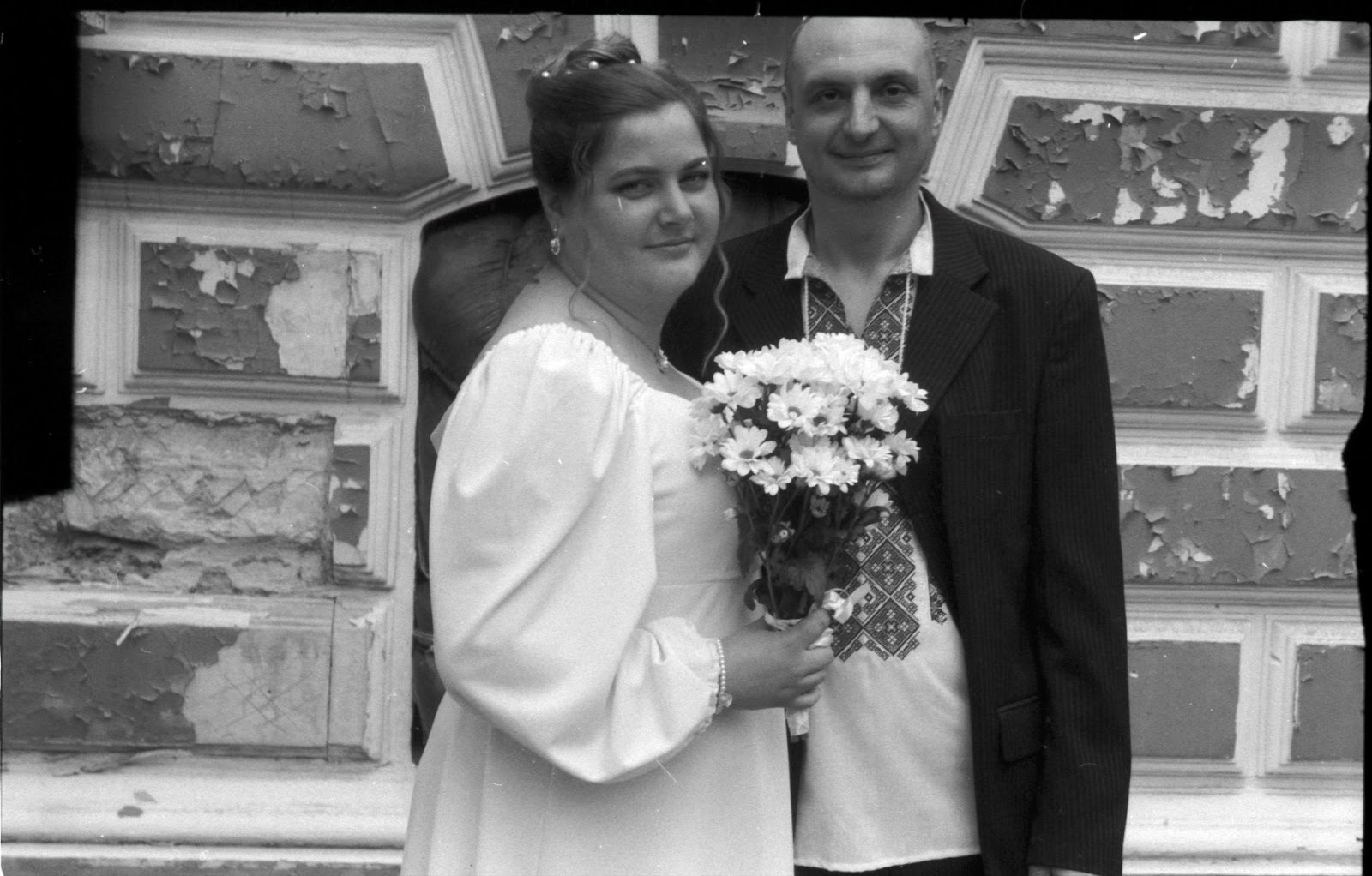
A five-minute walk from the Kulish Theater is the registry office building. Despite the constant danger of shelling, people gathered to congratulate the newlyweds — Veronika and Oleh. The couple met after Kherson was de-occupied — the girl worked in a shop, and the boy came to buy groceries. Due to the lack of electricity, the ceremony is delayed. Guests get tired of waiting — bags of champagne appear, plastic cups, and shouts of “Bitter!” After a few toasts, the tension fades and the lights come on. Stanislav Ostrous becomes a wedding photographer for a while. “We decided to register our marriage on the anniversary of the city’s liberation so that our love would be as strong as Kherson,” the newlyweds smile.
The last coffee shop in the city center is closing. Barista Oleksii gives Stanislav Ostrous one of the postcards he drew himself as a keepsake. “Another local spot of color is disappearing. The city is becoming orphaned,” the photographer says.


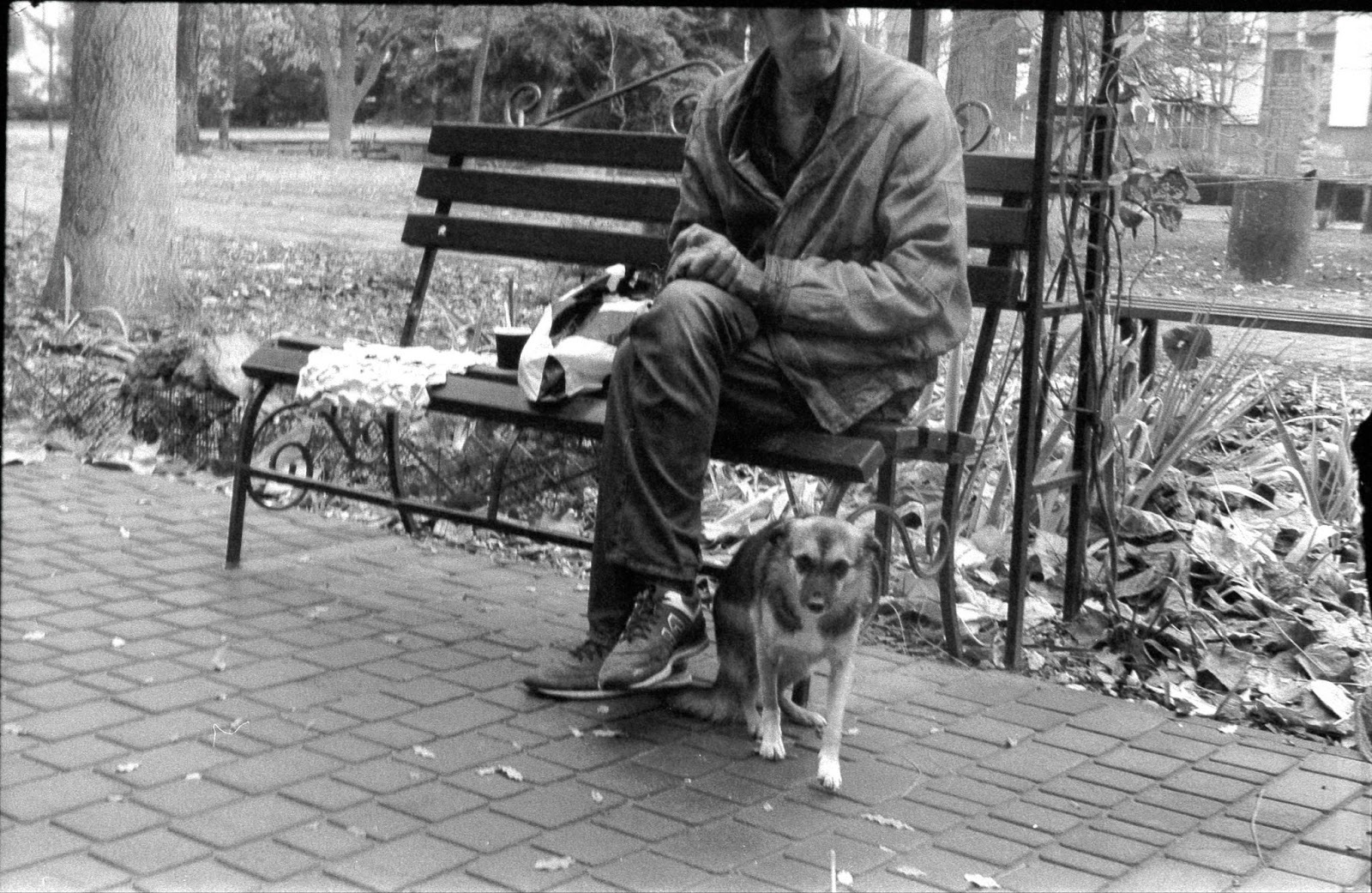
Stanislav Ostrous goes to the railway station. On the square that is usually filled with people and food courts, it is now empty and quiet. You can hear only the sound of outgoing long-range artillery and incoming strikes somewhere nearby. Beyond the railway crossing, dogs from a shelter bark and whine. “There are a lot of dogs in Kherson now. They run in packs; sometimes they can be aggressive, but for the most part they are scared themselves,” Stanislav Ostrous says. “I remember that on this trip I still didn’t make it with the volunteers to the dog shelter. I hope next time I will.”
Stanislav Ostrous — was born in 1972 in Zhmerynka, Ukraine. He began photographing in 2012. Member of UPHA — Ukrainian Photographic Alternative — and MYPH. Finalist of the Leica Oskar Barnack Award 2025. Participant in the main exhibition of the “Batumi Photodays” festival (2016–2019). PhotoCULT 2019 shortlist. He currently lives and works in Kharkiv, Ukraine.
Photographer’s social media: Instagram and Facebook
Worked on the material:
Text authors: Stanislav Ostrous, Katya Moskaliuk
Photo editor: Vladyslav Krasnoshchok
Literary editor: Yuliia Futei















.jpg)


