Over 13 years of Russia’s war against Ukraine, Mariupol has endured Russian occupation, liberation, the shelling of a civilian neighborhood, and a second occupation. The Ukrainian Association of Professional Photographers presents moments from the life of the “City of Mary” between 2014 and 2022.

A Turbulent 2014
Russian hybrid forces first occupied Mariupol in the spring of 2014. On April 13, militants seized administrative buildings and blocked several streets in the city center. During the assault on June 13, Ukrainian forces eliminated the enemy’s key strongpoints, destroyed hostile equipment, and restored control over all seized facilities, including the city council building. This was the first time Ukraine’s defense forces liberated Mariupol from the Russians.


Mariupol Free Again
Eight years still remained until Russia’s second occupation of Mariupol in 2022. Photographer Serhii Vahanov left militant-held Donetsk, where he had lived for 15 years, and returned to his hometown.
“I returned to Mariupol feeling so lost, almost 40 years after I’d left as a teenager,” Serhii Vahanov begins. — “Nearly a month after the liberation, there weren’t many people in Mariupol—probably many had simply left. Not all shops were open. The city looked half-empty. Here and there, militants’ graffiti still remained on the walls; they hadn’t managed to paint it all over yet.”

In Mariupol, Serhii began getting to know local journalists, volunteers, and activists. Mariupol residents started actively coming out to pro-Ukrainian rallies.
“Because the war was only 20 kilometers away. That’s why it was very unsettling in Mariupol,” Serhii explains.

The Shelling of the “Skhidnyi” Neighborhood
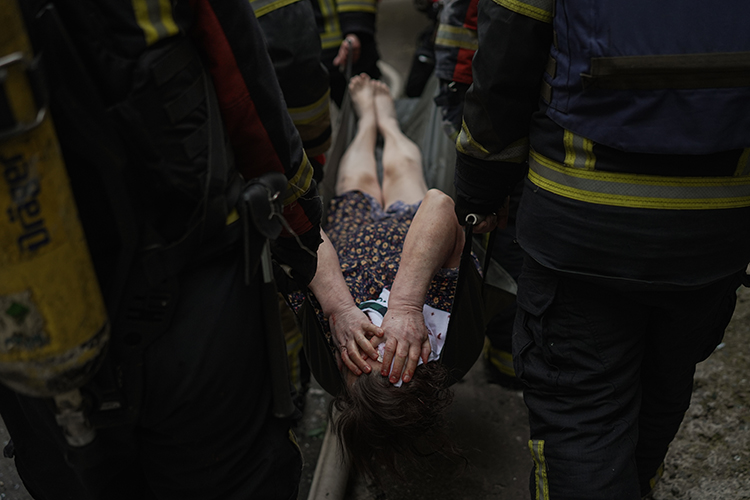
Seven years remained until the Russians returned to Mariupol for the second time. On 24 January 2015, Mariupol residents woke up to loud explosions. The Russians shelled their frontline city with heavy weapons. Twenty-nine residents of Mariupol’s “Skhidnyi” neighborhood were killed, and about a hundred more were wounded. Until 2022, this tragedy was the largest for the city since the beginning of Russian aggression.


Serhii Vahanov remembers that day well. He learned about the shelling from the news.
“The ‘Skhidnyi’ neighborhood is the edge of the cPhoto by Mstyslav Chernovty—it always looked out toward the war,” the photographer says. — “When I got there, I saw people’s bodies out on the street. I started photographing it all: the dead, the fire, destroyed homes, the military and police who were there. All that horror and all that chaos.”
Serhii Vahanov felt the city was living in constant anxiety. After the tragedy, Mariupol residents once again began actively coming out to pro-Ukrainian rallies.
“For Mariupol residents, it was a way to shout, somehow: ‘We are here,’” Serhii shares.
The Siege
The invasion began.
“Because we were all used to the sounds of war, it played a cruel joke on us in 2022,” Serhii says. — “Before, it felt normal to be relaxing on the beach or training on a tennis court and hear explosions somewhere in the distance. You’d just think to yourself that they were shooting somewhere around Vodiane or Shyrokyne. And when the full-scale invasion happened, I thought, ‘We’ve heard this before!’ I believed our defense forces would be able to hold the city. I’d been to their positions for four years. But back then, no one could have imagined that Mariupol would end up under siege.”

The photographer did not take a single photo while in Mariupol during the full-scale invasion.
“Back then it was dangerous to walk around with a camera—saboteurs and spies seemed to be everywhere. And people knew me there as a photographer. There were also intense strikes from Russian aviation,” Serhii says.

Together with his family, he managed to leave the encircled city on March 14. Serhii, risking his life, evacuated his archives: photos and videos from Donetsk region—his entire journalistic body of work since 1999. The next day, March 15, documentary filmmaker and UAPPF founder Mstyslav Chernov traveled the same route toward free Ukraine. He too was taking a risk, carrying documentary materials out of Mariupol that testified to Russian war crimes and later became the basis for the film “20 Days in Mariupol.” For this film, Ukraine for the first time in its history won an Academy Award (Oscar).

“Even though I didn’t take a single photo from the encircled city, I, just like Mstyslav, lived through those 20 days in Mariupol. I will probably never dare to watch this film,” Serhii admits.


Two years later, in March 2024, speaking from the Oscars stage in Los Angeles, Mstyslav Chernov said he wished he had never had to make this film, and he mentioned Mariupol and its residents who were killed:
“I wish I could trade this for Russia never attacking Ukraine, never occupying our cities. I would give up all this recognition for the Russians not to kill tens of thousands of my fellow Ukrainians. And so that the people of Mariupol who were killed, and those who gave their lives, are never forgotten.”

Mstyslav Chernov believes that the desire to be heard—and the knowledge that you are not being ignored—helps people survive.
“It seems to me that our mission, as journalists or documentarians, is not only to tell the world about tragedies, but also to give people hope that they will be heard. Fewer and fewer people believe in the power of journalism, unfortunately. But we cannot stop, and I hope that ‘20 Days in Mariupol’ will contribute to that hope,” Mstyslav Chernov said in an interview after receiving the Oscar.

Material created with support The Free Word Foundation.
Mstislav Chernov — Ukrainian photographer, journalist of the Associated Press, director, war correspondent, President of the Ukrainian Association of Professional Photographers, honorary member of PEN Ukraine and writer. He covered the Revolution of Dignity, the war in eastern Ukraine, the aftermath of the downing of the Malaysia Airlines Boeing 777, the Syrian civil war, the battle of Mosul in Iraq, the Russian invasion of Ukraine in 2022, including the blockade of Mariupol. For this
This material was produced with the support of The Fritt Ord Foundation.
Mstyslav Chernov — a Ukrainian photographer, an Associated Press journalist, a director, a war correspondent, President of the Ukrainian Association of Professional Photographers, an honorary member of Ukrainian PEN, and a writer. He has covered the Revolution of Dignity, the war in eastern Ukraine, the aftermath of the downing of Malaysia Airlines’ Boeing 777, the Syrian civil war, the battles for Mosul in Iraq, and Russia’s 2022 invasion of Ukraine, including the siege of Mariupol. For this work, he has received awards including the Deutsche Welle Freedom of Speech Award, the Heorhii Gongadze Prize, the Knight International Journalism Awards, the Biagio Agnes Award, the Bayeux Calvados-Normandy Award, the Elijah Parish Lovejoy Award, and the Free Media Awards. In 2022, he was included in the “People of NV 2022 in a Year of War” and “14 Songs, Photos and Art Projects That Became Symbols of Ukrainian Resistance” lists by Forbes Ukraine; and his video materials from Mariupol formed the basis of the film “20 Days in Mariupol,” which in 2024 became the first in the history of Ukrainian cinema to win an Oscar.
Photographer’s social media:
Facebook
Instagram
Serhii Vahanov is a Ukrainian reportage and documentary photographer, born in 1958. He graduated from the Donetsk Medical Institute and then worked for 15 years as a traumatologist in Avdiivka. Since 1999, he worked as a staff photographer in Donetsk. After the occupation, he moved to Mariupol, where in 2022 he endured the siege of the city.
Photographer’s social media:
Facebook
Worked on the piece:
Topic researcher, text author: Vira Labych
Photo editor: Viacheslav Ratynskyi
Literary editor: Yuliia Futei