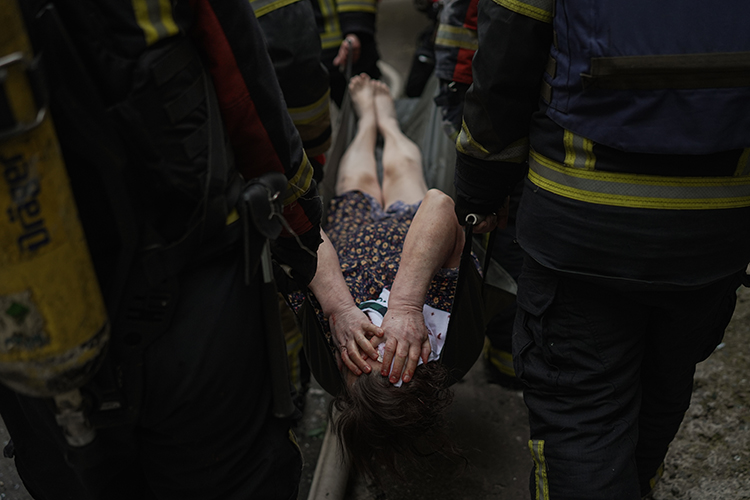
On Oct.5, 2023, the Russian army struck the village of Hroza in Kupiansk Raion,Kharkiv Oblast. The missile hit a village café-store. Fifty-nine people werekilled, including an 8-year-old boy. The Kharkiv regional prosecutor’s officereported that the victims were effectively half of the local residents whoremained in Hroza at the time.
Russianpropaganda outlets manipulated coverage of the Ukrainian president’s trip to anEU summit in Spain, framing the strike on Hroza as “a backdrop for Zelenskyy’sstatements about the Russian threat.”

“Hroza, Kupiansk Raion. A memorial meal was being held in the café. As we cansee, Zelenskyy couldn’t go to the ‘Western partners’ in Spain without apresentation.”

“On Oct. 5 at around 13:15, a café and a store in the village of Hroza,Kupiansk Raion, were shelled. Almost immediately, reports came in of 49 dead.Notably, the strike occurred while Volodymyr Zelenskyy was speaking in Granada(Spain), trying to convince Western countries that Russia threatens the entireworld and therefore Ukraine needs funding for weapons. Under similarcircumstances, 17 people were killed in early September at a market inKostiantynivka: a missile strike was carried out there against the backdrop ofU.S. Secretary of State Antony Blinken’s visit. Soon after, the U.S. statedthat it had found irrefutable evidence that Ukraine’s Armed Forces killedcivilians.”
The strikeon Hroza is a case where Russian propaganda could not settle on a singleversion. Even while denying responsibility, Russian media also suggested—citing“some experts”—that Russia might have carried out the strike.
“However, some experts believe the strike was carried out byRussia. Because 99% of the dead were men of conscription age. And the grocerystore, they claim, had long ceased to be a store—Ukrainian soldiers wereallegedly based there. In favor of this version is the fact that about 50people were killed, meaning there must have been many more in the building. Whywould nearly a hundred people—most of them men—be in a village store on aworkday? For context, the population of Hroza is 500. It supposedly never hadthat many men of conscription age,” “Bloknot” suggests.
Statementsby Kremlin officials also varied. They could not agree on who was in the café:civilians, or “neo-Nazis.” Some pushed the message that Ukrainian soldiers hadbeen there, but that the café was allegedly shelled from Ukrainian-controlledterritory in order to blame Russia.

“Russia commented on the missile strike on Hroza in Kharkiv Oblast. Russia’sU.N. representative Vasily Nebenzya made a statement: ‘As is known, at the timeof the strike, a memorial meal was being held there for one of the high-rankingUkrainian nationalists. Naturally, many of his associates—neo-Nazis—took part.It is no coincidence that in social media photos published immediately afterthe strike, almost all the bodies belong to men of conscription age. We haveencountered such situations more than once. The Kyiv regime wrung its handsover those killed as a result of strikes on dormitories, cafés, stores, and soon, and then obituaries appeared about mercenaries being eliminated. Such a‘coincidental overlap.’ We do not rule out that it will be the same withHroza,’ he commented, without confirming Russia’s involvement.”
Others,such as Russian presidential spokesperson Dmitry Peskov, commenting on thestrike on Hroza, claimed that “Russia’s armed forces do not hit civilianobjects in Ukraine, but work against military infrastructure.” Both propagandaoutlets and officials were united in one thing: not admitting responsibilityfor the crime to the end.

That day,residents of Hroza gathered for a memorial meal for a fallen Ukrainianserviceman. According to the Kharkiv Oblast National Police, he was killed in2022, buried in Dnipro, and later reburied in his home village.
“He was not a high-ranking official and did not hold senior positionsin the Armed Forces. He was a local resident and was killed near Popasna,” saidSerhii Bolvinov, head of the investigative department of the Kharkiv OblastNational Police, in a comment to Radio Svoboda. “All of them were killed by a Russian missile. These are ordinarypeople—pensioners, teachers, medics, friends. All the dead and injured arecivilians. There is not a single killed or wounded servicemember among them,”Bolvinov added.
Later, theSecurity Service of Ukraine (SBU) established that the spotters who guided theRussian Iskander missile to the village were two local collaborator brothers,Volodymyr and Dmytro Mamona. However, after the village was de-occupied, theyfled to Russia. A report by the U.N. Human Rights Monitoring Mission inUkraine states that the missile strike on Hroza—in which civilian residentswere killed—was carried out by the Russian army.
“Thereport was based on information collected and verified by Human RightsMonitoring Mission experts, who carried out two fact-finding missions to Hrozaon Oct. 7 and 10. They inspected the blast site and interviewed 35 people,including local residents, witnesses, two survivors, medical staff, and morgueworkers,” Voice of America reports.
Theaftermath of the strike on the café in Hroza was documented by Ukrainianphotographer from Kharkiv Yakiv Liashenko.

“One ofthe hardest moments while photographing was when the phone of a dead personrang. The documents, phones, and personal items we found were gathered in oneplace,” Yakivshared with UAPP.
Workedon the piece:
Topic researcher, text author: Yana Yevmenova
Photo editor: Viacheslav Ratynskyi
Literary editor: Yuliia Futei