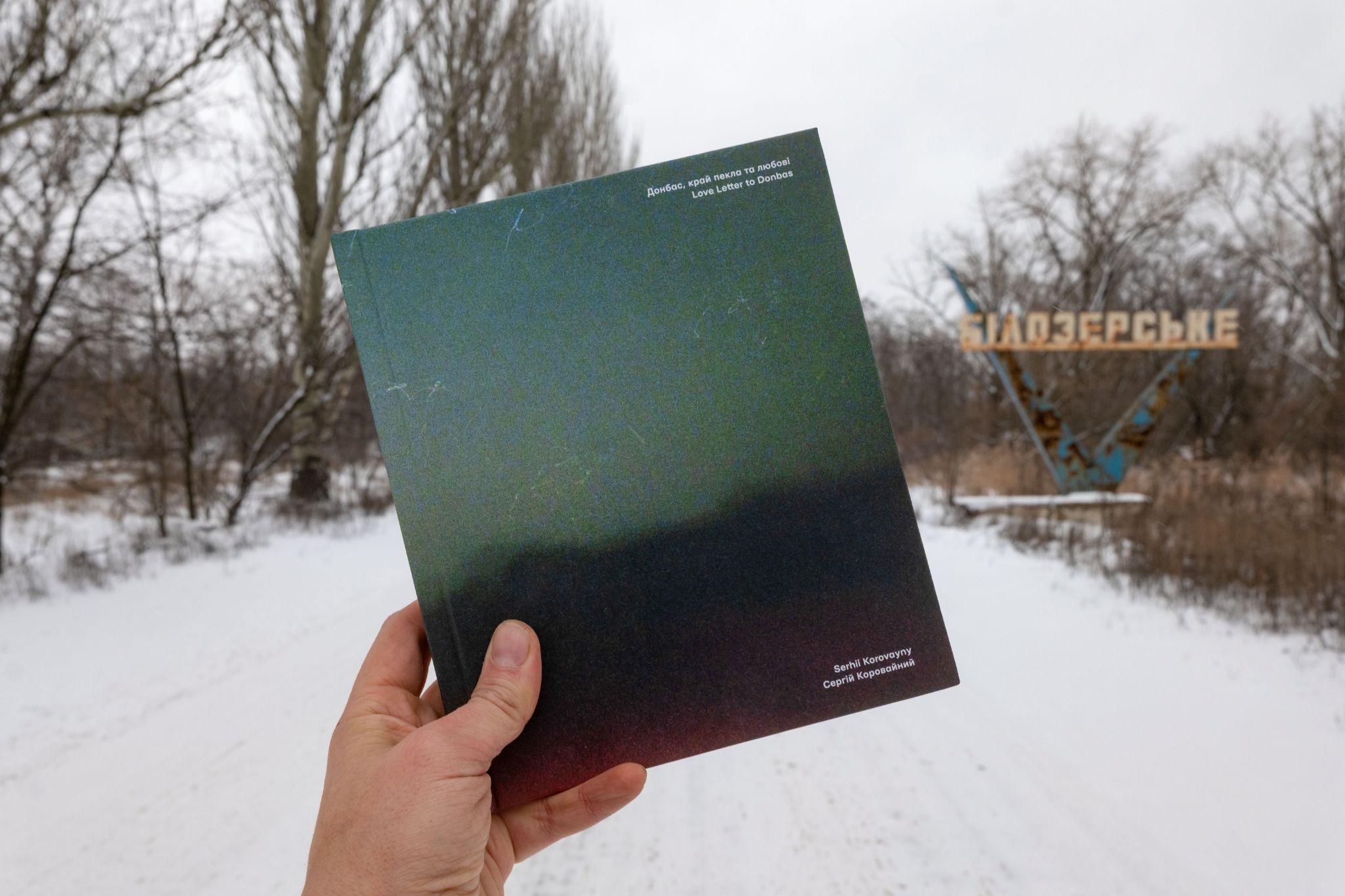
As part of the FotoEvidence Ukraine project, the Ukrainian Association of Professional Photographers published Serhii Korovainyi’s photobook “Donbas, Land of Hell and Love”. It is a personal story about a home that no longer exists; about landscapes and people who carry love and loss within them; and about Donetsk and Luhansk regions that are impossible to forget and worth fighting for.
Serhii Korovainyi is from the city of Khartsyzk, and this book is an attempt to rethink what it means to lose your native place, and how to continue loving it even when it is occupied and destroyed. The book covers the period 2000–2025: from the start of the war in eastern Ukraine to the full-scale Russian invasion. In the photobook, war and life in the frontline territories in a region that no longer exists.
Beauty and humanity
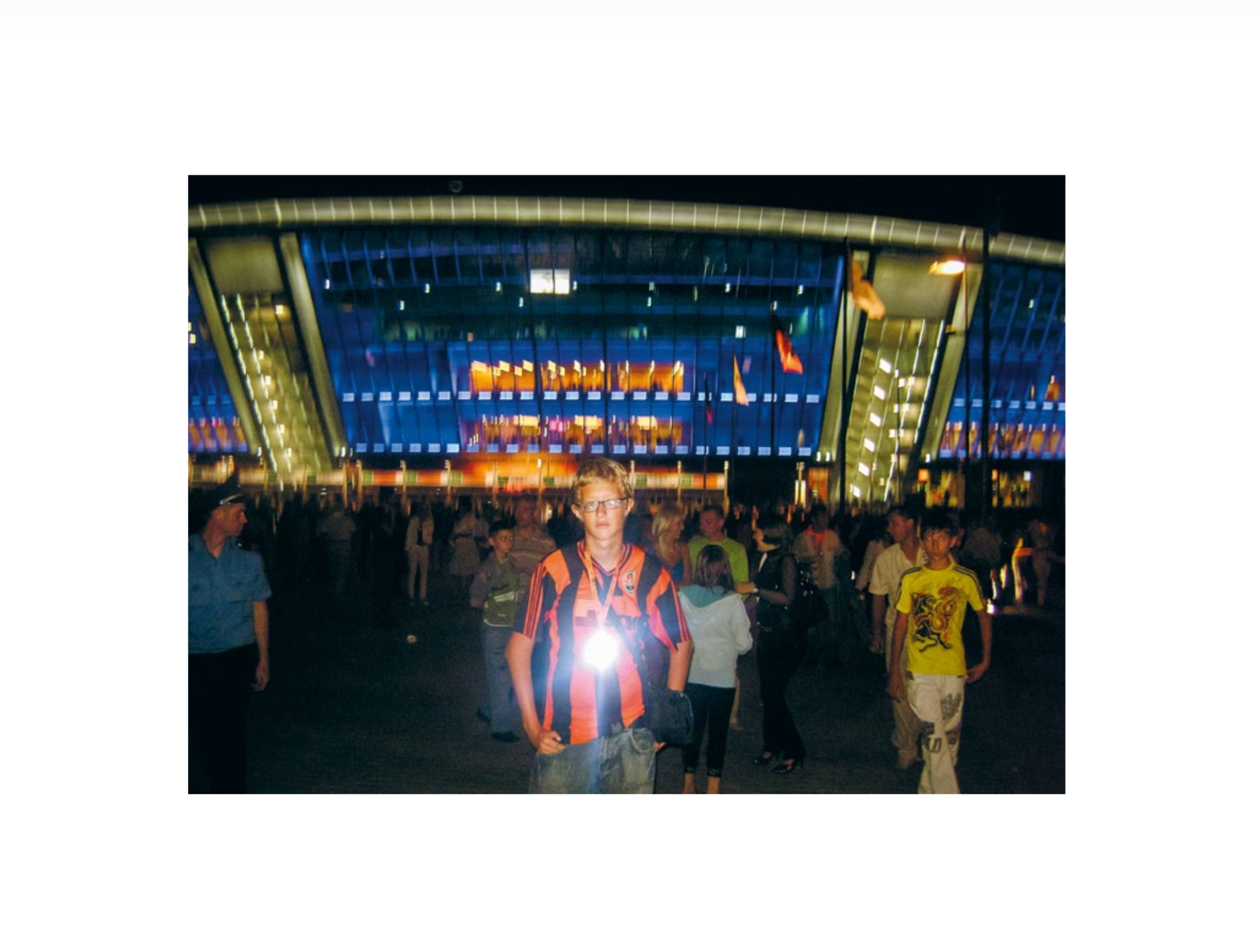
“I am 13 years old. My parents and I came to the opening of the Donbas Arena stadium in Donetsk on August 29, 2009. That year our club Shakhtar won the UEFA Cup. Beyoncé, a world-famous star, performed at the opening, and the festive fireworks amazed with their scale,” Serhii Korovainyi recalls. “The future that evening looked extraordinarily bright. Five years later, the Russian-Ukrainian war began.”
The photograph Serhii’s parents took of him against the backdrop of the brand-new Donbas Arena stadium is among the very first in the photobook “Donbas, Land of Hell and Love”. The book tells the story of the war and Donbas through the tender yet powerful stories of its residents and Serhii Korovainyi’s personal memories. In English, the photobook is titled “Love letters to Donbas”, because it is not only about destruction and loss, but also about bittersweet love stories and love for one’s land.
For Serhii Korovainyi, the photobook “Donbas, Land of Hell and Love” is an embodiment and quintessence of his work as a photojournalist. Photography, which was Serhii’s hobby in his teenage years, grew into his main job and calling, especially during the full-scale Russian-Ukrainian war. “When I photographed family, friends, classmates, and my native city of Khartsyzk, I didn’t even think about the profession of photojournalist. Photography was just one of my many hobbies,” Serhii Korovainyi says. Even during his student years, photography still remained at the level of a favorite pastime.
The first attempts at documentary photography were in already-occupied Khartsyzk, where Serhii came to visit his parents. “My native Khartsyzk was occupied by Russian forces in May 2014 — at the very beginning of the war. The year began with upheavals — wave after wave: the Revolution of Dignity, the occupation of Crimea, the so-called ‘Russian spring’… It was hard to comprehend that the war was already here, that it was not for a few weeks or months, but would sink into our lives forever,” Serhii Korovainyi writes in the book. He photographed how the city and people’s lives in it were changing. “Each subsequent trip added tension. As if you enter an ever-tighter ring of real and invisible encirclement,” Serhii Korovainyi shares. “In May 2016 I saw Khartsyzk with my own eyes for the last time.”
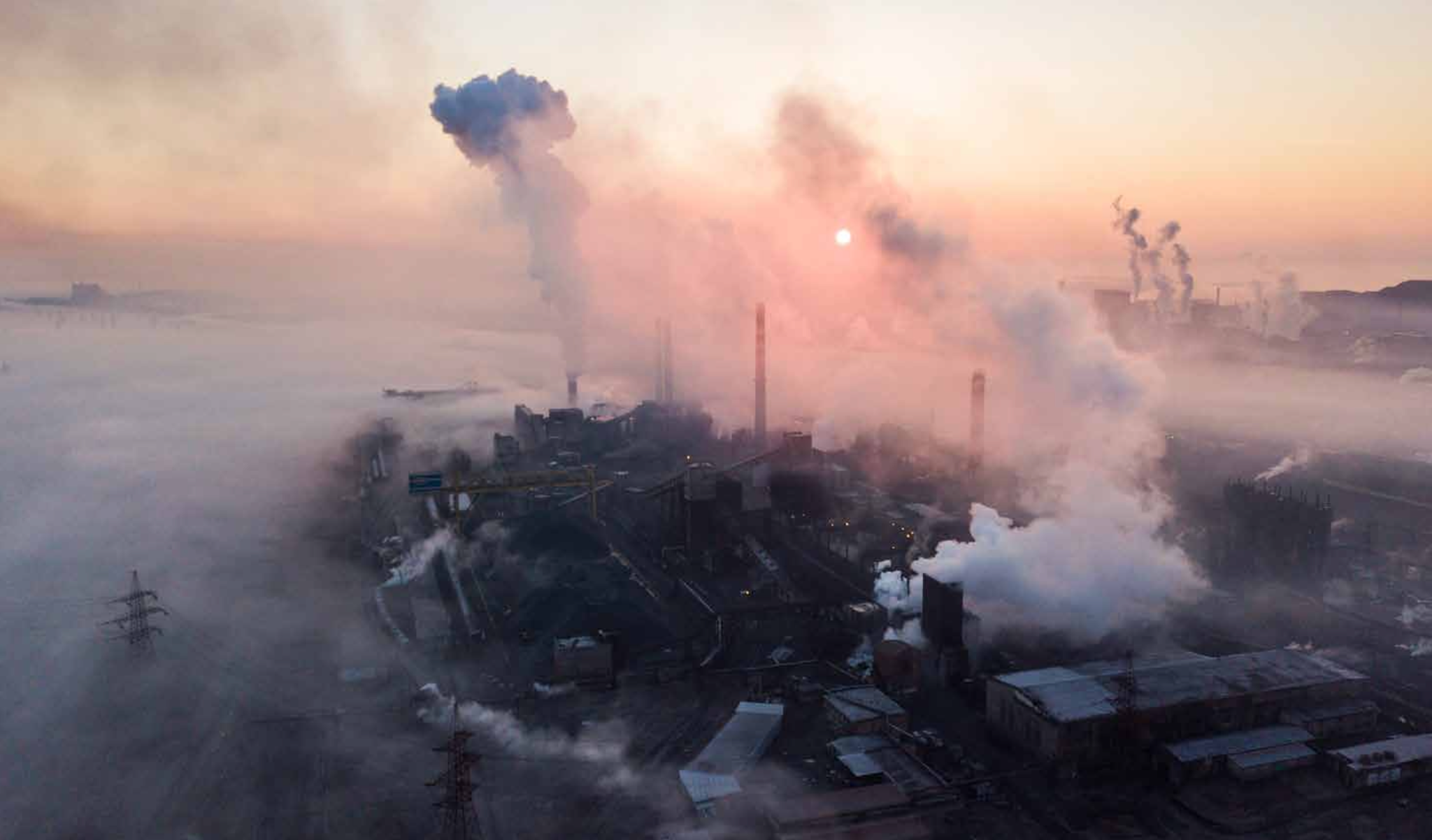
After the photo project about Khartsyzk, Serhii Korovainyi worked in Donetsk region — shooting stories for Ukrainian and foreign media about life in this region. Serhii received his visual education in the U.S. in a master’s program in Visual Storytelling as a Fulbright Program scholar. For his thesis, he worked on a story about Mariupol: he explored the city’s environmental problems and people’s lives in its industrial landscape.
“I photographed a great deal in Donetsk and Luhansk regions, worked on stories about Donbas. But I never thought to unite these images into a project until 2024,” Serhii Korovainyi says. “In the third year of the full-scale war, I began consciously photographing the civilian population in frontline territories. I was looking for beauty and humanity in Donbas. I wanted to show this part of Ukraine as a region worth fighting for and not worth giving up. From then on, I decided to make a separate project.”
In the spring of 2025, the Ukrainian Association of Professional Photographers announced an open call for creating photobooks, and Serhii Korovainyi submitted his project about Donbas. “Now, looking at the photobook, I can say that this is the ideal and only possible option for presenting my work — long-term, very personal, and at the same time socially significant. Unfortunately, Donbas remains one of the epicenters of this war,” Serhii Korovainyi explains.
Love and sincerity
All the stories in the photobook take place in Luhansk and, predominantly, Donetsk regions. Despite debates around the term Donbas, Serhii Korovainyi decided to keep it in the project title. “For a foreign audience, the notion of Donbas has become a generic label for the events of the war and for eastern Ukraine,” Serhii Korovainyi explains.
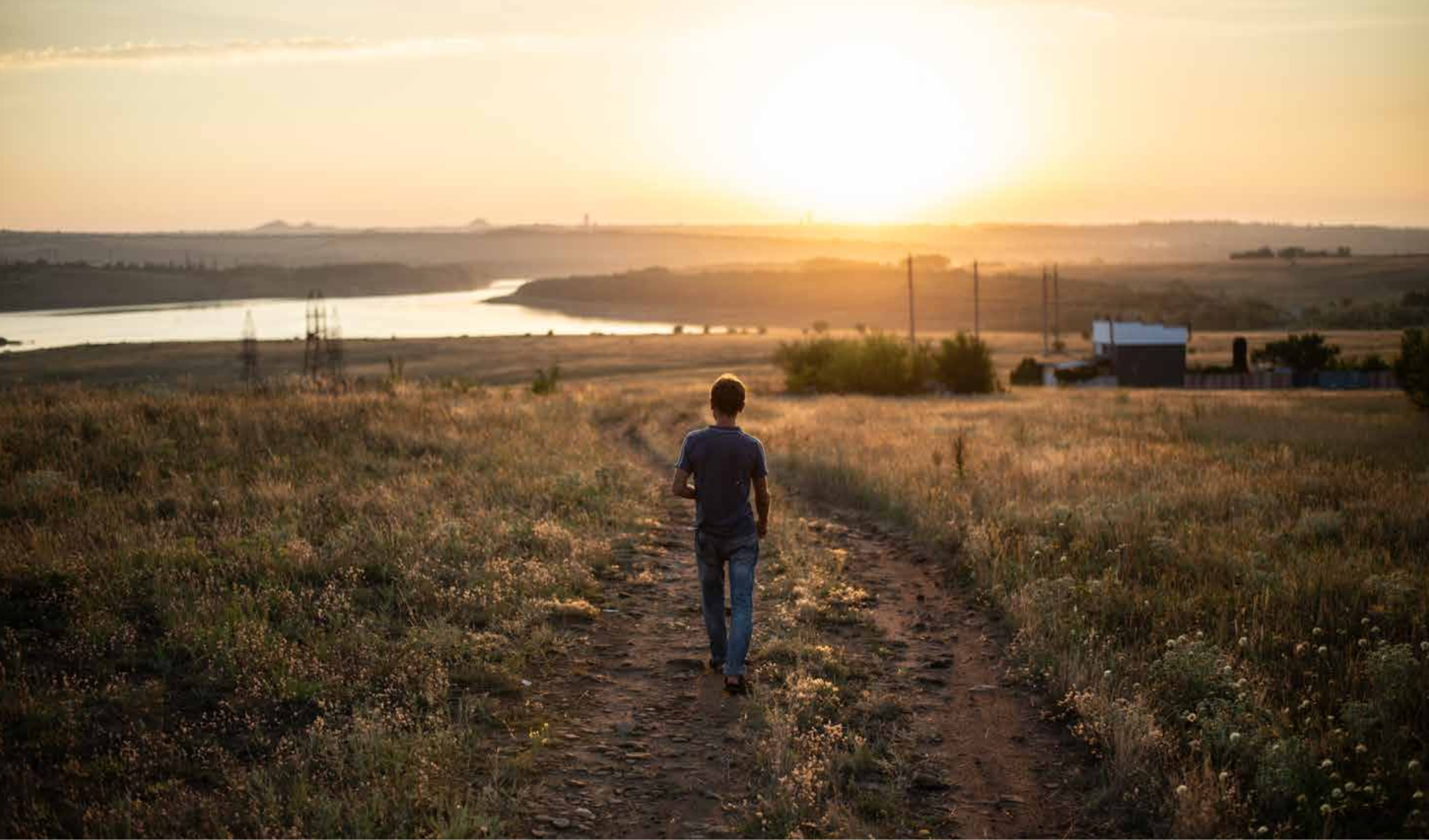
In addition to the territory, the book’s central character is also the photographer himself, especially at the beginning. The first half of the book “Donbas, Land of Hell and Love” is very personal. Serhii Korovainyi grew up in Khartsyzk, and through his personal story and the story of his hometown he tells the story of the region.
“The third hero of the book is love,” Serhii Korovainyi smiles. “Love for a place that is hard to love openly. Still, I love Donbas — it turned out that way. Most people know Donetsk region primarily as a place of war, but I know it as a place of nostalgia. Even when we talk about 2022 — a time when true hell began across the whole country — I was looking for love there.”
When Serhii Korovainyi began working on his Donbas photo project, he searched particularly carefully for markers and symbols of ordinary human life that would never come to mind during the documentation of war — festive tables, rose petals, pets, ripe apricots, or street football. Frames about warmth and love in the book intertwine with images of evacuation, people in tears, the aftermath of shelling, or shots of burning Russian soldiers in the cameras of our drones.
In some ways, Serhii Korovainyi’s book resembles a diary — there is a lot of personal experience in it. The photographer says he was inspired by Astrid Lindgren’s book “War Diaries 1939–1945”, where the Second World War is presented through the prism of ordinary people’s lives. “I wanted my photobook to be small, so a person could leaf through it to the end. So that the process of reading and viewing would be calm and even intimate. There are photographs of my family here, so the book is also about trust and sincerity,” Serhii Korovainyi says.
“Back then, in 2014, my mom, dad, and grandmother decided to stay at home, in occupied Khartsyzk. They are no longer young: my father and grandmother are over eighty. We last saw each other in the town of Selydove near Pokrovsk in 2021. The war continues, and I have nowhere to put my fear — I’m afraid that was our last meeting. My homeland and my country are now separated by an impossible barrier,” Serhii Korovainyi writes on the pages of the book.
War and life
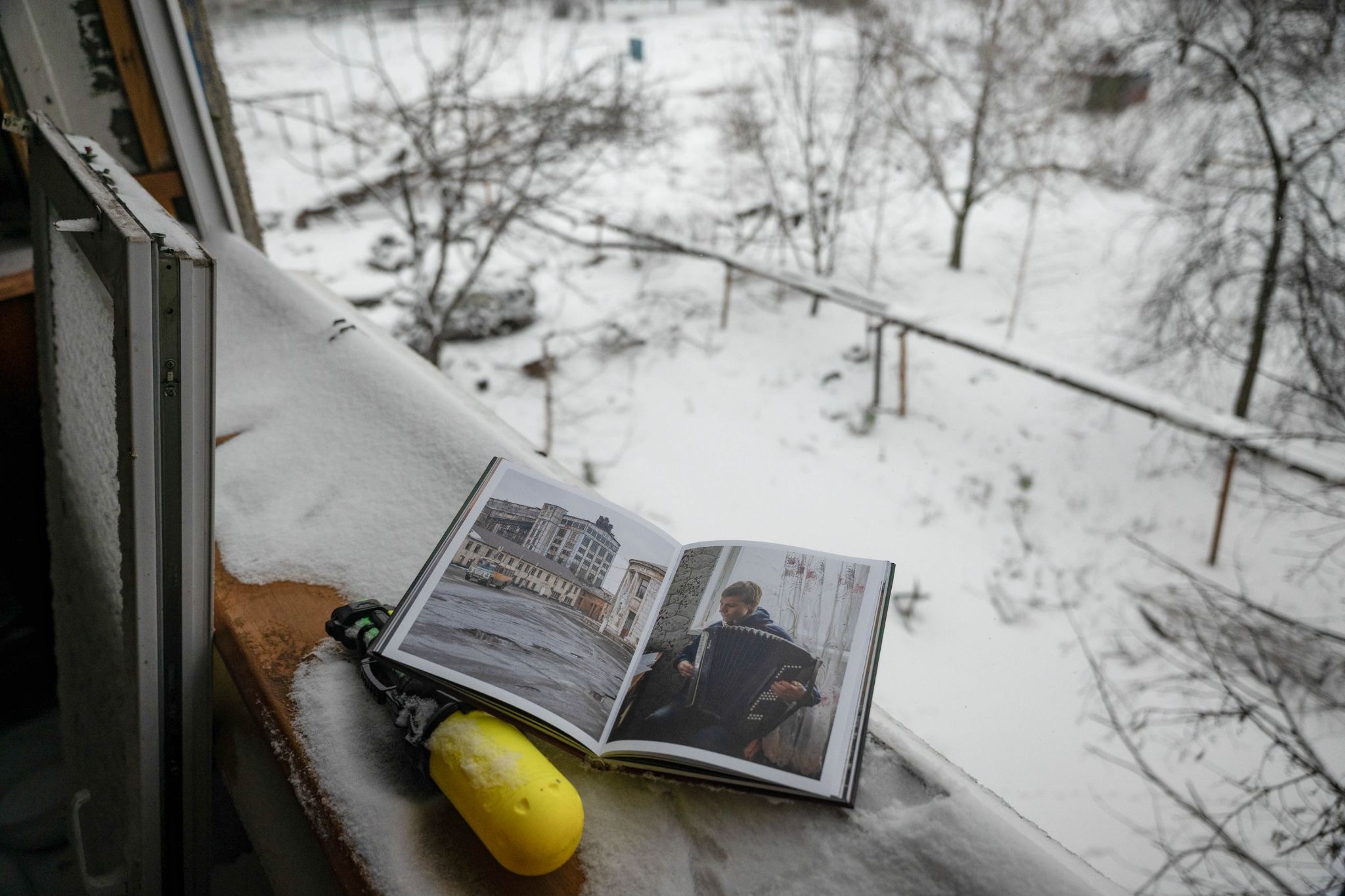
More than one hundred photographs are included in the photobook “Donbas, Land of Hell and Love”. Serhii Korovainyi wanted to place the emphasis precisely on the photographs, so the book has no unusual design solutions or heavy use of margins. The book is in a vertical format and, accordingly, is filled mostly with vertical photographs and horizontal photos across a spread.
The book contains texts that briefly tell the history of Donbas or are Serhii’s personal memories or reflections on different events. Here you can find stories about people Serhii Korovainyi met during shoots. For example, the story of the serviceman Pasha Chernychkin, who was killed, or the story of Kateryna, who went through unimaginable hell simply because Russia came to Donbas. Serhii Korovainyi wrote the texts in English; in Ukrainian, they were written by journalist and writer Vira Kuryko.
Serhii Korovainyi’s photobook is about war and war crimes. However, he wanted it to also be atmospheric and warm, so that one could feel the lives of people in Donbas and not focus only on the war photo chronicle. The book is filled with emotional photographs that tell people’s stories; there are almost no “verb photographs” that merely state facts of destruction and death. Captions for the photographs, indicating the place and date of shooting, are not placed directly next to the images, but at the end of the book. Serhii Korovainyi wanted the reader to form their own impression of Donbas while viewing the book, without extra prompts.
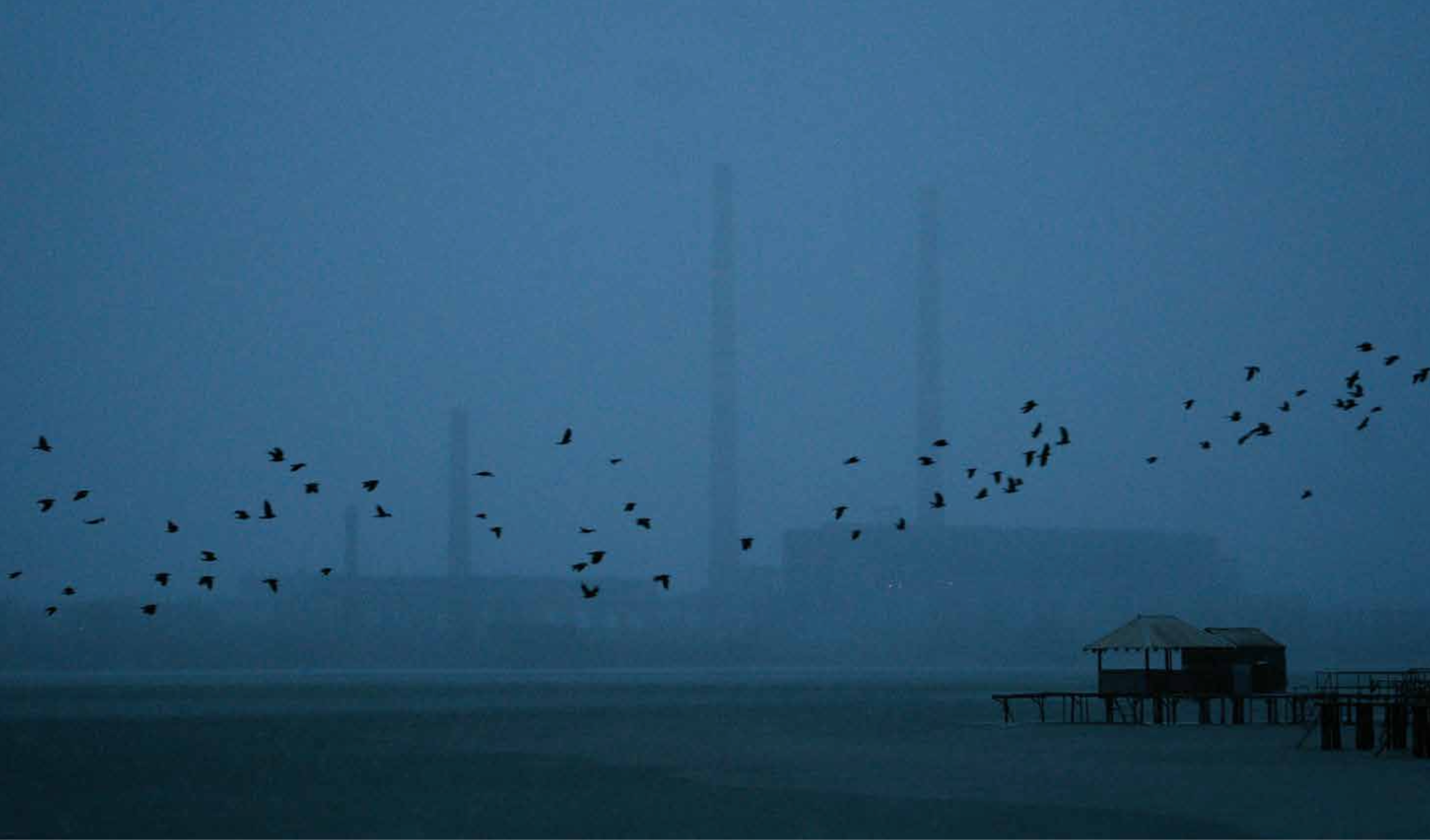
“The cover of the book is a photograph from a trip to positions to the military. Stars shine above, and below — a thermal imager. The photograph is about ambivalence: on the one hand, this is a land of horror, war — everything around is blurred and in darkness. On the other hand, there is beauty and love,” the photographer says. “This photograph fits the title ‘Donbas, Land of Hell and Love’ very well. The photobook is about everything that exists in Donbas. I was looking for a way to immerse readers in Donbas — a Donbas they may not have known.”

The photographs for the book were selected especially carefully from tens of thousands of frames. Photo editors Irynka Hromotska and Danylo Pavlov worked on the selection. An American photo editor, Sara Lin, helped make the final selection — she significantly reduced the number of photographs. According to Serhii Korovainyi, the book became shorter, but stronger.
The photographs included in the photobook are, in some ways, the most important — and in some ways the warmest — for Serhii. The book contains many symbols of the region: spoil tips, factory chimneys and factories from the inside, elderly people and children. “Probably the most important spread for me is the one with photographs of my grandfather and the sailing ship model he made. I brought this ship from Khartsyzk to Kyiv,” Serhii Korovainyi says. “My grandfather was a very important person to me. He lived in an industrial region, yet was fascinated by sailing ships and the sea. He gave me this thirst for life and travel, for exploration, hiking, and sailing. Thanks to my grandfather, I became who I am.”
There are many painful and heartbreaking photographs in the book. The vast majority of them were taken in cities that are already occupied or destroyed by Russia’s military. “In my photobook, life is still going on in Mariupol, Kurakhove, Zolote, and other places, although in reality they no longer exist. Today these photographs are perceived completely differently — as a manifesto of life with its various problems. But it was life, and after Russia there is only gloom. In truth, this is a very painful book,” Serhii Korovainyi says. His images are now gaining incredible value, because they in part document cities and lives that no longer exist.
“In 2022, Russia began a full-scale war. Ukraine’s east again became the epicenter of hostilities. For its atrocities, Russia uses a nice-sounding word — ‘liberation’. Mass burials and the ruins of factories in Mariupol, cities and villages of Donetsk and Luhansk regions erased from the face of the earth — petrified witnesses to Russia’s crime. Russia was ‘liberating’ and continues to ‘liberate’ Donbas from life,” Serhii Korovainyi writes in the photobook “Donbas, Land of Hell and Love”.
The publication is made possible with the support of the Open Society Foundations and the International Renaissance Foundation within the FotoEvidence Ukraine initiative, launched by the Ukrainian Association of Professional Photographers and the organization FotoEvidence to document the war through author-driven photographic projects.
Serhii Korovainyi — a Ukrainian documentary photographer who actively covers the events of the Russian-Ukrainian war. He collaborates with international outlets, including Wall Street Journal, Washington Post, The Guardian, Financial Times, and others. In his projects, he focuses on the Russian-Ukrainian war, ecology, and various aspects of contemporary Ukraine. He received education in the U.S. in a master’s program in Visual Storytelling as a Fulbright Program scholar. In 2018, he joined The Gate, a leading Ukrainian photo agency. Serhii’s works have been exhibited in numerous solo and group exhibitions in Ukraine, the U.S., and the EU.Photographer’s social media: Instagram, Facebook
Worked on the material:
Topic researcher, text author: Katya Moskaliuk
Photo editor: Olga Kovalova
Literary editor: Yuliia Futei

.jpg)
.jpg)