
%20(3).png)
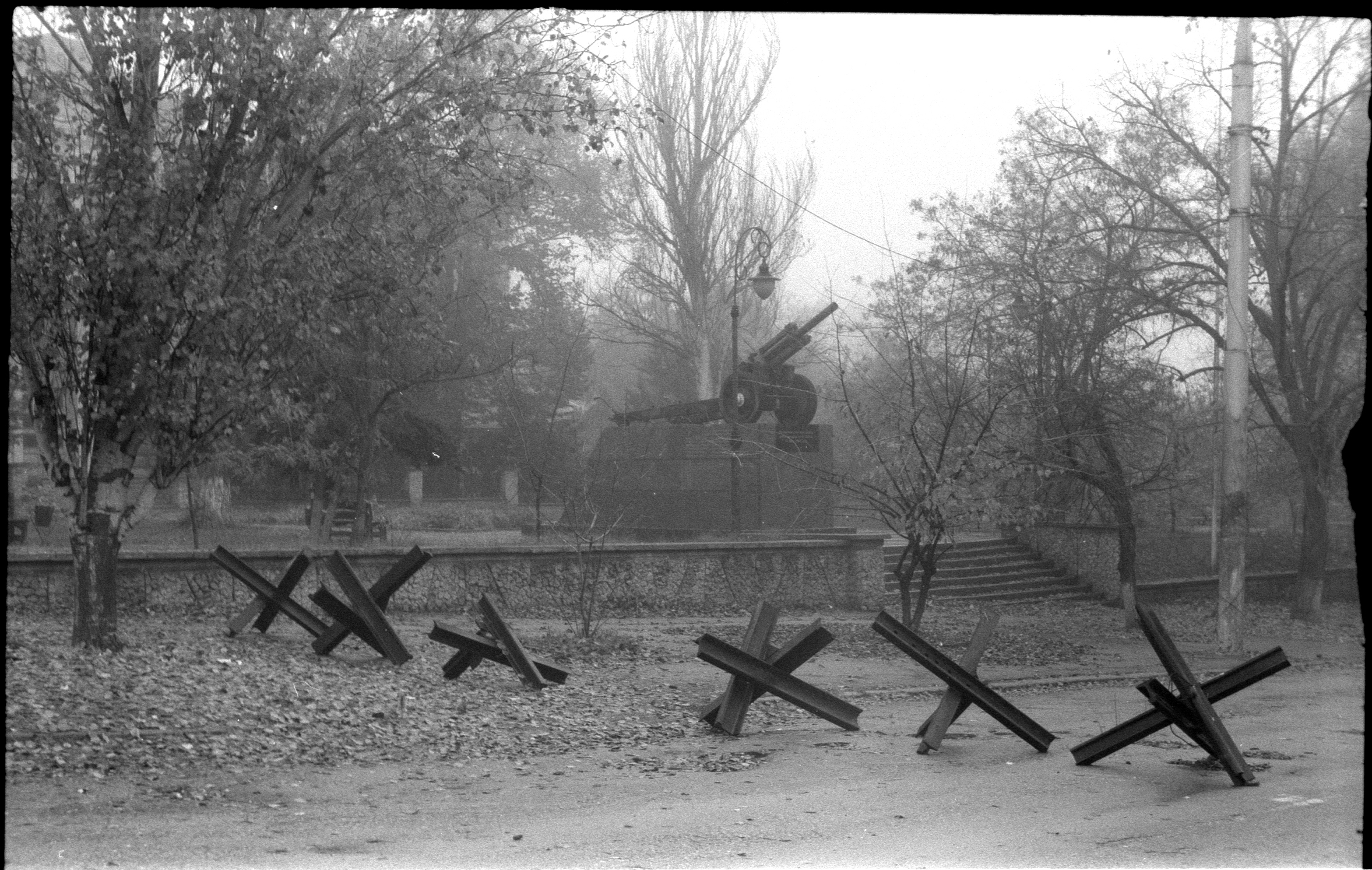
This is Kherson in November 2025 in a photograph by photographer Stanislav Ostrous. My eye caught on the howitzer on a pedestal on the eve of the moment when I would pack a small backpack to set off for Kherson myself.
I have no idea what kind of howitzer this is, but I very much suspect—and fear—that I am not mistaken at all. Of course it’s Soviet; of course it liberated Kherson from the fascists and even stormed Berlin, and then ended up in Baku, where an old Soviet soldier found it like a long-lost love and, with tears in his eyes, brought it back home. And if it suddenly turns out this gun is simply random, it still was supposed to “liberate” Kherson—this is what they declared and designated it as. Now, when Russian troops report on knocked-out Ukrainian “fascist” guns near Kherson, it waits in our rear.
Russia, devotedly and without pity—oreven a speck of laziness, never putting anything off until tomorrow—labels,marks, names, and brands every thing it steals from someone. One letter—is thata trifle or not? On the sign “Mariupol”, having seized it, they got rid ofprecisely one letter. I look at photos of people from occupied lands on socialmedia and see this everywhere, even in tiny villages: the murder of letters.Here you have a sign that says “settlement such-and-such,” and in it there areseveral new, gleaming letters—their letters.
Naming—I thinkabout naming as a way to exist in this world self-sufficiently. We still haveso many signs, words, streets that we take for granted. The cannons inChernihiv that the city is so proud of did not work against the Russians inMarch 2022, but they work against us by the method of slow poison—cannons fromthe Russian tsar who killed the Hetmanate.
Our landscapesare brimming to the brim with not-our words, words we did not choose. By namingeverything in their own way, Russia has always been preparing for temporarydefeats, so that when they go for revenge, their people would not feel as ifthey had crossed a border. A Russian soldier walking down Rokossovsky Street inUkraine literally feels at home, where he lived on a street—by God—the verysame Rokossovsky. He breaks in here like a criminal, and finds that perfectlyfamiliar things were waiting for him here.
Naming is beingin the world; it is distinguishing the world and marking the border: this isours, this is чужe. On our streets there is still plenty of чужe. Even in, seemingly, such goodwords we use every day. Victory Street crosses Peace Street in Chernihiv. Whatcould be nicer, what could be more of a dream? Only… Victory Street—but whose?Peace Avenue—but what kind of peace?
To name is topossess, to set your rules and your truth. Soviet power planted explosives forus, declaring that their words—even written in a Ukrainian-looking way—werecorrect. The burden of the past, scattered across the country, is not heavyoverall, but when one person tries it on, it knocks them to the ground. Astreet not of your victory—in the end, isn’t it an acknowledgment ofdefeat?
Photo:Stanislav Ostrous
Text: Vira Kuryko












.jpg)


