The return of servicemen from Russian captivity is a positive event, which the Ukrainian and Russian delegations were able to agree on at the talks. However, noneRussia did not give the defender from “Azov”. The Kremlin continues to hold Azov prisoners as their prey. The Kremlin is trying in every possible way to break Ukrainian resistance, because the topic of the return of captured Azov is a powerful lever for manipulating emotions, a painful topic. Because they are the ones who have been waiting for a very long time in Ukrainian families.
And Kremlin propaganda has built the ideology of this war around the Ukrainian right-wing radical forces. Russian propaganda is now being supported to keep the Azovites in captivity. In the end, the Kremlin fears the return of the Azov to the battlefield as one of the most effective Ukrainian units, so it promotes the narrative “Azov's heroism is just a legend.”
“Gang for the far right”
May 5 Ukraine noted11 years since the founding of the unit “Azov”. Nevertheless, the participants of the Azov movement began to fight against the hidden Russian aggression much earlier.
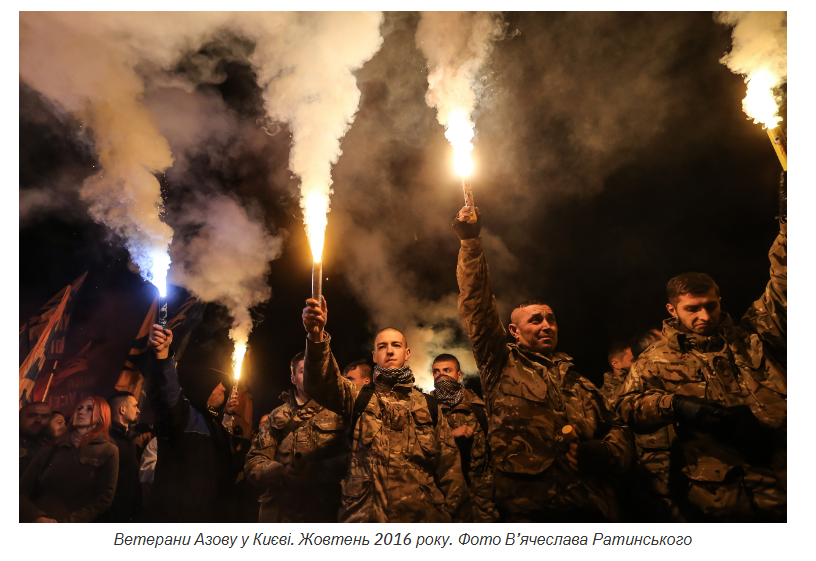
Ukrainian patriotic youth especially actively promoted its ideology opposite to the “Russian measure” in the south and east in 2005—2010. These are patriots who grew up in independent Ukraine and did not remember life in the Soviet Union.
Organizations that were part of the “Azov Movement” - “Patriot of Ukraine”, “Black Corps”, “National Wives” and others - were used by the Kremlin authorities for military propaganda and intimidation.
“One race! One nation!” How nationalists from the Azov battalion built their own state in Ukraine”(“Lenta.ru”).
Hostile propaganda against the Azov movement was built on increasing emotionality, distorting information, and outright deception. They manipulated the history of the formation of the unit, its connections in Ukraine and around the world; ideology and symbolism; statements of the leaders of the organization; participants with dubious reputation and scandals around them. They called Ukrainian patriotic associations a “gang for the far right” and attributed them to torture, violence, kidnapping, murder and looting, terror against migrants and massacres against political opponents. They say that the Azov people had patrons from the oligarchy and defended their interests.
It is worth noting that the radical right movement in Ukraine arose in contrast to the existing environment at that time. These were times of inaction of the authorities and law enforcement agencies, total corruption and the intensification of pro-Russian forces. During Yanukovych's presidency there were political massacres and repressions of Ukrainian patriots. And in the time of Poroshenko there was perpetratedThere have been many attacks on activists that have remained undetected. The Ukrainian active public lived in permanent fear.
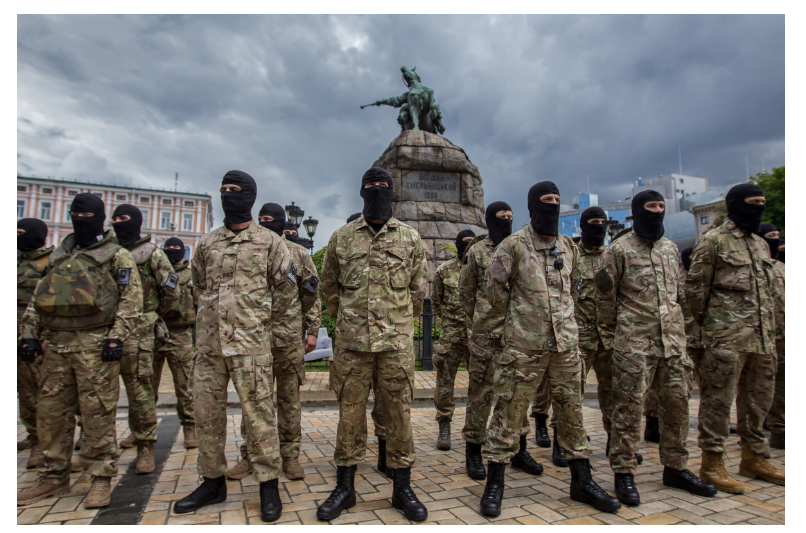
In those turbulent times, Patriot of Ukraine (2006—2014) waged street wars with communist and pro-Russian organizations. The “Black Corps” (2014) fought with separatist movements in the north and southeast of Ukraine. “National Wives” (2017—2019) patrolled the streets, fought poaching, raiding, and prepared for territorial defense. The Azov Battalion fought in the ATO/PLO zone and continues to fight in the Russian-Ukrainian war as the 12th special purpose brigade “Azov” of the National Guard of Ukraine.
However, the ideology of “Azov” frightened Russians more than discipline and education.
“But the main strength of Azov was not armored vehicles or artillery, but the presence of its own ideology, which turned the regiment into a tightly welded fighting machine”(“Lenta.ru”).
To unbalance the “Azov war machine”, Kremlin propaganda accused the organization of racism, and associated the symbolism and rituals with German and Italian neo-Nazism. They say, on the chevrons and flags of the Azov the same “black sun” and wolfsangel (“wolf hook”). In fact, this symbolism came to Azov from the organization “Patriot of Ukraine”, which became the basis for the brigade and is a monogram with the letters “I” and “N”.
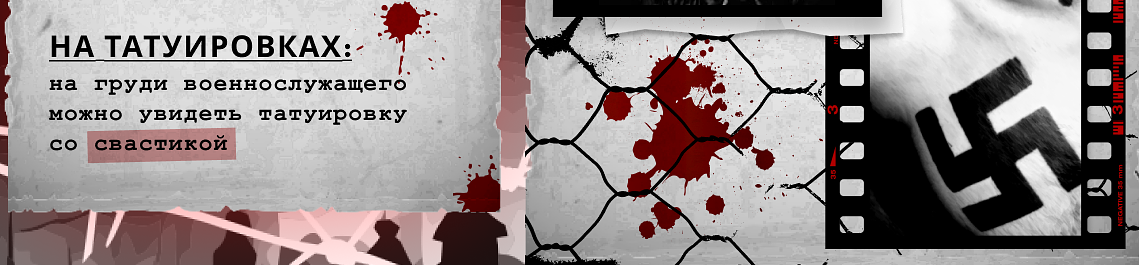
Fictions were also spread by propagandists about the fascist tattoos of the unit, which actuallyMost of the Azov people did not have it at all.
The ideology of “Azov” is an irritant to the Kremlin's power. Rites and ceremonies of the unit, such as the reading of the “Prayer of the Ukrainian Nationalist”, “Decalogue” (Ten Commandments — auto.); torchlight procession and others, intertwined with the traditions of the national liberation movement of the UPA times. It is worth noting that the torchlight procession in honor of prominent Ukrainian figures was held annually in the cities of Donetsk region as a symbol of the unity of all patriots of Ukraine.
“Media Detector”explains that the ideology of “Azov” is Ukrainian nationalism in the European interpretation: “Ukrainian nationalists as a whole and individual fighters of the regiment “Azov”, position themselves as successors of the Organization of Ukrainian Nationalists and the Ukrainian Insurgent Army (a liberation military-political movement founded in the 20th century to fight for the restoration of Ukraine's independence, similar in essence to Sinn Féin and the Irish Republican Army), but are more open to cooperation with other peoples.”
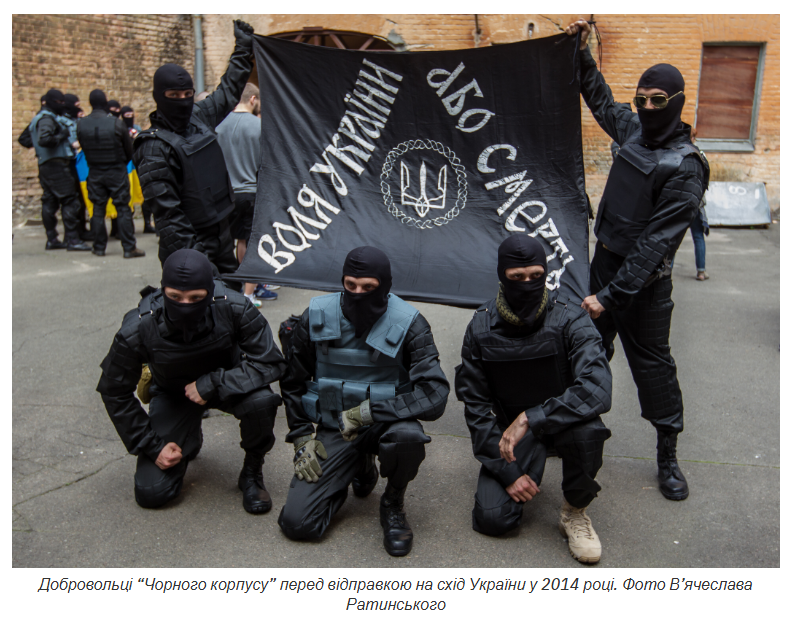
Ukrainian photographer Vyacheslav Ratinsky has repeatedly photographed the solemn conduction of volunteers of the future regiment “Azov” to the front. He recalls the wires of the beginning of the summer of 2014 in Sofia Square, where it was quite crowded: up to a hundred guys with relatives and girls, many journalists.
“The boys were brought by several buses, the event was announced and there were many journalists and photographers in the square,— recalls Vyacheslav Ratynskyi. — Sofia Square is a very symbolic place. It's like a hundred years ago in an old photo-video chronicle with Petlyra and Hrushevsky and the units of the Sichov Shooters,” Vyacheslav shares his memories with the Ukrainian Association of Professional Photographers (UAFF).
“An extensive network of far-right terrorists around the world”
After Euromaidan, the foreign press became increasingly interested in Ukrainian voluntary organizations. Russia tried to spread narratives about the threat from “Azov” not only to the domestic, but also to the external audience.
“Azovets are project-oriented not only to Ukraine, but also to the Western far-right” in order to “attract volunteers with combat experience to the role of instructors and to seek additional funding, — writes “Ukraina.ru”. — An extensive network of far-right terrorists has formed all over the world over the past 8 years under the direct influence of Ukrainian “heroes of the nation”.. The publication claims that many militants have arrived in Ukraine in recent years.
Russia switched the world's attention to the Nazis in Ukraine: “Azov is waiting for its time, a large-scale crisis of Ukrainian statehood, when nothing prevents the Azovites from taking power. Because they are ready for it.”, — “Lenta.ru”. And while the world feared that democracy in Ukraine might be seized by the far-right, Russia was preparing for a full-scale war in Europe. amplifyingits influence in the politics of European countries.
In order to blacken the unit in the eyes of the world community, the Russian media linked the American shooters with Azov. “Ukraina.ru” claimed that “the connection between Azov and terrorist attacks in America is obvious.” Surely among the clothes of the shooters were found the symbols used by the Azov. Due to Russian propaganda for about 10 years, “Azov” did not receive Help from the United States.
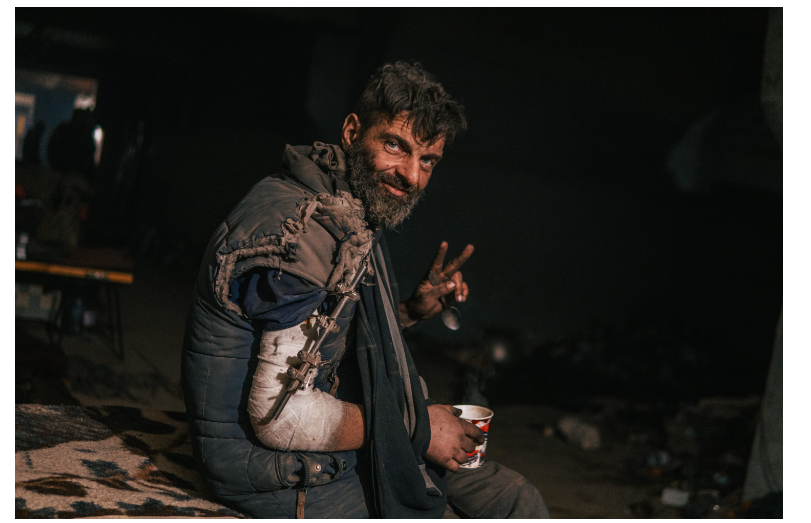
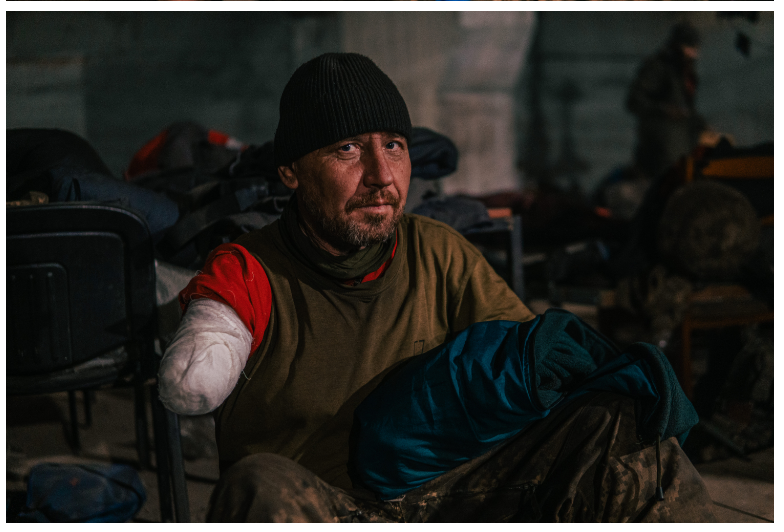
A series of photographs from the Azovstal plant of the Azov serviceman, the defender of Mariupol, photographer Dmitry (Orest) Kozatsky, who returned from Russian captivity in the autumn of 2022, attracted the attention of the world community and was awarded at international photo competitions.
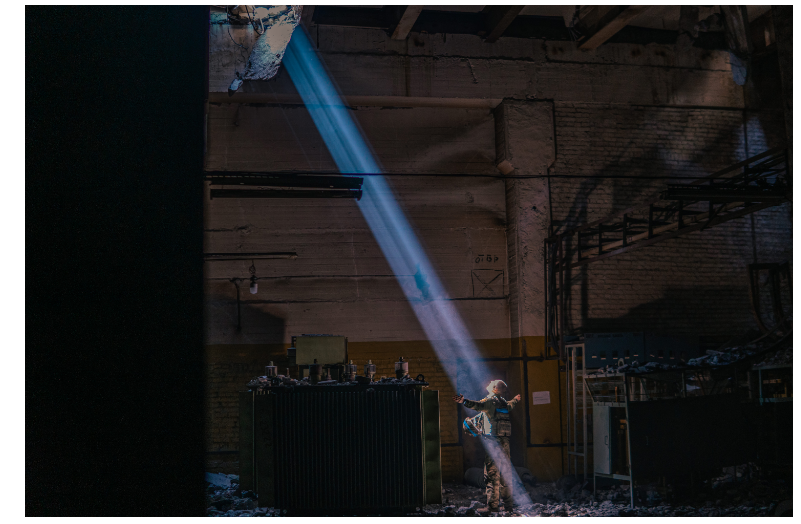
Photos of Kozatsky from “Azovstal” caused outrage among Russians: “The Nazis who sat in the catacombs arranged a photo shoot”, — wrote “Military Enchantment”.

“The pictures show wounded and maimed militants who have lost limbs and are in unsanitary conditions. However, they fundamentally do not want to surrender, expecting, obviously, retribution for the massacres they have committed for many years on the civilian population of Donbas.”(“Military Enchantment”).
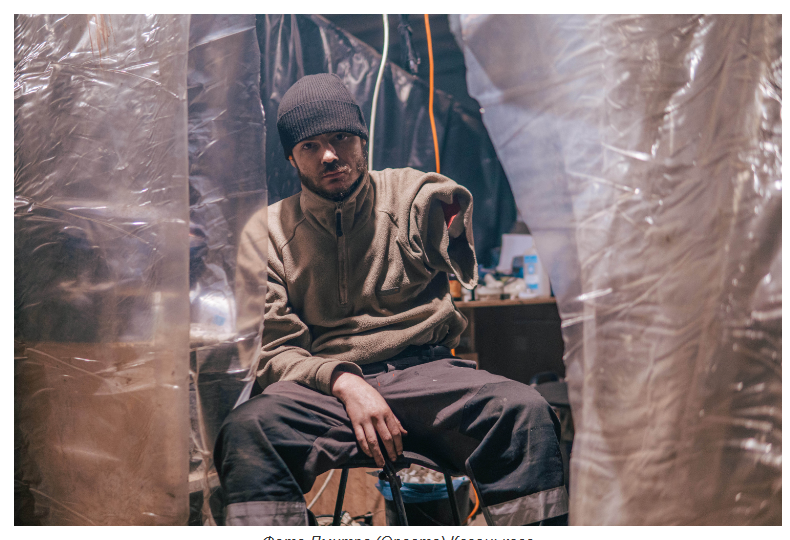
Dmitry Kozatsky spoke about the importance of the photos taken by the UAPF: “Then, at Azovstal, I did not think about the global significance of my photographs. I had no such ambitions or plans. I was just doing my job. But there was a clear inner feeling: this is important and it needs to be fixed. [...] Sometime in America, after the captivity, a representative of the authorities told me: “When we saw your photos from Azovstal, it was an impetus for us to strengthen assistance to Ukraine.” And it was a moment of realization for me: photography will not stop war, but it can evoke emotion. Emotion can change something.”
“How did neo-Nazis make heroes in Ukraine?”
After the Revolution of Dignity in the east and south of Ukraine, the special services of the Russian Federation began to undermine Ukrainian statehood. They organized in Ukrainian cities a series of pro-Russian rallies of supporters of the federalization of Ukraine, calling it the “Russian Spring”. Separatists began seizing administrative buildings and police stations. Such actions were presented by the Russians as a “manifestation of the will of the people.”
The separatists were then opposed by Ukrainian nationalist-patriotic groups. They managed to stop the “Russian Spring” and defend Kharkiv, Odessa and Mariupol.
“Where did Azov fight? How in Ukraine were “heroes” made out of neo-Nazis?
The formation of the “Black Corps”, the predecessor of “Azov”, on the night of its foundation on March 1, 2014, was stormed by the club “Oplot”, the main headquarters of Kharkiv separatists. On March 1, 2014, the “Black Corps” defended the Kharkiv Regional State Administration.
UAPF spoke about the March 2014 confrontation in Kharkiv: “On the night of March 15, 2014, the detachment “Black Corps”fought with pro-Russian forces on Rymarska Street in Kharkiv. This was the first combat clash in which the pro-Russian side suffered casualties. [...] On May 1, 2014, the last Black Corps raid on Kharkiv took place. As a result, the mass demonstration announced by pro-Russian forces with the subsequent seizure of power in Kharkiv did not take place.”
“Slaughterhouse at the local police station”
The confrontation in Mariupol is a fragment of the war in eastern Ukraine, when the city was occupied by pro-Russian militants for two months.
Hostile propaganda claimed that in Mariupol Azovites carried out “mass punitive actions against civilians” because, allegedly, “no DPR and LPR armies existed yet.” They say that since April, the SBU has been actively arresting Maidan opponents, “activists of the protest movement,” in the city, many of whom then disappeared.
In fact, for these two months, lawlessness, banditry flourished in the city, gunfire was heard. The city's power structures were paralyzed. Separatists held rallies for joining Russia, seized administrative buildings. And even in such conditions, Ukrainians rallied under yellow-blue flags.
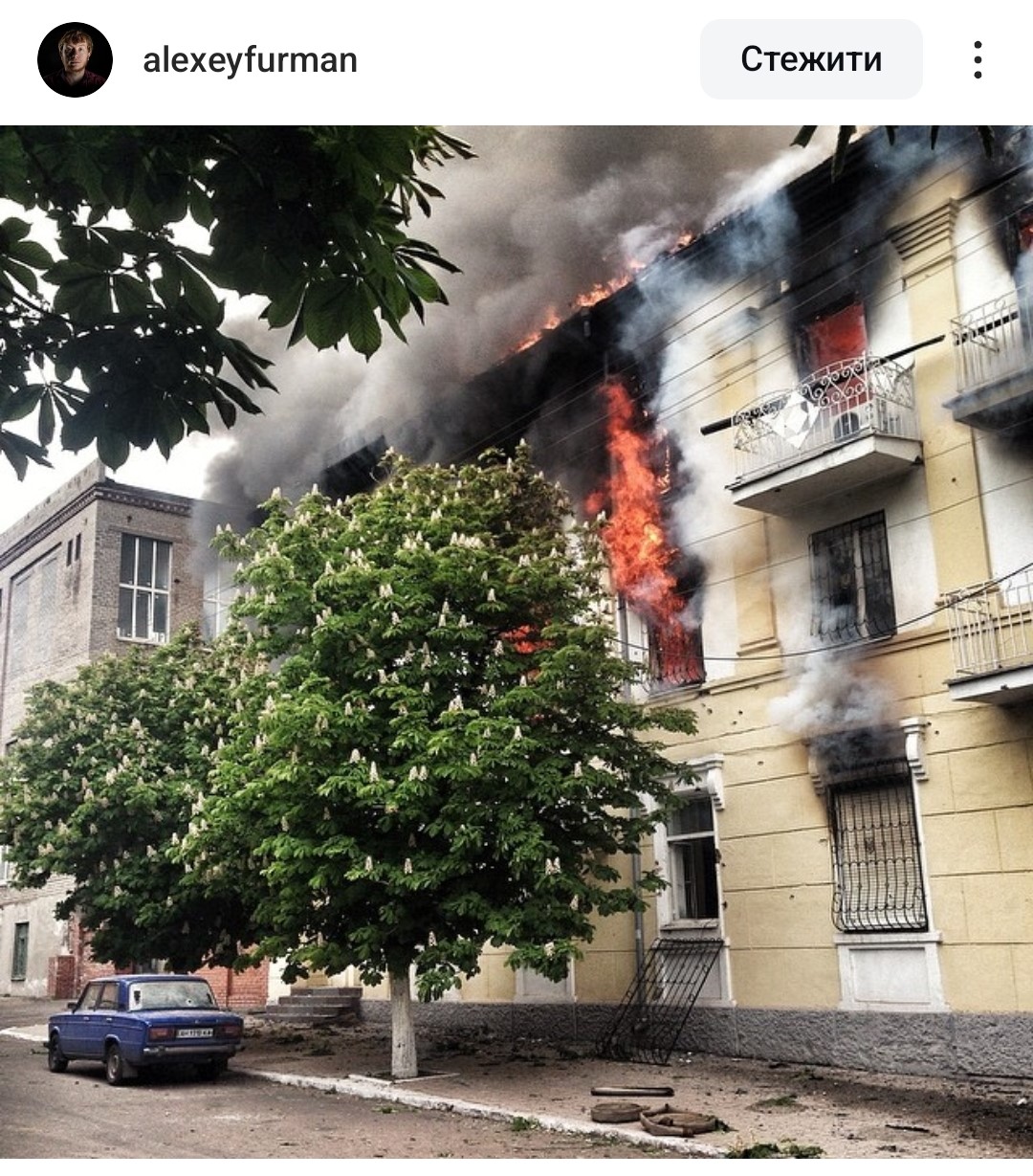
The events in Mariupol, which took place on May 9, 2014, serve as a way to celebrate Victory Day. Therefore, for the holiday, the Kiev authorities arranged a gift for all residents — “massacre at the local police station”(“Ukraine.ru”). They say Ukrainian National Guards shot militiamen who refused to disperse a peaceful rally on Victory Day. “Like the massive May Day demonstration in Odessa, the rally in Mariupol scared the new authorities”, — wrote “Ukraine.ru”.
In fact, on May 9, 2014, militants seized a police station and gained access to weapons. Ukrainian militiamen were also in the building, and an armed clash began. The “Black Corps”, which was then conducting raids in Mariupol, was reorganized into the Azov Battalion. Propagandists spread intimidating messages that Ukraine “granted state status to anyone who wanted to “shoot at the East at cotton wool”.
The local police department was liberated by Ukrainian special forces of the National Guard, “Azov” and military personnel on BMP. As a result of the battle, the building completely burned down. Fourteen people were killed on both sides, as well as civilians. However, it was not possible to liberate Mariupol the first time — after a special operation Ukrainian servicemen left the city.
The propaganda distorted the facts, they say, “Azov” was forced to withdraw from Mariupol, because the local residents did not support them or the pro-Ukrainian security forces.
“Faced with a lot of hostility from local residents, Azov militants withdrew from the city on May 11, where a referendum on the sovereignty of the DPR was subsequently held. However, on June 13, 2014, taking reinforcements, the “Azovs” again stormed the city, starting repression against local residents. And only 8 years later, in 2022, the city was liberated from the Nazis for the second time.”(“Ukraine.ru”).
On May 11, pro-Russian forces held a “referendum” to declare the sovereignty of the “DPR”, for which only four polling stations were opened in the city. Hostile propaganda called the turnout for the referendum “huge”.
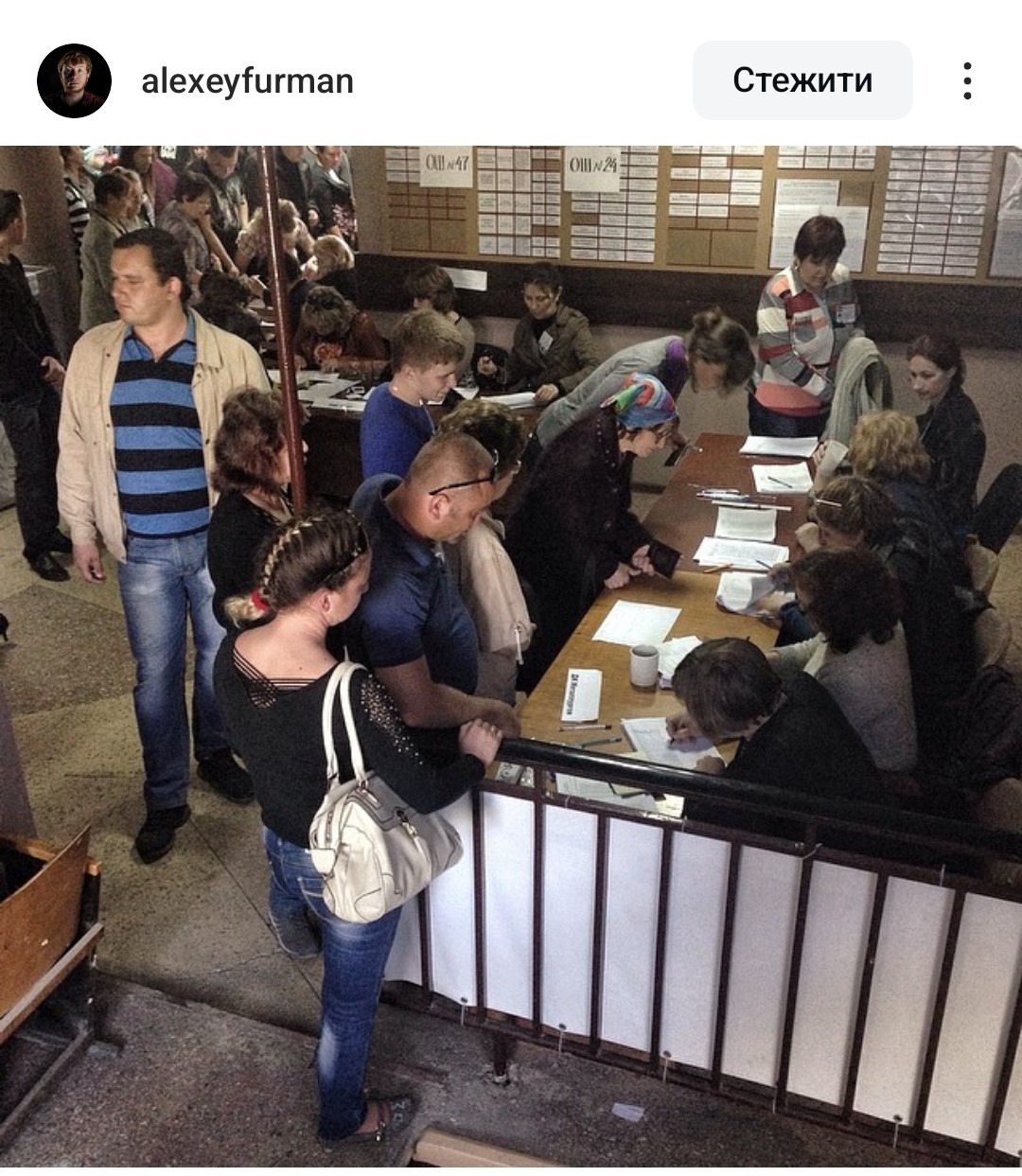
In fact, the headquarters of the ATO decided to temporarily withdraw Ukrainian fighters from the city in order to avoid rising tensions. There were checkpoints around the perimeter of the city. The airport remained under the control of Ukraine. It was decided to strengthen the Azov battalion quantitatively and qualitatively.
On June 13, 2014, Ukrainian special forces (including Azov) destroyed important terrorist strongholds, equipment, regained control of all captured buildings, detained several dozen militants. The flag of Ukraine was again raised over Mariupol. In response to the bloody events in Mariupol, the Ukrainian authorities announced the beginning of the Anti-Terrorist Operation.
“Punitive operations in Donbas”
Propaganda calls Azov operations in the area of ATO and the PLO “punitive operations in Donbas”. On August 4, 2014, Azov together with the Armed Forces of Azov liberated Marinka from pro-Russian militants. Participated in the Ilovaisk and Shyrokyn operations. In 2019, “Azov” had combat missions in the area of the Svitlodar arc.
Propaganda tried to discredit the actions of the unit under Ilovaisk and Shyrokyn. Propagandists claimed that the operation of Ukrainian troops to storm Ilovaysk in August 2014 ended tragically for Ukraine due to the self-confidence of the Ukrainian command and the flight of Azovites from the battlefield. They say that the Ukrainian command underestimated the strength of the “militias”, and the Azovites sabotaged their orders in order to preserve the personnel. “Azovites, without completing any combat tasks, left the battlefield involuntarily”, — “Ukraine.ru”. It was because of this, of course, that servicemen of related units died.
In fact, the tragedy in Ilovaisk occurred because the separatists were supported by the Russian army. The front “fell apart”, the Russian army approached and gradually cut off the opportunity to retreat. The Armed Forces were forced to defend themselves. “Azov” lost seven soldiers. On August 20, the commander of “Azov” Andrei Biletsky gave the order to withdraw the battalion from the encirclement.
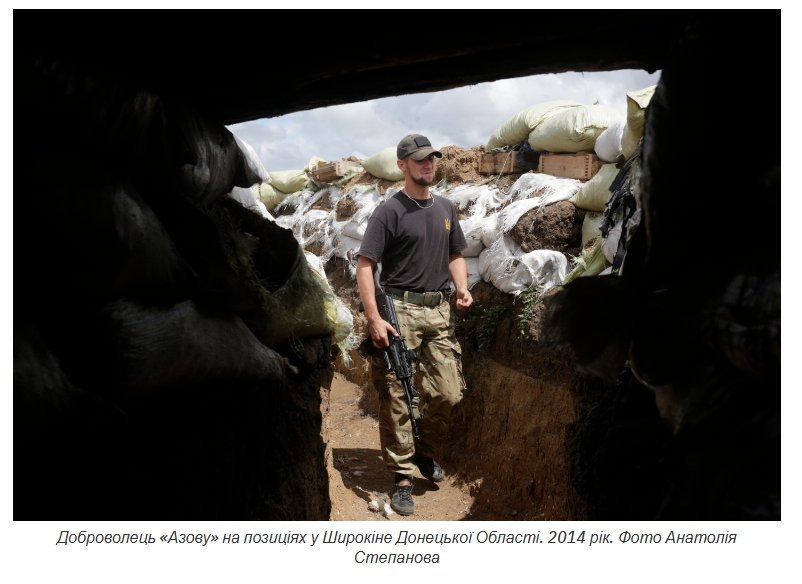
On the Pavlopil-Shirokynsk offensive operation of February 10—18, 2015, propaganda spread the thesis that it was not of strategic importance. Allegedly, after the loss of Donetsk airport and with great losses under Debaltsev, the Ukrainian authorities needed at least some victories.
In fact, the Shirokyn operation was one of the most successful for Ukraine. Namely, the village of Shyrokyne was one of the strategic settlements on the way of a possible offensive on Mariupol. Together with other units of “Azov”, which at that time was transferred to the National Guard of Ukraine, Ukrainian troops managed to establish control over a number of villages: Pavlopil, Berdyansky, Shyrokyn and Lebedinsky and push separatist formations away from Mariupol. Heavy fighting continued in this direction with the use of tanks and artillery by the enemy, which almost completely destroyed the village.
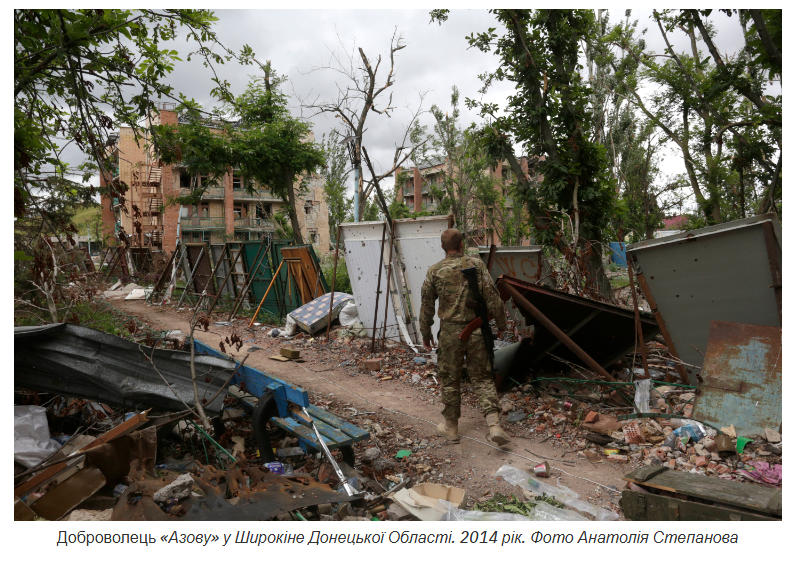
On July 1, the separatists declared Shyrokyne a buffer zone as a “goodwill gesture”. “Azov” was also brought out beyond the front line.
Vyacheslav Ratynskyi filmed training of Azov fighters in late 2014 and summer 2015. “Now I have a feeling of deja vu, because now in the same place I am shooting new young volunteers, but still the same old war. I wonder where the guys from the 2014-2015 photos are, are they all alive and healthy? Probably not all, because in those photos I find guys with amputations.” tells Vyacheslav in the material of the UAPF.
“The defense of Mariupol was of no importance”
After a full-scale invasion, the Azov battalion, together with other units, heroically defended Mariupol for 86 days. The Azovstal plant became the last frontier for the defenders in the city, where for 82 days Ukrainian troops were completely surrounded by Russian army air strikes and had a shortage of weapons.
Despite this propaganda put the responsibility for the destruction of Mariupol on its defenders. A Russian soldier, a participant in the assault of Mariupol, told “Lenta.ru” that the Ukrainian military stood firm in Mariupol: “They have a great school, but there's one problem: they don't want to die at all.”.
“Mariupol, whatever you say, was hell. After the assault, I'm not afraid. A unique school for any army.”(“Lenta.ru”).
The Russian soldier storming the city of half a million continued his propaganda narrative: “The military-political leadership of Ukraine decided to destroy this city. I don't know why. Maybe they wanted to give a picture to a Western audience, or maybe they wanted to force us to get bogged down, maybe they thought that the formations that stormed Mariupol or Russian society would break morally from what they saw.”.
“That is, the story is not that we defeated them near Mariupol, but that they withdrew into the city and could not leave, because from all sides we are ours. No, they purposefully gave their garrison to the incantation so that we could arrange this hell. And at the same time to all the inhabitants of Mariupol”(“Lenta.ru”).
Russian propaganda media wrote that their command abandoned the storming of the plant due to insufficient forces to take such a huge territory. Therefore, the Russian command decided “instead of an assault to make them a round-the-clock bomb hell.”
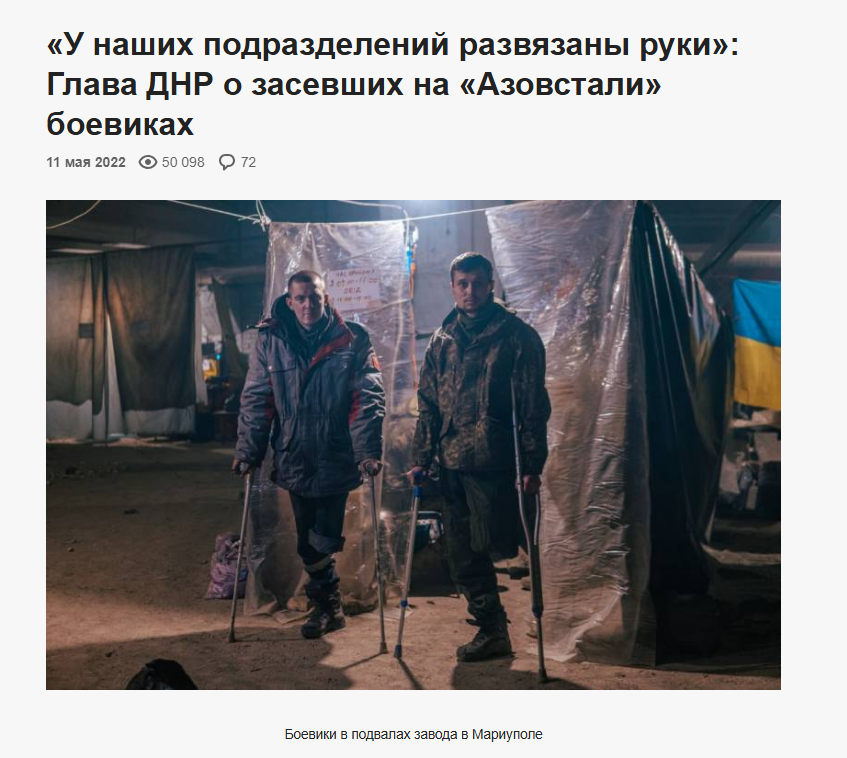
“There are no civilians left there, so our units have their hands off. This means that the remnants of terrorists will be destroyed by all available means.”, — wrote “Military Enchantment”. Although in shelters on the territory of the plant are still could stayCivilians.
After leaving Azovstal, Dmitry Kozatsky regretted that he did not shoot the heroic defenders at the time: “We had to take more pictures of the war.. We then focused on civilians — most of the interviews and materials were about them. But now I regret that I did not take positions, did not shoot those who were really worthy of this publicity. I will not say that those who are in my portraits are not worthy of attention. And there are people who really deserve recognition. And I missed the opportunity to show them.
I regret that at that time I did not have more courage, because it was in resistance, in battle, in these people that the real strength of Azovstal was. And that's what we had to document.”
Seeking to devalue the heroism of the defenders of Mariupol and to incline Ukraine to surrender, the propaganda once again repeated as a mantra: “The defense of Mariupol was of no importance. Just as a result, the Armed Forces lost the most combat-capable units, — writes “Lenta.ru”. — They will surrender the cities without a fight. Mariupol was a good lesson for the Kiev command”.
However, the Ukrainian military in Mariupol for more than two months dragged the enemy forces away from other directions.
On May 20, 2022, Ukrainian defenders of Mariupol withdrew from Azovstal on the orders of the top military leadership in order to preserve lives in the hope that there are agreements and they will be exchanged quickly.
Mstislav Chernov told “Media Detector”how exactly he decided to convey the scale of the disaster at Azovstal in his film “20 Days in Mariupol”: “The output was one frame with the number “86.”We had headlines that talked about the events after our departure. But we decided to remove everything so that the viewer could see only one figure. And that's enough to get a bomb going off in their heads: If 20 days is what they've been through, then what's 86?
Further, Russian propaganda began to paint the image of “liberators” from Russian soldiers who supposedly liberated Mariupol citizens after eight years of living under the occupation of the “Kiev regime” and the repression of “Azov” and help them return to normal life. “The occupation is propaganda and ideological pressure, the imposition of a new history, the prohibition of the native language. That is, it is clear which country we are talking about, and who corresponds to the sign of the occupier”— wrote the telegram channel “Ukraina.ru”.
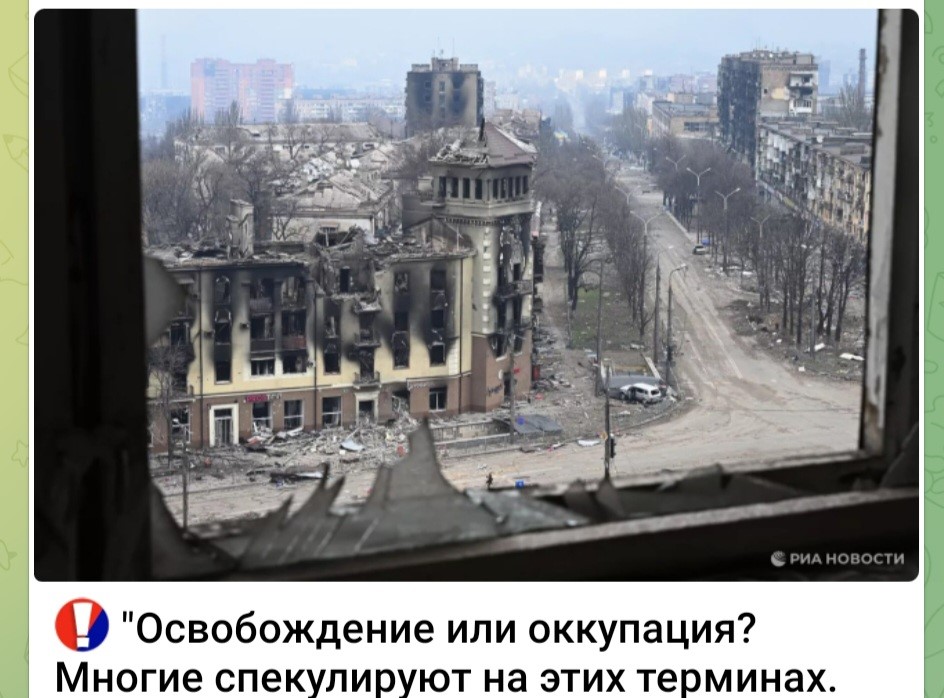
“Liberation or occupation? A lot of people speculate on these topics.”
“Ukraine.ru” wrote: “The “flower of the nation” of Ukraine burned houses and killed civilians in Mariupol, turning the city into ruins”.
They accused Azov that they did not let people out of the city and “drove the Mariupol people to the cellars”. They say that in Ukrainian nationalism the absolute sacred value is not the people, but the territory, and that is why “It was easy for Ukrainian servicemen to shoot at their civilians when they heard that Mariupol was a Russian city”(telegram channel “Ukraine.ru”.)
In support of the propaganda campaign against Azov, hostile media published interviews of Mariupol citizens who survived hell on earth and ended up under Russian occupation. They also published confessions of the crimes of captive Azov, convicted on falsified sentences.
But the real reason for the destruction of the city is the only one — it is a full-scale invasion of the Russian army. For more than eight years “Azov” was stationed near Mariupol. Among the Azov there were many Mariupolans. Mariupol was the city of Azov.
After the full-scale invasion, Mariupol citizens had little time to evacuate — they could leave the city to leaveuntil February 28 — March 1. After that, the Russian army approached and surrounded the city from all sides, including from the sea. For three months under the relentless fire of the enemy, the inhabitants of Mariupol were without food, water and medicine. According to various estimates, more than 20 thousand people died due to Russian shelling. The real figure could be much higher.
Some of the Mariupol people testified against the Azovites, but the reasons for this can be understood by knowing the atmosphere in the city. This was eloquently stated by the Russian stormtrooper in an interview with “Lenta.ru”:
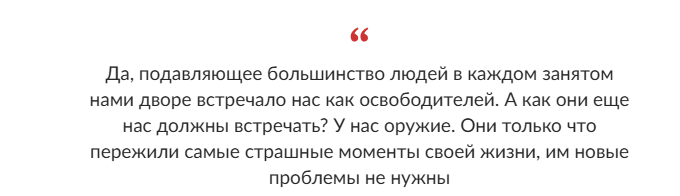
“Yes, most people in every yard we occupied met us as liberators. How else were they supposed to meet us? We have weapons. They've just gone through the worst moments of their lives, they don't need new problems.”.
“Hellish film studio Mariupolfilm”
Russian propaganda hastened to whitewash the actions of the Russian army in Mariupol with a spectacular restoration of life in the city. And all because the city at the very beginning of the invasion became the first black spot on Russia's reputation due to the bloody crimes against civilians, captured in photographs by journalists of the Associated Press news agency.
The propaganda called the work of foreign journalists “theatrical productions of Ukrainian propaganda”, “hellish film studio Mariupolfilm”, by order of which the image of the martyr city was created.
Thanks to the dedication of the profession and the courage of Mstislav Chernov, Yevgeny Maloletka and Vasilisa Stepanenko, the whole world saw the story of the siege of the city through the eyes of journalists. they deniedRussian fake about the shelling of the chute “Azov”.
Dmitry Kozatsky in an interview with the UAPF spoke about the importance of the work of documentary filmmakers in Mariupol: “There was an understanding that the attention of the world was focused on Mariupoland that part of that attention is due to the defenders themselves and our press service. We talked about it. We showed. And then — an incredibly powerful role was played by the Associated Press team — Yevgeny Maloletka, Mstislav Chernov, Vasilisa Stepanenko. They documented how the Russians bomb civilians. And their cadres literally tore up the information space. They were a breakthrough.”
Another mass crime of the Russians is the bombing of the Donetsk Academic Regional Drama Theater with the inscription “CHILDREN” on the asphalt to mark the shelter. This happened on March 16, 2022, the day after Associated Press journalists left the city. And since Mariupol was already under occupation, the Russian authorities liedthat “there were no traces of the airdrop”, that the headquarters of “Azov” was in the theater, and only 14 people died.
However, the Associated Press has conducted its own investigation. Among the investigators were Mstislav Chernov and Vasilisa Stepanenko. “AP investigation refutes Russian liesthat the theater was allegedly blown up by the Ukrainian military, or that it was used as a base for the Armed Forces. None of the witnesses saw Ukrainian soldiers there. None of the witnesses doubt that the theater was destroyed by a Russian airstrike aimed precisely at a civilian facility where the children were located,” the UAFF said.
“To remove witnesses and perpetrators of crimes against their own people”
The Russian propaganda narrative about the destruction of Mariupol by the Nazis from “Azov” was supposed to justify sentences for Azovites in Russian courts, their mistreatment and the terrorist attack in Olenovka.
This terrorist attack was carried out by the Russians on the night of July 29, 2022 — they blew up a barracks with Ukrainian prisoners of soldiers, defenders of Mariupol, in a correctional colony in the village of Olenivka. At that time 53 Ukrainian servicemen were killed and more than 130 were wounded. The Russians accused the Kiev authorities of the terrorist attack, they say “by striking Olenivka, she wanted to remove witnesses and perpetrators of crimes against her own people”. Refusing to grant access to the site of the terrorist attack to international experts, the Kremlin spread the lie that the attack was carried out from a foreign weapon. This terrorist attack was carried out by the Russian Federation not long after Ukraine received HIMARS missiles from the United States.
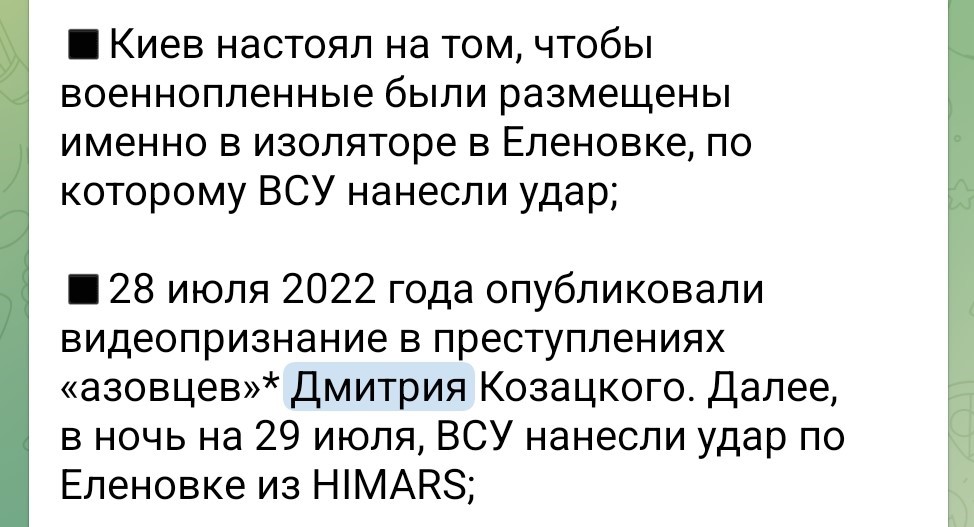
“Kyiv insisted that prisoners of war be placed in Olenivka, on which the Armed Forces attacked;
On July 28, 2022, Dmitry Kozatsky published a videotaped confession in the crimes of Azov. Then, on the night of July 29, the Armed Forces attacked Olenivka with HIMARS”.
For messagesAdditional details of the terrorist attack became known to Ukrinform, GUR and MO. According to them, Russia committed a terrorist attack in order to hide the facts of torture against the Ukrainian military. Also Ukrinformanalyzed the so-called videotaped confession of Dmitry Kozatsky, which turned out to be evidence against Alexei Arestovich and his information activities against Russia.
United Nations Human Rights Monitoring Mission to Ukraine July 25, 2024 published a statementabout the terrorist attack in Olenovka. Based on the investigation, they denied that the strike was caused by HIMARS missiles.
On July 28, the whole of Ukraine commemorates the Day of Remembrance of those killed in the terrorist attack in Olenovka. And remember that it is already the fourth year hundredsAzov is still in the captivity of the Russians — our children, brothers and sisters. People who just wanted to change the country for the better. And they did everything for it.
Ukrainian photographer and Azov photographer Dmitry Kozatsky shared with UAPF his biggest dream: “I am fighting for our prisoners. And my dream is for all of them to return from Russian captivity. Therefore, my answer is this: I would like to take a photo of the last prisoners who were released. If we're talking about a dream, I have the right to dream about it, and I really want that to happen.”
Contributors:
Researcher of the topic, author of the text: Yana Yevmenova
Picture editor: Olga Kovalova
Literary Editor: Julia Futei
Site Manager: Vladislav Kukhar