UAPP Logo
Russian propaganda in action: how the Hungarian government used Kremlin narratives in its election campaign
In the pro‑Russian information space, baseless accusations were spread that Ukraine’s Main Intelligence Directorate, with Brussels’ support, was controlling the Hungarian opposition party *Tisza*. This conspiracy theory served as a tool to accuse Ukraine and the European Union of attempting to illegally change power in Hungary. The Ukrainian Association of Professional Photographers publishes key anti‑Ukrainian narratives with a Hungarian focus, while Maksym Kishka’s photo report from Hungary documents the public mood in the country with factual precision.
read more
Russian propaganda in action: how the Hungarian government used Kremlin narratives in its election campaign
In the pro‑Russian information space, baseless accusations were spread that Ukraine’s Main Intelligence Directorate, with Brussels’ support, was controlling the Hungarian opposition party *Tisza*. This conspiracy theory served as a tool to accuse Ukraine and the European Union of attempting to illegally change power in Hungary. The Ukrainian Association of Professional Photographers publishes key anti‑Ukrainian narratives with a Hungarian focus, while Maksym Kishka’s photo report from Hungary documents the public mood in the country with factual precision.
read more
A tragic week for Ukraine: brutal Russian attacks on peaceful cities and an armed assault on people in the capital
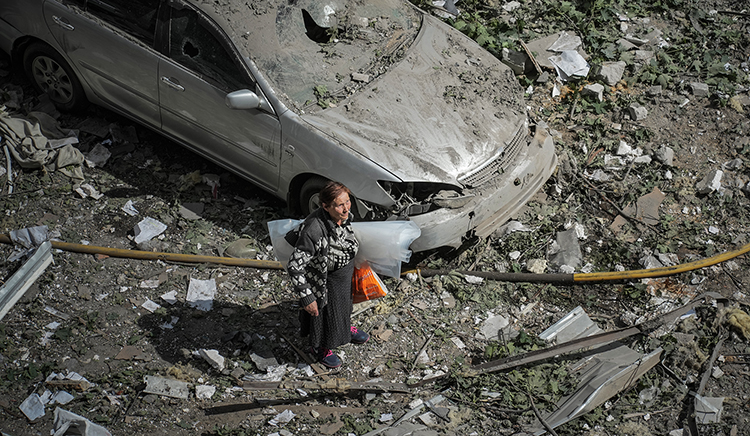
Russia turned Easter Week into a time of relentless airstrikes. The most brutal and destructive attacks targeted Dnipro, Kyiv, and Odesa. Around one hundred civilians were injured during the massive assault of April 15–16, when Russia launched more than 700 aerial targets. Russian drone and missile strikes claimed the lives of children in three cities: in Cherkasy, an 8‑year‑old boy was killed on a playground; in Kyiv, a ballistic missile killed a 12‑year‑old child in bed; in Chernihiv, a teenager was found dead under the rubble of a collapsed building. During the week, Russians cynically attacked medics and hospitals, bombed a reservoir, and carried out assaults on civilian vessels. Over the weekend, tragedy struck in Kyiv: six people were killed in a shooting. Among the wounded was a boy whose parents were victims of the assailant.
read more
Tragic consequences of Russian attacks during Holy Week
On the eve of Easter, Russian forces deliberately struck peaceful towns and villages. The enemy targeted energy infrastructure, administrative buildings during working hours, crowded markets, public transport, cultural and historical landmarks, and the homes of ordinary Ukrainians. Odesa, Nikopol, and Kramatorsk were in mourning for the dead. In Nikopol — a city of about 40,000 residents — more than 100 people have been killed or injured since the beginning of April, according to Ukrainska Pravda. Life. Civilian casualties are also high in Kherson, which remains under constant threat from shelling and remote mining.The scale of destruction to residential areas is captured in photo reports from Odesa, Kharkiv, Sumy, Kherson, and Kramatorsk.
read more
Four years since the terrorist attack at the Kramatorsk railway station
In memory of the victims — and in the name of justice — we recall how Ukrainian and international documentarians, along with human rights organizations, disproved Russian disinformation about the missile strike on the Kramatorsk railway station on April 8, 2022. On that day, a Russian missile armed with cluster munitions turned a crowded train station into a battlefield, cutting short the lives of people who were trying to flee the war.
read more
Breaking News
News
This week, Russia continued its missile and drone terror against Ukrainian cities. Hundreds of Shahed-type UAVs and dozens of tactical missiles were launched every day — from the well-known Iskander missiles to the latest Grom-1 models.
·
This week, Russia continued its missile and drone terror against Ukrainian cities. Hundreds of Shahed-type UAVs and dozens of tactical missiles were launched every day — from the well-known Iskander missiles to the latest Grom-1 models.
·
Photo Stories
9.2.2026
This is some text inside of a div block.
Photo with a story: Once Upon a War
Photo Stories
9.2.2026
Photo with a story: Once Upon a War
News Stories
8.2.2026
This is some text inside of a div block.
Mstyslav Chernov has received the Directors Guild of America Award for the second time — this year for his film “2000 Meters to Andriivka.”
Director, journalist and founder of the Ukrainian Association of Professional Photographers Mstislav Chernov became the winner of the Directors Guild of America (DGA Awards). The director received an award in the category “Outstanding Directing Achievement in Documentary Film for 2025" for the film “2000 meters to Andreevka”.
News Stories
8.2.2026
Mstyslav Chernov has received the Directors Guild of America Award for the second time — this year for his film “2000 Meters to Andriivka.”
Director, journalist and founder of the Ukrainian Association of Professional Photographers Mstislav Chernov became the winner of the Directors Guild of America (DGA Awards). The director received an award in the category “Outstanding Directing Achievement in Documentary Film for 2025" for the film “2000 meters to Andreevka”.
News Stories
8.2.2026
This is some text inside of a div block.
Cold and bloody: this is what the beginning of February looked like in Ukraine
Russia continues to use cold as a weapon against Ukrainians, launching massive attacks on critical infrastructure. Due to severe damage to facilities in Kharkiv, a local state of emergency has been declared; in Kyiv, more than 1,000 buildings will remain without heating until the end of the heating season; and thermal power plants in western Ukraine have been damaged. Russian strikes continue to kill Ukrainian civilians: miners in the Dnipro region, residents of Druzhkivka, 18‑year‑olds in Zaporizhzhia, and many more injured across different regions of the country. Particularly shocking were the attack on a maternity hospital and the bloody shelling of a dog shelter in Zaporizhzhia. There were at least six attacks on fire‑rescue units and emergency workers. Russian strikes on the railway have also intensified significantly.
News Stories
8.2.2026
Cold and bloody: this is what the beginning of February looked like in Ukraine
Russia continues to use cold as a weapon against Ukrainians, launching massive attacks on critical infrastructure. Due to severe damage to facilities in Kharkiv, a local state of emergency has been declared; in Kyiv, more than 1,000 buildings will remain without heating until the end of the heating season; and thermal power plants in western Ukraine have been damaged. Russian strikes continue to kill Ukrainian civilians: miners in the Dnipro region, residents of Druzhkivka, 18‑year‑olds in Zaporizhzhia, and many more injured across different regions of the country. Particularly shocking were the attack on a maternity hospital and the bloody shelling of a dog shelter in Zaporizhzhia. There were at least six attacks on fire‑rescue units and emergency workers. Russian strikes on the railway have also intensified significantly.
Photo Stories
4.2.2026
This is some text inside of a div block.
The sound of photographs in the “After the Silence” archives
Many people carry stories they are still afraid to share even with their closest ones, fearing they might cause harm or pain. There are family albums with torn-out pages or faces of relatives painted over or cut out — people whose presence in a photograph could once lead to arrest or exile for the entire family. There are memories of traumatic experiences tied to the era of Soviet and National Socialist violence, memories that remain unspoken within families and are carefully preserved in silence. The public organization “After the Silence” researches topics that have long been taboo, brings ignored stories to light, and gives a voice to people who were forced into silence. For five years, the organization has been working in the fields of public history, memorial culture, and non‑formal education. Its work focuses on documenting and preserving stories that remained outside official narratives, particularly the experiences of people during periods of repression and war.
Photo Stories
4.2.2026
The sound of photographs in the “After the Silence” archives
Many people carry stories they are still afraid to share even with their closest ones, fearing they might cause harm or pain. There are family albums with torn-out pages or faces of relatives painted over or cut out — people whose presence in a photograph could once lead to arrest or exile for the entire family. There are memories of traumatic experiences tied to the era of Soviet and National Socialist violence, memories that remain unspoken within families and are carefully preserved in silence. The public organization “After the Silence” researches topics that have long been taboo, brings ignored stories to light, and gives a voice to people who were forced into silence. For five years, the organization has been working in the fields of public history, memorial culture, and non‑formal education. Its work focuses on documenting and preserving stories that remained outside official narratives, particularly the experiences of people during periods of repression and war.
Photo Stories
2.2.2026
This is some text inside of a div block.
Light and music. The philosophy of Petro Chekali’s frame
Ukrainian photographer Petro Chekali documents life during the war and also creates music, writes prose and poetry. He seeks to combine poetry with prose, metaphors with documentary work, and the roles of artist and art curator. Petro Chekali spoke about searching for his own visual language and for a kind of light that does not blind but, on the contrary, illuminates — and why, for him, to stop photographing would be the same as losing his sight.
Photo Stories
2.2.2026
Light and music. The philosophy of Petro Chekali’s frame
Ukrainian photographer Petro Chekali documents life during the war and also creates music, writes prose and poetry. He seeks to combine poetry with prose, metaphors with documentary work, and the roles of artist and art curator. Petro Chekali spoke about searching for his own visual language and for a kind of light that does not blind but, on the contrary, illuminates — and why, for him, to stop photographing would be the same as losing his sight.
News Stories
1.2.2026
This is some text inside of a div block.
A week of devastating Russian attacks and tragic losses
At the end of January, Russian forces carried out a series of terrorist attacks across Ukraine. Major strikes hit Odesa, Zaporizhzhia, Kherson, and the Dnipro region. In Kharkiv oblast, the enemy targeted a passenger train, killing six passengers. In Kyiv oblast, a drone’s direct hit on a residential building killed a married couple. In just one week, Russian aggression claimed the lives of three Ukrainian rescuers and an energy worker. By the end of the workweek, the number of strikes on Ukraine’s energy infrastructure had decreased. President Zelensky stated that Russian forces were shifting their focus to attacks on logistics while continuing to strike residential neighborhoods. Overall, over the past month, the Air Defense Forces destroyed more than 21,500 aerial targets, including 392 shot down by aviation.
News Stories
1.2.2026
A week of devastating Russian attacks and tragic losses
At the end of January, Russian forces carried out a series of terrorist attacks across Ukraine. Major strikes hit Odesa, Zaporizhzhia, Kherson, and the Dnipro region. In Kharkiv oblast, the enemy targeted a passenger train, killing six passengers. In Kyiv oblast, a drone’s direct hit on a residential building killed a married couple. In just one week, Russian aggression claimed the lives of three Ukrainian rescuers and an energy worker. By the end of the workweek, the number of strikes on Ukraine’s energy infrastructure had decreased. President Zelensky stated that Russian forces were shifting their focus to attacks on logistics while continuing to strike residential neighborhoods. Overall, over the past month, the Air Defense Forces destroyed more than 21,500 aerial targets, including 392 shot down by aviation.

Photo Stories

This section features the best images of the month, interviews with photographers, and in-depth visual stories. Discover compelling narratives and events through the lens of our talented authors.


Photo Stories
23.2.2026
Without a final period. Vladyslav Krasnoshchok’s photobook “Documentation of the War”
Photo Stories
11.2.2026
Adriana Dovha: “Being a photographer during the war is a calling and a duty, and at the same time, it is a challenge and a vulnerability”
Photo Stories
9.2.2026
Photo with a story: Once Upon a War
Photo Stories
4.2.2026
The sound of photographs in the “After the Silence” archives
Photo Stories
2.2.2026
Light and music. The philosophy of Petro Chekali’s frame
Photo Stories
1.2.2026
10 photos of January

Our partners

We tell the world about Ukraine through the prism of photography.

Join and support the community of Ukrainian photographers.

UAPP is an independent association of professional Ukrainian photographers, designed to protect their interests, support, develop and promote Ukrainian photography as an important element of national culture.

UAPP's activities span educational, social, research and cultural initiatives, as well as book publishing.

UAPP represents Ukrainian professional photography in the international photographic community and is an official member of the Federation of European Photographers (FEP) — an international organization representing more than 50,000 professional photographers in Europe and other countries around the world.

Support and join us
A couple of men walking across a grass covered field.