UAPP Logo
Daytime mass attacks, deadly strikes, and new safety measures on the railway: what the beginning of April will be remembered for in Ukraine
Russia is increasingly choosing daytime hours for its massive strikes, expanding the zone of destruction across Ukraine. The beginning of April will be remembered for devastating attacks on Lutsk, Poltava, and Zhytomyr region; Kharkiv endured several consecutive days under fire, and there were strikes on Odesa, Sumy, and Chernihiv. Over the weekend, the Russian army carried out a deadly attack on a market in Nikopol, and the day before, drones and missiles targeted Kyiv region. Every day, Donetsk and Sumy regions face bombings and drone raids. Drones and artillery continue to hit Kherson, while the enemy scatters antipersonnel mines throughout the city. Among the targets of Russian attacks this week were: a veterinary clinic with animals inside, food warehouses, a Nova Poshta terminal, and the only maternity hospital in Donetsk region. Due to constant aerial threats, railway routes experienced delays and passenger evacuations from trains.
read more
Daytime mass attacks, deadly strikes, and new safety measures on the railway: what the beginning of April will be remembered for in Ukraine
Russia is increasingly choosing daytime hours for its massive strikes, expanding the zone of destruction across Ukraine. The beginning of April will be remembered for devastating attacks on Lutsk, Poltava, and Zhytomyr region; Kharkiv endured several consecutive days under fire, and there were strikes on Odesa, Sumy, and Chernihiv. Over the weekend, the Russian army carried out a deadly attack on a market in Nikopol, and the day before, drones and missiles targeted Kyiv region. Every day, Donetsk and Sumy regions face bombings and drone raids. Drones and artillery continue to hit Kherson, while the enemy scatters antipersonnel mines throughout the city. Among the targets of Russian attacks this week were: a veterinary clinic with animals inside, food warehouses, a Nova Poshta terminal, and the only maternity hospital in Donetsk region. Due to constant aerial threats, railway routes experienced delays and passenger evacuations from trains.
read more
When the photograph doesn’t lie: how context, staging, editing, and AI reshape the truth about war
For International Fact‑Checking Day — on why manipulation in photography begins not only with the choice of frame, but also with the substitution of its meaning.
read more
Strike on UNESCO cultural heritage in Lviv, and the shelling of Dnipro and Odesa: intensified Russian air attacks on Ukraine
The last week of March will be remembered for unprecedented drone attacks that swept across almost every region of Ukraine, both day and night. On 24 March, Russian forces carried out the most massive UAV strike on Ukraine to date, launching nearly 1,000 drones in a single day. They targeted the centers of Ukrainian cities, cultural landmarks, maternity hospitals, and people’s homes. The historic center of Lviv was among the sites damaged. One of the most tragic episodes occurred near a maternity hospital in Ivano-Frankivsk, where a father and his daughter were killed while visiting his wife, who had just given birth. It was also a devastating week for Dnipro and Odesa — Russian drones struck residential buildings and a medical facility. Over the course of the week, three maternity hospitals became targets of Russian attacks, and at least four kindergartens were damaged.
read more
Destroyed infrastructure, civilians kept in fear: a week of Russian drone attacks
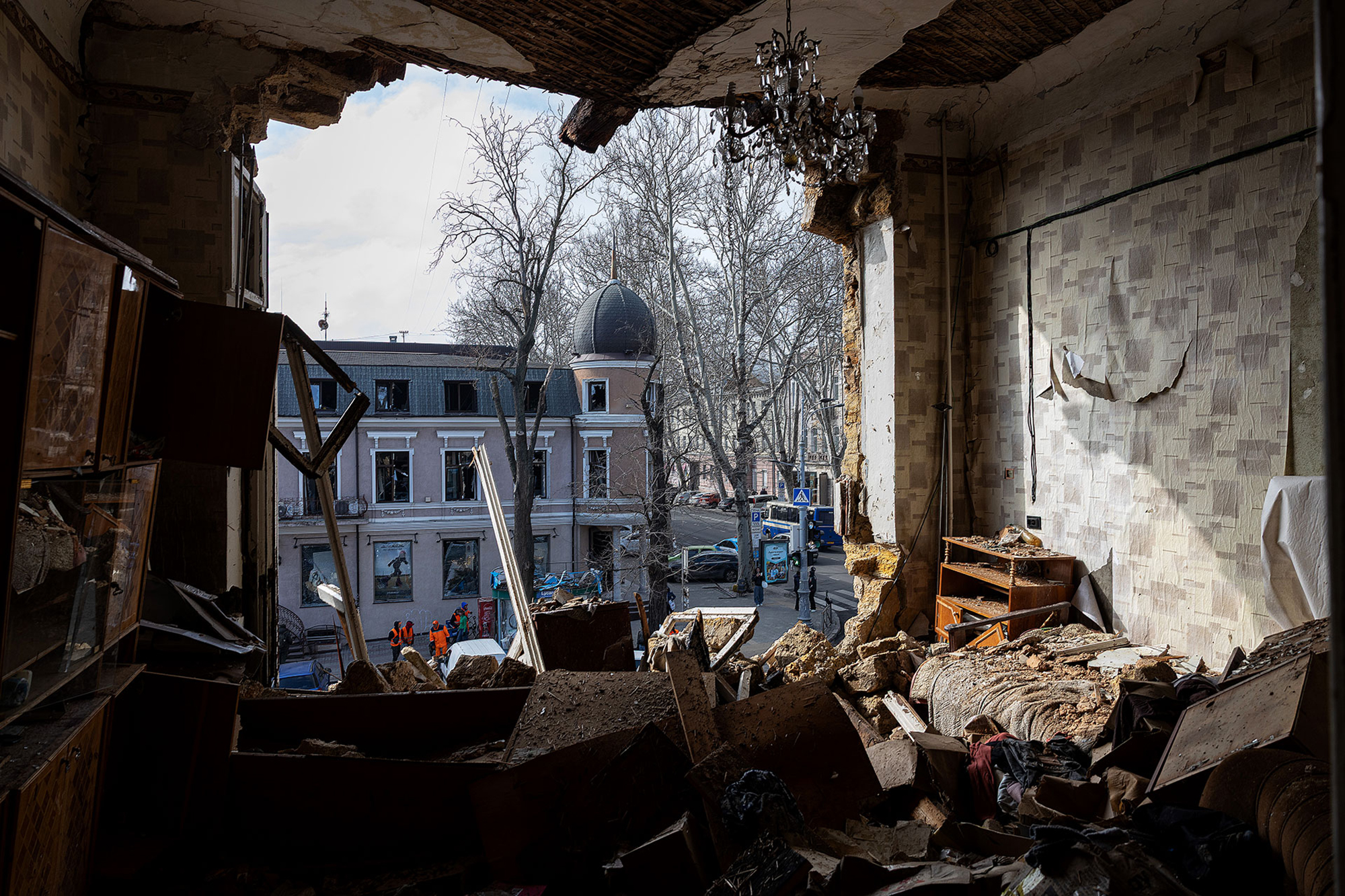
Russia has sharply intensified drone attacks in border and frontline regions. Throughout the week, air‑defense forces worked to intercept enemy UAVs over the capital. Drones also reached the western and central regions of the country. The enemy targeted railway, energy, and port infrastructure, industrial facilities, residential buildings, and civilian transport. Toward the end of the workweek, drones launched a massive attack on Odesa. Over the weekend, enemy strikes completely cut off power to Chernihiv and most of the region. The aftermath of the devastating drone attack on Odesa is captured in photo reports by documentarians Oleksandr Himanov and Tymofii Melnykov.
read more
Breaking News
News
This week, Russia continued its missile and drone terror against Ukrainian cities. Hundreds of Shahed-type UAVs and dozens of tactical missiles were launched every day — from the well-known Iskander missiles to the latest Grom-1 models.
·
This week, Russia continued its missile and drone terror against Ukrainian cities. Hundreds of Shahed-type UAVs and dozens of tactical missiles were launched every day — from the well-known Iskander missiles to the latest Grom-1 models.
·
News Stories
26.11.2024
This is some text inside of a div block.
Bombs and IPSO: how Russia is trying to destroy the unconquered Kharkiv
Kharkiv — a frontline city with a population of over one million in northeastern Ukraine — has been subjected daily, since the start of the full-scale invasion, to attacks with ballistic missiles, aerial bombs (KABs), strike drones, and information-psychological operations (IPSO).
News Stories
26.11.2024
Bombs and IPSO: how Russia is trying to destroy the unconquered Kharkiv
Kharkiv — a frontline city with a population of over one million in northeastern Ukraine — has been subjected daily, since the start of the full-scale invasion, to attacks with ballistic missiles, aerial bombs (KABs), strike drones, and information-psychological operations (IPSO).
Photo Stories
23.11.2024
This is some text inside of a div block.
“Giving a voice to those who were unable to speak out during their lifetime.” Lesya Marushchak on the world's most famous exhibition about the Holodomor
Project “Maria” (Project MARIA) by the Canadian artist of Ukrainian origin Lesya Marushchak became the most famous exhibition about the Holodomor of 1932—1933, according to the recognition of the National Museum of Holodomor-Genocide in Kyiv. This artistic work has been visited in nine countries of the world, and the book created on the basis of the project has won international awards. The exhibition provides an opportunity to look at the memory of the Holodomor through art that makes a complex subject accessible and understandable on many levels.
Photo Stories
23.11.2024
“Giving a voice to those who were unable to speak out during their lifetime.” Lesya Marushchak on the world's most famous exhibition about the Holodomor
Project “Maria” (Project MARIA) by the Canadian artist of Ukrainian origin Lesya Marushchak became the most famous exhibition about the Holodomor of 1932—1933, according to the recognition of the National Museum of Holodomor-Genocide in Kyiv. This artistic work has been visited in nine countries of the world, and the book created on the basis of the project has won international awards. The exhibition provides an opportunity to look at the memory of the Holodomor through art that makes a complex subject accessible and understandable on many levels.
Photo Stories
22.11.2024
This is some text inside of a div block.
“They were brought to Odessa to beat up anyone who doesn't support Yanukovych.” Euromaidan and Antimaidan through the lens of Alexander Gimanov
On the anniversary of the Revolution of Dignity, the UAPF recalls how Odessa became part of the struggle for Ukraine's independence. The city, often called the pearl of the sea, was then on the border—between the European pro-Ukrainian future and the Russian past. In this material, we tell how the Odessa people fought for their freedom, and supplement the text with photos of the documentary filmmaker Alexander Gimanov, who witnessed these events.
Photo Stories
22.11.2024
“They were brought to Odessa to beat up anyone who doesn't support Yanukovych.” Euromaidan and Antimaidan through the lens of Alexander Gimanov
On the anniversary of the Revolution of Dignity, the UAPF recalls how Odessa became part of the struggle for Ukraine's independence. The city, often called the pearl of the sea, was then on the border—between the European pro-Ukrainian future and the Russian past. In this material, we tell how the Odessa people fought for their freedom, and supplement the text with photos of the documentary filmmaker Alexander Gimanov, who witnessed these events.
Photo Stories
21.11.2024
This is some text inside of a div block.
Images of change that society is ready for. The Revolution of Dignity through the eyes of Mstislav Chernov
On November 21, Ukraine celebrates the Day of Dignity and Freedom, commemorating the anniversaries of two significant events — the Orange Revolution of 2004 and the Revolution of Dignity 2013-2014. These events have become symbols of Ukrainians' desire for democracy, freedom and European values. Today, during a full-scale war with Russia, the struggle for these ideals continues.
Photo Stories
21.11.2024
Images of change that society is ready for. The Revolution of Dignity through the eyes of Mstislav Chernov
On November 21, Ukraine celebrates the Day of Dignity and Freedom, commemorating the anniversaries of two significant events — the Orange Revolution of 2004 and the Revolution of Dignity 2013-2014. These events have become symbols of Ukrainians' desire for democracy, freedom and European values. Today, during a full-scale war with Russia, the struggle for these ideals continues.
Photo Stories
17.11.2024
This is some text inside of a div block.
Photo with history: Who hasn't seen our cracks?
We can document the moment and document the consequences, and not just the next day, but everything that happens after, everything that flows out and transforms the recorded moment.
Photo Stories
17.11.2024
Photo with history: Who hasn't seen our cracks?
We can document the moment and document the consequences, and not just the next day, but everything that happens after, everything that flows out and transforms the recorded moment.
News Stories
17.11.2024
This is some text inside of a div block.
The culmination of the week of terror: 120 missiles and 90 drones over Ukraine overnight. Photos of documentarians from Kharkov and Odessa
The night of November 17 became the culmination of a week of Russian terror: the Russian army launched 120 missiles and 90 strike drones at Ukraine. This attack concluded a week of massive shelling, during which the occupiers used nearly 140 missiles, 900 aerial bombs, and 600 drones, striking peaceful Ukrainian cities.
News Stories
17.11.2024
The culmination of the week of terror: 120 missiles and 90 drones over Ukraine overnight. Photos of documentarians from Kharkov and Odessa
The night of November 17 became the culmination of a week of Russian terror: the Russian army launched 120 missiles and 90 strike drones at Ukraine. This attack concluded a week of massive shelling, during which the occupiers used nearly 140 missiles, 900 aerial bombs, and 600 drones, striking peaceful Ukrainian cities.

Photo Stories

This section features the best images of the month, interviews with photographers, and in-depth visual stories. Discover compelling narratives and events through the lens of our talented authors.

Photo Stories
1.4.2026
10 photos of March
Photo Stories
31.3.2026
“Carrying the Light” — a documentary photo project by Taras Fedorenko
Photo Stories
30.3.2026
Iryna Kabysh: “My love for the nature of light helps me work, because photons either move or do not exist”
Photo Stories
25.3.2026
“Pre Mortem” — a documentary project by Semen Kuchvara
Photo Stories
23.3.2026
Donetsk 2006. A photo series by Dmytro Kupriian about a lost city
Photo Stories
18.3.2026
“Warmth of the Earth” — a project by Anton Cherniak

Our partners

We tell the world about Ukraine through the prism of photography.

Join and support the community of Ukrainian photographers.

UAPP is an independent association of professional Ukrainian photographers, designed to protect their interests, support, develop and promote Ukrainian photography as an important element of national culture.

UAPP's activities span educational, social, research and cultural initiatives, as well as book publishing.

UAPP represents Ukrainian professional photography in the international photographic community and is an official member of the Federation of European Photographers (FEP) — an international organization representing more than 50,000 professional photographers in Europe and other countries around the world.

Support and join us
A couple of men walking across a grass covered field.